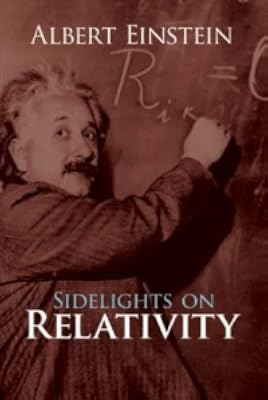
Sidelights on Relativity
by Albert Einstein
On This Page
Description
An Address delivered on May 5th, 1920, in the University of LeydenHow does it come about that alongside of the idea of ponderable matter, which is derived by abstraction from everyday life, the physicists set the idea of the existence of another kind of matter, the ether? The explanation is probably to be sought in those phenomena which have given rise to the theory of action at a distance, and in the properties of light which have led to the undulatory theory. Let us devote a little while show more to the consideration of these two subjects.
Outside of physics we know nothing of action at a distance. When we try to connect cause and effect in the experiences which natural objects afford us, it seems at first as if there were no other mutual actions than those of immediate contact, e.g. the communication of motion by impact, push and pull, heating or inducing combustion by means of a flame, etc. It is true that even in everyday experience weight, which is in a sense action at a distance, plays a very important part. But since in daily experience the weight of bodies meets us as something constant, something not linked to any cause which is variable in time or place, we do not in everyday life speculate as to the cause of gravity, and therefore do not become conscious of its character as action at a distance. It was Newton's theory of gravitation that first assigned a cause for gravity by interpreting it as action at a distance, proceeding from masses. Newton's theory is probably the greatest stride ever made in the effort towards the causal nexus of natural phenomena. And yet this theory evoked a lively sense of discomfort among Newton's contemporaries, because it seemed to be in conflict with the principle springing from the rest of experience, that there can be reciprocal action only through contact, and not through immediate action at a distance. It is only with reluctance that man's desire for knowledge endures a dualism of this kind. How was unity to be preserved in his comprehension of the forces of nature? Either by trying to look upon contact forces as being themselves distant forces which admittedly are observable only at a very small distance - and this was the road which Newton's followers, who were entirely under the spell of his doctrine, mostly preferred to take; or by assuming that the Newtonian action at a distance is only apparently immediate action at a distance, but in truth is conveyed by a medium permeating space, whether by movements or by elastic deformation of this medium. Thus the endeavour toward a unified view of the nature of forces leads to the hypothesis of an ether. This hypothesis, to be sure, did not at first bring with it any advance in the theory of gravitation or in physics generally, so that it became customary to treat Newton's law of force as an axiom not further reducible. But the ether hypothesis was bound always to play some part in physical science, even if at first only a latent part.
. show less
Tags
Recommendations













Member Reviews
The two brief lectures in this volume are each interesting in their own right, although there is little to unify them beyond concern for the most foundational aspects of the science of physics.
The first, on "Ether and the Theory of Relativity," treats the now-quaint-sounding topic of the luminiferous ether, which seems to have gone the way of phlogiston and other obsolete scientific topics. Surprisingly, Einstein insists that there is a role for the ether concept in relativistic physics! It is, however, a "gravitational ether" from which every mechanical characteristic has been eliminated, and which is therefore just as easily denominated as space. Although this paper avoids mathematical and experimental details, a certain prior show more familiarity with the history of modern physics is very useful in appreciating it, since Einstein races through an extensive series of theorists in his summary of the evolution of the ether concept.
The second paper begins by offering the distinction between geometry as an axiomatic philosophical undertaking, and the empirical physical science of "practical geometry." Einstein explains that the effort to adjust physical laws to accommodate known events and behaviors to the axiomatic system of Euclidean geometry was in fact a driving force behind the theory of relativity, even though it eventually became necessary to posit non-Euclidean space as a result of that theory. The later part of the paper is concerned to permit novices to acquire an imaginative appreciation of finite but unbounded spaces--in particular spaces curved through the fourth dimension in a hyperspherical fashion. show less
The first, on "Ether and the Theory of Relativity," treats the now-quaint-sounding topic of the luminiferous ether, which seems to have gone the way of phlogiston and other obsolete scientific topics. Surprisingly, Einstein insists that there is a role for the ether concept in relativistic physics! It is, however, a "gravitational ether" from which every mechanical characteristic has been eliminated, and which is therefore just as easily denominated as space. Although this paper avoids mathematical and experimental details, a certain prior show more familiarity with the history of modern physics is very useful in appreciating it, since Einstein races through an extensive series of theorists in his summary of the evolution of the ether concept.
The second paper begins by offering the distinction between geometry as an axiomatic philosophical undertaking, and the empirical physical science of "practical geometry." Einstein explains that the effort to adjust physical laws to accommodate known events and behaviors to the axiomatic system of Euclidean geometry was in fact a driving force behind the theory of relativity, even though it eventually became necessary to posit non-Euclidean space as a result of that theory. The later part of the paper is concerned to permit novices to acquire an imaginative appreciation of finite but unbounded spaces--in particular spaces curved through the fourth dimension in a hyperspherical fashion. show less
The man was a genius and probably a bit insane, but this was an interesting read!
This little book, Sidelights on Relativity, presents two lectures given by Einstein. The first, concerns the relation between the ether concept and general relativity. Einstein concludes that the concept of empty space in general relativity is an existing entity, which may have properties (in analogy to the ether), but these properties are not mechanical or material in any sense, neither solid nor fluid.
The second lecture, Geometry and Experience, gives a perfect example of the kind of property that empty space (modern version of the ether) may have. This property is that of 'curvature' which is the central concept of general relativity theory. He relates this concept to the geometrical measurements which are actually made in show more practice, in the sense of geometry as a physical science. He also gives some hints which may help the reader to visualize higher dimensional spaces. In addition, this lecture includes Einstein's often quoted remark "As far as the laws of mathematics refer to reality, they are not certain; and as far as they are certain, they do not refer to reality".
For Newton, the space between particles was absolutely empty, consisting of exactly nothing. In the 19th century some physicists considered the possibility that space could be filled with a medium (the ether) with material properties (solid or liquid) which could support vibrations (oscillations of motion). Einstein rejected both of these views and introduced the idea of a space which could have non-material properties but not material properties. This key concept has had an influence in both relativity theories and quantum theories, but its full implication has not yet been assimilated by the scientific culture. Thus this book may be of greater significance than the title suggests.
This book is reminiscent of the book Essays in Science (Philosophical Library, 1930's) which is a collection of writings by Einstein on various scientific subjects. That book is abstracted from a still earlier work Mein Weltbild which gives Einstein's views on many topics including social issues. show less
The second lecture, Geometry and Experience, gives a perfect example of the kind of property that empty space (modern version of the ether) may have. This property is that of 'curvature' which is the central concept of general relativity theory. He relates this concept to the geometrical measurements which are actually made in show more practice, in the sense of geometry as a physical science. He also gives some hints which may help the reader to visualize higher dimensional spaces. In addition, this lecture includes Einstein's often quoted remark "As far as the laws of mathematics refer to reality, they are not certain; and as far as they are certain, they do not refer to reality".
For Newton, the space between particles was absolutely empty, consisting of exactly nothing. In the 19th century some physicists considered the possibility that space could be filled with a medium (the ether) with material properties (solid or liquid) which could support vibrations (oscillations of motion). Einstein rejected both of these views and introduced the idea of a space which could have non-material properties but not material properties. This key concept has had an influence in both relativity theories and quantum theories, but its full implication has not yet been assimilated by the scientific culture. Thus this book may be of greater significance than the title suggests.
This book is reminiscent of the book Essays in Science (Philosophical Library, 1930's) which is a collection of writings by Einstein on various scientific subjects. That book is abstracted from a still earlier work Mein Weltbild which gives Einstein's views on many topics including social issues. show less
Ratings
Members
- Recently Added By
Lists

Author Information

367+ Works 16,467 Members
Albert Einstein was born on March 14, 1879 in Ulm. He spent his childhood in Munich where his family owned a small machine shop. By the age of twelve, Einstein had taught himself Euclidean Geometry. His family moved to Milan, where he stayed for a year, and he used it as an excuse to drop out of school, which bored him. He finished secondary show more school in Aarau, Switzerland and entered the Swiss Federal Institute of Technology in Zurich. Einstein graduated in 1900, by studying the notes of a classmate since he did not attend his classes out of boredom, again. His teachers did not like him and would not recomend him for a position in the University. For two years, Einstein worked as a substitute teacher and a tutor before getting a job, in 1902, as an examiner for a Swiss patent office in Bern. In 1905, he received his doctorate from the University of Zurich for a theoretical dissertation on the dimension of molecules. Einstein also published three theoretical papers of central importance to the development of 20th Century physics. The first was entitled "Brownian Motion," and the second "Photoelectric Effort," which was a revolutionary way of thinking and contradicted tradition. No one accepted the proposals of the first two papers. Then the third one was published in 1905 and called "On the Electrodynamics of Moving Bodies." Einstein's words became what is known today as the special theory of relativity and said that the physical laws are the same in all inertial reference systems and that the speed of light in a vacuum is a universal constant. Virtually no one understood or supported Einstein's argument. Einstein left the patent office in 1907 and received his first academic appointment at the University of Zurich in 1909. In 1911, he moved to a German speaking university in Prague, but returned to Swiss National Polytechnic in Zurich in 1912. By 1914, Einstein was appointed director of the Kaiser Wilhelm Institute of Physics in Berlin. His chief patron in those early days was German physicist Max Planck and lent much credibility to Einstein's work. Einstein began working on generalizing and extending his theory of relativity, but the full general theory was not published until 1916. In 1919, he predicted that starlight would bend in the vicinity of a massive body, such as the sun. This theory was confirmed during a solar eclipse and cause Einstein to become world renowned after the phenomenon. Einstein received be Nobel Prize in Physics in 1921. With his new fame, Einstein attempted to further his own political and social views. He supported pacifism and Zionism and opposed Germany's involvement in World War I. His support of Zionism earned him attacks from both Anti-Semitic and right wing groups in Germany. Einstein left Germany for the United States when Hitler came into power, taking a position at the Institute for Advanced Study in Princeton, New Jersey. Once there, he renounced his stand on pacifism in the face of Nazi rising power. In 1939 he collaborated with other physicists in writing a letter to President Franklin D. Roosevelt informing him of the possibility that the Nazis may in fact be attempting to create an atomic bomb. The letter bore only Einstein's signature but lent credence to the letter and spurred the U.S. race to create the bomb first. Einstein became an American citizen in 1940. After the war, Einstein was active in international disarmament as well as world government. He was offered the position of President of Israel but turned the honor down. Albert Einstein died on April 18, 1955 in Princeton, New Jersey. (Bowker Author Biography) show less
Classifications
Statistics
- Members
- 156
- Popularity
- 210,796
- Reviews
- 3
- Rating
- (3.63)
- Languages
- English
- Media
- Paper, Ebook
- ISBNs
- 14
- UPCs
- 1
- ASINs
- 8