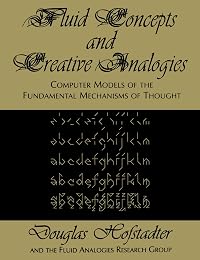
Fluid Concepts And Creative Analogies: Computer Models Of The Fundamental Mechanisms Of Thought
by Douglas Hofstadter
On This Page
Description
Readers of earlier works by Douglas Hofstadter will find this book a natural extension of his style and his ideas about creativity and analogy; in addition, psychologists, philosophers, and artificial-intelligence researchers will find in this elaborate web of ingenious ideas a deep and challenging new view of mind.Tags
Recommendations








Member Reviews
A very detailed and in-depth look at various computer programs that Hofstadter and his team designed in an attempt to model certain aspects of human thought, notably pattern-matching, analogy-making, and, in a limited sense, creativity.
It should be noted that this book was published in 1995, and a lot of the work it describes was done even earlier than that, so it's... Well, maybe not "dated," exactly, as the ideas in it are still valid and interesting. But presumably no longer a reflection of the state-of-the-art in artificial intelligence research. I don't really know enough about the current state of the field, though, to know whether the approaches considered here have borne fruit since. My vague impression is that a lot of it has show more gone in the direction of building better expert systems instead, something Hofstadter is a bit disparaging about.
Anyway. A number of different programs are discussed here, all of which have certain commonalities. In particular, they're meant to approach problems the way a human might approach them, not the way we'd normally expect a computer to. For example, the Seek-Whence program was designed to analyze sequences of numbers of the kind you might find in an IQ test, the sort where one is expected to recognize a pattern in the numbers and supply the next digit. But instead of taking a brute-force approach, in which it mindlessly tests each sequence to see if it fits some pre-supplied list of possible rules, it instead uses a complex technique that mimics what humans seem to do: looking for obvious connections that "jump out," building tentative hypotheses and trying to make them work, abandoning one line of reasoning in favor of a more attractive one and then perhaps going back to the first one later, and so on.
Another example is the Copycat program, which builds analogies involving strings of letters. Basically, it answers puzzles like this: "I change ABC into ABD. Now, you do the same thing to IJK." As a human, what do you do? Most people will respond with IJL, following the rule "change the last letter to the one that comes next in the alphabet." But why do we see that as the rule, and not "change the last letter to D" or even "change any Cs you find to Ds"? The programmers came up with some actual answers to that, and were able to make the program "think" about this sort of thing more or less the way that people do.
I find this stuff, in general, absolutely fascinating. As for the nitty-gritty specifics, though, my brain was sort of split in two here, between the part that found all the intricate little details -- of which there are many, all of which are pretty important to understanding how these programs work -- absolutely fascinating, and the part that quickly started to find the reality of reading about all those details rather tedious. That second part was unfortunately helped along a bit by the fact that all the programs operate on similar principles and the chapters in the book were originally published independently, which means there's a fair amount of repetition. I will admit, by the time I got to the description of the final program -- a then-in-progress attempt to get a computer to generate new typeface designs of a certain kind -- I was having real difficulty forcing myself to pay attention. Having reached the end of it, though, I am now looking back on it and thinking, "Well, that was interesting stuff, really. Even if I'm glad I don't have to read any more of it." show less
It should be noted that this book was published in 1995, and a lot of the work it describes was done even earlier than that, so it's... Well, maybe not "dated," exactly, as the ideas in it are still valid and interesting. But presumably no longer a reflection of the state-of-the-art in artificial intelligence research. I don't really know enough about the current state of the field, though, to know whether the approaches considered here have borne fruit since. My vague impression is that a lot of it has show more gone in the direction of building better expert systems instead, something Hofstadter is a bit disparaging about.
Anyway. A number of different programs are discussed here, all of which have certain commonalities. In particular, they're meant to approach problems the way a human might approach them, not the way we'd normally expect a computer to. For example, the Seek-Whence program was designed to analyze sequences of numbers of the kind you might find in an IQ test, the sort where one is expected to recognize a pattern in the numbers and supply the next digit. But instead of taking a brute-force approach, in which it mindlessly tests each sequence to see if it fits some pre-supplied list of possible rules, it instead uses a complex technique that mimics what humans seem to do: looking for obvious connections that "jump out," building tentative hypotheses and trying to make them work, abandoning one line of reasoning in favor of a more attractive one and then perhaps going back to the first one later, and so on.
Another example is the Copycat program, which builds analogies involving strings of letters. Basically, it answers puzzles like this: "I change ABC into ABD. Now, you do the same thing to IJK." As a human, what do you do? Most people will respond with IJL, following the rule "change the last letter to the one that comes next in the alphabet." But why do we see that as the rule, and not "change the last letter to D" or even "change any Cs you find to Ds"? The programmers came up with some actual answers to that, and were able to make the program "think" about this sort of thing more or less the way that people do.
I find this stuff, in general, absolutely fascinating. As for the nitty-gritty specifics, though, my brain was sort of split in two here, between the part that found all the intricate little details -- of which there are many, all of which are pretty important to understanding how these programs work -- absolutely fascinating, and the part that quickly started to find the reality of reading about all those details rather tedious. That second part was unfortunately helped along a bit by the fact that all the programs operate on similar principles and the chapters in the book were originally published independently, which means there's a fair amount of repetition. I will admit, by the time I got to the description of the final program -- a then-in-progress attempt to get a computer to generate new typeface designs of a certain kind -- I was having real difficulty forcing myself to pay attention. Having reached the end of it, though, I am now looking back on it and thinking, "Well, that was interesting stuff, really. Even if I'm glad I don't have to read any more of it." show less
Four-fifths of this book is an incisive and convincing takedown of some current trends in the field that used to be called 'AI.' Hofstadter's specialty and bias is toward 'microdomains,' wherein he asks computers to develop associations ('analogies') between extremely simple entities, encoding for shape, proximity, reflection, and other patterns.
The section on Tabletop is worth the price of the book.
He makes a number of forays along the way, striking out at colleagues in the field who take different approaches; some of this is insightful and convincing, but some of it leaves me feeling like I have witnessed one side of an academic spat. Hofstadter certainly makes his point that a lot of what popularly passes for AI is not much more than show more speech recognition, and does not usefully advance (as his own work absolutely does) real understanding of how a machine might mimic 'thought' (particularly 'creative thought') and 'understanding.'
The latter fifth of the book provides a titillating look at then-unfinished work on applying some of these concepts to typographic design. Here Hofstadter overextends his expertise in type design a little (as he does in the field of poetry, in his book Le Ton Beau de Marot), but his enthusiasm is infectious and I admire the courage of his omnivorous intellect.
(john) show less
The section on Tabletop is worth the price of the book.
He makes a number of forays along the way, striking out at colleagues in the field who take different approaches; some of this is insightful and convincing, but some of it leaves me feeling like I have witnessed one side of an academic spat. Hofstadter certainly makes his point that a lot of what popularly passes for AI is not much more than show more speech recognition, and does not usefully advance (as his own work absolutely does) real understanding of how a machine might mimic 'thought' (particularly 'creative thought') and 'understanding.'
The latter fifth of the book provides a titillating look at then-unfinished work on applying some of these concepts to typographic design. Here Hofstadter overextends his expertise in type design a little (as he does in the field of poetry, in his book Le Ton Beau de Marot), but his enthusiasm is infectious and I admire the courage of his omnivorous intellect.
(john) show less
Look, Hofstadter is in love with his brilliance... again! Why do I keep reading his crap?
Ratings
Members
- Recently Added By
Author Information

29+ Works 23,042 Members
Douglas Hofstadter is College of Arts and Sciences Professor of Cognitive Science at Indiana University
Series
Belongs to Publisher Series
Common Knowledge
- Canonical title*
- Fluid concepts and creative analogies
- Original title
- Fluid concepts and creative analogies : computer models of the fundamental mechanisms of thought
- Original publication date
- 1995
- Dedication
- To D. and M.
- First words
- This book attempts to present roughly a decade and a half of research in cognitive science carried out by a significant number of people.
- Last words
- (Click to show. Warning: May contain spoilers.)While it is certain that no project emanating from our research group will ever come close to passing the Turing Test, we nonetheless hope that the work we have described in this book may help lead, in the distant future, to architectures that go much further than we have toward capturing the genuine fluid mentality that Alan Turing so clearly envisioned when he first proposed his deservedly celebrated Test.
- Canonical DDC/MDS
- 153.4
*Some information comes from Common Knowledge in other languages. Click "Edit" for more information.
Classifications
- Genres
- Science & Nature, Technology, Nonfiction, General Nonfiction, Philosophy
- DDC/MDS
- 153.4 — Philosophy & psychology Psychology Conscious mental processes and intelligence Thought, thinking, reasoning, intuition, value, judgment
- LCC
- BF311 .H617 — Philosophy, Psychology and Religion Psychology Psychology Consciousness. Cognition
- BISAC
Statistics
- Members
- 862
- Popularity
- 31,610
- Reviews
- 4
- Rating
- (3.78)
- Languages
- English, Finnish, German, Italian
- Media
- Paper, Ebook
- ISBNs
- 8
- ASINs
- 3