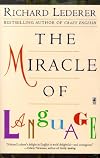
Miracle of Language
by Richard Lederer
On This Page
Description
Master verbalist Richard Lederer, America's "Wizard of Idiom" "(Denver Post), presents a love letter to the most glorious of human achievements... Welcome to Richard Lederer's beguiling celebration of language -- of our ability to utter, write, and receive words. No purists need stop here. Mr. Lederer is no linguistic sheriff organizing posses to hunt down and string up language offenders. Instead, join him "In Praise of English," and discover why the tongue described in Shakespeare's day as show more "of small reatch" has become the most widely spoken language in history: "English never rejects a word because of race, creed, or national origin. Did you know that" jukebox "comes from Gullah and" canoe "from Haitian Creole?" "Many of our greatest writers have invented words and bequeathed new expressions to our eveyday conversations. Can you imagine making up almost ten percent of our written vocabulary? Scholars now know that William Shakespeare did just that!" He also points out the pitfalls and pratfalls of English. If a man mans a station, what does a woman do? In the "The Department of Redundancy Department," "Is English Prejudiced?" and other essays, Richard Lederer urges us not to abandon that which makes us human: the capacity to distinguish, discriminate, compare, and evaluate.Copyright © Libri GmbH. All rights reserved. show lessTags
Recommendations






















Member Reviews
The insults to your intelligence begin right in the introduction, where you'll find a stupidly self-aggrandizing, obviously fictional anecdote about a policeman rewarding him for criticizing the officer's grammar during a traffic stop ("Are you the guy who writes those books about language?").
Then there's the pitifully shallow chapter on biased language, that can't decide how seriously to treat its subject;
Then there's the chapter on redundancy, where the author hilariously twists himself into linguistic pretzels to avoid overusing the word "redundancy";
Then there's the WTF chapter where he rhapsodizes on how unique and inimitable Emily Dickinson is, then prints some poems by his middle school English pupils, claiming that they've show more captured her spirit exactly. (!!)
He seems to be trying to Frankenstein together the remaining miscellany of his notebooks into an abomination that's part trivia and part lazy analysis; yet he also wants to be admired as a scholar and an authority. Predictably, he fails at everything, and cheapens every subject he touches.
This book will punish you, not reward you, for reading it. show less
Then there's the pitifully shallow chapter on biased language, that can't decide how seriously to treat its subject;
Then there's the chapter on redundancy, where the author hilariously twists himself into linguistic pretzels to avoid overusing the word "redundancy";
Then there's the WTF chapter where he rhapsodizes on how unique and inimitable Emily Dickinson is, then prints some poems by his middle school English pupils, claiming that they've show more captured her spirit exactly. (!!)
He seems to be trying to Frankenstein together the remaining miscellany of his notebooks into an abomination that's part trivia and part lazy analysis; yet he also wants to be admired as a scholar and an authority. Predictably, he fails at everything, and cheapens every subject he touches.
This book will punish you, not reward you, for reading it. show less
Fifteen years ago, I attended a library conference where Richard Lederer was the keynote speaker. His message was intriguing and I bought several of his books but it has taken me this long to read the first one. The miracle of language is really a misnomer and the title should really be “The miracle of English.” Although the first two chapters do deal with language in general, Lederer’s main concern is English and the writers of English over the years who have shaped English into an international language. He points out that English has a greater vocabulary than any other language, with words from the Angles, the French and Latin. And the language does not hesitate to take in words from other languages and, if there isn’t a show more word, to make one up. Later in the book, he discusses seven of the most influential authors in the English language, praises books and libraries, and ends with a section of quotes from various authors about words. His makes a case for using simple words instead of convoluted language and quotes a section from Ecclesiastes and a version written by George Orwell which is 1 ½ times as long, showing how sterile modern English can be. Then there is the section about how words can change history and the example is chilling.
Lederer, a teacher of high school English and a columnist for a local newspaper, writes in an informal style. I felt that he tried to cover too much in this book since chapters seemed to move from gender problems in English to makers of new words to how to write poetry with examples from several of his high school students. Although he credited authors, he did not cite where the material was originally from. There is an index but it is not complete. The authors that he quoted in the chapter “Words about words” do not appear at all. As an academic librarian and having an interest in language, I expected more from this book. show less
Lederer, a teacher of high school English and a columnist for a local newspaper, writes in an informal style. I felt that he tried to cover too much in this book since chapters seemed to move from gender problems in English to makers of new words to how to write poetry with examples from several of his high school students. Although he credited authors, he did not cite where the material was originally from. There is an index but it is not complete. The authors that he quoted in the chapter “Words about words” do not appear at all. As an academic librarian and having an interest in language, I expected more from this book. show less
I was expecting something more Steven Pinker-esque from this book—I hear Lederer is a neat speaker and enjoys to talk about language, so I expected the book to be more engaging and exploratory. Instead, it read like a disconnected series of newspaper columns (and I say that because I know he wrote a column in a newspaper—otherwise, it's a series of very short chapters). Sorry, Mr. Lederer, but this book didn't make me—a linguist!—feel like these examples of language were terribly miraculous.
Such potential.
Such potential.
I would use this book to show connections between the English and Spanish languages, and draw connections to how they were formed and how they are related.
Ratings
Members
- Recently Added By
Author Information

59+ Works 5,045 Members
Richard Lederer, the well-known wordsmith, originally intended to practice medicine. He entered Haverford College as a pre-medical student, but when he realized that he was more interested in the textbooks' language than their substance, he switched his major to English. He next attended Harvard Law School, but again switched majors--this time show more entering Harvard's Master of Arts and Teaching program. After graduation, he taught English and media at St. Paul's School, in Concord, N.H., for 27 years. Upon earning his Ph.D. in English and Linguistics from the University of New Hampshire, he decided to pursue a career writing books on the English language. His first book, Anguished English, was a popular success and launched his career. His books, newspaper columns, and speaking engagements have allowed Lederer, in his own words, "to extend my mission of teachership." Lederer describes himself as a "verbivore" - one who consumes words. He says, "Carnivores eat meat; herbivores eat plants and vegetables; verbivores devour words." His fascination with word play (particularly, palindromes and puns) resulted in his nicknames--"Attila the Pun" and "Conan the Grammarian." (Bowker Author Biography) show less
Work Relationships
Is contained in
Common Knowledge
Classifications
Statistics
- Members
- 398
- Popularity
- 77,917
- Reviews
- 4
- Rating
- (3.56)
- Languages
- English
- Media
- Paper, Ebook
- ISBNs
- 4
- ASINs
- 2