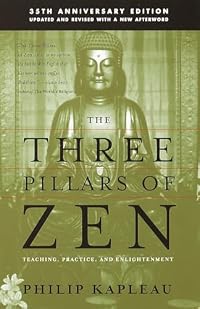
The Three Pillars of Zen
by Philip Kapleau Roshi
On This Page
Description
In this classic work of spiritual guidance, the founder of the Rochester Zen Center presents a comprehensive overview of Zen Buddhism. Exploring the three pillars of Zen-teaching, practice, and enlightenment-Roshi Philip Kapleau, the man who founded one of the oldest and most influential Zen centers in the United States, presents a personal account of his own experiences as a student and teacher, and in so doing gives listeners invaluable advice on how to develop their own practices. Revised show more and updated, this edition features a new afterword by Sensei Bodhin Kjolhede, who succeeded Kapleau as spiritual director of the Rochester Zen Center. A moving, eye-opening work, The Three Pillars of Zen is the definitive introduction to the history and discipline of Zen. show lessTags
Recommendations























Member Reviews
Three Pillars of Zen is rightfully a classic in its field. Philip Kapleau ably provides an insider's view of Zen, focusing on the experience of zazen, the proper term for Zen style meditation, as done during sesshin, the week-long spiritual intensive that providently culminates in kensho, enlightenment.
The object of Zen is to discard the delusions of the discriminatory mind: sensation, thought, self, so words are of little use, like mistaking a finger pointing at the moon for the moon. But there is a state of still tension, taut like a bowstring, that enables a person to break through to a higher level of understanding. This takes effort, devotion, and faith, but it is eminently possible. The best parts of the book concern eight show more personal accounts of reaching enlightenment from a mix of contemporary Japanese and Western seekers, more or less ordinary people who did a few years of meditation, a few sesshins, and focused on the koan Mu until they found what they were seeking. A second standout is the records of dokusan, the one-on-one encounters between a teacher and student that are the heart of the mind-to-mind transmission of Zen, and which by long tradition (though apparently no hard rule) are not written down.
There's some things I did not much care for. Kapleau includes a large amount of commentary which I found boring and irrelevant next to the first-hand experiences. The goal of this book was to transmit Zen to the West, since it was fading in Japan. This missionary impulse carries with it a great sense of superiority, over academic theologians, tantric yoga, and slightly different schools of zen. And somewhat surprising to me, sesshin is more active and aggressive than I expected. Poor sitting is corrected with thwacks of a baton, violent strikes intended to goad the student through to their goal, but which seem at odds with a religion of peace. show less
The object of Zen is to discard the delusions of the discriminatory mind: sensation, thought, self, so words are of little use, like mistaking a finger pointing at the moon for the moon. But there is a state of still tension, taut like a bowstring, that enables a person to break through to a higher level of understanding. This takes effort, devotion, and faith, but it is eminently possible. The best parts of the book concern eight show more personal accounts of reaching enlightenment from a mix of contemporary Japanese and Western seekers, more or less ordinary people who did a few years of meditation, a few sesshins, and focused on the koan Mu until they found what they were seeking. A second standout is the records of dokusan, the one-on-one encounters between a teacher and student that are the heart of the mind-to-mind transmission of Zen, and which by long tradition (though apparently no hard rule) are not written down.
There's some things I did not much care for. Kapleau includes a large amount of commentary which I found boring and irrelevant next to the first-hand experiences. The goal of this book was to transmit Zen to the West, since it was fading in Japan. This missionary impulse carries with it a great sense of superiority, over academic theologians, tantric yoga, and slightly different schools of zen. And somewhat surprising to me, sesshin is more active and aggressive than I expected. Poor sitting is corrected with thwacks of a baton, violent strikes intended to goad the student through to their goal, but which seem at odds with a religion of peace. show less
Although I had heard of Kapleau's book when I began zazen in earnest, 20 years ago, I never got around to reading it. I was satisfied with Suzuki Roshi's Zen Mind, Beginner's Mind as a "beginner book" and didn't see any need to go back to what I imagined were concepts I had already learned and let go of. Well I was wrong but I'm glad I was wrong because it meant I could read this book with some experience. Yes, it is a so called beginner book. It does a lot of introductory work that anyone starting out with Zen will really appreciate.
That said, the orientation provided here is nothing to gloss over for experienced practitioners. This book revitalized my practice. It nourished me. It inspired me to remember the importance of kensho.
I show more highly recommend this book to both new and experienced students of Zen. It will either keep you steadfast or set you on a proper course of study. show less
That said, the orientation provided here is nothing to gloss over for experienced practitioners. This book revitalized my practice. It nourished me. It inspired me to remember the importance of kensho.
I show more highly recommend this book to both new and experienced students of Zen. It will either keep you steadfast or set you on a proper course of study. show less
Although I had heard of Kapleau's book when I began zazen in earnest, 20 years ago, I never got around to reading it. I was satisfied with Suzuki Roshi's Zen Mind, Beginner's Mind as a "beginner book" and didn't see any need to go back to what I imagined were concepts I had already learned and let go of. Well I was wrong but I'm glad I was wrong because it meant I could read this book with some experience. Yes, it is a so called beginner book. It does a lot of introductory work that anyone starting out with Zen will really appreciate.
That said, the orientation provided here is nothing to gloss over for experienced practitioners. This book revitalized my practice. It nourished me. It inspired me to remember the importance of kensho.
I show more highly recommend this book to both new and experienced students of Zen. It will either keep you steadfast or set you on a proper course of study. show less
That said, the orientation provided here is nothing to gloss over for experienced practitioners. This book revitalized my practice. It nourished me. It inspired me to remember the importance of kensho.
I show more highly recommend this book to both new and experienced students of Zen. It will either keep you steadfast or set you on a proper course of study. show less
The first of Kapleau's books I read was 'Awakening to Zen', which I found touched me a lot more than this book, and I was a little disapointed with this read, as I had hoped for a lot from it. That said, this is still an excellent reference for those interested in Zen, with the discussion of koans especially good. I found that some of the talk about makkyo (sp?) and certain schools of zen a bit exclusive of other areas of zen, but we have to remember that this is written from Kapleau's experience and perspective, and take it for what it is.
This book is filled with valuable information penned by erudite scholars and Zen masters.
It is most suitable as a work of reference and is not to be read cover to cover. It needs to be owned and I don’t own it so I didn’t get far with it, having to return it quickly to the library, since there were apparently others waiting in line for it.
It’s a book for the serious student of Zen, and can in no way be called an easy read.
We are told in detail how to practice zazen, a form of Zen meditation.
Part two deals with enlightenment and contains “eight contemporary enlightenment experiences of Japanese and Westerners”. In one experience a Japanese executive realized clearly “that Mind is no other than mountains and rivers and the show more great wide earth, the sun and the moon and the stars”. Later he seemed to be struck by lightning and the next instant heaven and earth crumbled and disappeared”.
The various enlightenment experiences are described in detail, including the events leading up to them, Unfortunately, I didn’t have time to read much of any of them.
I’m pretty much an ignoramus as regards Zen, but it seems to me that for the serious student this book is an absolute must and contains about everything you could need to know.
The book contains valuable illustrations of zazen postures. show less
It is most suitable as a work of reference and is not to be read cover to cover. It needs to be owned and I don’t own it so I didn’t get far with it, having to return it quickly to the library, since there were apparently others waiting in line for it.
It’s a book for the serious student of Zen, and can in no way be called an easy read.
We are told in detail how to practice zazen, a form of Zen meditation.
Part two deals with enlightenment and contains “eight contemporary enlightenment experiences of Japanese and Westerners”. In one experience a Japanese executive realized clearly “that Mind is no other than mountains and rivers and the show more great wide earth, the sun and the moon and the stars”. Later he seemed to be struck by lightning and the next instant heaven and earth crumbled and disappeared”.
The various enlightenment experiences are described in detail, including the events leading up to them, Unfortunately, I didn’t have time to read much of any of them.
I’m pretty much an ignoramus as regards Zen, but it seems to me that for the serious student this book is an absolute must and contains about everything you could need to know.
The book contains valuable illustrations of zazen postures. show less
This book is a primer on Zen Buddhism. It's well written and does what it aims to do.
Roshi Philip Kapleau had hoped to clear some misrepresentations of Zen in the West with this book, and from it's continued publication, I suppose it has succeeded somewhat.
This book is split into three general parts. The first part is a collection of letters and talks that were printed to give a general idea of what Zen Buddhism is. It contains guidance on the practice of zazen and shikan-taza, which are techniques used to attain enlightenment. The second part contains letters and diary entries from modern people that have undergone Zen Training for various reasons and purposes. The third part contains a supplemental section that shows how to do the show more positions like the full lotus posture and the half lotus posture.
This book is meant to be studied, I am sure, but I just read it through. show less
Roshi Philip Kapleau had hoped to clear some misrepresentations of Zen in the West with this book, and from it's continued publication, I suppose it has succeeded somewhat.
This book is split into three general parts. The first part is a collection of letters and talks that were printed to give a general idea of what Zen Buddhism is. It contains guidance on the practice of zazen and shikan-taza, which are techniques used to attain enlightenment. The second part contains letters and diary entries from modern people that have undergone Zen Training for various reasons and purposes. The third part contains a supplemental section that shows how to do the show more positions like the full lotus posture and the half lotus posture.
This book is meant to be studied, I am sure, but I just read it through. show less
This is a tad dated. It was written on the front end of the buddhist emergence in America, and Kapleau seems scared to try to place it in an American or Western context. But still a good book.
Members
- Recently Added By
Lists

Favourite Books
1,817 works; 308 members
Author Information

26 Works 2,630 Members
Work Relationships
Is contained in
Common Knowledge
- Canonical title
- The Three Pillars of Zen
- Original publication date
- 1965
Classifications
- Genres
- Religion & Spirituality, Nonfiction, Philosophy, General Nonfiction
- DDC/MDS
- 294.3927 — Religion Other religions Buddhism/Hinduism Buddhism Buddhism - Branches and schools Mahayana Buddhism Zen Buddhism
- LCC
- BQ9265.4 .T48 — Philosophy, Psychology and Religion Buddhism Buddhism Modifications, schools, etc. Special modifications, sects, etc. Zen Buddhism
- BISAC
Statistics
- Members
- 1,660
- Popularity
- 13,416
- Reviews
- 20
- Rating
- (4.03)
- Languages
- 8 — Dutch, English, French, German, Italian, Polish, Spanish, Swedish
- Media
- Paper, Audiobook, Ebook
- ISBNs
- 26
- ASINs
- 20