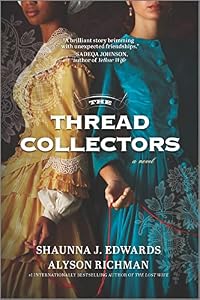
The Thread Collectors
by Shaunna J. Edwards, Alyson Richman
On This Page
Description
"An unforgettable story of female strength, hope and friendship. This collaborative work is magnificent—a true revelation!" —Pam Jenoff, New York Times bestselling author of The Woman with the Blue Star"A brilliant story brimming with unexpected friendships and family ties. Historically sound and beautifully stitched, The Thread Collectors will stay with you long after the last page is turned." —Sadeqa Johnson, international bestselling author of Yellow Wife
1863: In a small Creole show more cottage in New Orleans, an ingenious young Black woman named Stella embroiders intricate maps on repurposed cloth to help enslaved men flee and join the Union Army. Bound to a man who would kill her if he knew of her clandestine activities, Stella has to hide not only her efforts but her love for William, a Black soldier and a brilliant musician.
Meanwhile, in New York City, a Jewish woman stitches a quilt for her husband, who is stationed in Louisiana with the Union Army. Between abolitionist meetings, Lily rolls bandages and crafts quilts with her sewing circle for other soldiers, too, hoping for their safe return home. But when months go by without word from her husband, Lily resolves to make the perilous journey South to search for him.
As these two women risk everything for love and freedom during the brutal Civil War, their paths converge in New Orleans, where an unexpected encounter leads them to discover that even the most delicate threads have the capacity to save us. Loosely inspired by the authors' family histories, this stunning novel will stay with readers for a long time. show less
Tags
Recommendations



Member Recommendations

Member Reviews
In The Thread Collectors, the character of Jacob Kling is based on a musician who enlisted in the 31st Regiment of New York. Having left his wife, Lily, a harpist, behind in New York, Jacob is stationed at Camp Parapet near Jefferson, Louisiana, assisting the doctor who is examining the many Black men who have arrived to serve with the Louisiana Native Guards. Jacob's older brother has enlisted in the 29th Regiment of Mississippi. Samuel left New York and established a mercantile emporium in Satartia, Mississippi. Samuel was dispatched by their father to expand the family's trading business and, surprisingly, found a Jewish bride and settled there. The brothers' opposing stances create tension, especially when Lily is unable to hide her show more feelings during a visit. She is appalled that Samuel would join the effort to maintain slavery, but Samuel insists that he had no choice and is fighting not to protect slavery, but to hold onto the business and home he has worked hard to establish. He believes that if the Rebel forces lose, his family will be destitute. The brothers' affection for each other is never in question and both despair at the prospect that they could find themselves on opposite sides of a battlefield.
As the story opens, Stella and William are saying good-bye to each other, unsure if they will ever be reunited. William is running away from New Orleans and his master, risking his life to join the Union Army at the enlistment camp ten miles away. William and Stella love each other but are not permitted to marry or even make decisions about their own lives. They believe that once the Union Army wins the war, that will change.
There, he meets Jacob and the physician Jacob is assisting, who is astounded that William does not bear the kind of physical scars that so many other enslaved men do and his hands have no calluses. William has never performed hard labor. His musical talent was discovered when he was just six years old and he was sent to live in the main house where he was forced to play the flute to amuse and entertain his master's wife and their guests. He was required to dress in the hand-me-down suits of his master's son and perform on command, which was demeaning. Although singled out for his musical prowess, he was denied the opportunity to learn to read music because reading is forbidden . . . and a punishable offense. William can express his feelings through his music, but lacks the ability to commit his thoughts and emotions to paper.
Stella lives in a Creole cottage with her half-sister, Ammanee. Their mother, Janie, lives nearby in her own cottage on Rampart Street. Their homes are furnished with cast-off items, and their masters provide them with meager allowances to buy food. They are among the light-skinned women who enjoy elevated living conditions because they have been granted favor by the white men who control their lives. Janie was separated from Ammanee's father, the love of her life, and never saw him again, but given her "freedom papers" when Stella was fathered by her master. She is not free to leave, however. Mr. Percy permitted seven-year-old Ammanee to be her half-sister's nursemaid and promised Janie that she could select the man who would be Stella's master. Stella was "sent to market" when she was eighteen years old and it was there that she met William, playing his flute. Keeping his promise to Janie, Mr. Percy negotiated a deal with Mason Frye, William's master, for Stella. She would be provided four bolts of fabric, ten spools of threat, three cotton slips and bloomers, two cast-iron pots, a copper kettle, a wooden desk, a chair, and a mirror. And most importantly, Ammanee would also be purchased to serve as Stella's maid. The three women are fortunate to be together, but Stella is required to submit to her master's demands and whims, and when, after William escapes, she realizes she is pregnant, worries what will happen if the child's skin color is too dark to convince Frye that he is the father.
Stella is a skilled seamstress, of necessity, and after she embroiders a map to guide William, she is called upon by her neighbors to create maps for their sons and brothers who also plan to join the Union Army. She incorporates information gleaned by Ammanee from conversations she overhears while working in the nearby church. Because fabric and thread are precious commodities, quilts, purses, and petticoats must be repurposed, with thread being carefully extracted in order to be used again. Stella codes the maps in various colors signifying routes that are believed to be less fraught with danger than others.
As the war rages on, William is pressed into service, along with a young drummer boy who barely speaks, performing nightmarish tasks he could never have imagined. Teddy is just ten years old, and eventually reveals how he came to be completely alone in the world, his drum his only possession, and in a Union Army camp. William, in particular, is fond of and determined to protect him. Jacob wrote a beautiful song for Lily, "Girl of Fire," and many of the soldiers have learned it. In the evenings, along with other musicians, Jacob, William, and Teddy bring comfort to and boost the morale of the men who are fighting.
They develop a strong sense of camaraderie through their music, as well as their individual senses of being "other than." Jacob hides his background, painfully aware that many of the men he encounters have never before met a Jew and not all will accept him. William stands apart from many of the other men who have endured harsh physical conditions their entire lives. But William is no stranger to hardship and heartbreak, having watched his mother suffer.
A holiday cease-fire inspires William to enlist Jacob's assistance to make it special for young Teddy. But their trek into the nearby woods ends tragically and tests the bonds the men have formed. With no idea what is happening to William or even if he is still alive, Ammanee and Stella will do whatever is necessary in order to keep Stella's child safe. When weeks pass with no word from Jacob, Lily is overcome with worry and determined to find him. But journeying from New York into the South is extremely dangerous, especially for a woman traveling alone, and there are no registries in which the names of soldiers are logged, nor do the various military hospitals maintain records of their patients. Lily's father in unable to convince her to remain at home and wait for word about Jacob's whereabouts and condition, and she embarks on a treacherous trip to Samuel's home. She is shocked when she arrives and see what has become of Samuel and his family. She begins visiting hospitals in search of her husband. There, she witnesses and begins to appreciate the horrifying effects of war as she walks among the wounded and near-dead, hoping to find Jacob among them.
The Thread Collectors is a sprawling, engrossing story featuring compelling and fully developed characters. Authors Shaunna J. Edwards and Alyson Richman illustrate the various ways in which their Black characters enjoy better living conditions than many of their contemporaries. Yet, despite those advantages, they are not free. They are still enslaved. Even if they do not bear physical scars inflicted through mistreatment and back-breaking labor, they are emotionally scarred as a result of seeing loved ones abused and ripped away, and being confined and controlled, deprived autonomy even over their own bodies. But they are hopeful, believing that the Union Army will prevail and they will at last be free to live their lives on their own terms.
They are each, in their own ways, resilient and resourceful, resorting to drastic measures, if required, in order to survive. Jacob and Lily are earnest and endearing, but unprepared for the harsh realities of war. Edwards and Richman use the letters they write to each other not only to advance the story, but also provide insight into their feelings, especially concerning the ideological division that threatens the Kling brothers' relationship.
As the fast-paced and inventive story proceeds, Edwards and Richman cleverly pull together the various storyline threads. Lily, Stella, and Ammenee are tenacious and brave. Eventually, Lily and Stella come face to face and learn about the unlikely friendship between Jacob and William, men of quiet integrity and honor, that is convincingly depicted. Initially because of their mutual love of music, but ultimately because of the atrocities of war, Jacob and William find commonality, and mutual respect and admiration for each other.
The Thread Collectors is a tale of unbreakable bonds of family and love for those we choose to be our family members. It is also an illustrationg of the inherent strain in the mother-daughter relationship between Janie, a woman who has survived unspeakable heartbreak and views the world in a pragmatic, realistic manner, and Stella, who is initially idealistic and naive, but quickly matures when she becomes a mother who will do anything to protect her child.
The Thread Collectors is a unique and absorbing work of historical fiction about the most harrowing period in America history that is also timely and contemporary. Edwards and Richman penned the book in 2020, "as the world wrestled with growing awareness of racialized violence and inequality," in an effort to combine their creative "energy to find beauty in that darkness." They have indeed crafted a beautifully memorable story that continues to resonate long after reading the last page of the book.
Thanks to NetGalley for an Advance Reader's Copy of the book. show less
As the story opens, Stella and William are saying good-bye to each other, unsure if they will ever be reunited. William is running away from New Orleans and his master, risking his life to join the Union Army at the enlistment camp ten miles away. William and Stella love each other but are not permitted to marry or even make decisions about their own lives. They believe that once the Union Army wins the war, that will change.
There, he meets Jacob and the physician Jacob is assisting, who is astounded that William does not bear the kind of physical scars that so many other enslaved men do and his hands have no calluses. William has never performed hard labor. His musical talent was discovered when he was just six years old and he was sent to live in the main house where he was forced to play the flute to amuse and entertain his master's wife and their guests. He was required to dress in the hand-me-down suits of his master's son and perform on command, which was demeaning. Although singled out for his musical prowess, he was denied the opportunity to learn to read music because reading is forbidden . . . and a punishable offense. William can express his feelings through his music, but lacks the ability to commit his thoughts and emotions to paper.
Stella lives in a Creole cottage with her half-sister, Ammanee. Their mother, Janie, lives nearby in her own cottage on Rampart Street. Their homes are furnished with cast-off items, and their masters provide them with meager allowances to buy food. They are among the light-skinned women who enjoy elevated living conditions because they have been granted favor by the white men who control their lives. Janie was separated from Ammanee's father, the love of her life, and never saw him again, but given her "freedom papers" when Stella was fathered by her master. She is not free to leave, however. Mr. Percy permitted seven-year-old Ammanee to be her half-sister's nursemaid and promised Janie that she could select the man who would be Stella's master. Stella was "sent to market" when she was eighteen years old and it was there that she met William, playing his flute. Keeping his promise to Janie, Mr. Percy negotiated a deal with Mason Frye, William's master, for Stella. She would be provided four bolts of fabric, ten spools of threat, three cotton slips and bloomers, two cast-iron pots, a copper kettle, a wooden desk, a chair, and a mirror. And most importantly, Ammanee would also be purchased to serve as Stella's maid. The three women are fortunate to be together, but Stella is required to submit to her master's demands and whims, and when, after William escapes, she realizes she is pregnant, worries what will happen if the child's skin color is too dark to convince Frye that he is the father.
Stella is a skilled seamstress, of necessity, and after she embroiders a map to guide William, she is called upon by her neighbors to create maps for their sons and brothers who also plan to join the Union Army. She incorporates information gleaned by Ammanee from conversations she overhears while working in the nearby church. Because fabric and thread are precious commodities, quilts, purses, and petticoats must be repurposed, with thread being carefully extracted in order to be used again. Stella codes the maps in various colors signifying routes that are believed to be less fraught with danger than others.
As the war rages on, William is pressed into service, along with a young drummer boy who barely speaks, performing nightmarish tasks he could never have imagined. Teddy is just ten years old, and eventually reveals how he came to be completely alone in the world, his drum his only possession, and in a Union Army camp. William, in particular, is fond of and determined to protect him. Jacob wrote a beautiful song for Lily, "Girl of Fire," and many of the soldiers have learned it. In the evenings, along with other musicians, Jacob, William, and Teddy bring comfort to and boost the morale of the men who are fighting.
They develop a strong sense of camaraderie through their music, as well as their individual senses of being "other than." Jacob hides his background, painfully aware that many of the men he encounters have never before met a Jew and not all will accept him. William stands apart from many of the other men who have endured harsh physical conditions their entire lives. But William is no stranger to hardship and heartbreak, having watched his mother suffer.
A holiday cease-fire inspires William to enlist Jacob's assistance to make it special for young Teddy. But their trek into the nearby woods ends tragically and tests the bonds the men have formed. With no idea what is happening to William or even if he is still alive, Ammanee and Stella will do whatever is necessary in order to keep Stella's child safe. When weeks pass with no word from Jacob, Lily is overcome with worry and determined to find him. But journeying from New York into the South is extremely dangerous, especially for a woman traveling alone, and there are no registries in which the names of soldiers are logged, nor do the various military hospitals maintain records of their patients. Lily's father in unable to convince her to remain at home and wait for word about Jacob's whereabouts and condition, and she embarks on a treacherous trip to Samuel's home. She is shocked when she arrives and see what has become of Samuel and his family. She begins visiting hospitals in search of her husband. There, she witnesses and begins to appreciate the horrifying effects of war as she walks among the wounded and near-dead, hoping to find Jacob among them.
The Thread Collectors is a sprawling, engrossing story featuring compelling and fully developed characters. Authors Shaunna J. Edwards and Alyson Richman illustrate the various ways in which their Black characters enjoy better living conditions than many of their contemporaries. Yet, despite those advantages, they are not free. They are still enslaved. Even if they do not bear physical scars inflicted through mistreatment and back-breaking labor, they are emotionally scarred as a result of seeing loved ones abused and ripped away, and being confined and controlled, deprived autonomy even over their own bodies. But they are hopeful, believing that the Union Army will prevail and they will at last be free to live their lives on their own terms.
They are each, in their own ways, resilient and resourceful, resorting to drastic measures, if required, in order to survive. Jacob and Lily are earnest and endearing, but unprepared for the harsh realities of war. Edwards and Richman use the letters they write to each other not only to advance the story, but also provide insight into their feelings, especially concerning the ideological division that threatens the Kling brothers' relationship.
As the fast-paced and inventive story proceeds, Edwards and Richman cleverly pull together the various storyline threads. Lily, Stella, and Ammenee are tenacious and brave. Eventually, Lily and Stella come face to face and learn about the unlikely friendship between Jacob and William, men of quiet integrity and honor, that is convincingly depicted. Initially because of their mutual love of music, but ultimately because of the atrocities of war, Jacob and William find commonality, and mutual respect and admiration for each other.
The Thread Collectors is a tale of unbreakable bonds of family and love for those we choose to be our family members. It is also an illustrationg of the inherent strain in the mother-daughter relationship between Janie, a woman who has survived unspeakable heartbreak and views the world in a pragmatic, realistic manner, and Stella, who is initially idealistic and naive, but quickly matures when she becomes a mother who will do anything to protect her child.
The Thread Collectors is a unique and absorbing work of historical fiction about the most harrowing period in America history that is also timely and contemporary. Edwards and Richman penned the book in 2020, "as the world wrestled with growing awareness of racialized violence and inequality," in an effort to combine their creative "energy to find beauty in that darkness." They have indeed crafted a beautifully memorable story that continues to resonate long after reading the last page of the book.
Thanks to NetGalley for an Advance Reader's Copy of the book. show less
In her debut novel, The Thread Collectors, Shaunna J. Edwards, along with older pro Alyson Richman (who I have read before) together have created an engrossing saga of the civil war. I was most impressed by the authors’ extensive research. The novel is just full of real events from this era. And the characters are loosely based on the ancestors of the authors, both black and Jewish people of that time.
There are two stories that enfold. Stella, a black woman and skilled seamstress in Louisiana, has a particular needlework skill. She sews maps with repurposed thread. Stella is kept by her master, but in love with a black slave, William, who enlists in the Union army. He is a very talented musician and plays the flute for his regiment. show more There he meets another musician, Jacob, a white Jewish man and they bond and become fast friends. Jacob’s wife Lily is back in New York City and helps the Union cause with various projects. Jacob also has a brother in Mississippi who is a confederate. This creates another point of tension in the story.
Although the novel starts out a bit slow, the pace picks up as the men face devastating problems and the story also captures the issues Stella faces as she is pregnant and those of Lily as she searches for her husband when she stops getting his letters.
Each in their own way show resiliency to survive the harsh realities of their circumstances and use their personal strengths to overcome what they are dealt. And thanks to Stella’s mapmaking skills the story comes to a satisfying conclusion. show less
There are two stories that enfold. Stella, a black woman and skilled seamstress in Louisiana, has a particular needlework skill. She sews maps with repurposed thread. Stella is kept by her master, but in love with a black slave, William, who enlists in the Union army. He is a very talented musician and plays the flute for his regiment. show more There he meets another musician, Jacob, a white Jewish man and they bond and become fast friends. Jacob’s wife Lily is back in New York City and helps the Union cause with various projects. Jacob also has a brother in Mississippi who is a confederate. This creates another point of tension in the story.
Although the novel starts out a bit slow, the pace picks up as the men face devastating problems and the story also captures the issues Stella faces as she is pregnant and those of Lily as she searches for her husband when she stops getting his letters.
Each in their own way show resiliency to survive the harsh realities of their circumstances and use their personal strengths to overcome what they are dealt. And thanks to Stella’s mapmaking skills the story comes to a satisfying conclusion. show less
I was worried that a co-authored work of fiction might be disjointed or difficult/unpleasant to read. It was, in fact, consistent and flowed easily.
The story was unique and described parts of history of which I was unfamiliar. The characters were believable and fleshed out. Well done.
The story was unique and described parts of history of which I was unfamiliar. The characters were believable and fleshed out. Well done.
In THE THREAD COLLECTORS, Alyson Richman (a favorite author of mine) and Shaunna J. Edwards (this is her debut novel) team up to paint a portrait of the Civil War from what might be called cross perspectives; Black and white, North and South, rich and poor, slavery and freedom. As explained in the Authors’ Note, the authors collaborated as a way to “find beauty” in the darkness of the racial violence and inequality that surrounds American society.
Drawing on their own decades-long friendship and their individual family histories (Richman is white and Jewish, Edwards is black and Christian), these two women have crafted a story of war, slavery, love, and friendship around four main characters:
• Lily - the daughter of a wealthy, show more Jewish New York City merchant who is a dedicated abolitionist.
• Jacob - her husband, a talented musician from a less prosperous Jewish family who fights in the Union army.
• Stella - a beautiful enslaved woman in Louisiana who is auctioned off to become the mistress of a rich white planter.
• William - an enslaved man whose musical genius gets exploited by his master until he runs away to fight for the North.
How these four lives intersect I’ll leave for you to discover. But all four take great risks in their efforts to protect their loved ones.
The book paints quite a bleak picture of the conflict, that can be hard to read at some points. Split families, massive casualties, rudimentary medical care, widespread disease, and lack of adequate, even minimal supplies. And of course, prejudice against Black Americans deeply ingrained on both sides of the war.
The novel covers just a few years, beginning just before the Civil War begins, though the back stories of each character are woven in. I definitely found the first half of the book much less compelling than the second. Perhaps that was because so many backgrounds needed to be explained. But the book eventually picks up pace and becomes quite dramatic and powerful (even suspenseful) as it builds toward its conclusion.
I recommend THE THREAD COLLECTORS, especially because it’s the only book I’ve ever read about this time period that includes three less well-known aspects of the Civil War story:
• That the Union Army treated Black soldiers MUCH differently than White soldiers, despite the fact that both were on the same side.
• That Jewish soldiers fought, facing their own hurdles of discrimination.
• The ways in which women contributed to the war effort.
You’ll learn a lot. show less
Drawing on their own decades-long friendship and their individual family histories (Richman is white and Jewish, Edwards is black and Christian), these two women have crafted a story of war, slavery, love, and friendship around four main characters:
• Lily - the daughter of a wealthy, show more Jewish New York City merchant who is a dedicated abolitionist.
• Jacob - her husband, a talented musician from a less prosperous Jewish family who fights in the Union army.
• Stella - a beautiful enslaved woman in Louisiana who is auctioned off to become the mistress of a rich white planter.
• William - an enslaved man whose musical genius gets exploited by his master until he runs away to fight for the North.
How these four lives intersect I’ll leave for you to discover. But all four take great risks in their efforts to protect their loved ones.
The book paints quite a bleak picture of the conflict, that can be hard to read at some points. Split families, massive casualties, rudimentary medical care, widespread disease, and lack of adequate, even minimal supplies. And of course, prejudice against Black Americans deeply ingrained on both sides of the war.
The novel covers just a few years, beginning just before the Civil War begins, though the back stories of each character are woven in. I definitely found the first half of the book much less compelling than the second. Perhaps that was because so many backgrounds needed to be explained. But the book eventually picks up pace and becomes quite dramatic and powerful (even suspenseful) as it builds toward its conclusion.
I recommend THE THREAD COLLECTORS, especially because it’s the only book I’ve ever read about this time period that includes three less well-known aspects of the Civil War story:
• That the Union Army treated Black soldiers MUCH differently than White soldiers, despite the fact that both were on the same side.
• That Jewish soldiers fought, facing their own hurdles of discrimination.
• The ways in which women contributed to the war effort.
You’ll learn a lot. show less
In THE THREAD COLLECTORS, Alyson Richman (a favorite author of mine) and Shaunna J. Edwards (this is her debut novel) team up to paint a portrait of the Civil War from what might be called cross perspectives; Black and white, North and South, rich and poor, slavery and freedom. As explained in the Authors’ Note, the authors collaborated as a way to “find beauty” in the darkness of the racial violence and inequality that surrounds American society.
Drawing on their own decades-long friendship and their individual family histories (Richman is white and Jewish, Edwards is black and Christian), these two women have crafted a story of war, slavery, love, and friendship around four main characters:
• Lily - the daughter of a wealthy, show more Jewish New York City merchant who is a dedicated abolitionist.
• Jacob - her husband, a talented musician from a less prosperous Jewish family who fights in the Union army.
• Stella - a beautiful enslaved woman in Louisiana who is auctioned off to become the mistress of a rich white planter.
• William - an enslaved man whose musical genius gets exploited by his master until he runs away to fight for the North.
How these four lives intersect I’ll leave for you to discover. But all four take great risks in their efforts to protect their loved ones.
The book paints quite a bleak picture of the conflict, that can be hard to read at some points. Split families, massive casualties, rudimentary medical care, widespread disease, and lack of adequate, even minimal supplies. And of course, prejudice against Black Americans deeply ingrained on both sides of the war.
The novel covers just a few years, beginning just before the Civil War begins, though the back stories of each character are woven in. I definitely found the first half of the book much less compelling than the second. Perhaps that was because so many backgrounds needed to be explained. But the book eventually picks up pace and becomes quite dramatic and powerful (even suspenseful) as it builds toward its conclusion.
I recommend THE THREAD COLLECTORS, especially because it’s the only book I’ve ever read about this time period that includes three less well-known aspects of the Civil War story:
• That the Union Army treated Black soldiers MUCH differently than White soldiers, despite the fact that both were on the same side.
• That Jewish soldiers fought, facing their own hurdles of discrimination.
• The ways in which women contributed to the war effort.
You’ll learn a lot. show less
Drawing on their own decades-long friendship and their individual family histories (Richman is white and Jewish, Edwards is black and Christian), these two women have crafted a story of war, slavery, love, and friendship around four main characters:
• Lily - the daughter of a wealthy, show more Jewish New York City merchant who is a dedicated abolitionist.
• Jacob - her husband, a talented musician from a less prosperous Jewish family who fights in the Union army.
• Stella - a beautiful enslaved woman in Louisiana who is auctioned off to become the mistress of a rich white planter.
• William - an enslaved man whose musical genius gets exploited by his master until he runs away to fight for the North.
How these four lives intersect I’ll leave for you to discover. But all four take great risks in their efforts to protect their loved ones.
The book paints quite a bleak picture of the conflict, that can be hard to read at some points. Split families, massive casualties, rudimentary medical care, widespread disease, and lack of adequate, even minimal supplies. And of course, prejudice against Black Americans deeply ingrained on both sides of the war.
The novel covers just a few years, beginning just before the Civil War begins, though the back stories of each character are woven in. I definitely found the first half of the book much less compelling than the second. Perhaps that was because so many backgrounds needed to be explained. But the book eventually picks up pace and becomes quite dramatic and powerful (even suspenseful) as it builds toward its conclusion.
I recommend THE THREAD COLLECTORS, especially because it’s the only book I’ve ever read about this time period that includes three less well-known aspects of the Civil War story:
• That the Union Army treated Black soldiers MUCH differently than White soldiers, despite the fact that both were on the same side.
• That Jewish soldiers fought, facing their own hurdles of discrimination.
• The ways in which women contributed to the war effort.
You’ll learn a lot. show less
I was quickly drawn into this historical fiction story and was captivated to the last page. It is an emotional read as the cruelty of both the war and the life of the slaves is clearly spelled out. My heart broke at such senseless loss of lives. This is a beautifully written story that embodies family and friendship.
Set during the Civil War, the story focuses on two couples. William and Stella are slaves in a small Creole cottage outside New Orleans. Jacob and Lily Kling are a Jewish couple living in New York. William and Jacob, both musicians, join the Union Army, become friends, and bond over their music. Lily, an abolitionist, stitches quilts and packages bandages to send to the Union troops. A talented seamstress, Stella embroidered show more intricate maps on cloth to help enslaved men flee and join the Union Army. There are other very memorable characters that round out this amazing story.
This book is a collaboration between a Black author and a Jewish author. They bring pieces of their cultural and family histories to life and show how both Black soldiers and Jewish soldiers were marginalized in the Civil War. Edwards and Richman here give voice to these brave people.
Do not skip reading the Authors’ Notes as they address their real-life ancestors that influenced the characters in the book. show less
Set during the Civil War, the story focuses on two couples. William and Stella are slaves in a small Creole cottage outside New Orleans. Jacob and Lily Kling are a Jewish couple living in New York. William and Jacob, both musicians, join the Union Army, become friends, and bond over their music. Lily, an abolitionist, stitches quilts and packages bandages to send to the Union troops. A talented seamstress, Stella embroidered show more intricate maps on cloth to help enslaved men flee and join the Union Army. There are other very memorable characters that round out this amazing story.
This book is a collaboration between a Black author and a Jewish author. They bring pieces of their cultural and family histories to life and show how both Black soldiers and Jewish soldiers were marginalized in the Civil War. Edwards and Richman here give voice to these brave people.
Do not skip reading the Authors’ Notes as they address their real-life ancestors that influenced the characters in the book. show less
Wow, what a wonderful book about friendship and loyalty between unlikely friends set in the Civil War era. The friendship that developed between musician/soldiers Jacob and William was unusual. Jacob was Jewish from the North and William was black and from the south but signed up to fight with the Union Army. Their musical talents brought them together and created a bond that was never broken. Stella was an amazing seamstress that used her talents to create sewn maps for people to use to escape their slave owners. Stella loved William but couldn't be with him because of their status in the community. Lily, Jacob's wife, lived in NYC and thought she was doing all she could to help the wounded soldiers until she found out how much more show more there was to do. I loved the different perspective about people who were caught up in the Civil War and how the authors used their family history to develop the story. I highly recommend this book! show less
Members
- Recently Added By
Author Information

1 Work 195 Members

25+ Works 2,575 Members
Alysin Richman was born on May 19, 1972. She graduated from Wellesley College in 1994 and received a Thomas J. Watson Fellowship. She is best known for her novel The Lost Wife, which is a story about a husband and wife who are separated in a concentration camp during World War II and met up years later at their grandchildren's wedding. Her other show more title's include The Mask Carver's Son, The Ryhthm of Memory, The Last Van Gogh, and The Garden of Letters. (Bowker Author Biography) show less
Some Editions
Awards and Honors
Distinctions
Common Knowledge
- Canonical title
- The Thread Collectors
- Original publication date
- 2022
- People/Characters
- Stella; William; Jacob Kling; Lillian “Lily “ Kahn; Janie; Ammanee (show all 17); Samuel Kling; Mason Frye; Tilly; Isaiah; Theodore “Teddy” Bennett; Benjamin; Arthur Kahn; Elsa Kahn; Claudette; Wade; Eliza Kling
- Important places
- New Orleans, Louisiana, USA; New York, New York, USA; Camp Parapet, Jefferson, Louisiana, USA; Satartia, Mississippi, USA; Sapelo Island, Georgia, USA; Port Hudson, Louisiana, USA (show all 8); Brooklyn, New York, New York USA; Iberia, Louisiana
- Epigraph
- “If you don’t know where you’re going, you should know where you come from.”
—-Gullah Geechee proverb - Dedication
- For my original Stella and my future Wade.
—-Shaun’s J. Edwards
To my family, who fills me with love and stories.
—-Alyson Richman - First words
- She opens the door to the Creole cottage just wide enough to ensure it is truly him.
- Quotations
- Take care of the roots in order to heal the tree.
- Last words
- (Click to show. Warning: May contain spoilers.)Over Wade’s fussing, Stella could barely hear the words that escaped Lily’s lips. Yet she found herself full of hope. She saw William and Jacob embrace as friends. And she felt the warmth of Lily’s hand.
- Blurbers
- Loigman, Lynda Cohen; Johnson, Sadeqa; Jenoff, Pam; Davis, Fiona
Classifications
Statistics
- Members
- 195
- Popularity
- 167,109
- Reviews
- 16
- Rating
- (3.89)
- Languages
- English
- Media
- Paper, Audiobook, Ebook
- ISBNs
- 9
- ASINs
- 4