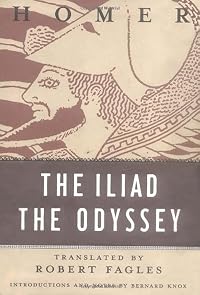
The Iliad / The Odyssey
by Homer
There is 1 current discussion about this work.
On This Page
Description
Homer's Iliad and Odyssey are unquestionably two of the greatest epic masterpieces in Western literature. Though more than 2,700 years old, their stories of brave heroics, capricious gods, and towering human emotions are vividly timeless. The Iliad can justly be called the world's greatest war epic. The terrible and long-drawn-out siege of Troy remains one of the classic campaigns, the heroism and treachery of its combatants unmatched in song and story. Driven by fierce passions and show more loyalties, men and gods battle to a devastating conclusion. The Odyssey chronicles the many trials and adventures Odysseus must pass through on his long journey home from the Trojan wars to his beloved wife. Though the stormy god of the ocean has sworn vengeance against him, and witches and sirens try to lure him off course, Odysseus is clever and has the brilliant goddess Athena on his side. show lessTags
Recommendations

























Member Recommendations

Member Reviews
THE ILIAD
The wrath of Achilles not only begins the oldest piece of Western literature, but is also its premise. The Iliad has been the basis of numerous clichés in literature, but at its root it is a story of a war that for centuries was told orally before being put down by Homer in which the great heroes of Greece fought for honor and glory that the men of Homer’s day could only imagine achieving.
The story of the Trojan War is well known and most people who have not read The Iliad assume they know what happens, but in fact at the end of the poem the city of Troy still stands and a wooden horse has not been mentioned. The Iliad tells of several weeks in the last year of the war that revolve around the dishonorable actions of show more Agamemnon that leads to Achilles refusing to fight with the rest of the Greeks and the disaster it causes in the resulting engagements against the Trojans. But then Achilles allows his friend Patroclus to lead his men into battle to save the Greek ships from being put to the torch only for Patroclus to advance to the walls of Troy and be slain by Hector. The wrath of Achilles turns from Agamemnon to Hector and the Trojans, leading to the death of Troy’s greatest warrior and the poem ending with his funeral.
Although the actions of Achilles and Hector take prominence, there are several other notable “storylines” one doesn’t know unless you’ve read epic. First and foremost is Diomedes, the second greatest fighter amongst the Greeks but oftentimes overlooked when it comes to adaptations especially to other important individuals like Odysseus, Menelaus, and the pivotal Patroclus. The second is how much the Olympians and other minor deities are thought to influence the events during this stretch of the war and how both mortals and immortals had to bow to Fate in all circumstances. The third is how ‘nationalistic’ the epic is in the Greek perspective because even though Hector is acknowledged the greatest mortal-born warrior in the war on both sides, as a Trojan he has to have moments of cowardice that none of the Greek heroes are allowed to exhibit and his most famous kill is enabled by Apollo instead of all by himself. And yet, even though Homer writes The Iliad as a triumphant Greek narrative the sections that have Hector’s flaws almost seem hollow as if Homer and his audience both subconsciously know that his epic is not the heroic wrath of Achilles but the tragic death of Hector.
The Iliad is the ultimate classic literature and no matter your reading tastes one must read it to have a better appreciation for all of literature as a whole. Although the it was first written over 2500 years ago, it shows the duality of heroic feats and complete tragedy that is war.
THE ODYSSEY
The crafty hero of The Iliad is in the last leg of his long ten year journey home, but it not only his story that Homer relates to the reader in this sequel to the first war epic in literature. The Odyssey describes the Odysseus’ return to Ithaca after twenty years along with the emergence of his son Telemachus as a new hero while his faithful wife Penelope staves off suitors who are crowding their home and eating their wealth daily.
Although the poem is named after his father, Telemachus’ “arc” begins first as the reader learns about the situation on Ithaca around Odysseus’ home and the search he begins for information on his father’s whereabouts. Then we shift to Odysseus on a beach longing to return home when he is informed his long sojourn is about to end and he sets off on a raft and eventually arrives among the Phaeacians, who he relates the previous ten years of his life to before they take him back home. On Ithaca, Odysseus and his son eventually meet and begin planning their revenge on the Penelope’s suitors that results in slaughter and a long-awaited family reunion with Penelope.
First and foremost The Odyssey is about coming home, in both Telemachus’ and Odysseus’ arcs there are tales of successful homecomings, unsuccessful homecomings, and homecoming that never happen of heroes from The Iliad. Going hand-in-hand with homecomings is the wanderings of other heroes whose adventures are not as exciting or as long as Odysseus’. Interwoven throughout the poem with homecomings and wanderings is the relationship between guests and hosts along with the difference between good and bad for both that has long reaching consequences. And finally throughout Odysseus’ long journey there are tests everywhere of all types for him to overcome or fail, but the most important are Penelope’s both physical and intimate.
Even though it is a sequel, The Odyssey is in complete contrast to The Iliad as instead of epic battle this poem focuses on a hero overcoming everything even the gods to return home. Suddenly the poet who gave readers a first-hand account of war shows his readers the importance of returning from war from the perspective of warriors and their families. Although they are completely different, The Odyssey in fact compliments The Iliad as well as completing it which means if you read one you have to read the other. show less
The wrath of Achilles not only begins the oldest piece of Western literature, but is also its premise. The Iliad has been the basis of numerous clichés in literature, but at its root it is a story of a war that for centuries was told orally before being put down by Homer in which the great heroes of Greece fought for honor and glory that the men of Homer’s day could only imagine achieving.
The story of the Trojan War is well known and most people who have not read The Iliad assume they know what happens, but in fact at the end of the poem the city of Troy still stands and a wooden horse has not been mentioned. The Iliad tells of several weeks in the last year of the war that revolve around the dishonorable actions of show more Agamemnon that leads to Achilles refusing to fight with the rest of the Greeks and the disaster it causes in the resulting engagements against the Trojans. But then Achilles allows his friend Patroclus to lead his men into battle to save the Greek ships from being put to the torch only for Patroclus to advance to the walls of Troy and be slain by Hector. The wrath of Achilles turns from Agamemnon to Hector and the Trojans, leading to the death of Troy’s greatest warrior and the poem ending with his funeral.
Although the actions of Achilles and Hector take prominence, there are several other notable “storylines” one doesn’t know unless you’ve read epic. First and foremost is Diomedes, the second greatest fighter amongst the Greeks but oftentimes overlooked when it comes to adaptations especially to other important individuals like Odysseus, Menelaus, and the pivotal Patroclus. The second is how much the Olympians and other minor deities are thought to influence the events during this stretch of the war and how both mortals and immortals had to bow to Fate in all circumstances. The third is how ‘nationalistic’ the epic is in the Greek perspective because even though Hector is acknowledged the greatest mortal-born warrior in the war on both sides, as a Trojan he has to have moments of cowardice that none of the Greek heroes are allowed to exhibit and his most famous kill is enabled by Apollo instead of all by himself. And yet, even though Homer writes The Iliad as a triumphant Greek narrative the sections that have Hector’s flaws almost seem hollow as if Homer and his audience both subconsciously know that his epic is not the heroic wrath of Achilles but the tragic death of Hector.
The Iliad is the ultimate classic literature and no matter your reading tastes one must read it to have a better appreciation for all of literature as a whole. Although the it was first written over 2500 years ago, it shows the duality of heroic feats and complete tragedy that is war.
THE ODYSSEY
The crafty hero of The Iliad is in the last leg of his long ten year journey home, but it not only his story that Homer relates to the reader in this sequel to the first war epic in literature. The Odyssey describes the Odysseus’ return to Ithaca after twenty years along with the emergence of his son Telemachus as a new hero while his faithful wife Penelope staves off suitors who are crowding their home and eating their wealth daily.
Although the poem is named after his father, Telemachus’ “arc” begins first as the reader learns about the situation on Ithaca around Odysseus’ home and the search he begins for information on his father’s whereabouts. Then we shift to Odysseus on a beach longing to return home when he is informed his long sojourn is about to end and he sets off on a raft and eventually arrives among the Phaeacians, who he relates the previous ten years of his life to before they take him back home. On Ithaca, Odysseus and his son eventually meet and begin planning their revenge on the Penelope’s suitors that results in slaughter and a long-awaited family reunion with Penelope.
First and foremost The Odyssey is about coming home, in both Telemachus’ and Odysseus’ arcs there are tales of successful homecomings, unsuccessful homecomings, and homecoming that never happen of heroes from The Iliad. Going hand-in-hand with homecomings is the wanderings of other heroes whose adventures are not as exciting or as long as Odysseus’. Interwoven throughout the poem with homecomings and wanderings is the relationship between guests and hosts along with the difference between good and bad for both that has long reaching consequences. And finally throughout Odysseus’ long journey there are tests everywhere of all types for him to overcome or fail, but the most important are Penelope’s both physical and intimate.
Even though it is a sequel, The Odyssey is in complete contrast to The Iliad as instead of epic battle this poem focuses on a hero overcoming everything even the gods to return home. Suddenly the poet who gave readers a first-hand account of war shows his readers the importance of returning from war from the perspective of warriors and their families. Although they are completely different, The Odyssey in fact compliments The Iliad as well as completing it which means if you read one you have to read the other. show less
We all know the story of the Odyssey: Cyclops, Circe, Calaypso, ten years lost at sea among the mythic horrors of ancient Greece only to return home to a palace full of useless nobles trying to seduce your wife. What I didn't realize was how small the classical tale was. It seems most of the book is descriptions of Greek hospitality, of guest-rights and gifts, of repeated complaints of the suitors, and elaborately plotted revenge.
For what it's worth, Fagles is probably the best translation, one which manages to full capture the barbaric glory of the epic. The front material, on the improvisational tradition of bardic poetry, and the historiographer debates over the Odyssey, are well worth the reader's time.
For what it's worth, Fagles is probably the best translation, one which manages to full capture the barbaric glory of the epic. The front material, on the improvisational tradition of bardic poetry, and the historiographer debates over the Odyssey, are well worth the reader's time.
Together these two works attributed to Homer are considered among the oldest surviving works of Western literature, dating to probably the eighth century BCE, and are certainly among the most influential. I can't believe I once found Homer boring. In my defense, I was a callow teen, and having a book assigned in school often tends to perversely make you hate it. But then I had a "Keats conversion experience." Keats famously wrote a poem in tribute to a translation of Homer by Chapman who, Keats wrote, opened to him "realms of gold." My Chapman was Fitzgerald, although on a reread of The Odyssey I tried the Fagles translation and really enjoyed it. Obviously, the translation is key if you're not reading in the original Greek, and I show more recommend looking at several side by side to see which one best suits.
A friend of mine who is a classicist says she prefers The Illiad--that she thinks it the more mature book. The Illiad deals with just a few weeks in the last year of the decade-long Trojan War. As the opening lines state, it deals with how the quarrel between the Greek's great hero Achilles and their leader Agamemnon "caused the Akhaians loss on bitter loss and crowded brave souls into the undergloom." So, essentially, The Illiad is a war story. One close to three thousand years old with a mindset very alien to ours. One where unending glory was seen as a great good over personal survival or family. One where all felt that their ends were fated. And one with curiously human, or at least petty, gods. Some see the work as jingoistic, even pro-war, and I suppose it can be read that way, but what struck me was the compassion with which Homer wrote of both sides. We certainly care for the Trojan Hector as much as or more (in my case much more) than for the sulky and explosive Achilles. For the Trojan King Priam as much or more (in my case much more) than King Agamemnon. Homer certainly doesn't obscure the pity, the waste, and the grief war brings. And there are plenty of scenes in the work that I found unforgettable: The humorous scene where Aphrodite is wounded and driven from the field. The moving scene between Hector and his wife and child. The grief Helen feels in losing a friend. The confrontation between Priam and Achilles.
I do love The Illiad, but I'd give The Odyssey a slight edge. Even just reading general Greek mythology, Odysseus was always a favorite, because unlike figures such as Achilles or Heracles he succeeded on his wits, not muscle. It's true, on this reread, especially in contrast to say The Illiad's Hector, I do see Odysseus' dark side. The man is a pirate and at times rash, hot-tempered, even vicious. But I do feel for his pining for home and The Odyssey is filled with such a wealth of incident--the Cyclops, Circe, Scylla and Charybdis, the Sirens--and especially Hades, the forerunner of Dante's Hell. And though my friend is right that the misogynist ancient Greek culture isn't where you go for strong heroines, I love Penelope; described as the "matchless queen of cunning," she's a worthy match for the crafty Odysseus. The series of recognition scenes on Ithaca are especially moving and memorable--I think my favorite and the most poignant being that of Odysseus' dog Argos.
Epic poems about 2,700 years old, in the right translation both works can nevertheless speak to me more eloquently than many a contemporary novel. show less
A friend of mine who is a classicist says she prefers The Illiad--that she thinks it the more mature book. The Illiad deals with just a few weeks in the last year of the decade-long Trojan War. As the opening lines state, it deals with how the quarrel between the Greek's great hero Achilles and their leader Agamemnon "caused the Akhaians loss on bitter loss and crowded brave souls into the undergloom." So, essentially, The Illiad is a war story. One close to three thousand years old with a mindset very alien to ours. One where unending glory was seen as a great good over personal survival or family. One where all felt that their ends were fated. And one with curiously human, or at least petty, gods. Some see the work as jingoistic, even pro-war, and I suppose it can be read that way, but what struck me was the compassion with which Homer wrote of both sides. We certainly care for the Trojan Hector as much as or more (in my case much more) than for the sulky and explosive Achilles. For the Trojan King Priam as much or more (in my case much more) than King Agamemnon. Homer certainly doesn't obscure the pity, the waste, and the grief war brings. And there are plenty of scenes in the work that I found unforgettable: The humorous scene where Aphrodite is wounded and driven from the field. The moving scene between Hector and his wife and child. The grief Helen feels in losing a friend. The confrontation between Priam and Achilles.
I do love The Illiad, but I'd give The Odyssey a slight edge. Even just reading general Greek mythology, Odysseus was always a favorite, because unlike figures such as Achilles or Heracles he succeeded on his wits, not muscle. It's true, on this reread, especially in contrast to say The Illiad's Hector, I do see Odysseus' dark side. The man is a pirate and at times rash, hot-tempered, even vicious. But I do feel for his pining for home and The Odyssey is filled with such a wealth of incident--the Cyclops, Circe, Scylla and Charybdis, the Sirens--and especially Hades, the forerunner of Dante's Hell. And though my friend is right that the misogynist ancient Greek culture isn't where you go for strong heroines, I love Penelope; described as the "matchless queen of cunning," she's a worthy match for the crafty Odysseus. The series of recognition scenes on Ithaca are especially moving and memorable--I think my favorite and the most poignant being that of Odysseus' dog Argos.
Epic poems about 2,700 years old, in the right translation both works can nevertheless speak to me more eloquently than many a contemporary novel. show less
So The Odyssey was much better than The Iliad. But still... how anyone found this entertaining is beyond me. Sure, you have the makings of an epic - in fact these are THE penultimate epics. You have wars & battles, adventurous journeys, mythical creatures, beautiful women, meddlesome deities, even a trip to the Underworld. But the story-telling is painful.
I understand that in a time of oral history, the lineage we get on so many characters was vital to the audience for which this was written. It's the repetition of dialogue that makes this move so slowly I wanted to gouge my eyes out. When Agamemnon tells Ajax to go say something to Menelaus, I don't need to read Ajax reciting the exact same words to Menelaus; a simple " Ajax did so, & show more Menelaus replied..." would have sufficed. This is what I can't see any audience at any time enjoying - people like action, they like the story moving forward.
Odysseus' tale of his trials on his journey were entertaining, & skimped on this aggravating practice. Still, I couldn't bring myself to rate this any higher.
I read this book completely of my own free will, simply to know I had read this classic. To that end, I'm glad I did. But with the exception of a few chapters in The Odyssey, it was a hard slog. show less
I understand that in a time of oral history, the lineage we get on so many characters was vital to the audience for which this was written. It's the repetition of dialogue that makes this move so slowly I wanted to gouge my eyes out. When Agamemnon tells Ajax to go say something to Menelaus, I don't need to read Ajax reciting the exact same words to Menelaus; a simple " Ajax did so, & show more Menelaus replied..." would have sufficed. This is what I can't see any audience at any time enjoying - people like action, they like the story moving forward.
Odysseus' tale of his trials on his journey were entertaining, & skimped on this aggravating practice. Still, I couldn't bring myself to rate this any higher.
I read this book completely of my own free will, simply to know I had read this classic. To that end, I'm glad I did. But with the exception of a few chapters in The Odyssey, it was a hard slog. show less
So I’m driving east on Interstate 40 headed towards the coast and I am way, way beyond anything resembling civilization. There isn’t, and isn’t going to be a rest stop or turn off to break the monotonous view for miles. The only thing I have to look forward to is the upcoming exit for Faison, NC—the proud home of the Mount Olive pickle. It’s boring as hell but I don’t really mind, because I have the audio version of the Iliad playing and Achilles is wreaking havoc among the Trojans. It’s been five long books, but he has finally gotten off his duff to fight and is slaughtering the enemy left and right. “Rage,” intones Homer, “red, red Rage.” The Bard has long since stopped talking about the “flashing helmets” of show more the armies and the “bright armor” of the heroes. Now it is all blood and gore—the spatter of it as Achilles’ chariot drives over the bodies of the fallen—Greek and Trojan alike—the way blood and tissue sprays up onto the flanks of his galloping horses, the way it cakes the wheels and sides of the chariot, and coats his outstretched arms.
The red rage of Achilles becomes an inferno when he sees Hector, the great Trojan warrior, on the field of battle wearing the armor he stripped from Petrocles, Achilles’ friend and lover. He leaps towards Hector mad with wrath, shouting, shouting in his fury and anguish and Hector flees all the while begging for mercy although he knows there is none to be had and the noise of war is incredible, roaring, and even the goddess Athena is shrieking and all of a sudden woooo-wooo-ooooo….
…I get pulled over by a sheriff because I apparently blew by him doing 85 miles an hour and never even saw him. read full review show less
The red rage of Achilles becomes an inferno when he sees Hector, the great Trojan warrior, on the field of battle wearing the armor he stripped from Petrocles, Achilles’ friend and lover. He leaps towards Hector mad with wrath, shouting, shouting in his fury and anguish and Hector flees all the while begging for mercy although he knows there is none to be had and the noise of war is incredible, roaring, and even the goddess Athena is shrieking and all of a sudden woooo-wooo-ooooo….
…I get pulled over by a sheriff because I apparently blew by him doing 85 miles an hour and never even saw him. read full review show less
It's a damn Greek tragedy!
The Iliad takes us through the battle of Troy and the Greek invasion. We are able to Marvel at great warriors like Hector and Achilles. We are able to hear of their struggles and their woes and eventually their deaths.
The Odyssey takes us through the 10-year struggle to return home after the Trojan War has ended. Odysseus battles mystical creatures and the Wrath of the Gods as he tries desperately to come back home to his throne.
Homer is definitely a master of the Greek epic. His writing resembles that of a playwright of modern day and even harkens back to a bit of Shakespearean feeling in the emotion of the characters. This is definitely a classic for the ages and in my opinion one that should be read once by show more everyone. show less
The Iliad takes us through the battle of Troy and the Greek invasion. We are able to Marvel at great warriors like Hector and Achilles. We are able to hear of their struggles and their woes and eventually their deaths.
The Odyssey takes us through the 10-year struggle to return home after the Trojan War has ended. Odysseus battles mystical creatures and the Wrath of the Gods as he tries desperately to come back home to his throne.
Homer is definitely a master of the Greek epic. His writing resembles that of a playwright of modern day and even harkens back to a bit of Shakespearean feeling in the emotion of the characters. This is definitely a classic for the ages and in my opinion one that should be read once by show more everyone. show less
Other than the gruesome, violent images often presented in magnificent detail (hey, it is a war!), I really enjoy reading Homer's epic poem. Where else are we given such insight into stubborn Agamemnon, noble Hector, intelligent and well-spoken Odysseus, lazy and spineless Paris, guilt-ridden Helen, the wrath of the warrior Achille's and how vain he can be? We can identify with Trojan and Greek alike, agonizing with both sides over the destructiveness of war. We get the inside story on all the Greek and Trojan heroes and what makes them tick. And best of all, we get a behind-the-scenes, humorous look at the Greek gods; their strengths, weaknesses and all the squabbles and fuss that take place between them. The Iliad is really incomplete show more without The Odyssey, so I will be reading and reviewing that book as well. I had read a synopsis of the adventures of Odysseus in high school, but it was nice to read the entire epic poem to get the full story. Odysseus is an intelligent, cunning hero and you are really rooting for him by the time he finally makes it home from his long journey and is ready to take action against the usurpers of his household. So many stories of this time period end in tragedy, it's nice that there is a satisfactory end to Odysseus's story after so many years of pain and heartache for him and his family. I enjoyed The Odyssey more than The Iliad because it seems a more intimate story overall. We really come to know the man Odysseus, his son Telemachus and wife, Penelope through their thoughts and interactions with others. The Iliad takes place during the Trojan war and focuses on the Greek and Trojan warriors and what takes place on the battlefield. The Odyssey is not quite a continuation of the Iliad, but takes place 10 years after the end of the Trojan war from which the great warrior Odysseus never returned. It seems he had some trouble on the high seas and on various islands along the way and has been unable to make it home. In the meantime, his home has been invaded by suitors who think he is dead and want to marry Penelope. Telemachus is not strong or powerful enough to throw them out and goes on a journey to find news of his father. With the help of the gods, Odysseus and Telemachus are finally able to defend their home. I would recommend reading both The Iliad and Odyssey together but if you're only going to pick up one, read The Odyssey. show less
Members
- Recently Added By
Lists

Favourite Books
1,817 works; 316 members

Best of World Literature
431 works; 51 members

Books that changed the world
67 works; 63 members

Great Books Favorites
71 works; 6 members

100 Books to Read in a Lifetime (That Are Older Than 200 Years)
415 works; 173 members

Favourite Greek Books
97 works; 1 member

CCE 100 Great Books List
145 works; 8 members

Poetry Corner
187 works; 15 members

Literary Works Read in College
316 works; 15 members

I Can't Finish This Book
189 works; 22 members

The Telegraph's 110 Best Books: The Perfect Library
101 works; 18 members

The League of Extraordinary Gentlemen
87 works; 4 members

Recommend the 20 best books you've read in the last five years
2,168 works; 606 members

Fake Top 100 Fiction
81 works; 4 members

Western Canon
206 works; 2 members

Before Austen Comes Aesop
318 works; 9 members
Talk Discussions
Current Discussions
The Iliad & The Odyssey, LE (12.viii.2025) in Folio Society Devotees (May 31)
Past Discussions
Question about different Homer editions in Franklin Library Collectors (June 2025)
Author Information

1,801+ Works 129,957 Members
Homer is the author of The Iliad and The Odyssey, the two greatest Greek epic poems. Nothing is known about Homer personally; it is not even known for certain whether there is only one true author of these two works. Homer is thought to have been an Ionian from the 9th or 8th century B.C. While historians argue over the man, his impact on show more literature, history, and philosophy is so significant as to be almost immeasurable. The Iliad relates the tale of the Trojan War, about the war between Greece and Troy, brought about by the kidnapping of the beautiful Greek princess, Helen, by Paris. It tells of the exploits of such legendary figures as Achilles, Ajax, and Odysseus. The Odyssey recounts the subsequent return of the Greek hero Odysseus after the defeat of the Trojans. On his return trip, Odysseus braves such terrors as the Cyclops, a one-eyed monster; the Sirens, beautiful temptresses; and Scylla and Charybdis, a deadly rock and whirlpool. Waiting for him at home is his wife who has remained faithful during his years in the war. Both the Iliad and the Odyssey have had numerous adaptations, including several film versions of each. (Bowker Author Biography) show less
Some Editions
Awards and Honors
Notable Lists
Series
Belongs to Publisher Series
dtv weltliteratur (2101)
Work Relationships
Is contained in
Contains
Is retold in
Has the adaptation
Inspired
Has as a commentary on the text
Common Knowledge
- Canonical title
- The Iliad / The Odyssey
- Original title
- Iliade; Odysseia
- Original publication date
- c. 8th Century BCE "Iliad" / "Odyssey" (Homeric epic poems) (Homeric epic poems)
- People/Characters
- Odysseus; Achilles; Agamemnon; Hector; Priam; Paris of Troy (show all 12); Helen of Troy; Aeolus; Agenor; Ajax; Ajax the Lesser; Briseis
- Related movies
- Helen of Troy (1956 | IMDb)
- Dedication*
- An Friedrich Leopold
Grafen zu Stolberg
1780 - First words
- Sing, O goddess, the anger of Achilles son of Peleus, that brought countless ills upon the Achaeans.
- Quotations
- Then forth he came, his both knees falt'ring, both
/ His strong hands hanging down, and all with froth
/ His cheeks and nostrils flowing, voice and breath
/ Spent to all use, and down he sank to death. /
The sea h... (show all)ad soak'd his heart through; all his veins
/ His toils had rack'd t'a labouring woman's pains, /
Dead-weary was he.
And Zeus said: “Hera, you can choose some other time for paying your visit to Oceanus — for the present let us devote ourselves to love and to the enjoyment of one another. Never yet have I been so overpowered by passion ... (show all)neither for goddess nor mortal woman as I am at this moment for yourself — not even when I was in love with the wife of Ixion who bore me Pirithoüs, peer of gods in counsel, nor yet with Danaë, the daintly ankled daughter of Acrisius, who bore me the famed hero Perseus. Then there was the daughter of Phonenix, who bore me Minos and Rhadamanthus. There was Semele, and Alcmena in Thebes by whom I begot my lion-hearted son Heracles, while Samele became mother to Bacchus, the comforter of mankind. There was queen Demeter again, and lovely Leto, and yourself — but with none of these was I ever so much enamored as I now am with you.”
Then forth he came, his both knees falt'ring, both / His strong hands hanging down, and all with froth / His cheeks and nostrils flowing, voice and breath / Spent to all use, and down he sank to death. / The sea had soak'd hi... (show all)s heart through; all his veins / His toils had rack'd t'a labouring woman's pains, / Dead-weary was he. - Last words
- (Click to show. Warning: May contain spoilers.)Then Minerva assumed the form and voice of Mentor, and presently made a covenant of peace between the two contending parties.
- Original language
- Ancient Greek
- Disambiguation notice
- This work contains both (and only) The Iliad and The Odyssey. It should not be combined with either work separately or with Greek versions of the same texts (due to the "dead languages" exception).
*Some information comes from Common Knowledge in other languages. Click "Edit" for more information.
Classifications
- Genres
- Poetry, Fiction and Literature
- DDC/MDS
- 809 — Literature & rhetoric Literature, rhetoric & criticism History, description, critical appraisal of more than two literatures
- LCC
- PA4025 .A1 .B88 — Language and Literature Greek language and literature. Latin language and literature Greek literature Individual authors Homer
- BISAC
Statistics
- Members
- 7,205
- Popularity
- 1,611
- Reviews
- 53
- Rating
- (4.13)
- Languages
- 19 — Czech, Danish, Dutch, English, Finnish, French, German, Greek (Ancient), Greek, Hebrew, Hungarian, Italian, Latin, Norwegian (Bokmål), Norwegian, Russian, Spanish, Swedish, Portuguese (Portugal)
- Media
- Paper, Audiobook, Ebook
- ISBNs
- 177
- UPCs
- 2
- ASINs
- 168