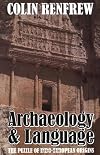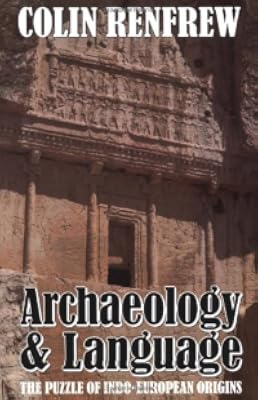
Archaeology and Language: The Puzzle of Indo-European Origins
by Colin Renfrew
On This Page
Description
In this book Colin Renfrew directs remarkable new light on the links between archaeology and language, looking specifically at the puzzling similarities that are apparent across the Indo-European family of ancient languages, from Anatolia and Ancient Persia, across Europe and the Indian subcontinent, to regions as remote as Sinkiang in China. Professor Renfrew initiates an original synthesis between modern historical linguistics and the new archaeology of cultural process, boldly proclaiming show more that it is time to reconsider questions of language origins and what they imply about ethnic affiliation--issues seriously discredited by the racial theorists of the 1920s and 1930s and, as a result, largely neglected since. Challenging many familiar beliefs, he comes to a new and persuasive conclusion: that primitive forms of the Indo-European language were spoken across Europe some thousands of years earlier than has previously been assumed. show lessTags
Recommendations









Member Recommendations
Member Reviews
This book represents an archaeologist's attempt to take a fresh look at the archaeology and linguistics of the language we tend to call "proto-Indo-European," and try on that basis to relocate the origin of the language. Author Colin Renfrew cautiously attempts to relocate the origin, and also to date it much earlier than most recent studies.
I incline to think that his attempt at relocation has held up better than his attempt to re-date. This book is almost forty years old now, and neither archaeology nor linguistics have stood still. I don't think anyone today would accept Renfrew's date of 8000+ years ago for the origin of PIE, although the location is still a matter of some debate.
There are a lot of criticisms which can be leveled at show more the work, most of which are better left to experts than to someone like me, but there is one important note that is a real drawback to Renfrew's logic, and it needs to be drawn out. Renfrew criticizes the whole notion of a "family tree" of Indo-European, and therefore restricts its use. His argument is, basically, that no family tree has been constructed that can explain all the linguistic phenomena we observe. That is, if you take all the differences we observe in Indo-European languages, and treat them as "splits" in the history, there is no tree of languages which makes every split correspond to a proper split in the genealogy.
This is true, but it's also not relevant. A genealogy of languages is not a genealogy of people (although, even in people, cousins can marry, causing traits that originated in one part of a genealogy to show up in people in another part). A genealogy of languages is, so to speak, an averaging-out of all the genealogies of individual language features.
I'll give an analogy from the human genome. All humans are, of course, more related to each other than they are to any chimpanzee. That's their overall relatedness. But take blood types. Type A and type B blood are caused by different genes -- and both chimpanzees and humans have the same blood types: The split into types A/B/O blood precedes the split between humans and chimps (indeed, it appears to precede the split from gorillas). So a person with type A blood, as far as blood goes, is more closely related to a type-A-blood chimpanzee than to a type-B-blood human. Other than that, and a few other traits, the human is more related to the human. But individual features do not follow the same genealogy as a whole creature, whether in genealogy, DNA, or linguistics. Failing to appreciate that puts a big part of Renfrew's argument on very shaky ground.
To top it all off, the whole book rests on a whole lot of very detailed argument based on things few people will understand very well. And the writing is not good enough to explain it all, or make it pleasant to learn.
I bought this book because I want to know more about PIE, and frankly it was cheap. Sadly, I don't think it justified the effort. If you're a true expert in the field, it's probably still worth reading, just to see what arguments Renfrew used. But if you just want to learn about PIE, there are much better (if more expensive) books. show less
I incline to think that his attempt at relocation has held up better than his attempt to re-date. This book is almost forty years old now, and neither archaeology nor linguistics have stood still. I don't think anyone today would accept Renfrew's date of 8000+ years ago for the origin of PIE, although the location is still a matter of some debate.
There are a lot of criticisms which can be leveled at show more the work, most of which are better left to experts than to someone like me, but there is one important note that is a real drawback to Renfrew's logic, and it needs to be drawn out. Renfrew criticizes the whole notion of a "family tree" of Indo-European, and therefore restricts its use. His argument is, basically, that no family tree has been constructed that can explain all the linguistic phenomena we observe. That is, if you take all the differences we observe in Indo-European languages, and treat them as "splits" in the history, there is no tree of languages which makes every split correspond to a proper split in the genealogy.
This is true, but it's also not relevant. A genealogy of languages is not a genealogy of people (although, even in people, cousins can marry, causing traits that originated in one part of a genealogy to show up in people in another part). A genealogy of languages is, so to speak, an averaging-out of all the genealogies of individual language features.
I'll give an analogy from the human genome. All humans are, of course, more related to each other than they are to any chimpanzee. That's their overall relatedness. But take blood types. Type A and type B blood are caused by different genes -- and both chimpanzees and humans have the same blood types: The split into types A/B/O blood precedes the split between humans and chimps (indeed, it appears to precede the split from gorillas). So a person with type A blood, as far as blood goes, is more closely related to a type-A-blood chimpanzee than to a type-B-blood human. Other than that, and a few other traits, the human is more related to the human. But individual features do not follow the same genealogy as a whole creature, whether in genealogy, DNA, or linguistics. Failing to appreciate that puts a big part of Renfrew's argument on very shaky ground.
To top it all off, the whole book rests on a whole lot of very detailed argument based on things few people will understand very well. And the writing is not good enough to explain it all, or make it pleasant to learn.
I bought this book because I want to know more about PIE, and frankly it was cheap. Sadly, I don't think it justified the effort. If you're a true expert in the field, it's probably still worth reading, just to see what arguments Renfrew used. But if you just want to learn about PIE, there are much better (if more expensive) books. show less
A controversial new theory on the spread of Indo-European languages. Suggests our language evolved among the first settled farmers of Anatolia around 7000 BC and spread gradually and peacefully from there through agriculture. (Not the traditional theories of mass migrations, conquests on a huge scale.) Interesting arguments.
Renfrew believes that the Indo-European languages spread from Anatolia into Europe (into Greece and beyond). He says it spread with the expansion of farming. Interesting.
Leí este libro atraído por el tema y el prestigio de su autor. El título es algo equívoco y sólo el subtítulo aclara su contenido: una sugestiva y controvertida hipótesis sobre la indoeuropización del viejo continente a través de oleadas de agricultores procedentes de Asia Menor. Anatolia sería el hogar ancestral de los indoeuropeos y no las estepas de Asia central o cualquier otro paraje.
Años antes había leído ' Los indoeuropeos y los orígenes de Europa' de Francisco Villar (Gredos, Madrid 1996), un magnífico libro sobre la cuestión que, entre otras, valoraba la hipótesis de Renfrew:
"Refrew invierte toda esta visión. El hogar de los indoeuropeos sería la cuna misma de la agricultura: Asia Menor (...) Serían los show more indoeuropeos los inventores mismos de la agricultura y el proceso de indoeuropeización de Europa sería simplemente sinónimo de su neolitización. Los indoeuropeos serían, pues, también los responsables de los ritos, costumbres y celebraciones típicamente agrarias, que antes designábamos con el nombre opaco de “mediterráneas”. Y como consecuencia de ello, nada sabemos de los habitantes preindoeuropeos de Europa.
Propiamente hablando nada habría que saber en realidad de ellos. Europa, antes de la neotilización, cuando sus poblaciones paleolíticas tenían que vivir sólo de la caza, estaría muy débilmente poblada. Y esos elementos preneolíticos-preindoeuropeos, relegados a áreas marginales no apetecidas por las pujantes colonias agrícolas, sin capacidad expansiva de su población por escasez alimentaria, habrían terminado por extinguirse sin dejar ninguna huella (...) Como consecuencia, los escasos elementos no indoeuropeos de Europa (los iberos de la antigüedad, los vascos) no serían preindoeuropeos, sino inmigrantes establecidos en Europa con posterioridad a su indoeuropeización". show less
Años antes había leído ' Los indoeuropeos y los orígenes de Europa' de Francisco Villar (Gredos, Madrid 1996), un magnífico libro sobre la cuestión que, entre otras, valoraba la hipótesis de Renfrew:
"Refrew invierte toda esta visión. El hogar de los indoeuropeos sería la cuna misma de la agricultura: Asia Menor (...) Serían los show more indoeuropeos los inventores mismos de la agricultura y el proceso de indoeuropeización de Europa sería simplemente sinónimo de su neolitización. Los indoeuropeos serían, pues, también los responsables de los ritos, costumbres y celebraciones típicamente agrarias, que antes designábamos con el nombre opaco de “mediterráneas”. Y como consecuencia de ello, nada sabemos de los habitantes preindoeuropeos de Europa.
Propiamente hablando nada habría que saber en realidad de ellos. Europa, antes de la neotilización, cuando sus poblaciones paleolíticas tenían que vivir sólo de la caza, estaría muy débilmente poblada. Y esos elementos preneolíticos-preindoeuropeos, relegados a áreas marginales no apetecidas por las pujantes colonias agrícolas, sin capacidad expansiva de su población por escasez alimentaria, habrían terminado por extinguirse sin dejar ninguna huella (...) Como consecuencia, los escasos elementos no indoeuropeos de Europa (los iberos de la antigüedad, los vascos) no serían preindoeuropeos, sino inmigrantes establecidos en Europa con posterioridad a su indoeuropeización". show less
Jun 29, 2010 (Edited)Spanish
N° 303
Jun 4, 2026French
Ratings
Members
- Recently Added By
Lists

Indo-European Studies
55 works; 5 members

Books in the Bibliography of The Dawn of Everything by Graeber & Wengrow
478 works; 2 members
Author Information

73+ Works 2,780 Members
Colin Renfrew is Disney Professor of Archaeology and Director of the McDonald Institute for Archaeological Research at the University of Cambridge.
Some Editions
Common Knowledge
- Canonical title
- Archaeology and Language: The Puzzle of Indo-European Origins
- Original publication date
- 1987
- People/Characters
- V. Gordon Childe; Marija Gimbutas
- Important places
- Persia; Anatolia
- Important events
- Mycenaen Age
- Dedication
- To the memory of my father
ARCHIBALD RENFREW - First words
- Preface: What Song the Sirens Sang
Language is the most remarkable and most characteristic of all human creations.
Classifications
Statistics
- Members
- 475
- Popularity
- 64,168
- Reviews
- 5
- Rating
- (3.68)
- Languages
- 9 — English, French, German, Greek, Italian, Norwegian (Bokmål), Polish, Spanish, Swedish
- Media
- Paper
- ISBNs
- 15