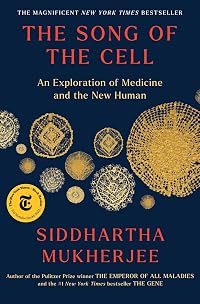
The Song of the Cell: An Exploration of Medicine and the New Human
by Siddhartha Mukherjee
On This Page
Description
The discovery of cells--and the reframing of the human body as a cellular ecosystem--announced the birth of a new kind of medicine based on the therapeutic manipulations of cells. A hip fracture, a cardiac arrest, Alzheimer's, dementia, AIDS, pneumonia, lung cancer, kidney failure, arthritis, COVID--all could be viewed as the results of cells, or systems of cells, functioning abnormally. And all could be perceived as loci of cellular therapies. In The Song of the Cell, Mukherjee tells the show more story of how scientists discovered cells, began to understand them, and are now using that knowledge to create new treatments and new human show lessTags
Recommendations













Member Reviews
Summary: A history of the advances of cell biology including the cutting-edge innovations that allow for the modification or implantation of cells, creating in essence, a new human.
There was a time when those who studied organic life did not understand that a fundamental component of all living things was the cell. And then Hooke in England and van Leeuwenhoek in Amsterdam used their primitive microscopes to look at water droplets and tissue and saw–cells. Not only that, these early cell biologists realized all living organisms were constituted of one or more cells that are the basic structure on which all of life is organized.
Siddhartha Mukherjee, a cancer researcher, takes his readers on a step by step narrative unpacking the basics show more of cell biology (and pathology) for a lay audience. He takes us through the different structures within the cell and the incredible phenomenon of cell division. He traces how cells develop into living organisms from a tiny clump to a blastocyst to a living human being or other creature.
Perhaps the most fascinating section of the book is that on the nature of blood. He describes the different components of blood–red cells, how blood clots, and the intricacies of the immune cell and how self recognizes non-self, and what happens when self fails to recognize non-self and when self thinks self is non-self. Later, we learn that all the different components of our blood arise from a single type of stem cell.
Amid the story (and the writing) came the pandemic. Mukherjee remarks that it came at a time when cell biologists were celebrating breakthroughs in understanding immunology. And COVID-19 unraveled so much of what we thought we knew, once again showing us how much we’ve yet to learn. Here as in the rest of the story, Mukherjee intermixes personal narratives, sometimes tragic, with the science.
He takes up how cells work together. There are the “citizen cells” of the heart muscle, pulsating in rhythm for decades. There are the “contemplating cells,” the neurons, and the fascinating role of microglia in pruning away unused connections, creating the particular ways we are “wired.” Then there are cells within key organs that maintain homeostasis, those in our pancreas our metabolism, in our kidneys, our salt levels, and our liver, metabolizing harmful chemicals like alcohol.
An underlying theme that Mukherjee draws to a focus at the end are the ways we intervene to modify cells. It may be the interventions to halt and destroy cancer cells, runaway cells that cannot turn off their multiplication and trick the body to not recognize the foreign, yet non-foreign, invader destroying it. We’ve pioneered IVF techniques and, in the case of one researcher at least, genetically edited and embryo (and went to prison for it), resulting in the first gene-edited baby. The use of edited stem cells to reverse sickle cell anemia, to reverse osteoarthritis and a host of other therapies suggest the possibility of “new humans,” or at least renewed ones.
There are always the questions of how far to go with such things, questions that often arise only after we realize something is possible. Mukherjee explores the boundaries between maintaining and restoring health and the enhancements that somehow change who we are. What is most troubling about the latter augmentations is that they reflect a certain privilege not open to all, creating the potential for two races, those of super-humans and then ordinary humans. How long will it be before they are viewed as sub-human?
Aside from these sometimes fascinating and sometimes vexing questions is the sheer wonder Mukherjee describes, aptly called the “song” of the cell. Often, his writing sings and soars, and one finds oneself saying, “how wondrous.” Sometimes the song descends as well, as we learn of the microbes that invade us or the cancer that consumes and wastes us. Sometimes the song is beautifully complex, like a baroque fugue, and other times chaotic, difficult to make sense of, as are many of the intricacies of various cancers. This was a stunning work, leaving me in a state of wonder, even with all the mysteries of the cell yet to be unraveled. show less
There was a time when those who studied organic life did not understand that a fundamental component of all living things was the cell. And then Hooke in England and van Leeuwenhoek in Amsterdam used their primitive microscopes to look at water droplets and tissue and saw–cells. Not only that, these early cell biologists realized all living organisms were constituted of one or more cells that are the basic structure on which all of life is organized.
Siddhartha Mukherjee, a cancer researcher, takes his readers on a step by step narrative unpacking the basics show more of cell biology (and pathology) for a lay audience. He takes us through the different structures within the cell and the incredible phenomenon of cell division. He traces how cells develop into living organisms from a tiny clump to a blastocyst to a living human being or other creature.
Perhaps the most fascinating section of the book is that on the nature of blood. He describes the different components of blood–red cells, how blood clots, and the intricacies of the immune cell and how self recognizes non-self, and what happens when self fails to recognize non-self and when self thinks self is non-self. Later, we learn that all the different components of our blood arise from a single type of stem cell.
Amid the story (and the writing) came the pandemic. Mukherjee remarks that it came at a time when cell biologists were celebrating breakthroughs in understanding immunology. And COVID-19 unraveled so much of what we thought we knew, once again showing us how much we’ve yet to learn. Here as in the rest of the story, Mukherjee intermixes personal narratives, sometimes tragic, with the science.
He takes up how cells work together. There are the “citizen cells” of the heart muscle, pulsating in rhythm for decades. There are the “contemplating cells,” the neurons, and the fascinating role of microglia in pruning away unused connections, creating the particular ways we are “wired.” Then there are cells within key organs that maintain homeostasis, those in our pancreas our metabolism, in our kidneys, our salt levels, and our liver, metabolizing harmful chemicals like alcohol.
An underlying theme that Mukherjee draws to a focus at the end are the ways we intervene to modify cells. It may be the interventions to halt and destroy cancer cells, runaway cells that cannot turn off their multiplication and trick the body to not recognize the foreign, yet non-foreign, invader destroying it. We’ve pioneered IVF techniques and, in the case of one researcher at least, genetically edited and embryo (and went to prison for it), resulting in the first gene-edited baby. The use of edited stem cells to reverse sickle cell anemia, to reverse osteoarthritis and a host of other therapies suggest the possibility of “new humans,” or at least renewed ones.
There are always the questions of how far to go with such things, questions that often arise only after we realize something is possible. Mukherjee explores the boundaries between maintaining and restoring health and the enhancements that somehow change who we are. What is most troubling about the latter augmentations is that they reflect a certain privilege not open to all, creating the potential for two races, those of super-humans and then ordinary humans. How long will it be before they are viewed as sub-human?
Aside from these sometimes fascinating and sometimes vexing questions is the sheer wonder Mukherjee describes, aptly called the “song” of the cell. Often, his writing sings and soars, and one finds oneself saying, “how wondrous.” Sometimes the song descends as well, as we learn of the microbes that invade us or the cancer that consumes and wastes us. Sometimes the song is beautifully complex, like a baroque fugue, and other times chaotic, difficult to make sense of, as are many of the intricacies of various cancers. This was a stunning work, leaving me in a state of wonder, even with all the mysteries of the cell yet to be unraveled. show less
Dudes. Have you ever thought about the fact that you are made entirely of cells? And somehow they coordinate their individual activities so you can grow, heal, think, live, and die? Holy shit! In this very readable and fascinating book, Mukherjee weaves together basic cell biology, the history of how we learned what we know so far about cells, his own experience as an oncologist and researcher, and his own personal life experiences. Somehow he keeps all the threads in order and after finishing this book, the reader has a pretty well-rounded understanding of what is going on with our crazy cells, what we still don't understand, and the many people who got us to this point. As a cancer person, this really helped me understand my own show more treatment (I finally get exactly what it is that neutrophils do and how the CDK4/6 inhibitors I took in my first and second lines of treatment really work!). Even non-cancer people can prepare to have their minds blown. Do you understand diabetes? The immune system? How a sperm and egg turn into a person? Maybe you think you do, but I bet you will learn a few things if you dig into this book. I read Mukherjee's Pulitzer-prize winning history of cancer, The Emperor of All Maladies, and really liked it but found his prose sometimes a bit too flowery for my taste. In The Song of the Cell, he keeps the same novelistic writing style, but (for the most part) reins in the overly florid metaphors. This book was just great. Highly recommended. show less
Siddhartha Mukherjee, one of our age’s most brilliant medical writers, is a cancer doctor with research interests in the basic sciences of cell biology and genetics. He is also an engaging writer with a deep knowledge of the history of science. His books, one of which has won a Pulitzer Prize, combine all these crosscurrents to convey a compelling narrative. He’s done it for both genetics and cancer, and here, he hits another home run writing about cell biology.
In this book, he describes the long history of this field and how it has given us more understanding about our bodies’ various facets. He describes how cell biology has impacted various organ systems and translates knowledge of basic science to clinical effects. He also show more describes patient stories of contemporary impacts of research and cutting-edge research trials that hope to impart new wisdom to the medical establishment.
In this and other works, I’ve read few other authors who can make the history of medicine come alive to the same degree as Mukherjee. His passion for the subject combines many aspects, including stories about scientists’ personal lives, scientific details that have huge impacts on patients (i.e., all of us), and ethical challenges of managing biological innovations.
This book contains a lot of biological knowledge and healthcare experience. Reading about biology is not for the feint of heart. But his prose makes the process enjoyable. Aspiring healthcare workers and biological researchers will benefit from perusing its pages. It can teach a bunch about cell biology while keeping the reader mentally and spiritually engaged. This book provides us with a fun way to learn more about our bodies so that we don’t fall asleep in the process. show less
In this book, he describes the long history of this field and how it has given us more understanding about our bodies’ various facets. He describes how cell biology has impacted various organ systems and translates knowledge of basic science to clinical effects. He also show more describes patient stories of contemporary impacts of research and cutting-edge research trials that hope to impart new wisdom to the medical establishment.
In this and other works, I’ve read few other authors who can make the history of medicine come alive to the same degree as Mukherjee. His passion for the subject combines many aspects, including stories about scientists’ personal lives, scientific details that have huge impacts on patients (i.e., all of us), and ethical challenges of managing biological innovations.
This book contains a lot of biological knowledge and healthcare experience. Reading about biology is not for the feint of heart. But his prose makes the process enjoyable. Aspiring healthcare workers and biological researchers will benefit from perusing its pages. It can teach a bunch about cell biology while keeping the reader mentally and spiritually engaged. This book provides us with a fun way to learn more about our bodies so that we don’t fall asleep in the process. show less
This is my third Mukherjee book. I’m a glutton for punishment! Being undeniably a non-scientist, I still find his books accessible and worth the struggle. He is a clever educator who piles on science history and supplements it with plot grabbing anecdotes. The stories mean little though without the science history. I particularly enjoy the analogies he finds to make his content more understandable to the lay person.
I also appreciate that he summarizes at regular intervals to remind the novice reader what we've learned and where we are going next. I am glad I read it and would recommend it to curious readers and to those for whom medical science is their interest or vocation. show less
The CD4-positive T cell sits at the crossroads of cellular immunity. To call it a “helper” cell is to call Thomas Cromwell a mid-level bureaucrat; the CD4 cell is not so much a helper as it is the master machinator of the entire immune system, the coordinator, the central nexus through which virtually all immuneshow more
information flows.Loc 3800
I also appreciate that he summarizes at regular intervals to remind the novice reader what we've learned and where we are going next. I am glad I read it and would recommend it to curious readers and to those for whom medical science is their interest or vocation. show less
Once again the author brings complex concepts of biology and medicine to the lay public in this homage to the living cell. The first part of the book is devoted to the origins of cell biology through the use of primitive microscopes, observational techniques, and primitive experimentation. This is a bit slow going.
The story picks up as the narrative enters modern times and we are introduced to Nobel Prize winners who advance the understanding of cellular anatomy and physiology are applied to the practice of medicine. Examples of patients who are treated by techniques developed as a result of these advances are included.
The author is well read and uses literature and metaphor to illustrate and sometimes embellish scientific ideas and show more concepts. As a hematologist and oncologist, his thinking reflects a deep respect for both the art and science of the practice of medicine.
As this long treatise on the various aspects of the cell comes to a close, the author reflects that much of the past century's research has been based on atomism, attempting to advance scientific understanding by breaking things down to their component parts. He reflects that what we don't understand is how these units relate to one another in a more holistic way and future advances may rely on developing this sort of understanding. Hence the title The Song of the Cell.....using the metaphor of music to encourage the understanding of how cells interact (sing) together for the outcomes we observe.
A favorite quote:
p. 274 "To see his drawings of neurons is to realize how much can be learned by just seeing. It is to return to characters such as Da Vinci or Vesalius who imagined drawing as thinking: an astute observer and draftsman could generate a scientific theory as much as an experimental interventionist. Cajal sketched what he saw and his understanding of how the nervous system "worked" emanated entirely from drawing cells and drawing conclusions." show less
The story picks up as the narrative enters modern times and we are introduced to Nobel Prize winners who advance the understanding of cellular anatomy and physiology are applied to the practice of medicine. Examples of patients who are treated by techniques developed as a result of these advances are included.
The author is well read and uses literature and metaphor to illustrate and sometimes embellish scientific ideas and show more concepts. As a hematologist and oncologist, his thinking reflects a deep respect for both the art and science of the practice of medicine.
As this long treatise on the various aspects of the cell comes to a close, the author reflects that much of the past century's research has been based on atomism, attempting to advance scientific understanding by breaking things down to their component parts. He reflects that what we don't understand is how these units relate to one another in a more holistic way and future advances may rely on developing this sort of understanding. Hence the title The Song of the Cell.....using the metaphor of music to encourage the understanding of how cells interact (sing) together for the outcomes we observe.
A favorite quote:
p. 274 "To see his drawings of neurons is to realize how much can be learned by just seeing. It is to return to characters such as Da Vinci or Vesalius who imagined drawing as thinking: an astute observer and draftsman could generate a scientific theory as much as an experimental interventionist. Cajal sketched what he saw and his understanding of how the nervous system "worked" emanated entirely from drawing cells and drawing conclusions." show less
Mukherjee, Siddhartha. The Song of the Cell: An Exploration of Medicine and the New Human. Scribner, 2022.
If Siddhartha Mukherjee ever says he wants to look at a sample of your blood, you should probably let him, because he is an expert in cancers of the blood. He is also one of the best popular science writers since Isaac Asimov folded his tent. In The Song of the Cell, he combines a history of our knowledge about the anatomy and physiology of cells with some heart-wrenching stories from his medical practice. The new human he predicts in his subtitle is a product of cellular engineering and evolution, developments ranging from immunotherapies to rebuilt knees. He is optimistic about the future, but his chapter on COVID has a frequent show more refrain of “We don’t know.” 4 stars. show less
If Siddhartha Mukherjee ever says he wants to look at a sample of your blood, you should probably let him, because he is an expert in cancers of the blood. He is also one of the best popular science writers since Isaac Asimov folded his tent. In The Song of the Cell, he combines a history of our knowledge about the anatomy and physiology of cells with some heart-wrenching stories from his medical practice. The new human he predicts in his subtitle is a product of cellular engineering and evolution, developments ranging from immunotherapies to rebuilt knees. He is optimistic about the future, but his chapter on COVID has a frequent show more refrain of “We don’t know.” 4 stars. show less
Rather than focus on the topic, the author meanders all over the place. There are lengthy autobiographical sections, including whining about having to spend weekends at his gorgeous beach house to escape the Covid lockdown in NYC. He also spends an excessive amount of time describing the appearance of researchers and other inane anecdotes and historical tidbits, again at the expense of the subject matter. The result is a journalistic history of cell research, rather than a book that's actually about cells.
Members
- Recently Added By
Published Reviews
The rise of the ‘new human’ – how stem cells are revolutionising medicine.
Siddhartha Mukherjee's brilliant The Song of The Cell explains how these building blocks will upend our understanding of life itself.
very cell in your body, from toenail to brain, comes from a single original cell: the fertilized egg that was you at conception. So every different organ and tissue in the human body show more can in principle be produced by an embryonic cell, or stem cell. That being the case, why don’t we grow new limbs after injury, like salamanders and starfish do? Alas, our cells don’t always do what we’d wish. At least, not yet.
The prospect of the kind of “cellular engineering” that might make such therapies possible is one among many themes of The Song of The Cell, whose author, the oncologist Siddhartha Mukherjee, previously wrote the bestselling The Emperor of All Maladies: A Biography of Cancer (2010). Cancer itself is a recurring thread here too, being another way in which our cells can rebel against our hopes and desires. (There are some particularly moving scenes at the bedside of a friend and patient of the author’s.) What can make the disease so intractable, he explains, is that a single tumour can contain cells that have mutated in different ways, so that it is “an assemblage of nonidentical diseases”. So even novel therapies that sequence a tumour’s genome are not guaranteed to succeed.
No one knows how the planet’s first biological cell – the shared ancestor of all living things, from magic mushrooms to Liz Truss – constructed itself, billions of years ago. But somehow a bunch of proto-genetic material surrounded itself with a protective bubble and life got going. Later, single cells decided it might be worth getting together – perhaps huddling for defence, though again no one really knows – and so multicellular organisms such as shrubs and lizards were eventually made possible. As Mukherjee explains, cells have evolved into exquisite nanobots, packed with all sorts of machinery for energy production, replication, and – in the case of immune cells – hunting and killing.
Immunotherapy – the re-education of a patient’s own immune cells, the better to target cancer or other disease – is one of the cutting-edge medical interventions that really interest Mukherjee, and he relates some fascinating case studies of how it can work or fail. The problem is often that the supercharged immune cells go after other innocent organs (say, the liver) as well as the enemy. In a short but excellent chapter on the covid-19 pandemic, meanwhile, Mukherjee explains the especially vicious cellular effects of the Sars-Cov-2 virus’s hijacking and subverting of the immune system itself. Still it isn’t known how exactly this is done. “The monotony of answers is humbling, maddening,” the author writes. “We don’t know. We don’t know. We don’t know.”
What we do know, however, is already impressive. The fact that living tissues are made from cells was first discovered only in the late 17th century, by microscope-building investigators such as Robert Hooke and the Dutch cloth merchant Antonie Van Leeuwenhoek. (Hooke called them “cells” because their structure reminded him of monks’ rooms.) Two hundred years later, it was still common for surgeons who dropped a scalpel on a blood-and-pus-soaked floor simply to wipe it off on their gowns for reuse. (Pus was thought to have splendid healing powers.) And now, a mere 150 years later, we can rewrite the DNA inside cells to cure some kinds of vision or hearing loss.
By engaging in such medical magic, Mukherjee argues that we are in a sense creating “new humans”, which might be thought a slight overstatement, but one cannot begrudge him his delight in his chosen science. Indeed, the subject of the cell is so vast in his hands – covering not only the anatomy of single cells, but also everything from IVF and heart attacks to battlefield medicine, deep-brain stimulation for depression, the Thalidomide disaster, the discovery of insulin, and gene-edited babies – that he has effectively attempted to write a book about the entirety of human biology and modern medicine. The guiding metaphor of “new humans”, as we allegedly shall be once immunological and genetic engineering becomes routine, is therefore structurally useful if not altogether convincing.
It is fortunate, then, that Mukherjee he is such an engaging writer, alert to both nanoscopic beauty and the potential deceptions of metaphor. After a particularly gruelling hospital episode, he comments: “Ever since that evening, I never use the word ‘bloodbath’ casually.” The most immediate parts of the book, indeed, are the periodic case studies from the author’s clinical practice, written with compassionate warmth and humour, and the personal glimpses into an ordinary scientific life and the dedication that goes with it. At one lovely point, he relates how he spends Monday mornings alone in a darkened room at his hospital, looking at blood samples under a microscope. It’s his favourite time of day. “I love looking at cells, in the way a gardener loves looking at plants.”
He also has an amusing habit of describing British places (Oxford, Oldham) as interminably rainy or foggy purgatories in which scientists must nonetheless doggedly pursue the truth, with wry asides at “the English habit of deadly euphemism” he encountered as a student. One scientific mentor, he relates, had a habit of reacting to an idea he thought ludicrous by calling it “subtle”. Mukherjee remembers: “At lab meetings, I must confess, I was often rather subtle.” In a more flattering sense of that term, he still is. show less
Siddhartha Mukherjee's brilliant The Song of The Cell explains how these building blocks will upend our understanding of life itself.
very cell in your body, from toenail to brain, comes from a single original cell: the fertilized egg that was you at conception. So every different organ and tissue in the human body show more can in principle be produced by an embryonic cell, or stem cell. That being the case, why don’t we grow new limbs after injury, like salamanders and starfish do? Alas, our cells don’t always do what we’d wish. At least, not yet.
The prospect of the kind of “cellular engineering” that might make such therapies possible is one among many themes of The Song of The Cell, whose author, the oncologist Siddhartha Mukherjee, previously wrote the bestselling The Emperor of All Maladies: A Biography of Cancer (2010). Cancer itself is a recurring thread here too, being another way in which our cells can rebel against our hopes and desires. (There are some particularly moving scenes at the bedside of a friend and patient of the author’s.) What can make the disease so intractable, he explains, is that a single tumour can contain cells that have mutated in different ways, so that it is “an assemblage of nonidentical diseases”. So even novel therapies that sequence a tumour’s genome are not guaranteed to succeed.
No one knows how the planet’s first biological cell – the shared ancestor of all living things, from magic mushrooms to Liz Truss – constructed itself, billions of years ago. But somehow a bunch of proto-genetic material surrounded itself with a protective bubble and life got going. Later, single cells decided it might be worth getting together – perhaps huddling for defence, though again no one really knows – and so multicellular organisms such as shrubs and lizards were eventually made possible. As Mukherjee explains, cells have evolved into exquisite nanobots, packed with all sorts of machinery for energy production, replication, and – in the case of immune cells – hunting and killing.
Immunotherapy – the re-education of a patient’s own immune cells, the better to target cancer or other disease – is one of the cutting-edge medical interventions that really interest Mukherjee, and he relates some fascinating case studies of how it can work or fail. The problem is often that the supercharged immune cells go after other innocent organs (say, the liver) as well as the enemy. In a short but excellent chapter on the covid-19 pandemic, meanwhile, Mukherjee explains the especially vicious cellular effects of the Sars-Cov-2 virus’s hijacking and subverting of the immune system itself. Still it isn’t known how exactly this is done. “The monotony of answers is humbling, maddening,” the author writes. “We don’t know. We don’t know. We don’t know.”
What we do know, however, is already impressive. The fact that living tissues are made from cells was first discovered only in the late 17th century, by microscope-building investigators such as Robert Hooke and the Dutch cloth merchant Antonie Van Leeuwenhoek. (Hooke called them “cells” because their structure reminded him of monks’ rooms.) Two hundred years later, it was still common for surgeons who dropped a scalpel on a blood-and-pus-soaked floor simply to wipe it off on their gowns for reuse. (Pus was thought to have splendid healing powers.) And now, a mere 150 years later, we can rewrite the DNA inside cells to cure some kinds of vision or hearing loss.
By engaging in such medical magic, Mukherjee argues that we are in a sense creating “new humans”, which might be thought a slight overstatement, but one cannot begrudge him his delight in his chosen science. Indeed, the subject of the cell is so vast in his hands – covering not only the anatomy of single cells, but also everything from IVF and heart attacks to battlefield medicine, deep-brain stimulation for depression, the Thalidomide disaster, the discovery of insulin, and gene-edited babies – that he has effectively attempted to write a book about the entirety of human biology and modern medicine. The guiding metaphor of “new humans”, as we allegedly shall be once immunological and genetic engineering becomes routine, is therefore structurally useful if not altogether convincing.
It is fortunate, then, that Mukherjee he is such an engaging writer, alert to both nanoscopic beauty and the potential deceptions of metaphor. After a particularly gruelling hospital episode, he comments: “Ever since that evening, I never use the word ‘bloodbath’ casually.” The most immediate parts of the book, indeed, are the periodic case studies from the author’s clinical practice, written with compassionate warmth and humour, and the personal glimpses into an ordinary scientific life and the dedication that goes with it. At one lovely point, he relates how he spends Monday mornings alone in a darkened room at his hospital, looking at blood samples under a microscope. It’s his favourite time of day. “I love looking at cells, in the way a gardener loves looking at plants.”
He also has an amusing habit of describing British places (Oxford, Oldham) as interminably rainy or foggy purgatories in which scientists must nonetheless doggedly pursue the truth, with wry asides at “the English habit of deadly euphemism” he encountered as a student. One scientific mentor, he relates, had a habit of reacting to an idea he thought ludicrous by calling it “subtle”. Mukherjee remembers: “At lab meetings, I must confess, I was often rather subtle.” In a more flattering sense of that term, he still is. show less
added by AntonioGallo
Lists

Top Five Books of 2022
736 works; 272 members

2023 Notable Books for Adults
26 works; 2 members

Simon & Schuster
136 works; 4 members

Vlogbrothers Book Recommendations
307 works; 4 members

Books Read in 2025
4,091 works; 97 members

In Our Time books
4,934 works; 2 members
Author Information

9+ Works 11,131 Members
Siddhartha Mukherjee was born in 1970 in New Delhi, India. He received an undergraduate degree in biology from Stanford University, a DPhil in immunology from Magdalen College, Oxford University, and a M.D. from Harvard Medical School. He is known for his work on the formation of blood, and the interactions between the micro-environment and cancer show more cells. His book, The Emperor of All Maladies: A Biography of Cancer, won the 2011 Pulitzer Prize in general non-fiction. He is an assistant professor of medicine at Columbia University and a staff physician at Columbia University Medical Center. His articles have appeared in Nature, The New England Journal of Medicine, The New York Times, and The New Republic. (Bowker Author Biography) show less
Awards and Honors
Awards
Distinctions
Common Knowledge
- Original publication date
- 2022-10
- People/Characters
- Robert Hooke; Antonie van Leeuwenhoek; Rudolf Ludwig Carl Virchow
- Epigraph
- In the sum of the parts, there are only the parts. The world must be measured by eye. - Wallace Stevens
[Life] is a continuing rhythmic movement, of the pulse, of the gait, even of the cells. - Friedrich Nietzsche - Dedication
- To W.K. and E.W. - among the first to cross
- First words
- (Prelude) The conversation took place over dinner in October 1837.
Introduction) In November 2017, I watched my friend Sam P. die because his cells had rebelled against his body.
Both of us, you and I, began as single cells. - Quotations*
- "On August 6, 1945, at about eight fifteen in the morning, thirty-one thousand feet above the Japanese city of Hiroshima, an atomic bomb nicknamed Little Boy was dropped from an American military aircraft, a B-29 bomber n... (show all)icknamed the Enola Gay. The bomb took about forty-five seconds to descend, and then detonated in midair, nineteen hundred feet above the Shima Surgical Hospital, where nurses and doctors were at work, and patients still in their beds. It released about the energetic equivalent of fifteen kilotons of TNT -- about thirty-five thousand car bombs going off at once. A circle of fire, more than four miles in radius, spread out from the epicenter, destroying everything in its wake. The tar on the streets boiled. Glass flowed like liquid. Houses were flicked into oblivion, as if by a giant, incinerating hand. Outside the stone steps of Sumitomo bank, a man or woman who was vaporized instantly left a shadow of herself on the stone that had been blistered white by the conflagration.
"The waves of death that followed had three crests. About seventy thousand to eighty thousand people -- nearly 30 percent of the city's population -- were broiled to death almost instantly. 'I was trying to describe the mushroom [cloud], this turbulent mass,' one of the tail gunners of the aircraft wrote: 'I saw fires springing up in different places, like flames shooting up on a bed of coals [ ... ] it looked like lava or molasses covering the whole city, and it seemed to flow outward into the foothills where the little valleys would come into the plain, with fires starting up all over.'
"Then came a second wave -- from radiation sickness (or 'atomic bomb sickness' as it was initially called). As the psychiatrist Robert Jay Lifton said, 'Survivors began to notice in themselves a strange form of illness. It consisted of nausea, vomiting, and loss of appetite; diarrhea with amounts of blood in the stools; fever and weakness; purple spots on various parts of body from bleeding into the skin ... inflammation and ulceration of the mouth, throat, and gums.'
"But there was yet a third wave of devastation to come. Survivors who received the lowest doses of radiation began to develop bone marrow failure, resulting in chronic anemias. Their white cell counts sputtered, then declined and collapsed over a few months. As the scientists Irving Weissman and Judith Shizuru put it, 'those who died from the lowest lethal dose irradiation almost certainly died of hematopoietic [blood production] failure.' It wasn't the acute death of blood cells that killed these survivors. It was the inability to sustain the constant replenishment of blood; a collapse homeostasis of blood. The balance between regeneration and death had tipped. To paraphrase Bob Dylan: the cells not busy being born were dying.
"Macabre as it was, the bombing of Hiroshima provided proof that the human body possesses cells that continuously generate blood, not just in the moment, but for prolonged periods of time, through adulthood. If these cells are killed -- as they were in Hiroshima -- the entire blood system would eventually falter, unable to balance the rate of natural decay with the rate of rejuvenation. In time, these cells, capable of rejuvenating blood, would be termed 'blood-forming' -- or 'hematopoietic' -- 'stem and progenitor cells.'
"Our understanding of stem cells was born of a paradox: an unfathomably violent attack in an attempt to restore peace at the end of an unfathomably violent war. But stem cells are themselves a biological paradox. Their two principal functions seem, at face value, to be precisely opposed to each other. On one hand, a stem cell must generate functional 'differentiated' cells; a blood stem cell, for instance, must divide to give rise to the cells that form the mature elements of blood-white cells, red cells, platelets. But on the other hand, it must also divide to replenish itself -- i.e., a stem cell. If a stem cell achieved only the former function -- differentiation into mature, functional cells-the reservoir of replenishment would eventually be exhausted. Over the course of adulthood, our blood counts would keep falling year after year, until there were none left. In contrast, if it only achieved its own replenishment -- a phenomenon termed 'self-renewal' -- there would be no production of blood.
"It is the acrobatic balance between self-preservation and selflessness -- self-renewal and differentiation -- that makes the stem cell indispensable for an organism, and thereby enables the homeostasis of tissues such as blood. Cynthia Ozick, the essayist, once wrote that the ancients believed that the moist track of slime left behind by a snail in its trail was part of the snail's self. Bit by bit, as the slime rubs off, the snail is depleted, until the organism disappears altogether. A stem cell (or in the snail's case, a slime-producing cell) is a mechanism to ensure that the moist track of slime -- i.e., new cells -- are generated constantly and that the snail does not rub itself into oblivion." - Last words
- (Click to show. Warning: May contain spoilers.)As humans entering a new realm of medicine, we will have to learn how to embrace them, challenge them, and incorporate them into our cultures, societies, and selves.
(Click to show. Warning: May contain spoilers.)(Epilogue) He will be a new sum of new parts. - Blurbers
- Egan, Jennifer; Nurse, Paul
- Original language
- English
*Some information comes from Common Knowledge in other languages. Click "Edit" for more information.
Classifications
Statistics
- Members
- 1,296
- Popularity
- 18,751
- Reviews
- 30
- Rating
- (3.95)
- Languages
- 7 — Dutch, English, German, Italian, Portuguese, Spanish, Turkish
- Media
- Paper, Audiobook, Ebook
- ISBNs
- 21
- ASINs
- 10