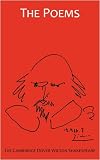
The Poems
by William Shakespeare
On This Page
Description
A collection of Shakespeare's Sonnets and A Lover's Complaint.Tags
Recommendations


















Member Reviews
I am an English major, but by no means a Shakespeare scholar, and I read these poems because it seemed disgraceful for an English major not to have read them. Literary peer pressure can be a very strong thing.
I read this collection slowly, one or two sonnets a night, and gave myself time to think about what I was reading. Of course it isn't all sonnets. This collection also includes the longer poems, "Venus and Adonis," "The Rape of Lucrece," "The Phoenix and Turtle," and "A Lover's Complaint." I'll take each one individually.
"Venus and Adonis" is the story of a goddess, Venus, who falls in love with a human youth, Adonis. Adonis is strangely unresponsive to her blandishments. The poem consists of her trying to convince him to return show more her advances, and his refusals. I'll say right now that certain parts really made me blush! Female desire is portrayed as a rapacious, unyielding force. In the end Adonis is killed in a boar hunt, and Venus says, "Had I been toothed like him [the boar], I must confess / With kissing him I should have killed him first." Yikes!
"The Rape of Lucrece" tells the story of a woman who is raped by a guest, Tarquinius, in her husband's house. Lucrece's husband Collatinus had boasted of her purity once, and when it was tested she was the only lady found faithful to her husband. It was then that Tarquinius saw her beauty and became inflamed with lust. This is, of course, highly artificial and stylized, and both Lucrece and Tarquinius give great speeches. What I found interesting was how Shakespeare was able to keep the suspense — would Tarquinius really do it? Despite all the high-flown language, I felt as if I were there in his head, weighing the risks against the desire. As the title reveals, he does go through with it, and Lucrece kills herself afterward. In this tale it's male lust that is the destructive force.
"The Phoenix and the Turtle" uses the idea of a phoenix and a turtledove that love one another so deeply that they become one in a metaphysical sense. The primary point seems to be that love can extend beyond the grave. David Bevington, who wrote the notes for this edition, says that the language is reminiscent of theological works discussing the oneness of the Holy Trinity. I think this is a good observation, and it enhances my enjoyment of this short poem.
"A Lover's Complaint" is rather lackluster; a young girl is bemoaning the unfaithfulness of her lover, and enumerating his many attractions. It is a universal theme, but I'll admit it was a bit of a chore to get through.
And the sonnets... the sonnets. Often Shakespeare's more moving sonnets are quoted, the ones that glorify the constancy of love, the virtues of the beloved, the faithfulness of the lover. But I was rather surprised to see how many sonnets seemed to be long, fawning compliments to Shakespeare's patron! Perhaps they are entirely sincere — how could I know? — but the praise is so lavish, it really seems over the top.
And yet I enjoyed many of the sonnets. Shakespeare's adroit turn of phrase is well-used here, and many of the poems mark a very vulnerable honesty on his part. Would that all of us could take the emotional events of our lives and turn them into timeless verse!
If you are interested in Shakespeare's poetry, I recommend you read it slowly over a period of days or weeks. I enjoyed reading a sonnet a night and then turning off my lamp with the ideas of the poem still drifting about in my head. The poems haven't changed my life, but I'm glad I read them. Recommended. show less
I read this collection slowly, one or two sonnets a night, and gave myself time to think about what I was reading. Of course it isn't all sonnets. This collection also includes the longer poems, "Venus and Adonis," "The Rape of Lucrece," "The Phoenix and Turtle," and "A Lover's Complaint." I'll take each one individually.
"Venus and Adonis" is the story of a goddess, Venus, who falls in love with a human youth, Adonis. Adonis is strangely unresponsive to her blandishments. The poem consists of her trying to convince him to return show more her advances, and his refusals. I'll say right now that certain parts really made me blush! Female desire is portrayed as a rapacious, unyielding force. In the end Adonis is killed in a boar hunt, and Venus says, "Had I been toothed like him [the boar], I must confess / With kissing him I should have killed him first." Yikes!
"The Rape of Lucrece" tells the story of a woman who is raped by a guest, Tarquinius, in her husband's house. Lucrece's husband Collatinus had boasted of her purity once, and when it was tested she was the only lady found faithful to her husband. It was then that Tarquinius saw her beauty and became inflamed with lust. This is, of course, highly artificial and stylized, and both Lucrece and Tarquinius give great speeches. What I found interesting was how Shakespeare was able to keep the suspense — would Tarquinius really do it? Despite all the high-flown language, I felt as if I were there in his head, weighing the risks against the desire. As the title reveals, he does go through with it, and Lucrece kills herself afterward. In this tale it's male lust that is the destructive force.
"The Phoenix and the Turtle" uses the idea of a phoenix and a turtledove that love one another so deeply that they become one in a metaphysical sense. The primary point seems to be that love can extend beyond the grave. David Bevington, who wrote the notes for this edition, says that the language is reminiscent of theological works discussing the oneness of the Holy Trinity. I think this is a good observation, and it enhances my enjoyment of this short poem.
"A Lover's Complaint" is rather lackluster; a young girl is bemoaning the unfaithfulness of her lover, and enumerating his many attractions. It is a universal theme, but I'll admit it was a bit of a chore to get through.
And the sonnets... the sonnets. Often Shakespeare's more moving sonnets are quoted, the ones that glorify the constancy of love, the virtues of the beloved, the faithfulness of the lover. But I was rather surprised to see how many sonnets seemed to be long, fawning compliments to Shakespeare's patron! Perhaps they are entirely sincere — how could I know? — but the praise is so lavish, it really seems over the top.
And yet I enjoyed many of the sonnets. Shakespeare's adroit turn of phrase is well-used here, and many of the poems mark a very vulnerable honesty on his part. Would that all of us could take the emotional events of our lives and turn them into timeless verse!
If you are interested in Shakespeare's poetry, I recommend you read it slowly over a period of days or weeks. I enjoyed reading a sonnet a night and then turning off my lamp with the ideas of the poem still drifting about in my head. The poems haven't changed my life, but I'm glad I read them. Recommended. show less
La poesía de William Shakespeare se encuentra principalmente en sus sonetos, una colección de 154 poemas que exploran temas como el amor, la mortalidad y el paso del tiempo. También escribió obras narrativas como Venus y Adonis y La violación de Lucrecia, que reflejan su maestría en el lenguaje poético.
I read a different collection that I couldn't find on Goodreads, this is to represent it. What I read was the complete poems. Literally everything Shakespeare wrote besides his plays and sonnets. I didn't really enjoy these, although Rape of Lucrece sounded like a promising story and perhaps would have made a good play.
from RAPE OF LUCRECE:
“So that in vent’ring ill we leave to be
The things we are, for that which we expect;
And this ambitious foul infirmity,
In having much, torments us with defect
Of that we have: so then we do neglect
The thing we have, and all for want of wit,
Make something nothing by augmenting it.”
“O comfort-killing Night, image of hell,
Dim register and notary of shame,
Black stage for tragedies and murders show more fell,
Vast sin-concealing chaos, nurse of blame!
Blind muffled bawd, dark harbor for defame,
Grim cave of death, whisp’ring conspirator
With close-tongu’d treason and the ravisher!”
“...But no perfection is so absolute,
That some impurity doth not pollute.”
from VENUS AND ADONIS:
“Foul cank’ring rust the hidden treasure frets,
But gold that’s put to use more gold begets” show less
from RAPE OF LUCRECE:
“So that in vent’ring ill we leave to be
The things we are, for that which we expect;
And this ambitious foul infirmity,
In having much, torments us with defect
Of that we have: so then we do neglect
The thing we have, and all for want of wit,
Make something nothing by augmenting it.”
“O comfort-killing Night, image of hell,
Dim register and notary of shame,
Black stage for tragedies and murders show more fell,
Vast sin-concealing chaos, nurse of blame!
Blind muffled bawd, dark harbor for defame,
Grim cave of death, whisp’ring conspirator
With close-tongu’d treason and the ravisher!”
“...But no perfection is so absolute,
That some impurity doth not pollute.”
from VENUS AND ADONIS:
“Foul cank’ring rust the hidden treasure frets,
But gold that’s put to use more gold begets” show less
Ratings
Members
- Recently Added By
Author Information

6,098+ Works 442,119 Members
William Shakespeare, 1564 - 1616 Although there are many myths and mysteries surrounding William Shakespeare, a great deal is actually known about his life. He was born in Stratford-Upon-Avon, son of John Shakespeare, a prosperous merchant and local politician and Mary Arden, who had the wealth to send their oldest son to Stratford Grammar School. show more At 18, Shakespeare married Anne Hathaway, the 27-year-old daughter of a local farmer, and they had their first daughter six months later. He probably developed an interest in theatre by watching plays performed by traveling players in Stratford while still in his youth. Some time before 1592, he left his family to take up residence in London, where he began acting and writing plays and poetry. By 1594 Shakespeare had become a member and part owner of an acting company called The Lord Chamberlain's Men, where he soon became the company's principal playwright. His plays enjoyed great popularity and high critical acclaim in the newly built Globe Theatre. It was through his popularity that the troupe gained the attention of the new king, James I, who appointed them the King's Players in 1603. Before retiring to Stratford in 1613, after the Globe burned down, he wrote more than three dozen plays (that we are sure of) and more than 150 sonnets. He was celebrated by Ben Jonson, one of the leading playwrights of the day, as a writer who would be "not for an age, but for all time," a prediction that has proved to be true. Today, Shakespeare towers over all other English writers and has few rivals in any language. His genius and creativity continue to astound scholars, and his plays continue to delight audiences. Many have served as the basis for operas, ballets, musical compositions, and films. While Jonson and other writers labored over their plays, Shakespeare seems to have had the ability to turn out work of exceptionally high caliber at an amazing speed. At the height of his career, he wrote an average of two plays a year as well as dozens of poems, songs, and possibly even verses for tombstones and heraldic shields, all while he continued to act in the plays performed by the Lord Chamberlain's Men. This staggering output is even more impressive when one considers its variety. Except for the English history plays, he never wrote the same kind of play twice. He seems to have had a good deal of fun in trying his hand at every kind of play. Shakespeare wrote 154 sonnets, all published on 1609, most of which were dedicated to his patron Henry Wriothsley, The Earl of Southhampton. He also wrote 13 comedies, 13 histories, 6 tragedies, and 4 tragecomedies. He died at Stratford-upon-Avon April 23, 1616, and was buried two days later on the grounds of Holy Trinity Church in Stratford. His cause of death was unknown, but it is surmised that he knew he was dying. (Bowker Author Biography) show less
Some Editions
Series
Belongs to Publisher Series
Work Relationships
Common Knowledge
- Canonical title
- The Poems
Classifications
Statistics
- Members
- 482
- Popularity
- 62,727
- Reviews
- 3
- Rating
- (4.14)
- Languages
- English, Hungarian, Italian, Spanish
- Media
- Paper, Ebook
- ISBNs
- 27
- ASINs
- 36