On This Page
Description
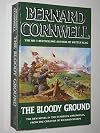
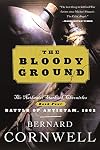
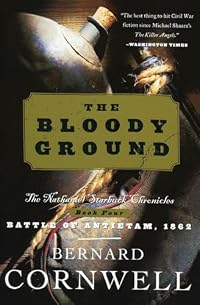
The fourth book in The Starbuck Chronicles, The Bloody Ground follows Boston-born Confederate officer Nathaniel Starbuck as the Confederate army under Robert E. Lee invades the North, culminating in the Battle of Antietam Creek.It is only weeks after the Second Manassas in September 1862, and Robert E. Lee takes the war north, where he will be met by "Little Mac," General George McClellan, whose northern army far outnumbers and outguns the invading Confederates. In Richmond, Virginia, show more Starbuck is given command of a punishment battalion, a motley collection of cowards, thieves, deserters, and murderers, officered by men who do not welcome Starbuck's arrival. Setting off to join Lee's army, Starbuck's men reach Harper's Ferry in time to take part in Stonewall Jackson's capture of the Union garrison. From there, it is on to the legendary horror of Sharpsburg beside the Antietam Creek, forever to be remembered as the bloodiest single day of the war. There, in the cornfield, Starbuck and his despised men will have their courage and commitment tested as never before.
. Historical Fiction. Fiction. show less
Tags
Recommendations






Member Reviews
Some thoughts on the series as a whole:
Starbuck's character development hits a wall somewhere in book 3. He's a preacher's son who fights against his country, curses, drinks, whores, and even murders. But it's just a downward trend and then a leveling-off. We really need a good conclusion to this series, but given that it's been 25 years since this book and Bernard Cornwell is pushing 80, I doubt we'll ever see it. A shame, a book describing what Starbuck does in, say, late June/early July of 1863 would be interesting.
Starbuck murders four people in three separate episodes during this series. The last two instances of murder actually made me laugh out loud, which is either a reflection on my own character or maybe a reflection on how show more strange these scenes were.
When Starbuck kills a Major in his Legion that refuses a direct order and then immediately follows up the cold blooded murder with the (real!) catchphrase of Stonewall Jackson's men in the summer of 1862: "Oh, My God, just lay me down."...That is hilarious. Then Starbuck uses a cannon(!) firing canister (like a giant shotgun) to kill two of his own men who had shot him in the mouth just a couple of minutes before. I mean...this is the Civil War equivalent of using a BFG to kill a single monster in DOOM. show less
Starbuck's character development hits a wall somewhere in book 3. He's a preacher's son who fights against his country, curses, drinks, whores, and even murders. But it's just a downward trend and then a leveling-off. We really need a good conclusion to this series, but given that it's been 25 years since this book and Bernard Cornwell is pushing 80, I doubt we'll ever see it. A shame, a book describing what Starbuck does in, say, late June/early July of 1863 would be interesting.
Starbuck murders four people in three separate episodes during this series. The last two instances of murder actually made me laugh out loud, which is either a reflection on my own character or maybe a reflection on how show more strange these scenes were.
When Starbuck kills a Major in his Legion that refuses a direct order and then immediately follows up the cold blooded murder with the (real!) catchphrase of Stonewall Jackson's men in the summer of 1862: "Oh, My God, just lay me down."...That is hilarious. Then Starbuck uses a cannon(!) firing canister (like a giant shotgun) to kill two of his own men who had shot him in the mouth just a couple of minutes before. I mean...this is the Civil War equivalent of using a BFG to kill a single monster in DOOM. show less
There are just so many good mysteries out there. The Starbuck books view the Civil War through the eyes of a transplanted New Englander fighting for the Confederacy. This is the 4th in the series. Not being a fan of the Southern point of view, I was reluctant to pick these up, but Cornwell tells such a good tale that they are very difficult to put down. Nothing deep here, just lots of fun. Starbuck in this one has been yanked from his company — he’s a major — and assigned to the Yellowlegs, a regiment so-named because they ran away from a fight. Starbuck, unhappy with the assignment, and also a transplanted northerner, arrives at camp only to be mistaken for a drunk Lieutenant Potter, who is late in arriving at his new assignment show more to the Yellowlegs also (interestingly, yellowlegs was an appellation given to U.S. cavalry troops). Masquerading as Potter, Starbuck soon discovers a pattern of corruption and with the help of his friend Delancey — who happens to be a Yankee spy unbeknownst to Starbuck — turns tables on the other officers in the company who had been tormenting him, believing Starbuck to be a lowly lieutenant. The events of the novel revolve around the Battle at Sharpsburg (known as Antietam in the North), the bloodiest battle in United States history, where more than 23,000 soldiers died. McClellan does not fare well, seen rightly so, as a vacillating, reluctant, overanxious general who placed too much reliance on his Pinkert[b:on intelligence|1185416|La Voie et sa vertu = Tao-tê-king (Points Sagesses ; 16 ISSN 0339-4239)|Laozi|http://photo.goodreads.com/books/1181735892s/1185416.jpg|100074]. Lee had invaded the North with far fewer troops than McClellan had at his disposal, but McClellan insisted he was outnumbered. Starbuck and his brigade are placed in the thick of the battle (most of the characters are completely fictional — and the famous copy of order 191 is delivered to McClellan by Delancey who appears to have no basis in fact).
An example of Cornwell’s fun: Starbuck is speaking with Potter: “You’ve still got the whiskey?” “Safe in its stone bottle, wrapped in two shirts, a piece of canvas, and an unbound copy of Macaulay’s Essays. It isn’t a complete volume. I found it dangling in a Harper’s Ferry privy and the first thirty pages had already been consumed for hygienic purposes.” “Wouldn’t you rather have found his poetry?” Starbuck asked. “In a privy? No, I think not. Besides, I already have swathes of Macauley in my head, or what remains of my head,” Potter said, touching the bloody bandage over his left ear. “ ‘To every man upon this earth Death cometh soon or late, And how can man die better Than facing fearful odds.’ ” Potter shook his head at the appropriateness of the words. “Too good for a privy, Starbuck. My father hung the works of Roman Catholic theologians in our outhouse. It was, he said, the only thing they were fit for, but the insult misfired. I damn nearly converted to popery after reading Newman’s lectures. Father thought I was constipated till he found out what I was doing, and after that we used newspapers like every other Christian, but father always made sure that any verses of scripture were cut out before the sheets were threaded on the string.”
In a historical note at the end, Cornwell references [b:Landscape Turned Red: The Battle of Antietam|681617|Landscape Turned Red The Battle of Antietam|Stephen W. Sears|http://photo.goodreads.com/books/1177102615s/681617.jpg|668010]by Stephen Sears as the best book on the battle, so I’ve added that to my reading list which continues to grow beyond an unreasonable size. show less
An example of Cornwell’s fun: Starbuck is speaking with Potter: “You’ve still got the whiskey?” “Safe in its stone bottle, wrapped in two shirts, a piece of canvas, and an unbound copy of Macaulay’s Essays. It isn’t a complete volume. I found it dangling in a Harper’s Ferry privy and the first thirty pages had already been consumed for hygienic purposes.” “Wouldn’t you rather have found his poetry?” Starbuck asked. “In a privy? No, I think not. Besides, I already have swathes of Macauley in my head, or what remains of my head,” Potter said, touching the bloody bandage over his left ear. “ ‘To every man upon this earth Death cometh soon or late, And how can man die better Than facing fearful odds.’ ” Potter shook his head at the appropriateness of the words. “Too good for a privy, Starbuck. My father hung the works of Roman Catholic theologians in our outhouse. It was, he said, the only thing they were fit for, but the insult misfired. I damn nearly converted to popery after reading Newman’s lectures. Father thought I was constipated till he found out what I was doing, and after that we used newspapers like every other Christian, but father always made sure that any verses of scripture were cut out before the sheets were threaded on the string.”
In a historical note at the end, Cornwell references [b:Landscape Turned Red: The Battle of Antietam|681617|Landscape Turned Red The Battle of Antietam|Stephen W. Sears|http://photo.goodreads.com/books/1177102615s/681617.jpg|668010]by Stephen Sears as the best book on the battle, so I’ve added that to my reading list which continues to grow beyond an unreasonable size. show less
The fourth in the series, The Bloody Ground depicts the Battle of Antietam near Sharpsburg, Maryland in fall 1862. The battle--which Southerners prefer to call the Battle of Sharpsburg--is known as the bloodiest day of the war. The Antietam Creek ran red with blood with 23,000 casualties and was not a decisive win for either side. The battle had importance, though, because it clearly demonstrated McClellan's poor leadership and gave Lincoln a reason to at least not have to claim an defeat. He followed up with the Emancipation Proclamation. And, in the midst of his sometimes gut wrenching depiction of the battle field, Cornwell tells this political and military history in an entertaining but insightful way.
This is book 4 in a very good series about the Civil War. I hope Mr. Cornwell is going to write a couple more to finish the war and bring Starbuck back to Richmond and his future. I sometimes wonder if Mr. Cornwell has a puritanical streak in him, he seems to like to make life very hard on his main characters. I would recommend reading the whole series to everyone they are very well written and enjoyable. I'll be waiting the next installment.
The last edition of Cornwell's Civil War Starbuck Chronicles, this book particularly hits on the realism and horror of war. Antietam remains one of the most horrific battles in American history, and Cornwell describes it well.
Ratings
Members
- Recently Added By
Author Information

168+ Works 93,335 Members
Bernard Cornwell was born in London, England, on February 23, 1944, and came to the United States in 1980. He received a B.A. from the University of London in 1967. Cornwell served as producer of the British Broadcasting Corporation from 1969-1976. After this he was head of current affairs for BBC-TV in Belfast, Northern Ireland. In 1979 he became show more editor of television news for Thames Television of London. Since 1980 he has been a freelance writer. he lives with his wife on Cape Cod. Cornwell's Sharpe series, adventure stories about a British soldier set in the Peninsula War of 1808-1814, are built on the author's interest in the Duke of Wellington's army. Titles include Sharpe's Rifles, Sharpe's Revenge, Sharpe's Siege, Sharpe's Regiment, and Sharpe's Waterloo. The Last Kingdom series has ten books. Book ten, The Flame Bearer is on the bestsellers list. He has also written other works including Wildtrack, Killer's Wake, Sea Lord, Stormchild, Rebel, Copperhead, and Battle Flag. His title Death of Kings made The New York Times Best Seller List in 2012 and In 2014 his title The Pagan Lord made the list again. (Bowker Author Biography) show less
Some Editions
Series

Work Relationships
Common Knowledge
- Canonical title
- The Bloody Ground
- Original publication date
- 1996
- First words
- It rained.
Classifications
Statistics
- Members
- 624
- Popularity
- 46,502
- Reviews
- 5
- Rating
- (3.59)
- Languages
- English, Hungarian, Portuguese (Portugal)
- Media
- Paper, Audiobook, Ebook
- ISBNs
- 33
- ASINs
- 6