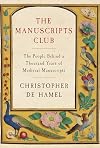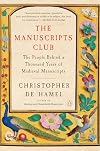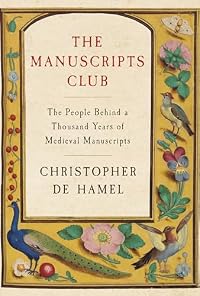
The Manuscripts Club: The People Behind a Thousand Years of Medieval Manuscripts
by Christopher De Hamel
On This Page
Description
"The people who made, saved, and sometimes destroyed medieval manuscripts, over a thousand years of history, from the acclaimed author of Meetings with Remarkable Manuscripts The Manuscripts Club tells of twelve men and women, from the eleventh century to the twentieth, who all share an overwhelming obsession with illuminated manuscripts. The saint, the patron, the bookseller, the artist, the antiquary, the collector, the rabbi, the savant, the librarian, the editor, the forger, and the show more curator had very different reasons for their passion, but manuscripts animated the lives of them all. Christopher de Hamel takes us into in their homes and workplaces, from the monasteries and synagogues of Normandy and Moravia to the universities of Germany and the museums of America, to chart a kinship of minds and to peer into these extraordinary lives among manuscripts. In the pages of his book, remarkable manuscripts tumble through the centuries, connecting a French prince and a Greek peasant and a Black curator. This is a story about society and manuscripts, what manuscripts do for people, and why they mattered and still matter to us. As much as it is a story about transcendent human connection, it is also a story of greed, discovery and disaster. The Manuscripts Club celebrates the most treasured books ever made and their enduring hold on our imaginations"-- show lessTags
Recommendations






















Member Reviews
Very much the counterpart of Meetings with Remarkable Manuscripts, and just as good. Here the focus is on twelve people who had some sort of connection to manuscripts, whether writing them or collecting them etc. These aren’t just potted biographies. Each essay has that little bit extra. He’s researched properly, gone to where they lived, studied their books. I think the secret here is imagination. He can conjure up a scene from the past from some jotting on a scrap of paper. Particularly nice are his imagined conversations with these people. In the one on St. Anselm he’s taken his side of the conversation of various places in his works and cobbled it together.
This is a particularly nicely made book, as it would have to be for show more £40 (I borrowed it from the library). Good quality paper and beautifully illustrated. Lots of the illustrations run to the edge of the page so you can see their strata if you look at the edges when the book is closed. So I wouldn’t want you to think I’m unappreciative of a beautiful book. There’s an illumination by Simon Bening on page 134 that at first glance I thought was some sort of 3D embroidery. I’ve seen a few Medieval manuscripts under glass. I’m not the kind of person who would ever be allowed to handle them – and rightly so. I like to go to churches with fragile medieval wall paintings and chat up the vicar until she trusts me. Then, when no-ones looking I like to climb up on the pews and poke the paintings all over. But I’ve handled some modern manuscripts and there’s a real thrill to know that what you hold in your hands is a totally unique object and no-one else can be reading another copy at the same time. However, if you put a Books of Hours in front of me I’d be bored in five minutes. There’s a particularly interesting bit in the essay on Theodor Mommsen where de Hamel is obviously nonplussed by his interest in manuscripts because of the text. Really I’m with Mommsen on this one. De Hamel is interested in manuscripts as art. One thing this book does is give a history of the place of manuscripts over time – from working tools in monasteries to over-priced status symbols for the wealthy. show less
This is a particularly nicely made book, as it would have to be for show more £40 (I borrowed it from the library). Good quality paper and beautifully illustrated. Lots of the illustrations run to the edge of the page so you can see their strata if you look at the edges when the book is closed. So I wouldn’t want you to think I’m unappreciative of a beautiful book. There’s an illumination by Simon Bening on page 134 that at first glance I thought was some sort of 3D embroidery. I’ve seen a few Medieval manuscripts under glass. I’m not the kind of person who would ever be allowed to handle them – and rightly so. I like to go to churches with fragile medieval wall paintings and chat up the vicar until she trusts me. Then, when no-ones looking I like to climb up on the pews and poke the paintings all over. But I’ve handled some modern manuscripts and there’s a real thrill to know that what you hold in your hands is a totally unique object and no-one else can be reading another copy at the same time. However, if you put a Books of Hours in front of me I’d be bored in five minutes. There’s a particularly interesting bit in the essay on Theodor Mommsen where de Hamel is obviously nonplussed by his interest in manuscripts because of the text. Really I’m with Mommsen on this one. De Hamel is interested in manuscripts as art. One thing this book does is give a history of the place of manuscripts over time – from working tools in monasteries to over-priced status symbols for the wealthy. show less
I sure could use the superlatives I used for Christopher De Hamel's previous work, Meetings with Remarkable Manuscripts, here: it's wonderful how he conveys his enthusiasm for everything related to medieval manuscripts and their collectors. Through 12 figures, spanning the 11th to the 20th century, he provides a good sense of how manuscripts were created, cherished, obsessively collected, sometimes forged, lost in fire, and so on. Essentially, this is an alternative cultural history of Western Europe.
But De Hamel also exaggerates: I found myself reading this book after about six figures, dragging on due to the abundance of detail. At times, the book felt more like a tourist guide, and the fictional conversations with the historical show more figures were unnecessary for me.
Another minor point, but one I'm that’s myself to blame: I bought the paperback edition this time, and I regret that, because the many black-and-white illustrations don't really do justice to the visual appeal of the works of art that these manuscripts actually are. But don't worry: De Hamel continues to produce books that only encourage a love of books (and manuscripts), and that is absolutely a great achievement! show less
But De Hamel also exaggerates: I found myself reading this book after about six figures, dragging on due to the abundance of detail. At times, the book felt more like a tourist guide, and the fictional conversations with the historical show more figures were unnecessary for me.
Another minor point, but one I'm that’s myself to blame: I bought the paperback edition this time, and I regret that, because the many black-and-white illustrations don't really do justice to the visual appeal of the works of art that these manuscripts actually are. But don't worry: De Hamel continues to produce books that only encourage a love of books (and manuscripts), and that is absolutely a great achievement! show less
Twelve fascinating essays, each covering the life of a manuscript collector or producer through the ages, between the 11th and 20th centuries. It is a deeply researched work, and the mini review by Jan Morris nails it: "The most enjoyable work of high scholarship I have ever read." My two favourites, though it is a crowded field, would be Theodor Mommsen and Belle da Costa Greene.
A interesting and sometimes distrubing trend in recent non-fiction is to structure their work around 10, 12, 24, etc. characters or events, some of which may not even seem that historically important. Sometimes it works, as in this book by an acknowledged manuscript expert, De Hamel. From St. Anselm to Belle Greene, a fascinating history of illuminated manuscripts is put together, if. at times, a little bit, inconsistently, such as including Rive and Simonides in this list. Overall, I really enjoyed this bit and will read some of De Hamel's other efforts.
This can be viewed as a companion volume to De Hamel's Meetings with Remarkable Manuscripts, very much a favourite of mine.
Whereas the earlier volume, as the name suggests, focuses on looking at, in great depth, specific manuscripts from across the centuries, this focuses on 12 individuals, from St Anselm through to some modern names (mostly unknown to me), who had interacted with books/manuscripts in some specific manner, whether as a collector, seller, publisher, illuminator, librarian, forger, editor, curator etc.
De Hamel describes the relationship between each person and books/manuscripts, and in doing so, often describes particular books as well.
These are not biographies as such but do paint a picture.
The book itself is lavishly show more illustrated and is beautiful to hold and read.
Whilst "Meetings" is my preferred read, I suspect if I had read these two books in reverse order, this would be my favourite!
A must read for anyone interested in books.
Big Ship
8 April 2024 show less
Whereas the earlier volume, as the name suggests, focuses on looking at, in great depth, specific manuscripts from across the centuries, this focuses on 12 individuals, from St Anselm through to some modern names (mostly unknown to me), who had interacted with books/manuscripts in some specific manner, whether as a collector, seller, publisher, illuminator, librarian, forger, editor, curator etc.
De Hamel describes the relationship between each person and books/manuscripts, and in doing so, often describes particular books as well.
These are not biographies as such but do paint a picture.
The book itself is lavishly show more illustrated and is beautiful to hold and read.
Whilst "Meetings" is my preferred read, I suspect if I had read these two books in reverse order, this would be my favourite!
A must read for anyone interested in books.
Big Ship
8 April 2024 show less
I learned alot. The difficulties in building a manuscript collection. What different collectors valued.
Ratings
Members
- Recently Added By
Author Information

33+ Works 3,587 Members
Christopher De Hamel is the Fellow Librarian of Corpus Christi College, Cambridge. For 25 years he was responsible for all sales of medieval and illuminated manuscripts at Sotheby's in London. He has a doctorate from Oxford University and an honorary doctorate from St John's University, Collegeville, Minnesota. He is a Fellow of the Society of show more Antiquaries show less
Awards and Honors
Distinctions
The Guardian Book of the Day (2022-10-24)
Common Knowledge
- Canonical title
- The Manuscripts Club: The People Behind a Thousand Years of Medieval Manuscripts
- Original title
- The Posthumous Papers of the Manuscripts Club
- Disambiguation notice
- The Manuscripts Club (2023) was originally published in Great Britain as The Posthumous Papers of the Manuscripts Club (2022).
Classifications
- Genres
- Art & Design, Nonfiction, History, General Nonfiction
- DDC/MDS
- 091.09 — Computer science, information & general works Manuscripts & rare books (books about rare books) Manuscripts Manuscripts, history and critique of
- LCC
- Z106.5 .E85 .D43 — Bibliography, Library Science and Information Resources Books (General). Writing. Paleography Manuscripts. Paleography
- BISAC
Statistics
- Members
- 416
- Popularity
- 73,991
- Reviews
- 6
- Rating
- (4.10)
- Languages
- English
- Media
- Paper, Audiobook, Ebook
- ISBNs
- 6
- ASINs
- 2