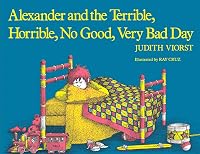
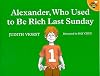
Alexander and the Terrible, Horrible, No Good, Very Bad Day
by Judith Viorst
Alexander by Judith Viorst (1)
On This Page
Description
On a day when everything goes wrong for him, Alexander is consoled by the thought that other people have bad days too.Tags
Recommendations










Member Recommendations
Member Reviews
We've all been there, Alexander - those days that start out bad and only go downhill from there. This classic picture book presents an honest picture of the gloomy clouds that cover our lives from time to time.
The story is told from Alexander's perspective, a young boy of elementary age who is the smallest of three boys. And he is not a happy camper. Everything that can go wrong is going wrong, whether it's from bad luck or his brothers being mean. As the day goes on, the reader can see how his unhappiness colors his perceptions, so that he grumbles about events that might normally pass unnoticed. Isn't that just the way we are when we get upset? Kids, with their irrefutable and irrational logic, can be even harder to console.
Despite show more the topic, this book is extremely comical. We can laugh at Alexander because we have felt what he is feeling, and because some of his accusations are outrageous and yet we still sympathize with him. The black and white illustrations add to the humor. They capture his ill mood in intricate detail, at the same time portraying a child's world. I love this picture book. The pictures and the topic are wonderfully wrought. The story shows children that everyone has those days, and encourages them that frustrated and sad and angry feelings are valid, and that they can be handled with humor. show less
The story is told from Alexander's perspective, a young boy of elementary age who is the smallest of three boys. And he is not a happy camper. Everything that can go wrong is going wrong, whether it's from bad luck or his brothers being mean. As the day goes on, the reader can see how his unhappiness colors his perceptions, so that he grumbles about events that might normally pass unnoticed. Isn't that just the way we are when we get upset? Kids, with their irrefutable and irrational logic, can be even harder to console.
Despite show more the topic, this book is extremely comical. We can laugh at Alexander because we have felt what he is feeling, and because some of his accusations are outrageous and yet we still sympathize with him. The black and white illustrations add to the humor. They capture his ill mood in intricate detail, at the same time portraying a child's world. I love this picture book. The pictures and the topic are wonderfully wrought. The story shows children that everyone has those days, and encourages them that frustrated and sad and angry feelings are valid, and that they can be handled with humor. show less
I love any book that helps children to understand that their feelings are valid and okay to have. This is definitely that kind of book. What is so great about this book, what I think makes it a true classic, is the simplicity. I doesn't go into detail. It doesn't try to fix. It doesn't try to explain. It's simply a depiction of a terrible day. And then Alexander goes to bed and the day ends. And that's it. In the simplicity is the message that yes, some days are just bad and they don't get better and that's okay. The day ends and you start over. That, I think, is an important message. One that is hard to get across to young readers, but one that this book does very gracefully.
This classic is a truly authentic read.....authentically worthy of the praise it receives....authentic in its structure....authentically great illustrations and complementary visual imagry ....and authentic in its ability to cut through the hoopla of societal expectations and just be negative in a realistic way, because life isn't always sanguine. I appreciate that Alexander is just having a bad day, and isn't apologizing to anyone for his grumpiness. My children enjoy this book as much as I do.
"I went to sleep with gum in my mouth and now there's gum in my hair and when I got out of bed this morning I tripped on the skateboard and by mistake I dropped my sweater in the sink while the water was running and I could tell it was going to be a terrible, horrible, no good, very bad day." What a hilarious and great opener to this book! I loved how this book shows children that sometimes people have bad days, but to never feel alone because your day probably won't be AS bad as Alexander's! I also loved how relatable Alexander is to not only little kids, but adults too! He is constantly dealing with the little stresses such as spilling coffee all day long. As bad as you may feel for Alexander, his unfortunate situations all day really show more are comical! show less
So begin the trials and tribulations of the irascible Alexander, who has been earning the sympathy of readers since 1972. People of all ages have terrible, horrible days, and Alexander offers us the cranky commiseration we crave as well as a reminder that things may not be all that bad. As Alexander's day progresses, he faces a barrage of bummers worthy of a country- western song: getting smushed in the middle seat of the car, a dessertless lunch sack, a cavity at the dentist's office, stripeless sneakers, witnessing kissing on television, and being forced to sleep in railroad-train pajamas. He resolves several times to move to Australia.
Alexander wakes up with gum in his hair and so begins a day wherein nothing can go right.
Even though this book is classic that has been in print since well before my birth, I actually never read it before this week when the child I was babysitting had checked it out of the library. So I do not have any nostalgic bond to it and my assessment of it is based entirely from the point of a view of an adult.
One thing I do really appreciate about this book is getting children thinking about their emotions -- and in particular, it lets kids know that it's okay to sometimes feel frustrated when things don't go way they way they expected or wish. Furthermore, the book reinforces that everyone has their bad days wherein it seems like everything show more goes wrong. I could see this book being used by parents or teachers to open up a discussion about their feelings or in conjunction with a lesson about emotions.
The downsides I saw were that the book didn't *quite* go far enough in then helping children deal with this heavy emotional stuff. Alexander starts off the day on a bad foot and no doubt his bad attitude follows him throughout the day, coloring the other events that occur. Sure, a lot of annoyances happen to him, but part of me felt like saying, "enough with the complaining already, kid" after a while. By the end of the book, he goes to bed with the feeling that tomorrow will be another "terrible, horrible, no good, very bad day." It would have been nice if there was some bit of hope in the story, indicating that while, yes, everyone has their bad days, those bad days are usually a blip that are sandwiched in between good and great days.
The cadence of the book was very good for a read aloud, particularly with the repetition of the phrase "a terrible, horrible, no good, very bad day." Viorst captures a young child's day well, including all the little things that could go wrong. The illustrations are finely etched with a good amount of details, but I personally would have preferred fully colored pictures as opposed to black and white pencil sketches. show less
Even though this book is classic that has been in print since well before my birth, I actually never read it before this week when the child I was babysitting had checked it out of the library. So I do not have any nostalgic bond to it and my assessment of it is based entirely from the point of a view of an adult.
One thing I do really appreciate about this book is getting children thinking about their emotions -- and in particular, it lets kids know that it's okay to sometimes feel frustrated when things don't go way they way they expected or wish. Furthermore, the book reinforces that everyone has their bad days wherein it seems like everything show more goes wrong. I could see this book being used by parents or teachers to open up a discussion about their feelings or in conjunction with a lesson about emotions.
The downsides I saw were that the book didn't *quite* go far enough in then helping children deal with this heavy emotional stuff. Alexander starts off the day on a bad foot and no doubt his bad attitude follows him throughout the day, coloring the other events that occur. Sure, a lot of annoyances happen to him, but part of me felt like saying, "enough with the complaining already, kid" after a while. By the end of the book, he goes to bed with the feeling that tomorrow will be another "terrible, horrible, no good, very bad day." It would have been nice if there was some bit of hope in the story, indicating that while, yes, everyone has their bad days, those bad days are usually a blip that are sandwiched in between good and great days.
The cadence of the book was very good for a read aloud, particularly with the repetition of the phrase "a terrible, horrible, no good, very bad day." Viorst captures a young child's day well, including all the little things that could go wrong. The illustrations are finely etched with a good amount of details, but I personally would have preferred fully colored pictures as opposed to black and white pencil sketches. show less
Judith Viorst tells the story of a boy's really, really bad day. This is a great example of 1st person narration, where the writing style captures the boy's personality, emotions, and talking style. I love how she uses long, windy sentences that sound just like the long, self-pitying, no break-taking speech of someone who is completely fed up. I also love the gentle rhythm of the writing. Kids love this book, relating to the boy's problems, and loving his hilarious way of describing it. The illustrations are perfect: his face always looks so scrunched up and resigned.
This is also a great book to use to connect to personal narrative. Kids can work on finding their own voice and personality and using writing style to portray their emotions.
This is also a great book to use to connect to personal narrative. Kids can work on finding their own voice and personality and using writing style to portray their emotions.
Members
- Recently Added By
Lists

Favorite Childhood Books
1,651 works; 519 members

Best children's picture books
377 works; 85 members

Top-Rated Children's Books
87 works; 16 members
1001 Children's Books You Must Read Before You Grow Up
774 works; 100 members

Mensa for Kids Excellence in Reading Award Program (Grades K-3)
64 works; 6 members

Childhood Favorites
427 works; 24 members

my children books reading list-from 100 great books
101 works; 7 members

Works That Inspired Disney Movies
119 works; 13 members
Honey For a Child's Heart
1,152 works; 25 members

Read the book and saw the movie
1,170 works; 195 members
Ambleside Books
459 works; 18 members

Best Friendship Stories
205 works; 16 members

Sonlight Books
1,487 works; 25 members

75 Books for Literacy Block: Fall 2016
17 works; 2 members

CCE 1000 Good Books List
1,033 works; 12 members

Blue Pyramid 1,276 Best Books of All Time
1,248 works; 32 members

Bennett's 30 Great Books Every Preschooler Should Meet
30 works; 3 members
Reading Rainbow
193 works; 10 members

Youth: Emotions & Feelings
126 works; 1 member

75 Books for Fall Literacy Block - Dr. Reed
67 works; 2 members

Early Picture Books
467 works; 9 members

Books We Loved As Children
603 works; 253 members

Books With Our Favorite First Lines
168 works; 104 members
Favorite Picture Books
479 works; 160 members

Recommended Reading List
219 works; 1 member

1970s
657 works; 23 members

Books With the Most Memorable Titles
478 works; 158 members

scav
54 works; 2 members

Before Austen Comes Aesop
318 works; 9 members
Books About Boys
175 works; 15 members

Books by Jewish Authors
68 works; 5 members

Amusing Book Titles
146 works; 39 members

NPR Books You Love: 100 Favorite Books For Young Readers
100 works; 1 member
Author Information

93+ Works 36,464 Members
Judith Viorst was born in Newark, New Jersey on February 2, 1931. She graduated from Rutgers University (1952) and the Washington Psychoanalytic Institute (1981). She has written extensively, her works include children's books, collections of poetry, lyrics to musicals, several works of fiction, and a cookbook. She has won a Silver Pencil award show more (for The Tenth Good Thing About Barney) and an Emmy (for poems used in an Anne Bancroft TV special). (Bowker Author Biography) Judith Viorst is the bestselling author of "Forever Fifty," "How Did I Get to Be Forty," "Necessary Losses," & several other works. She is also the author of the classic children's book "Alexander & the Terrible, Horrible, No Good, Very Bad Day." A graduate of the Washington Psychoanalytic Institute, she is the recipient of various awards for her journalism & psychological writings. She lives in Washington, D.C., with her husband, political writer Milton Viorst. They have three sons. (Publisher Provided) show less
Some Editions
Awards and Honors
Awards
Series

Work Relationships
Is contained in
Has the adaptation
Is parodied in
Has as a student's study guide
Common Knowledge
- Canonical title
- Alexander and the Terrible, Horrible, No Good, Very Bad Day
- Original publication date
- 1972
- People/Characters
- Alexander; Anthony; Nicholas; Mom; Paul; Philip Parker (show all 9); Albert Moyo; Dad; Mickey Mouse (cameo)
- Related movies
- Alexander and the Terrible, Horrible, No Good, Very Bad Day (2014 | IMDb)
- Dedication
- For Robert Lescher, with love and thanks.
- First words
- I went to sleep with gum in my mouth and now there's gum in my hair and when I got out of bed this morning I tripped on the skateboard and by mistake I dropped my sweater in the sink while the water was running and I could te... (show all)ll it was going to be a terrible, horrible, no good, very bad day.
- Last words
- (Click to show. Warning: May contain spoilers.)My mom says some days are like that. Even in Timbuktu.
- Original language
- English
Classifications
Statistics
- Members
- 18,075
- Popularity
- 354
- Reviews
- 671
- Rating
- (4.24)
- Languages
- 5 — Chinese, Dutch, English, Hebrew, Spanish
- Media
- Paper, Audiobook, Ebook
- ISBNs
- 66
- ASINs
- 40