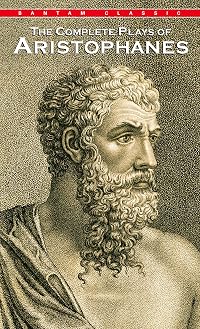
The Eleven Comedies
by Aristophanes
On This Page
Description
A poet who hated an age of decadence, armed conflict, and departure from tradition, Aristophanes' comic genius influenced the political and social order of his own fifth-century Athens. But as Moses Hadas writes in his introduction to this volume, 'His true claim upon our attention is as the most brilliant and artistic and thoughtful wit our world has known.' Includes The Acharnians, The Birds, The Clouds, Ecclesiazusae, The Frogs, The Knights, Lysistrata, Peace, Plutus, Thesmophoriazusae, show more and The Wasps. show lessTags
Recommendations










Member Reviews
This great book contains all eleven surviving plays by Aristophanes. This makes it excellent value.
The translation by Paul Roche into modern, colloquial English is very good. Roche doesn’t pull any punches when it comes to using crude language, so anyone who is offended by bad language will not like it. But if you’re prudish you won’t like Aristophanes’ bawdy plays anyway.
Here are a couple of (not too crude!) examples of Roche’s approach to translating Aristophanes:
LYSISTRATA: Good morning, Lampito, my Spartan darling!
How luscious you look! Quite stunning!
Such clear skin, and that firm body –
why you could strangle a bull.
And later...
LAMPITO: Like Menelaus at the sight of Helen’s melons,
Chucking away his sword when he meant show more to slay her on the spot.
The Ancient Greek “Old Comedy” of Aristophanes was wild and zany, and full of fantasy, sex, bawdiness, and political satire. It was very different from the “Comedy of Manners” represented by the later Greek “New Comedy”, which in turn influenced Roman drama and much later writers such as Moliere.
The background against which Aristophanes (and also the great tragic dramatists such as Sophocles) was writing was fifth century BC Athens. This was a high point of culture, which rested on the Athenian democracy of the time, but also on slavery and on Athens’ growing empire. Democracy in Athens was a great advance, but it excluded women and slaves. (It is possible, but not certain, that slaves and women were allowed to attend the Athenian theatre. There were certainly no women actors – men played the female parts.)
So there has understandably been much debate about Aristophanes’ views on democracy, slavery and women. Roche rightly says that “...his political outlook was conservative.” But to get more detail on this we need to go beyond Roche’s introduction and look at books such as G.E.M de Ste. Croix’s “The Class Struggle in the Ancient Greek World” and “The Origins of the Peloponnesian War”.
Aristophanes seems to have been a conservative democrat who thought that radical democracy involved the masses being duped by demagogues. For example, in “The Frogs”, he calls (via the chorus leader) for citizenship rights to be given back those who had supported the oligarchic coup of 411BC. Ste. Croix says that Aristophanes was a “snob” who didn’t like the “demagogues” (who were rich but not from aristocratic backgrounds) because they often took the side of the lower classes against their “betters”.
In the play “Wasps”, Aristophanes mocks the old man who is addicted to jury service. But Ste. Croix points out that “The Assembly and in particular the courts must have given the poorer citizen a considerable degree of protection against oppression by the rich and powerful.”
Of course, Aristophanes took slavery for granted. But slaves are at least generally shown with humanity, and there are no racist-type “jokes” aimed at them.
When it comes to women, it has been pointed out that the play Lysistrata, for example, contains a mixture of social reality (for example showing the difficulty women had in leaving the house), “comic” sexual stereotyping (through male eyes) and the crazy world of the Old Comedy.
In “The Poet and the Women” Euripides is mocked as being anti-women, but it is Aristophanes himself who is getting laughs by stereotyping women as “deceitful boozers”. (Though to be fair, the women get in a few digs against men, too.)
Of course we can enjoy Aristophanes, and Roche’s excellent translation, without all this analysis. But it can add to our enjoyment if we know something about the background to Aristophanes and his world. show less
The translation by Paul Roche into modern, colloquial English is very good. Roche doesn’t pull any punches when it comes to using crude language, so anyone who is offended by bad language will not like it. But if you’re prudish you won’t like Aristophanes’ bawdy plays anyway.
Here are a couple of (not too crude!) examples of Roche’s approach to translating Aristophanes:
LYSISTRATA: Good morning, Lampito, my Spartan darling!
How luscious you look! Quite stunning!
Such clear skin, and that firm body –
why you could strangle a bull.
And later...
LAMPITO: Like Menelaus at the sight of Helen’s melons,
Chucking away his sword when he meant show more to slay her on the spot.
The Ancient Greek “Old Comedy” of Aristophanes was wild and zany, and full of fantasy, sex, bawdiness, and political satire. It was very different from the “Comedy of Manners” represented by the later Greek “New Comedy”, which in turn influenced Roman drama and much later writers such as Moliere.
The background against which Aristophanes (and also the great tragic dramatists such as Sophocles) was writing was fifth century BC Athens. This was a high point of culture, which rested on the Athenian democracy of the time, but also on slavery and on Athens’ growing empire. Democracy in Athens was a great advance, but it excluded women and slaves. (It is possible, but not certain, that slaves and women were allowed to attend the Athenian theatre. There were certainly no women actors – men played the female parts.)
So there has understandably been much debate about Aristophanes’ views on democracy, slavery and women. Roche rightly says that “...his political outlook was conservative.” But to get more detail on this we need to go beyond Roche’s introduction and look at books such as G.E.M de Ste. Croix’s “The Class Struggle in the Ancient Greek World” and “The Origins of the Peloponnesian War”.
Aristophanes seems to have been a conservative democrat who thought that radical democracy involved the masses being duped by demagogues. For example, in “The Frogs”, he calls (via the chorus leader) for citizenship rights to be given back those who had supported the oligarchic coup of 411BC. Ste. Croix says that Aristophanes was a “snob” who didn’t like the “demagogues” (who were rich but not from aristocratic backgrounds) because they often took the side of the lower classes against their “betters”.
In the play “Wasps”, Aristophanes mocks the old man who is addicted to jury service. But Ste. Croix points out that “The Assembly and in particular the courts must have given the poorer citizen a considerable degree of protection against oppression by the rich and powerful.”
Of course, Aristophanes took slavery for granted. But slaves are at least generally shown with humanity, and there are no racist-type “jokes” aimed at them.
When it comes to women, it has been pointed out that the play Lysistrata, for example, contains a mixture of social reality (for example showing the difficulty women had in leaving the house), “comic” sexual stereotyping (through male eyes) and the crazy world of the Old Comedy.
In “The Poet and the Women” Euripides is mocked as being anti-women, but it is Aristophanes himself who is getting laughs by stereotyping women as “deceitful boozers”. (Though to be fair, the women get in a few digs against men, too.)
Of course we can enjoy Aristophanes, and Roche’s excellent translation, without all this analysis. But it can add to our enjoyment if we know something about the background to Aristophanes and his world. show less
Aristophanes is the great comic playwright of Ancient Greece, and set the standard and form of comedy in the Western World. Moreover, his plays are often cited in discussions of what ordinary life was like in the city of Athens in the times of Socrates. No less a figure than Plato accused Aristophanes' play The Clouds of contributing to the prosecution and death of Socrates. Aristophanes even appears in Plato's The Symposium as one of the guests. From The Birds we get the concept of Cloudcuckooland. His play Lysistrata was assigned me in high school (and I loved it by the way) but it was that Aristophanes was listed on 100 Significant books on Good Reading that gave me incentive to read the rest. In other words, yes, Aristophanes plays show more are one of those fundamental works any educated person should know--reason alone to become acquainted. But they're also fun--painless to read. Not stodgy--in fact often bawdy and inventive. In Peace his hero rides to Heaven--on a dung beetle. Lysistrata and Ecclesiazusae are both anti-war and feminist--yes, really.
Or so it strikes me, although I'm sure there are scholars of the period who in a close analysis might find the misogyny of Ancient Greece peeking through--in say pointing out how women use sex and deception in Lysistrata to get their way. But what we have here is arguably Aristophanes greatest (certainly his most famous) play, with a strong female title protagonist, who leads women from warring states to form a sex strike to stop a war. What's not to love?
Well, yes, these plays feature topical satire that often does depend on the context of Athenian politics during the Peloponnesian War, so loads of annotations, footnotes is a good. So is a natural, flowing translation. (The first time I read Lysistrata, I found the way the translator gave the Spartan women a Scottish dialect rather bizarre.) But those two requirements aside, these are still capable of inspiring laughter. show less
Or so it strikes me, although I'm sure there are scholars of the period who in a close analysis might find the misogyny of Ancient Greece peeking through--in say pointing out how women use sex and deception in Lysistrata to get their way. But what we have here is arguably Aristophanes greatest (certainly his most famous) play, with a strong female title protagonist, who leads women from warring states to form a sex strike to stop a war. What's not to love?
Well, yes, these plays feature topical satire that often does depend on the context of Athenian politics during the Peloponnesian War, so loads of annotations, footnotes is a good. So is a natural, flowing translation. (The first time I read Lysistrata, I found the way the translator gave the Spartan women a Scottish dialect rather bizarre.) But those two requirements aside, these are still capable of inspiring laughter. show less
Sometimes things do not translate well from one time to another (or one language to another, either). Some of the plays, such as the Birds, the Frogs, and Lysistrata, are interesting and fun plays. Many of the rest simply are too tied to the political players of the time to be compelling. It is difficult to find much relevant to today in plays extolling monarchy at the expense of democracy, so those plays are only interesting as a curiosity, since the story lines are only okay. There was some interest in the idea of a man ascending to heaven on a dung beetle to seek peace, but the story felt flat and underdeveloped. I realize it is not fair to a work out of its time to judge it by the standards of our own time, but I am not a classical show more scholar, and am not able to judge it by the standards of its own time (to be fair to me, I don't think many classical scholars are really able to do that either; they are just able to understand where it fit, and the political references, in a more detailed manner). Overall, it was a disappointment. show less
Oh My, the ancient Greeks knew how to have fun.
Amusing, risqué, clever, insightful and, if you have a good translation —or if you can read Greek—, poetic,
Amusing, risqué, clever, insightful and, if you have a good translation —or if you can read Greek—, poetic,
Contents: Acharnians / tr. by B. B. Rogers -- Knights / tr. by R. H. Webb -- Clouds / tr. by Moses Hadas -- Wasps / tr. by Moses Hadas -- Peace / tr. by B. B. Rogers -- Birds / tr. by R. H. Webb -- Lysistrata / tr. by Jack Lindsay -- Thesmophoriazusae / tr. by B. B. Rogers -- Frogs / tr. by R. H. Webb -- Ecclesiazusae / tr. by Jack Lindsay -- Plutus / tr. by B. B. Rogers
Members
- Recently Added By
Lists

Philip Ward's Lifetime Reading Plan
592 works; 22 members

Trinity College Booklist (1951): Class Eight, Classic Civilization
39 works; 3 members

Kilobook
19 works; 1 member

How to Read a Book's Recommended Reading List
309 works; 10 members

Western Canon
206 works; 2 members
Author Information

537 Works 20,786 Members
Aristophanes, 448 b.c. - 385 b.c. Aristophanes is considered to be one of the greatest comedic writers ever to have taken to the stage. He was born in Athens, Greece, in the town of Cydathenaeum. Aristophanes is believed to have been well educated, which would explain his propensity towards words. It is also believed that he owned land on the show more island of Aegina. Aristophanes was first a satirist, he was well known for attacking anything from politics to poets, mainly the war between Sparta and Athens and the poet Euripides. He wrote more than 40, eleven of which are still being acted today. "The Acharnians" was his first play, written in 425, B.C.. This was the first of his plays in reaction to the war, as well as the play "Peace." But perhaps Aristophanes most famous play, Lysistrata, made his true feelings of the war known. In this play, the women seek peace by claiming celibacy until the fighting is stopped. It is the play that he is most famous for, for capturing the feeling of the people in a way that was both lighthearted and poignant. Aristophanes died three years after the war ended, in 385, B.C.,but left behind a legacy that has lasted to the present day. (Bowker Author Biography) show less
Some Editions
Awards and Honors
Series
Belongs to Publisher Series
Work Relationships
Is contained in
Contains
Common Knowledge
- Canonical title
- The Eleven Comedies
- Alternate titles
- The Acharnians, Knights, Clouds, Wasps, Peace, Birds
- Original publication date
- 425 BCE [Acharnians]; 1912 (Collection) (Collection); 424 BCE [Knights]; 423 BCE [Clouds]; 422 BCE [Wasps]; 421 BCE [Peace] (show all 12); 414 BCE [Birds]; 411 BCE [Lysistrata]; 411 BCE [Thesmophoriazusae]; 415 BCE [Frogs]; 392 BCE [Ecclesiazusae]; 388 BCE [Plutus]
- People/Characters*
- Dikaiopolis; Amphitheos; Pseudartabas; Theoros
- Important places
- Athens, Greece
- Dedication
- To Patrick Horsbrugh ὃ ἅλσ του κοσμου
- First words
- The dates of Aristophanes' birth and death are variously given, but 445–375 B.C. is a possibility. We know that he was considered too young to present his first three plays in his own name: the lost Daiteleis (<... (show all)i>Banqueters), which won second prize at the Lenaea in 427 B.C., when he would have been only about eighteen; the lost Babylonians, which won second prize in 426 B.C.; and Acharnians, which brought him first prize in 425 B.C. when he was barely twenty. These plays and the four that followed over the next four years are the work of a very young man endowed with the courage to level unrelenting attacks on no less than the head of state—the demagogic Cleon.
[From Roche's Introduction]
The was with Sparta and Boeotia has been dragging on for six years. The countryside of Attica is a shambles and Athens itself is an overcrowded city in which plague has wreaked havoc. The Acharnians, inhabitants of a deme nor... (show all)thwest of Athens whose land has been repeatedly ravaged, are thirsting for revenge. Aristophanes' comedy is a plea for peace, whose fruits and comforts are contrasted with the destitution, hardships, and stupidity of war.
[From the introductory material to Roche's translation of Aristophanes' Acharnians]
DICAEOPOLIS: {with rambling thoughts}
The things that have made me eat my heart out—
uncountable as the sands of the dunes . . .
and the things that have made my heart leap with joy—
not more than four ... (show all). . . let's see . . .
[From Roche's translation of Aristophanes' Acharnians] - Last words
- (Click to show. Warning: May contain spoilers.)CHORUS: Now is not the time to be lagging
so let us start following,
Forming up behind them and singing.
[From Roche's translation of Aristophanes' Plutus (Wealth)] - Original language
- Greek (Ancient) (Ancient)
*Some information comes from Common Knowledge in other languages. Click "Edit" for more information.
Classifications
- Genre
- Fiction and Literature
- DDC/MDS
- 882.01 — Literature & rhetoric Classical & modern Greek literatures Classical Greek dramatic poetry and drama standard subdivisions; collections; history, description, critical appraisal; Specific periods Ancient period to ca. 499
- LCC
- PA3877 .A1 .H3 — Language and Literature Greek language and literature. Latin language and literature Greek literature Individual authors
- BISAC
Statistics
- Members
- 1,871
- Popularity
- 11,521
- Reviews
- 12
- Rating
- (3.96)
- Languages
- 9 — English, French, German, Greek, Hungarian, Italian, Portuguese, Russian, Spanish
- Media
- Paper, Ebook
- ISBNs
- 54
- UPCs
- 3
- ASINs
- 46