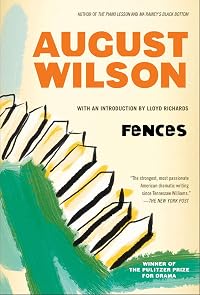
Fences
by August Wilson
Century Cycle: Production Order (play 4), Century Cycle: Chronological Order (1950s)
On This Page
Description
During the 1950s Troy Maxson struggles against racism and tries to preserve his feelings of pride in himself.Tags
Recommendations









Member Reviews
Published in 1983, this is the sixth play of August Wilson’s “Pittsburgh Cycle,” and by far the best known, winning the 1987 Pulitzer Prize for Drama. All the plays in the cycle take up various aspects of the American-American experience during the first part of the twentieth century. “Fences,” as the namely subtly hints at, looks at the differing ways of life and cultural assumptions that Americans – black and white – of two generations as they find themselves growing further and further apart.
The action revolves around Troy Maxson, the dictatorial, autocratic patriarch who rules over the play with a brooding, constant, suffocating presence. Everyone slavishly concedes to his authoritarian, overbearing personality – show more his wife Rose, his best friend Bono, and his two grown children, Lyons and Cory. Troy, now a garbage man, was once an aspiring baseball player when he was younger, but was unable to break into the game because of the color barrier. When his son shows similar athletic promise, he shuts down any opportunity for him to pursue it, demanding that he get a job at the local store instead. Whether it is out of spite or not is unclear, but his negation of his son’s dreams comes across as mean-spirited and petty. At another point, his son Cory asks his father “How come you ain’t never liked me?” to which Troy responds “Liked you? Who the hell said I gotta like you?”
Much of the play revolves around the ways Troy exerts his power over his wife and children. His son, Lyons, occasionally asks him for money, which always makes Troy bristle with resentment and sends him into a seething tirade about how Lyons shouldn’t feel entitled and should stop coming by just to borrow money. Troy has an affair with Alberta (whom we never see) and conceives a child with her, Raynell, whom we only see in the last scene at Troy’s funeral.
The title refers to the fence that Troy and his son try to build throughout the play, yet Troy always seems to be castigating him for doing something else, but it preforms other functions, too. Troy has an (extreme) aversion toward death and loss; the fence is, one supposes, there to militate against death. The fence had another, much more resonant meaning for me: it stands for the wall that separates black Americans raised in the 1930s and 1940s from their children raised in the 1960s, with all the social, cultural, and political baggage that comes along with that chasmal divide.
At the end of the play, Wilson has certainly made a hell of a character out of Troy – a character who begs for the readers’ sympathy. But as great of a playwright as he is, he just couldn’t bring me there; I could never see Troy as anything other than a tyrannical despot. I felt sorry for his children, and wondered why his wife suffered his presence. I tried to find virtues in him, but the fact that he is a soi-disant hard-drinking Lothario really doesn’t help his case. I have to admit, however, that I am biased: Troy reminds me of someone in my own family whose very presence I cannot bear, yet who I grew up around, and whose philistinism I occasionally still have to bear. Much of what he said in the play, his motivations, his attitudes, are exactly like those of said relative. I know it is precisely this fearful symmetry which caused such a visceral reaction toward the play itself. As much as I disliked Troy, the play itself is superb. To capture the psychology of a man like Troy, as well as his long-suffering wife and children, takes a superb craftsman, which Wilson definitely is. show less
The action revolves around Troy Maxson, the dictatorial, autocratic patriarch who rules over the play with a brooding, constant, suffocating presence. Everyone slavishly concedes to his authoritarian, overbearing personality – show more his wife Rose, his best friend Bono, and his two grown children, Lyons and Cory. Troy, now a garbage man, was once an aspiring baseball player when he was younger, but was unable to break into the game because of the color barrier. When his son shows similar athletic promise, he shuts down any opportunity for him to pursue it, demanding that he get a job at the local store instead. Whether it is out of spite or not is unclear, but his negation of his son’s dreams comes across as mean-spirited and petty. At another point, his son Cory asks his father “How come you ain’t never liked me?” to which Troy responds “Liked you? Who the hell said I gotta like you?”
Much of the play revolves around the ways Troy exerts his power over his wife and children. His son, Lyons, occasionally asks him for money, which always makes Troy bristle with resentment and sends him into a seething tirade about how Lyons shouldn’t feel entitled and should stop coming by just to borrow money. Troy has an affair with Alberta (whom we never see) and conceives a child with her, Raynell, whom we only see in the last scene at Troy’s funeral.
The title refers to the fence that Troy and his son try to build throughout the play, yet Troy always seems to be castigating him for doing something else, but it preforms other functions, too. Troy has an (extreme) aversion toward death and loss; the fence is, one supposes, there to militate against death. The fence had another, much more resonant meaning for me: it stands for the wall that separates black Americans raised in the 1930s and 1940s from their children raised in the 1960s, with all the social, cultural, and political baggage that comes along with that chasmal divide.
At the end of the play, Wilson has certainly made a hell of a character out of Troy – a character who begs for the readers’ sympathy. But as great of a playwright as he is, he just couldn’t bring me there; I could never see Troy as anything other than a tyrannical despot. I felt sorry for his children, and wondered why his wife suffered his presence. I tried to find virtues in him, but the fact that he is a soi-disant hard-drinking Lothario really doesn’t help his case. I have to admit, however, that I am biased: Troy reminds me of someone in my own family whose very presence I cannot bear, yet who I grew up around, and whose philistinism I occasionally still have to bear. Much of what he said in the play, his motivations, his attitudes, are exactly like those of said relative. I know it is precisely this fearful symmetry which caused such a visceral reaction toward the play itself. As much as I disliked Troy, the play itself is superb. To capture the psychology of a man like Troy, as well as his long-suffering wife and children, takes a superb craftsman, which Wilson definitely is. show less
I read this for a drama class last semester, and knew next to nothing about it before I picked it up and read it for myself. In contrast, I had some connection to all the other plays we read in that class—I’ve loved Shakespeare since I was a child, and so had no qualms with making the romp through A Midsummer Night’s Dream again; I consider myself somewhat of a Sondheim devotee and knew Sweeney Todd already; and though I was new to classical drama, I relished the chance to acquaint myself with Sophocles and his Theban cycle. Looking back, however, I have to say that I think Fences had the most impact on me of the plays we read.
August Wilson has crafted a tremendously powerful story here. Yes, it is an “African American play,” show more and racism is a prominent theme, but reducing it to just that, one misses out on the universality, the sheer humanity, of the characters and situations. This is a play about social ills, about love, about death, and most of all, about family. The characters commit wildly unpredictable, morally questionable acts—I’m thinking primarily of the protagonist, Troy Maxson, who was originally played on stage by James Earl Jones and more recently by Denzel Washington—and yet you can’t take your eyes off of them. Of all the cast, my heart went out particularly to Rose. Man, what a part! And what a life.
I don’t have any immediate plans to read the other plays in Wilson's century cycle, but he’s certainly on my radar now. Hopefully it won’t take another school assignment for me to seek his work out. show less
August Wilson has crafted a tremendously powerful story here. Yes, it is an “African American play,” show more and racism is a prominent theme, but reducing it to just that, one misses out on the universality, the sheer humanity, of the characters and situations. This is a play about social ills, about love, about death, and most of all, about family. The characters commit wildly unpredictable, morally questionable acts—I’m thinking primarily of the protagonist, Troy Maxson, who was originally played on stage by James Earl Jones and more recently by Denzel Washington—and yet you can’t take your eyes off of them. Of all the cast, my heart went out particularly to Rose. Man, what a part! And what a life.
I don’t have any immediate plans to read the other plays in Wilson's century cycle, but he’s certainly on my radar now. Hopefully it won’t take another school assignment for me to seek his work out. show less
Follows the year 1957 in the life of Troy Maxson. He ridicules his older son for always borrowing money from him. He refuses to allow his and Rose's, his wife, son, Cory to go to college or to get involved in sports. He has an affair which results in an out-of-wedlock pregnancy.
Troy keeps telling Cory he is to help build a fence around their house because Rose wants it. Cory helps when he is forced to help. Troy's friend, Bono, says that fences are to keep someone in or to keep something in. In Troy's case I think he tries to keep the world out of his house as it is changing. It is different from when he came up. Cory isn't interested in the fence because he sees a world outside of it that he wants to be part of. Rose lets Cory know show more Troy wanted the fence, not her.
Rose realizes she was fenced in due to expectations of what a woman should want. She knows she let Troy take over her life when they married. She did not fight for a space for herself. I found a lot of loneliness here. Even though Troy and Rose are married, they are lonely as the person they should be able to turn to and rely on isn't there or real. I understand Rose's anger and hurt when Troy tells her about the baby. They have both frozen the other out through the years.
If this was not a library book, it would be on my keeper shelf. There is so many layers here that multiple readings are necessary to catch all the nuances. So much is happening between characters that I haven't mentioned. I have to think more about them as well as Rose, Troy, and Cory. show less
Troy keeps telling Cory he is to help build a fence around their house because Rose wants it. Cory helps when he is forced to help. Troy's friend, Bono, says that fences are to keep someone in or to keep something in. In Troy's case I think he tries to keep the world out of his house as it is changing. It is different from when he came up. Cory isn't interested in the fence because he sees a world outside of it that he wants to be part of. Rose lets Cory know show more Troy wanted the fence, not her.
Rose realizes she was fenced in due to expectations of what a woman should want. She knows she let Troy take over her life when they married. She did not fight for a space for herself. I found a lot of loneliness here. Even though Troy and Rose are married, they are lonely as the person they should be able to turn to and rely on isn't there or real. I understand Rose's anger and hurt when Troy tells her about the baby. They have both frozen the other out through the years.
If this was not a library book, it would be on my keeper shelf. There is so many layers here that multiple readings are necessary to catch all the nuances. So much is happening between characters that I haven't mentioned. I have to think more about them as well as Rose, Troy, and Cory. show less
I enjoyed reading this play, though I usually do not enjoy the play format. The characters were believable, and their troubles contemporary and realistic. The family drama is interesting and is the focus of the play (with interactions between brothers, father-son, and husband-wife), but viewing these through the lens of a 1950-1960s African American family is enlightening, as the reader can see how racism and discrimination impact most aspects of the family's life.
August Wilson
FENCES
Plume, 1986
Play
"Can't visit the sins of the father upon the child."
A few summers back, August Wilson's play, FENCES, was performed at a local theater. I missed every performance. That was upsetting. I love seeing plays. Recently, I saw that FENCES was being made into a major motion picture with Denzel Washington. With renewed interest, I ordered the play, and read it in one sitting.
FENCES is set in the 1950s. The Acts mostly take place on Fridays. Payday. On the porch of a small house, with a dirt yard, we meet Troy Maxson, his wife Rose, their son Cory, Troy's other son, Lyons, and Troy's disabled brother, Gabe, and, additionally, Bono, Troy's lifelong friend.
Unfortunately, Troy is not a likeable man. Although he'd show more lived a hard life, his life is spent in the past. Despite having left home at fourteen, and spending fifteen years in prison for murder, he married, landed a good job as a garbage man, and started a family. His once dreamed of playing professional baseball. Too many things were stacked against him. The fact he was black became the tallest obstacle, and an impossible hurdle.
Hard working, Troy has little time for his boys. Lyons is in his thirties, and doesn't work. He is a musician, and despite having no money, and begging for cash from his father, it is clear Lyons wants to, in some way, salvage his relationship with his father. His constant pleas for Troy to come down to the club where his band plays scream for attention that time, and again, Troy ignores.
Rose's and Troy's son, Cory, is athletic. His football playing might land him a scholarship into college. A recruiter is anxious to discuss terms with Troy. Determined his son is living in a fantasy, Troy continually gives Cory a hard time, setting unrealistic goals with little care of the consequences.
Gabe, Troy's younger brother, fought in World War II. A plate in his head has him believing he is the Arch Angel Gabriel. The government checks helped Troy make ends meet, but when Gabe moves out, hard feelings set in.
Troy likes to make everyone believe he is smarter than he is. He wants people to know he is strong, and in charge. He is the King of his Castle. Ruler over Rose, and Cory, and even Lyons. What he says, goes. He is harsh, and brash, and obnoxious. Calloused, and careless.
His mistakes continually pile up. He makes one bad call after another. And then, when his reality is there facing him, ready to wrestle -- he has no one to blame for the outcome, except himself.
"You went back on yourself Troy. You gonna have to answer for that."
The thing is, I don't think Troy ever truly gets it. I don't think he ever understands that he was the problem. And that, for me, was the tragedy. That was what made this story so sad, and depressing. Troy never got it. He just never got it.
FENCES is a fantastic, taut play. I am going to have to read more August Wilson. No doubt about it. The messages were there. Clear, and not so subtle, and I loved the story.
Phillip Tomasso
Author of the Severed Empire Series, and
The Vaccination Trilogy show less
FENCES
Plume, 1986
Play
"Can't visit the sins of the father upon the child."
A few summers back, August Wilson's play, FENCES, was performed at a local theater. I missed every performance. That was upsetting. I love seeing plays. Recently, I saw that FENCES was being made into a major motion picture with Denzel Washington. With renewed interest, I ordered the play, and read it in one sitting.
FENCES is set in the 1950s. The Acts mostly take place on Fridays. Payday. On the porch of a small house, with a dirt yard, we meet Troy Maxson, his wife Rose, their son Cory, Troy's other son, Lyons, and Troy's disabled brother, Gabe, and, additionally, Bono, Troy's lifelong friend.
Unfortunately, Troy is not a likeable man. Although he'd show more lived a hard life, his life is spent in the past. Despite having left home at fourteen, and spending fifteen years in prison for murder, he married, landed a good job as a garbage man, and started a family. His once dreamed of playing professional baseball. Too many things were stacked against him. The fact he was black became the tallest obstacle, and an impossible hurdle.
Hard working, Troy has little time for his boys. Lyons is in his thirties, and doesn't work. He is a musician, and despite having no money, and begging for cash from his father, it is clear Lyons wants to, in some way, salvage his relationship with his father. His constant pleas for Troy to come down to the club where his band plays scream for attention that time, and again, Troy ignores.
Rose's and Troy's son, Cory, is athletic. His football playing might land him a scholarship into college. A recruiter is anxious to discuss terms with Troy. Determined his son is living in a fantasy, Troy continually gives Cory a hard time, setting unrealistic goals with little care of the consequences.
Gabe, Troy's younger brother, fought in World War II. A plate in his head has him believing he is the Arch Angel Gabriel. The government checks helped Troy make ends meet, but when Gabe moves out, hard feelings set in.
Troy likes to make everyone believe he is smarter than he is. He wants people to know he is strong, and in charge. He is the King of his Castle. Ruler over Rose, and Cory, and even Lyons. What he says, goes. He is harsh, and brash, and obnoxious. Calloused, and careless.
His mistakes continually pile up. He makes one bad call after another. And then, when his reality is there facing him, ready to wrestle -- he has no one to blame for the outcome, except himself.
"You went back on yourself Troy. You gonna have to answer for that."
The thing is, I don't think Troy ever truly gets it. I don't think he ever understands that he was the problem. And that, for me, was the tragedy. That was what made this story so sad, and depressing. Troy never got it. He just never got it.
FENCES is a fantastic, taut play. I am going to have to read more August Wilson. No doubt about it. The messages were there. Clear, and not so subtle, and I loved the story.
Phillip Tomasso
Author of the Severed Empire Series, and
The Vaccination Trilogy show less
3.5***
Troy Maxson is a strong man. He has survived a hard childhood and time spent without direction or purpose to become a responsible family man. He went through a time in American history where being proud and black meant facing obstacles that might crush a lesser man. But in the late 1950s things are beginning to change, and Troy Maxson is unsure how to behave in a world that frightens and angers him. What he learned so well in raising himself leaves him with a rigid sense of obligation, but no flexibility to deal with a world, a family, a wife and son he no longer understands.
Too bad my F2F book club decided to read this for discussion this month. I really dislike reading plays – reading is not the medium the playwright intended show more for reaching his audience. I’ve seen this play performed and it was powerful, dramatic, and thought-provoking. But reading it … I miss all the technique and skill that professional actors bring to translating Wilson’s words and directions into a visceral experience. There are some soliloquies that are exceptional – Troy reliving his boyhood and the event that caused him to leave home at age fourteen; Rose explaining her take on their marriage – but I had a hard time connecting to the characters through reading much of their dialogue on a page vs watching it unfold on the stage.
Wilson won the Pulitzer Prize for Drama for this play. If you get a chance to see a performance, don’t miss it! show less
Troy Maxson is a strong man. He has survived a hard childhood and time spent without direction or purpose to become a responsible family man. He went through a time in American history where being proud and black meant facing obstacles that might crush a lesser man. But in the late 1950s things are beginning to change, and Troy Maxson is unsure how to behave in a world that frightens and angers him. What he learned so well in raising himself leaves him with a rigid sense of obligation, but no flexibility to deal with a world, a family, a wife and son he no longer understands.
Too bad my F2F book club decided to read this for discussion this month. I really dislike reading plays – reading is not the medium the playwright intended show more for reaching his audience. I’ve seen this play performed and it was powerful, dramatic, and thought-provoking. But reading it … I miss all the technique and skill that professional actors bring to translating Wilson’s words and directions into a visceral experience. There are some soliloquies that are exceptional – Troy reliving his boyhood and the event that caused him to leave home at age fourteen; Rose explaining her take on their marriage – but I had a hard time connecting to the characters through reading much of their dialogue on a page vs watching it unfold on the stage.
Wilson won the Pulitzer Prize for Drama for this play. If you get a chance to see a performance, don’t miss it! show less
Saw this was soon to be a film and so I took this opportunity to revisit Mr. Wilson's world. It is a solid drama and should make a fine film. And I appreciated that it didn't turn sappy at the end, but accepted hard realities and a bit of the haunting quality of what has gone before.
Members
- Recently Added By
Lists

Plays I Like
230 works; 31 members

Overdue Podcast
806 works; 9 members

My Favorite Plays
25 works; 1 member
My Play Collection
769 works; 3 members
Essential/Recognized Stage Plays
115 works; 4 members

AP Lit
363 works; 6 members

Black Authors
384 works; 32 members
Best African American Literature
53 works; 9 members
Best Books of the 20th Century
193 works; 5 members
1:28 p.m.'s 350 Stage Plays Challenge
94 works; 3 members

Kansas Book Ban List
29 works; 1 member
1980s
356 works; 23 members

Books Read in 2002
197 works; 8 members

Every Non-Musical Play Nominated for a Tony Award
64 works; 3 members
Stage Plays/Screenplays/Dialogues/Anything Dialogue-Storytelling Related
81 works; 2 members

Must-Read Books by Black Authors
114 works; 92 members

Nifty Fifties
129 works; 14 members

Books You Read During High School (For School)
301 works; 53 members

Harold Bloom - The Western Canon: D. The Chaotic Age
833 works; 24 members
Blue Pyramid 1,276 Best Books of All Time
1,248 works; 32 members

Schomburg Centennial Reading List
100 works; 4 members
Author Information

Playwright August Wilson was born on April 27, 1945 in Pittsburgh, Pennsylvania. His experiences of living in a primarily black community and then being the only black student in his class at a Roman Catholic high school would inform his dramatic writings. He dropped out of school at the age of 15 and continued his education on his own. Wilson show more wrote a ten play cycle that chronicles each decade of the black experience in the 20th century. Each of his plays focuses on what he perceived as the largest issue to confront African-Americans in that decade. He won the Pulitzer Prize for Drama for Fences and Piano Lesson, the best play Tony Award for Fences, and seven New York Drama Critics' Circle awards. He also received the Whiting Foundation Award, the American Theatre Critics Award, the 1999 National Humanities Medal awarded by the President, and numerous honorary degrees. He died of liver cancer on October 2, 2005 at the age of 60. (Bowker Author Biography) show less
Some Editions
Awards and Honors
Awards
Notable Lists
Series


Work Relationships
Is contained in
Has the adaptation
Is abridged in
Has as a reference guide/companion
Has as a study
Has as a student's study guide
Common Knowledge
- Original title
- Fences
- Original publication date
- 1986
- People/Characters
- Troy Maxson
- Important places
- Pittsburgh, Pennsylvania, USA
- Related movies
- Fences (2016 | IMDb)
- Dedication
- for Lloyd Richards
who adds to whatever he touches - Blurbers
- Barnes, Clive; Simon, John; Gold, Sylviane
- Original language
- English
- Canonical DDC/MDS
- 812.54
- Canonical LCC
- PS3573.I45677 F427
Classifications
Statistics
- Members
- 2,169
- Popularity
- 9,376
- Reviews
- 21
- Rating
- (3.85)
- Languages
- English, Portuguese
- Media
- Paper, Ebook
- ISBNs
- 18
- ASINs
- 13