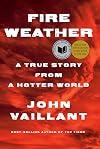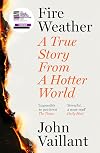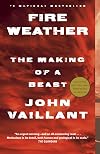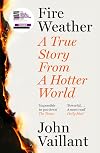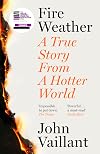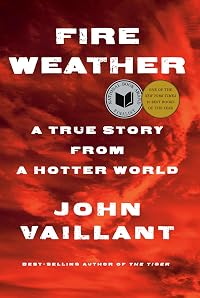
Fire Weather: A True Story from a Hotter World
by John Vaillant
On This Page
Description
"In May 2016, the city of Fort McMurray in Alberta, Canada, burned to the ground, forcing 88,000 people to flee their homes. It was the largest evacuation ever of a city in the face of a forest fire, raising the curtain on a new age of increasingly destructive wildfires. This book is a suspenseful account of one of North America's most devastating forest fires-and a stark exploration of our dawning era of climate catastrophes"--Tags
Recommendations




Member Recommendations
charlie68 A very readable book with a lot of inane facts that make the world more interesting.
Member Reviews
A number of years ago CBC published a list of 100 True Stories that Make You Proud to be Canadian. I think CBC needs to update the list and include this book on it. (Vaillant did have a book on that list--The Tiger -- which was a great book but it took place mostly in Siberia, whereas this is a story set right here.) Even if you followed every minute of coverage of the Fort MacMurray fire, I guarantee you will learn something new.
The book starts off with Origin Stories. Vaillant goes into how the oil industry started and grew into a mammoth business. The tar sands in northern Alberta were far from ideal in terms of accessibility or product but the oil companies and the Alberta government knew they could exploit this resource if they show more threw enough money and people at it. Years passed before the tar sands started showing a profit. And, like all resource industries, they are subject to the vicissitudes of the market place. Nevertheless, by May of 2016, over 100,000 people lived in Fort MacMurray and they earned incredible money. They had all the trappings of people with big money, big houses, big vehicles, lots of toys and lifestyle to equal the rich and famous.
In the second part of the book Vaillant describes the fire that overtook Fort Mac. On May 3, a wildfire started in the boreal forest close to the city. Within hours, everyone except first responders were evacuated as the city burned around them. Incredibly, no one died in the fire and only one person was killed as all these people evacuated. Vaillant goes into detail about why the fire was so bad but I won't repeat that. Just know that it was a fire like no-one there had ever experienced before. Actually, that's not quite true. A few years earlier, another Alberta community called Slave Lake experienced a similar conflagration and their fire chief and his son drove to Fort MacMurray to give the fire fighters there the benefit of their advice. However, by the time they got there any hope of turning the fire back was gone. Two story houses disappeared in five minutes after the fire struck them. Entire neighbourhoods were lost in the matter of minutes. The local fire fighters were aided by the provincial fire officials and heavy equipment from the mines were brought in. In some areas, this heavy equipment tore down new houses and pushed them into their basements to provide a fire break. It took several weeks before people could come back into the city and the fire was not put out completely until the next year.
The third part of the book, Reckonings, develops the connection between climate change and massive fires. One bombshell I learned from the book was that the oil companies had themselves done research on the increase of CO2 in the atmosphere and how that would impact Earth's climate but they disbanded the research in 1984. It is similar to the tobacco industry denying the health effects of their product for years after they knew from their own findings what was happening. And this may be the way, Vaillant speculates, to finally get to grips with climate change. Already there have been court challenges, some of which have been successful. If it is prohibitively expensive to carry on business as usual, then the oil industry will be forced to change.
One of the concepts this book introduced me to is the Lucretius Problem. Put simply, it is that a person will have difficulty imagining and assimilating things outside of their own personal experience. In the epic poem De Rarum Natura, Titus Lucretius Carus says
"Yes, and so any river is huge if it be the greatest man has seen
who has seen no greater before..
and each imagines as huge all things of every kind
which are greatest of those he has seen..."
Since reading about the Lucretius Problem I have postulated how it applies in any number of situations from people not shoveling the city sidewalk in front of their house because they don't personally walk the neighbourhood to children not learning to read cursive because they are not exposed to it. It's a game changer I think. show less
The book starts off with Origin Stories. Vaillant goes into how the oil industry started and grew into a mammoth business. The tar sands in northern Alberta were far from ideal in terms of accessibility or product but the oil companies and the Alberta government knew they could exploit this resource if they show more threw enough money and people at it. Years passed before the tar sands started showing a profit. And, like all resource industries, they are subject to the vicissitudes of the market place. Nevertheless, by May of 2016, over 100,000 people lived in Fort MacMurray and they earned incredible money. They had all the trappings of people with big money, big houses, big vehicles, lots of toys and lifestyle to equal the rich and famous.
In the second part of the book Vaillant describes the fire that overtook Fort Mac. On May 3, a wildfire started in the boreal forest close to the city. Within hours, everyone except first responders were evacuated as the city burned around them. Incredibly, no one died in the fire and only one person was killed as all these people evacuated. Vaillant goes into detail about why the fire was so bad but I won't repeat that. Just know that it was a fire like no-one there had ever experienced before. Actually, that's not quite true. A few years earlier, another Alberta community called Slave Lake experienced a similar conflagration and their fire chief and his son drove to Fort MacMurray to give the fire fighters there the benefit of their advice. However, by the time they got there any hope of turning the fire back was gone. Two story houses disappeared in five minutes after the fire struck them. Entire neighbourhoods were lost in the matter of minutes. The local fire fighters were aided by the provincial fire officials and heavy equipment from the mines were brought in. In some areas, this heavy equipment tore down new houses and pushed them into their basements to provide a fire break. It took several weeks before people could come back into the city and the fire was not put out completely until the next year.
The third part of the book, Reckonings, develops the connection between climate change and massive fires. One bombshell I learned from the book was that the oil companies had themselves done research on the increase of CO2 in the atmosphere and how that would impact Earth's climate but they disbanded the research in 1984. It is similar to the tobacco industry denying the health effects of their product for years after they knew from their own findings what was happening. And this may be the way, Vaillant speculates, to finally get to grips with climate change. Already there have been court challenges, some of which have been successful. If it is prohibitively expensive to carry on business as usual, then the oil industry will be forced to change.
One of the concepts this book introduced me to is the Lucretius Problem. Put simply, it is that a person will have difficulty imagining and assimilating things outside of their own personal experience. In the epic poem De Rarum Natura, Titus Lucretius Carus says
"Yes, and so any river is huge if it be the greatest man has seen
who has seen no greater before..
and each imagines as huge all things of every kind
which are greatest of those he has seen..."
Since reading about the Lucretius Problem I have postulated how it applies in any number of situations from people not shoveling the city sidewalk in front of their house because they don't personally walk the neighbourhood to children not learning to read cursive because they are not exposed to it. It's a game changer I think. show less
Summary: An account of the Fort McMurray fire of 2016, when a forest fire consumed a town and became a harbinger of things to come in a hotter, drier world.
I never wore face masks outdoors during all of the COVID epidemic. I did several days last summer when a smoky haze that had traveled a thousand miles settled over the Midwest and other parts of the eastern United States. For much of the summer, vast tracts of forest were on fire in Canada. News just today indicates there are zombie fires burning underground and dry conditions in western Canada portend another fire summer.
John Vaillant tells the story of what happened when a raging wilderness fire intersected with an oil industry town, Fort McMurray in Alberta. Fort McMurray grew to show more a city of 90,000 people because of our insatiable thirst for oil. The tar sands nearby are rich in bitumen, which can be converted through energy intensive processes to the petroleum products helping to warm our atmosphere. Fort McMurray also exists in the heart of the boreal forests that stretch across the north of Canada.
Conditions in the spring of 2016 were exceptionally warm and dry. A high pressure system yielded blue skies unseasonably high temperatures and low humidity, further drying out the forest around the town. On May 1, a small fire known as Fire 009, the ninth fire around Fort McMurray, was sited southwest of the town, on the other side of the river. By May 2, officials began to worry, even as they projected calm. But those in the know knew May 3 would be hard. No one knew how hard. Another hot, dry day, with winds coming around to blow out of the southwest and freshening. All the ingredients were present for the fire to explode…and it did. The morning began with brilliant blue skies. Suddenly, at 12:15, everyone discovered that a monster was among them. In rapid order, neighborhoods were consumed. While people got up expecting a normal day, suddenly they needed to evacuate–immediately–90,000 of them.
The amazing story is that none of them died. But much of the town did. Firefighters tore down rows of houses and were able to save others. What they discovered however was that when a fire became this intense, rivers were not a barrier, that fire tornados and other freak meteorological occurrences could cast the fire over firebreaks and natural obstacles. The fire would seek fuel.
That’s one of the interesting things the emerges from Vaillant’s rendering of the many eyewitness accounts–that the fire was a kind of living thing–akin to the Balrog in The Lord of the Rings. He describes the flammability of the boreal forest, particularly the black spruces, dripping with sap, exploding into flame as the wall of heat of the fire approaches. They are like bombs, containing all this stored energy. Vaillant describes another kind of bomb–the residential houses in the fire’s path. Made of vinyl siding, kiln dried wood framing, shingled roofs, polyurethane, polyester in furniture curtains and clothes, and all sorts of other petroleum based plastics throughout as well as gas cans, propane tanks, and other flammables. Houses went from livable structures to holes in the ground in less than five minutes.
Vaillant describes the stunning awakening from “this is no big deal” to “the apocalypse has come” of the residents. He goes on to describe the slower, more insidious burn as our atmosphere warms. He retells the story of what we know and when we knew it about greenhouse gasses and anthropogenic global warming. The basic physics was demonstrated in 1856. By 1956, scientists were testifying before Congress. Their predictions, even back then are startlingly accurate. There was no partisan debate. But nothing was done. As early as the 1970’s, the oil companies own scientists knew. And there was a window of time when something could be done to avert the dramatic climate changes we are seeing. Now we may be facing a rapidly closing window to avert changes on such a scale that they result in a mass extinction of much of life.
Vaillant is one of many voices describing the future on our doorstep. Year round fire seasons in many parts of the world is the impact on which he focuses. Fuel, dry conditions, wind, and a spark are all that’s needed for another Fort McMurray at the wilderness urban interfaces where many of us live. The irony is that we keep lighting the fire that fuels the fire everyday. Fort McMurray with its petrochemical industry, is in microcosm the story in which we all are implicated. Vaillant not only tells a riveting story about a monster fire. He tells a sobering story that demands we face the reality of the world we are leaving our children and grandchildren. It could very well be one where they are fighting, and maybe running, for their lives. But to where will they run? show less
I never wore face masks outdoors during all of the COVID epidemic. I did several days last summer when a smoky haze that had traveled a thousand miles settled over the Midwest and other parts of the eastern United States. For much of the summer, vast tracts of forest were on fire in Canada. News just today indicates there are zombie fires burning underground and dry conditions in western Canada portend another fire summer.
John Vaillant tells the story of what happened when a raging wilderness fire intersected with an oil industry town, Fort McMurray in Alberta. Fort McMurray grew to show more a city of 90,000 people because of our insatiable thirst for oil. The tar sands nearby are rich in bitumen, which can be converted through energy intensive processes to the petroleum products helping to warm our atmosphere. Fort McMurray also exists in the heart of the boreal forests that stretch across the north of Canada.
Conditions in the spring of 2016 were exceptionally warm and dry. A high pressure system yielded blue skies unseasonably high temperatures and low humidity, further drying out the forest around the town. On May 1, a small fire known as Fire 009, the ninth fire around Fort McMurray, was sited southwest of the town, on the other side of the river. By May 2, officials began to worry, even as they projected calm. But those in the know knew May 3 would be hard. No one knew how hard. Another hot, dry day, with winds coming around to blow out of the southwest and freshening. All the ingredients were present for the fire to explode…and it did. The morning began with brilliant blue skies. Suddenly, at 12:15, everyone discovered that a monster was among them. In rapid order, neighborhoods were consumed. While people got up expecting a normal day, suddenly they needed to evacuate–immediately–90,000 of them.
The amazing story is that none of them died. But much of the town did. Firefighters tore down rows of houses and were able to save others. What they discovered however was that when a fire became this intense, rivers were not a barrier, that fire tornados and other freak meteorological occurrences could cast the fire over firebreaks and natural obstacles. The fire would seek fuel.
That’s one of the interesting things the emerges from Vaillant’s rendering of the many eyewitness accounts–that the fire was a kind of living thing–akin to the Balrog in The Lord of the Rings. He describes the flammability of the boreal forest, particularly the black spruces, dripping with sap, exploding into flame as the wall of heat of the fire approaches. They are like bombs, containing all this stored energy. Vaillant describes another kind of bomb–the residential houses in the fire’s path. Made of vinyl siding, kiln dried wood framing, shingled roofs, polyurethane, polyester in furniture curtains and clothes, and all sorts of other petroleum based plastics throughout as well as gas cans, propane tanks, and other flammables. Houses went from livable structures to holes in the ground in less than five minutes.
Vaillant describes the stunning awakening from “this is no big deal” to “the apocalypse has come” of the residents. He goes on to describe the slower, more insidious burn as our atmosphere warms. He retells the story of what we know and when we knew it about greenhouse gasses and anthropogenic global warming. The basic physics was demonstrated in 1856. By 1956, scientists were testifying before Congress. Their predictions, even back then are startlingly accurate. There was no partisan debate. But nothing was done. As early as the 1970’s, the oil companies own scientists knew. And there was a window of time when something could be done to avert the dramatic climate changes we are seeing. Now we may be facing a rapidly closing window to avert changes on such a scale that they result in a mass extinction of much of life.
Vaillant is one of many voices describing the future on our doorstep. Year round fire seasons in many parts of the world is the impact on which he focuses. Fuel, dry conditions, wind, and a spark are all that’s needed for another Fort McMurray at the wilderness urban interfaces where many of us live. The irony is that we keep lighting the fire that fuels the fire everyday. Fort McMurray with its petrochemical industry, is in microcosm the story in which we all are implicated. Vaillant not only tells a riveting story about a monster fire. He tells a sobering story that demands we face the reality of the world we are leaving our children and grandchildren. It could very well be one where they are fighting, and maybe running, for their lives. But to where will they run? show less
Fire Weather: A True Story from a Hotter World is one of those “every human being should read this book” books. It’s that important. I have to admit, I’ve been a little bit of a head in the sand consumer of climate change journalism. It isn’t that I don’t believe in it. In fact, it’s probably just the opposite: I know it’s real and it’s catastrophic and it’s inevitable. Out of sight, out of mind. Well, that has to end or we end. Maybe not “we,” but certainly our grandchildren and great-grandchildren…if they manage to make it to existence.
The first 2/3 of this book provides the hook. It’s all about the wildfires in Alberta Canada. The last third is the lesson, a lesson that far too many, especially the show more political right, have refused to believe. I found out reading the book that much of the climate denying industry has quietly divested themselves of energy investments, not because they want to send a message, but because they know those companies are doomed. These deniers just don’t want to contribute to the truth getting out because it will hurt the price of their soon to be abandoned investments.
The political right all over the world but most notably in this country has been responsible for an awful lot of awful things in the past generation including an attempt to overthrow a duly elected government. But hard as that is to believe, its attempt to deny climate change is existential. We can live under an autocrat. We can live if climate change wins. show less
The first 2/3 of this book provides the hook. It’s all about the wildfires in Alberta Canada. The last third is the lesson, a lesson that far too many, especially the show more political right, have refused to believe. I found out reading the book that much of the climate denying industry has quietly divested themselves of energy investments, not because they want to send a message, but because they know those companies are doomed. These deniers just don’t want to contribute to the truth getting out because it will hurt the price of their soon to be abandoned investments.
The political right all over the world but most notably in this country has been responsible for an awful lot of awful things in the past generation including an attempt to overthrow a duly elected government. But hard as that is to believe, its attempt to deny climate change is existential. We can live under an autocrat. We can live if climate change wins. show less
his is not planet Earth as we found it. This is a new place–a fire planet we have made, with an atmosphere more conductive to combustion than at any time in the past 3 millions years. from Fire Weather by John Vaillant
First, there is Origin Stories, setting up the background information with a history of the Petrocene Age and the Alberta, Canada, oil sands, the use of hydrocarbons turning Homo Sapiens into Homo Flagrans. Then, Fire Weather, bringing alive the horror of the fire that destroyed Fort McMurray, home to thousands working to extract and process bitumen oil sands. We see how easily and quickly fire becomes a monsterous force destroying everything in its path, incinerating houses in minutes, melting aluminium from car tires. show more And last comes the Reckoning, a shattering recounting of how quickly humanity has altered our world, and despite knowing since the 1850s that we are doing so, how we continue to burn fossil fuels and accept the consequences.
But hope is a human construct, a coping mechanism in the face of an uncertainty that holds no sway in the natural world… there is a fine line between hope and denial and delusion. from Fire Weather by John Vaillant
This is a truly terrifying book. The inalterable force of nature. Humankind’s resistance in the face of fact. The improbable miracle of a planet capable of sustaining life in all its beauty and variety, a “stange and precarious grace” that we are even here. The power we have to destroy this home, or save it.
Thanks to the publisher for a free book. show less
First, there is Origin Stories, setting up the background information with a history of the Petrocene Age and the Alberta, Canada, oil sands, the use of hydrocarbons turning Homo Sapiens into Homo Flagrans. Then, Fire Weather, bringing alive the horror of the fire that destroyed Fort McMurray, home to thousands working to extract and process bitumen oil sands. We see how easily and quickly fire becomes a monsterous force destroying everything in its path, incinerating houses in minutes, melting aluminium from car tires. show more And last comes the Reckoning, a shattering recounting of how quickly humanity has altered our world, and despite knowing since the 1850s that we are doing so, how we continue to burn fossil fuels and accept the consequences.
But hope is a human construct, a coping mechanism in the face of an uncertainty that holds no sway in the natural world… there is a fine line between hope and denial and delusion. from Fire Weather by John Vaillant
This is a truly terrifying book. The inalterable force of nature. Humankind’s resistance in the face of fact. The improbable miracle of a planet capable of sustaining life in all its beauty and variety, a “stange and precarious grace” that we are even here. The power we have to destroy this home, or save it.
Thanks to the publisher for a free book. show less
The most frightening book I have read, or close enough. Climate change drives more intense wildfires, which in turn drive further climate change. Whether this will be what topples us... we'll never know, anyway! Plenty of other entrants!
This book rotates through several perspectives. We get detailed narratives of catastrophic fires - mostly Fort McMurray in Alberta, but also Redding, California. We also get a good outline of the history of understanding of the chain from combustion through CO2 to climate change. There is also a nice historical outline of petroleum and bitumen extraction.
Vaillant is not a scientist, so there are occasional bloopers ... e.g. he says that CO2 gets its mass from carbon. Well, as I remember the properties show more of elements, oxygen atoms are heavier than carbon atoms, and there are two oxygen atoms in CO2 to the one carbon atom. Well, I suppose CO2 is heavier than O2 because of the added carbon atom. Anyway this quibble doesn't affect the validity of the discussion in the book.
I really appreciated that Vaillant says that it's not technology that might steer us away from the looming catastrophe, but a change in our understanding and values. Which change would be easier? One place he doesn't really go, not in any depth... the more that environmental stresses impact us, the crazier our politics get, which actually accelerate the environmental stresses. Drill, baby, drill! That's another dire feedback loop. show less
This book rotates through several perspectives. We get detailed narratives of catastrophic fires - mostly Fort McMurray in Alberta, but also Redding, California. We also get a good outline of the history of understanding of the chain from combustion through CO2 to climate change. There is also a nice historical outline of petroleum and bitumen extraction.
Vaillant is not a scientist, so there are occasional bloopers ... e.g. he says that CO2 gets its mass from carbon. Well, as I remember the properties show more of elements, oxygen atoms are heavier than carbon atoms, and there are two oxygen atoms in CO2 to the one carbon atom. Well, I suppose CO2 is heavier than O2 because of the added carbon atom. Anyway this quibble doesn't affect the validity of the discussion in the book.
I really appreciated that Vaillant says that it's not technology that might steer us away from the looming catastrophe, but a change in our understanding and values. Which change would be easier? One place he doesn't really go, not in any depth... the more that environmental stresses impact us, the crazier our politics get, which actually accelerate the environmental stresses. Drill, baby, drill! That's another dire feedback loop. show less
One might think that the story of the great fire of Ft. McMurray, Alberta in 2016 would be similar to other accounts of disaster. The reader would be both horrified and somewhat reassured by the distance of the disaster from his own home in time and space. He or she might tell themself that they wouldn’t have bought tickets on the Titanic or been unlucky enough to be in Galveston in 1900. But this account is different since the author shows us how the Ft. McMurray fire was an example of things to come and that it was secondary to the increase in atmospheric carbon dioxide, which is not just a Canadian problem. I have had trouble sleeping since reading this.
===================
The author is fond of his similes. The book is peppered with show more them. Fire is like a person, a general, a flower, a lemur, a hurricane, like an oven filled with shoeboxes, etc., and fighting one is like playing lacrosse, but only "as it was originally conceived". These were distracting.
The author uses some big words, which I sometimes appreciated as with anagnorisis and ignescent, but which sometimes were a distraction as with infandous. I don’t think I've ever heard or read the word infandous before [My spellchecker recommends I use infamous.]. It is not in the Random House or Merriam-Webster unabridged dictionaries. I found it in the 1928 Oxford unabridged dictionary where it is listed as obsolete with references from the 17th century. It is also listed in Mrs. Byrne’s Dictionary of Unusual, Obscure, and Preposterous Words.
I appreciated the quote from Albert Bartlett, "The greatest shortcoming of the human race is our inability to understand the exponential function." I don't know if it is our greatest shortcoming, and it was Bartlett's thing, but I think it is clear that it is an especially unfortunate feature of innumeracy. I also liked the quote from Aubrey Clayton, "The problem with exponential growth is that it means most of the change is always in the recent past". I have asked critics if they remember Al Gore in a cherry-picker in front of a graph of atmospheric carbon dioxide over time. They laugh and say yes, and I inform them that since that movie was made we have produced more carbon dioxide than since we discovered fire. Not all graphed functions are linear. show less
===================
The author is fond of his similes. The book is peppered with show more them. Fire is like a person, a general, a flower, a lemur, a hurricane, like an oven filled with shoeboxes, etc., and fighting one is like playing lacrosse, but only "as it was originally conceived". These were distracting.
The author uses some big words, which I sometimes appreciated as with anagnorisis and ignescent, but which sometimes were a distraction as with infandous. I don’t think I've ever heard or read the word infandous before [My spellchecker recommends I use infamous.]. It is not in the Random House or Merriam-Webster unabridged dictionaries. I found it in the 1928 Oxford unabridged dictionary where it is listed as obsolete with references from the 17th century. It is also listed in Mrs. Byrne’s Dictionary of Unusual, Obscure, and Preposterous Words.
I appreciated the quote from Albert Bartlett, "The greatest shortcoming of the human race is our inability to understand the exponential function." I don't know if it is our greatest shortcoming, and it was Bartlett's thing, but I think it is clear that it is an especially unfortunate feature of innumeracy. I also liked the quote from Aubrey Clayton, "The problem with exponential growth is that it means most of the change is always in the recent past". I have asked critics if they remember Al Gore in a cherry-picker in front of a graph of atmospheric carbon dioxide over time. They laugh and say yes, and I inform them that since that movie was made we have produced more carbon dioxide than since we discovered fire. Not all graphed functions are linear. show less
4.5 stars
Record-breaking heat, strong winds, and desert-like humidity all played a part in the wildfire that hit Fort McMurray, Alberta in May 2016. This book initially introduces the reader to Fort McMurray and its main industry, the oil patch (or tarsands, to be more accurate – that’s not just the environmentalist in me saying that; it seems that really is the most accurate term for it (vs “oilsands” – it really is tar until a lot of equipment, energy, money, etc. go into it to make it liquid)).
The next section is all about the fire, as 88,000 people evacuated the city with no notice, almost all heading out the one highway in/out that doesn’t lead to a dead end. The book then mostly followed first responders who stayed show more back to fight the fires.
The last section of the book discusses climate change. And the impact this has on the environment, the temperature, fires, and other major disasters that are now happening much more frequently and are stronger than ever before.
I live in Alberta and very distinctly remember the wildfire; I expect many people around the world also remember, with the images and videos that came out as people were evacuating. I remember the one person’s camera inside their house with the fish tank that recorded the fire taking over the house until the camera cut out – this is described in the book (and I went to rewatch the video – those poor fish!).
I have never been to Fort McMurray, nor do I know anyone who works in the oil patch (if I do, I don’t know them well). Of course, the fire was the main pull for me to read the book; I also am fascinated by disaster stories. But also: has anyone else heard of “fire tornadoes”!? Holy crap! New phenomenon. The first one ever occurred in Australia in 2003, then it happened in California in 2017 or 2018. Crazy! The author did provide a lot of information on fires, in general, as well, which I found interesting.
I also read a lot about climate change, and Vaillant had a lot of information in this book, including quite a bit about oil companies that knew what was happening and that humans (and the contributions from oil/gas production) were part of (that is, the main) cause of climate change this time around. It made me think of tobacco companies who didn’t want to lose their profits, so they not only do nothing, they stifle attempts to make things better. show less
Record-breaking heat, strong winds, and desert-like humidity all played a part in the wildfire that hit Fort McMurray, Alberta in May 2016. This book initially introduces the reader to Fort McMurray and its main industry, the oil patch (or tarsands, to be more accurate – that’s not just the environmentalist in me saying that; it seems that really is the most accurate term for it (vs “oilsands” – it really is tar until a lot of equipment, energy, money, etc. go into it to make it liquid)).
The next section is all about the fire, as 88,000 people evacuated the city with no notice, almost all heading out the one highway in/out that doesn’t lead to a dead end. The book then mostly followed first responders who stayed show more back to fight the fires.
The last section of the book discusses climate change. And the impact this has on the environment, the temperature, fires, and other major disasters that are now happening much more frequently and are stronger than ever before.
I live in Alberta and very distinctly remember the wildfire; I expect many people around the world also remember, with the images and videos that came out as people were evacuating. I remember the one person’s camera inside their house with the fish tank that recorded the fire taking over the house until the camera cut out – this is described in the book (and I went to rewatch the video – those poor fish!).
I have never been to Fort McMurray, nor do I know anyone who works in the oil patch (if I do, I don’t know them well). Of course, the fire was the main pull for me to read the book; I also am fascinated by disaster stories. But also: has anyone else heard of “fire tornadoes”!? Holy crap! New phenomenon. The first one ever occurred in Australia in 2003, then it happened in California in 2017 or 2018. Crazy! The author did provide a lot of information on fires, in general, as well, which I found interesting.
I also read a lot about climate change, and Vaillant had a lot of information in this book, including quite a bit about oil companies that knew what was happening and that humans (and the contributions from oil/gas production) were part of (that is, the main) cause of climate change this time around. It made me think of tobacco companies who didn’t want to lose their profits, so they not only do nothing, they stifle attempts to make things better. show less
Members
- Recently Added By
Lists

Globe and Mail | Canadian Non-Fiction: June 3, 2023
10 works; 1 member

Globe and Mail | Canadian Non-Fiction: June 29, 2024
10 works; 1 member

Globe and Mail | Canadian Non-Fiction: January 25, 2025
10 works; 1 member

Top Five Books of 2024
795 works; 264 members

read in 2024
21 works; 1 member

Evergreen Award™ Winners and Nominees 2005–2024
200 works; 3 members
Globe and Mail | Canadian Non-Fiction: August 31, 2024
10 works; 1 member
Globe and Mail | Canadian Non-Fiction: August 24, 2024
10 works; 1 member
Globe and Mail | Canadian Non-Fiction: August 17, 2024
10 works; 1 member
Globe and Mail | Canadian Non-Fiction: August 10, 2024
10 works; 1 member
Globe and Mail | Canadian Non-Fiction: August 3, 2024
10 works; 1 member
Globe and Mail | Canadian Non-Fiction: July 27, 2024
10 works; 1 member
Globe and Mail | Canadian Non-Fiction: July 20, 2024
10 works; 1 member
Globe and Mail | Canadian Non-Fiction: July 13, 2024
10 works; 1 member

Globe and Mail | Canadian Non-Fiction: June 1, 2024
10 works; 1 member
Globe and Mail | Canadian Non-Fiction: June 10, 2023
10 works; 1 member
Globe and Mail | Canadian Non-Fiction: May 25, 2024
10 works; 1 member
Globe and Mail | Canadian Non-Fiction: May 18, 2024
10 works; 1 member
Globe and Mail | Canadian Non-Fiction: February 17, 2024
10 works; 1 member

Recently Added January 2024
8 works; 1 member

Books Read in 2024
4,623 works; 126 members
Globe and Mail | Canadian Non-Fiction: September 9, 2023
10 works; 1 member

Globe and Mail | Canadian Non-Fiction: September 2, 2023
10 works; 2 members
Globe and Mail | Canadian Non-Fiction: August 26, 2023
10 works; 1 member
Globe and Mail | Canadian Non-Fiction: July 22, 2023
10 works; 1 member
Globe and Mail | Canadian Non-Fiction: July 15, 2023
10 works; 1 member
Globe and Mail | Canadian Non-Fiction: July 8, 2023
10 works; 1 member
Globe and Mail | Canadian Non-Fiction: June 24, 2023
10 works; 1 member

Globe and Mail | Canadian Non-Fiction: June 17, 2023
10 works; 1 member
Top Five Books of 2025
954 works; 303 members
Author Information

5+ Works 3,570 Members
Some Editions
Awards and Honors
Common Knowledge
- Original publication date
- 2023-06-06
- Important places
- Fort McMurray, Alberta, Canada
- Important events
- 2016 Wildfire in Fort McMurray
- Epigraph
- In this great chain of causes and effects, no single fact can be considered in isolation. -Alexander von Humbolt
- Dedication
- To the scientists and visionaries
- First words
- On a hot afternoon in May 2016, five miles outside the young petro-city of Fort Murray, Alberta, a small wildfire flickered and ventilated, rapidly expanding its territory through a mixed forest that hadn't seen fire in decad... (show all)es. -Prologue
'If a tree burns in a forest and nobody sees it...' In Canada, this is more than a philosophical question. -Chapter 1 - Last words
- (Click to show. Warning: May contain spoilers.)Homo viriditas can guide us forward -- and, possibly, back.
- Blurbers
- Wallace-Wells, David; Gourevitch, Philip; Demuth, Bathsheba; Pyne, Stephen J.; Macfarlane, Robert
- Original language
- English
- Canonical DDC/MDS
- 363.37
- Canonical LCC
- SD421.N67
Classifications
- Genres
- Science & Nature, General Nonfiction, Nonfiction, History
- DDC/MDS
- 363.37 — Society, government, & culture Social problems and social services Public Safety - Police, Crime Investigation Terrorism, Disasters, Civil Defense Fires and fire-fighting
- LCC
- SD421 .N67 — Agriculture Forestry. Arboriculture. Silviculture Forestry Conservation and protection
- BISAC
Statistics
- Members
- 658
- Popularity
- 43,874
- Reviews
- 28
- Rating
- (4.42)
- Languages
- English, Italian, Spanish
- Media
- Paper, Audiobook, Ebook
- ISBNs
- 14
- ASINs
- 8