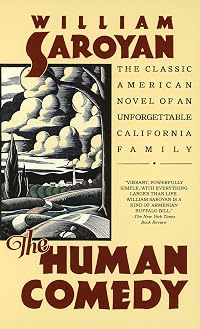
The Human Comedy
by William Saroyan
On This Page
Description
The place is Ithaca, in California's San Joaquin Valley. The time is World War II. The family is the Macauley's -- a mother, sister, and three brothers whose struggles and dreams reflect those of America's second-generation immigrants. In particular, fourteen-year-old Homer, determined to become one of the fastest telegraph messengers in the West, finds himself caught between reality and illusion as delivering his messages of wartime death, love, and money brings him face-to-face with human show more emotion at its most naked and raw. Gentle, poignant and richly autobiographical, this delightful novel shows us the boy becoming the man in a world that even in the midst of war, appears sweeter, safer and more livable than out own. show lessTags
Recommendations



































Member Recommendations

Member Reviews
This was Saroyan's own novelisation of a screenplay he'd written for MGM, which perhaps accounts for its almost unbearably decent, optimistic, American-Dream-celebrating tone.
It's 1943, and the small town of Ithaca in California's San Joaquin Valley is a place where the locals are happy to lecture you on profound truths of human nature at a moment's notice at any time of day or night, whilst ev'ry prospect pleases and only sports teachers are vile. The young men are away fighting a distant and seemingly endless war (it's not called Ithaca by accident, evidently), and child-labour is a lesser evil than the unspeakable thought that women and girls might be forced to go out to work, so fourteen-year-old Homer (!) is working nights show more delivering telegrams whilst his even younger friend August sells newspapers on street corners. Long live the free market!
There are a lot of lovely little scenes in this book — the raid on the unripe apricot tree, the scene where Homer's little brother Ulysses (!!) gets caught in a patent trap and no-one knows how to release him, and best of all Homer's impromptu lecture on noses in Ancient History. But it's not really enough to defeat the unrelenting niceness and the dead hand of narrative inevitability: we know from the start that there's only one way a story about a telegram boy whose brother is away in the war can end. show less
It's 1943, and the small town of Ithaca in California's San Joaquin Valley is a place where the locals are happy to lecture you on profound truths of human nature at a moment's notice at any time of day or night, whilst ev'ry prospect pleases and only sports teachers are vile. The young men are away fighting a distant and seemingly endless war (it's not called Ithaca by accident, evidently), and child-labour is a lesser evil than the unspeakable thought that women and girls might be forced to go out to work, so fourteen-year-old Homer (!) is working nights show more delivering telegrams whilst his even younger friend August sells newspapers on street corners. Long live the free market!
There are a lot of lovely little scenes in this book — the raid on the unripe apricot tree, the scene where Homer's little brother Ulysses (!!) gets caught in a patent trap and no-one knows how to release him, and best of all Homer's impromptu lecture on noses in Ancient History. But it's not really enough to defeat the unrelenting niceness and the dead hand of narrative inevitability: we know from the start that there's only one way a story about a telegram boy whose brother is away in the war can end. show less
Leyendo este libro he sentido simple y pura felicidad. Hacía mucho tiempo que no tenía este sentimiento leyendo un libro. Mientras lo leía me parecía estar dentro de una de esas viejas películas de Frank Capra. Hay que tener en cuenta que 'La comedia humana' es una novela escrita a principios de los 40, en plena Guerra Mundial, y eso se nota. Lo que me ha recordado a Capra han sido los personajes, su manera de pensar y de sentir, su bondad. Y es que esta novela me ha hecho reconciliarme con el género humano, en que podemos ser mejores de lo que somos. Se trata de un libro vivo, triste, feliz y maravilloso.
La historia transcurre en Ithaca, un pequeño pueblo californiano, y dos de los protagonistas se llaman Homer y Ulysses, como show more no podía ser menos. Se puede decir que hay un protagonista principal, Homer, aunque la novela es más bien coral, en donde vamos conociendo a algunos de los habitantes de este pueblo. Homer es un joven de 14 años que estudia de día y por la tarde trabaja como mensajero en la compañía de telégrafos. A veces ha de entregar telegramas en los que se comunica la muerte de algún soldado, y ésto lo deja cada vez más triste. Pero no puede dejar este trabajo porque necesita el dinero para su familia, ya que su hermano Marcus está en el frente y su padre falleció. También le gusta el trabajo, así como su jefe, el señor Spangler, y el telegrafista, el viejo señor Groggan. Estos dos personajes son maravillosos. Otro personaje entrañable es Ulysses, su hermano pequeño, un niño que siente curiosidad por todo y que nos ofrece algunos momentos memorables. Toda la novela está plagada de grandes personajes. Otra cosa a reseñar es que Saroyan no permanece ajeno al absurdo de las guerras y lo deja bien claro con su historia.
Al igual que ya no se ruedan películas como las de antes, tampoco se escriben libros con los de antes, como éste. show less
La historia transcurre en Ithaca, un pequeño pueblo californiano, y dos de los protagonistas se llaman Homer y Ulysses, como show more no podía ser menos. Se puede decir que hay un protagonista principal, Homer, aunque la novela es más bien coral, en donde vamos conociendo a algunos de los habitantes de este pueblo. Homer es un joven de 14 años que estudia de día y por la tarde trabaja como mensajero en la compañía de telégrafos. A veces ha de entregar telegramas en los que se comunica la muerte de algún soldado, y ésto lo deja cada vez más triste. Pero no puede dejar este trabajo porque necesita el dinero para su familia, ya que su hermano Marcus está en el frente y su padre falleció. También le gusta el trabajo, así como su jefe, el señor Spangler, y el telegrafista, el viejo señor Groggan. Estos dos personajes son maravillosos. Otro personaje entrañable es Ulysses, su hermano pequeño, un niño que siente curiosidad por todo y que nos ofrece algunos momentos memorables. Toda la novela está plagada de grandes personajes. Otra cosa a reseñar es que Saroyan no permanece ajeno al absurdo de las guerras y lo deja bien claro con su historia.
Al igual que ya no se ruedan películas como las de antes, tampoco se escriben libros con los de antes, como éste. show less
The title implies medieval farce, but what you get is a coming-of-age story set in 1940s California - a really good one. I'm as ready as the next person to chew apart and nitpick any novel to death (often more than most, actually), but in this case something's reached me so strongly that all I can see is the good in it.
I've read the negative criticisms. If this novel is "too sentimental," then I guess I've become a sentimental fool or else that's what it takes to beat down my jaded walls. If it's "too moralizing," I guess I'm foolish to wish I could say half these things so clearly to my own sons, who are still too young for this book. We don't live in such different circumstances than the 1940s that these simple truths about the show more realities of life (and death) aren't still applicable to anyone, anywhere. They can be so very hard to convey, absorb and understand for any of us at any age. Saroyan took a pretty fair shake at trying to help us do it this one time and I can afford to be a little grateful. show less
I've read the negative criticisms. If this novel is "too sentimental," then I guess I've become a sentimental fool or else that's what it takes to beat down my jaded walls. If it's "too moralizing," I guess I'm foolish to wish I could say half these things so clearly to my own sons, who are still too young for this book. We don't live in such different circumstances than the 1940s that these simple truths about the show more realities of life (and death) aren't still applicable to anyone, anywhere. They can be so very hard to convey, absorb and understand for any of us at any age. Saroyan took a pretty fair shake at trying to help us do it this one time and I can afford to be a little grateful. show less
All'inizio lo trovavo un po' stucchevole. E a me lo stucchevole non dispiace. C'è un po' di Frank Capra qui.
C'è da dire che l'ho letto in uno stato psichico particolare.
Non era certo il momento adatto, personalmente, per una storia così, anche se proseguendo la lettura ho iniziato ad entrare in sintonia con i personaggi e quell'ingenuità di cui parlava qualcuno è forse voluta, per esorcizzare quei momenti, come accennato anche nella prefazione:
Nella Commedia umana quindi l’autore non si propone tanto di descrivere la realtà, quanto di trasfigurarla in modo fantastico, come indica questo finale del romanzo. Gli stessi personaggi non sono realistici, ma hanno un valore simbolico...
La commedia umana rappresenta quindi un mondo show more ideale, senza difetti e senza contrasti, dove tutti sono buoni e puri ed esprimono nobili sentimenti e grande umanità, un paradiso perduto verso cui il lettore non può non sentire profonda nostalgia. In esso ogni aspetto negativo della vita sembra scomparire o diventare comunque più leggero. Perfino la guerra che infuria nel mondo, e che porta dovunque dolore e morte, viene vista senza eccessiva tragicità.
Forse sono storie così invece, e Frank Capra, che si potrebbe leggere e vedere per tirarsi su quando le cose vanno male.
Anche se oggi in molti li ritengono superati: si predilige l'ambiguità dei personaggi a quelli bidimensionali.
Il che è un bene nella maggior parte dei casi, ma oggi si eccede al contrario. Ogni tanto un po' di sana retorica e buoni sentimenti fa bene al cuore.
Commuoversi per l'idealismo di Jefferson Smith in "Mr. Smith va a Washington" e pensare "vorrei essere così" invece di rimanere affascinati da Tony Montana e dire "Cazzo che forte! li ha sterminati tutti!"(Frase che a suo tempo, ovviamente, ho detto anche io).
Leggere di personaggi dal cuore d'oro come Spangler, di ragazzini svegli come Omero e dolci come Ulisse non può non toccare il cuore.
Solo i cinici rimangono indifferenti, e spesso anche infastiditi, dalla rappresentazione di un personaggio puro.
Chi se ne frega se nella vita non esistono persone completamente pure e ognuno ha i suoi demoni, chi se ne frega della verosimiglianza, sognare non è vietato.
E nemmeno provare nostalgia, come dice nella prefazione, penso, Anna De Palma, per un periodo che non ho mai vissuto.
C'è anche una certa somiglianza con Bradbury (Un'estate incantata) nel modo di raccontare l'infanzia. Con amore e nostalgia.
E poi alcuni di quei passaggi educativi, ancora oggi, non farebbero male ai giovanissimi e forse nemmeno a qualche adulto. show less
C'è da dire che l'ho letto in uno stato psichico particolare.
Non era certo il momento adatto, personalmente, per una storia così, anche se proseguendo la lettura ho iniziato ad entrare in sintonia con i personaggi e quell'ingenuità di cui parlava qualcuno è forse voluta, per esorcizzare quei momenti, come accennato anche nella prefazione:
Nella Commedia umana quindi l’autore non si propone tanto di descrivere la realtà, quanto di trasfigurarla in modo fantastico, come indica questo finale del romanzo. Gli stessi personaggi non sono realistici, ma hanno un valore simbolico...
La commedia umana rappresenta quindi un mondo show more ideale, senza difetti e senza contrasti, dove tutti sono buoni e puri ed esprimono nobili sentimenti e grande umanità, un paradiso perduto verso cui il lettore non può non sentire profonda nostalgia. In esso ogni aspetto negativo della vita sembra scomparire o diventare comunque più leggero. Perfino la guerra che infuria nel mondo, e che porta dovunque dolore e morte, viene vista senza eccessiva tragicità.
Forse sono storie così invece, e Frank Capra, che si potrebbe leggere e vedere per tirarsi su quando le cose vanno male.
Anche se oggi in molti li ritengono superati: si predilige l'ambiguità dei personaggi a quelli bidimensionali.
Il che è un bene nella maggior parte dei casi, ma oggi si eccede al contrario. Ogni tanto un po' di sana retorica e buoni sentimenti fa bene al cuore.
Commuoversi per l'idealismo di Jefferson Smith in "Mr. Smith va a Washington" e pensare "vorrei essere così" invece di rimanere affascinati da Tony Montana e dire "Cazzo che forte! li ha sterminati tutti!"(Frase che a suo tempo, ovviamente, ho detto anche io).
Leggere di personaggi dal cuore d'oro come Spangler, di ragazzini svegli come Omero e dolci come Ulisse non può non toccare il cuore.
Solo i cinici rimangono indifferenti, e spesso anche infastiditi, dalla rappresentazione di un personaggio puro.
Chi se ne frega se nella vita non esistono persone completamente pure e ognuno ha i suoi demoni, chi se ne frega della verosimiglianza, sognare non è vietato.
E nemmeno provare nostalgia, come dice nella prefazione, penso, Anna De Palma, per un periodo che non ho mai vissuto.
C'è anche una certa somiglianza con Bradbury (Un'estate incantata) nel modo di raccontare l'infanzia. Con amore e nostalgia.
E poi alcuni di quei passaggi educativi, ancora oggi, non farebbero male ai giovanissimi e forse nemmeno a qualche adulto. show less
St. Barts 2017 #1 - Wonderful little gem - somewhat unexpected since my 1st round with Saroyan did not go quite so well. This is a very charming look at life in a WWII California family with one son off to war and the second son, Homer, steps up to do his best to work and support his widowed mother and 2 other siblings until the older brother returns. His work opportunity as a telegraph messenger thrusts him into adulthood whether he is ready or not. He is forced to confront the good, bad and the ugly and thus comes of age at 14. Put together in small compact chapters (with wonderful pen & ink drawings at each chapter beginning in this particular volume), we are drawn into the lives of this very typical family in a very typical American show more town. At times seeming a bit random, it all ties together very sensibly at the end. I will miss my time with the Macauleys.....Godspeed Homer..... show less
I enjoy—and collect—books from the 1930s and 1940s.
In The Human Comedy (Harcourt, Brace, 1943), William Saroyan writes about simple people in a simpler world.
Oh, not that people were ever simple, or that the world during the era of World War II was, in the least, simple. But Saroyan uses his age to reconstruct an Edenic vision. Innocent, might be a better term than simple. He writes about innocent people who maintain their innocence in spite of suffering, even in the context of a global disaster.
The Human Comedy centers on the everyday lives of the Macaulay family in the town of Ithaca (California, that is). There is the widowed mother and, especially, three of her sons: Ulysses, the youngest who always asks “Why?”; Homer, a show more youngster employed in the telegraph office, assisting the aged telegrapher, running his errands, delivering telegrams good and bad; and Marcus, a new recruit in the War. Ulysses, Homer, Ithaca—one already sees the universal suggested in this particular account, the timeless in this particular time.
Don Freeman’s line drawings are perfect illustrations for Saroyan’s viewpoint and tone: Homer on his bicycle, his sister Bess playing the piano, Mrs. Macaulay in her rocking chair, a classroom, the public library, a small hotel, a girl at a bus stop, soldiers on leave, a grocer, a little boy swinging on an apricot tree, the President of the Parlor Lecture Club at her podium,—and Marcus in his uniform playing an accordion.
But amidst the heart-warming dailiness of life in Ithaca, there is always the threat of calamity. A telegraph office reminds one of that.
“The pattern of life in Ithaca—of people everywhere in the world—followed a design which at first seemed senseless and crazy, but as the days and nights gathered together as months and years, the pattern was seen to have had beauty of form. The line of ugliness had been clothed in grace by the line of charity. The force of brutality had been tempered and sweetened by the greater force of gentility. The evil color of wrong had been lost in the bright color of right, and together they had become a color more beautiful than the color of right alone.”
Reading the book, you get to know Homer, you get to know Ulysses. You get to know Bess and her friend as they get to know the soldiers on leave. You get to know Mr. Grogan, the aged telegrapher, and Thomas Spangler, the ambitious young manager of the telegraph office, competing with Western Union. You get to know the village of Ithaca. You should be prepared for the story to end, but one is never prepared for the end of the story.
In a dedication of sorts, addressed to Takoohi Saroyan, the author says, “I have taken all this time to write a story especially for you, because I have wanted it to be an especially good story . . . .” Of Armenian heritage himself, Saroyan goes on, “As you cannot read and enjoy English as well as you read and enjoy Armenian, and as I cannot read or write Armenian at all, we can only hope for a good translator.”
A few years ago I saw a musical adaptation of this story on Broadway. It translated well into a modern era, its grace and gentility and good humor into music and dialogue for the stage. But it is rarely performed. It requires a large cast, and has no block buster hit songs. I wish I could see it once again.
Life is good, the story says, and in all its innocence the story lives on. I wish I knew a Saroyan writing for us in this first decade of the 21st century. show less
In The Human Comedy (Harcourt, Brace, 1943), William Saroyan writes about simple people in a simpler world.
Oh, not that people were ever simple, or that the world during the era of World War II was, in the least, simple. But Saroyan uses his age to reconstruct an Edenic vision. Innocent, might be a better term than simple. He writes about innocent people who maintain their innocence in spite of suffering, even in the context of a global disaster.
The Human Comedy centers on the everyday lives of the Macaulay family in the town of Ithaca (California, that is). There is the widowed mother and, especially, three of her sons: Ulysses, the youngest who always asks “Why?”; Homer, a show more youngster employed in the telegraph office, assisting the aged telegrapher, running his errands, delivering telegrams good and bad; and Marcus, a new recruit in the War. Ulysses, Homer, Ithaca—one already sees the universal suggested in this particular account, the timeless in this particular time.
Don Freeman’s line drawings are perfect illustrations for Saroyan’s viewpoint and tone: Homer on his bicycle, his sister Bess playing the piano, Mrs. Macaulay in her rocking chair, a classroom, the public library, a small hotel, a girl at a bus stop, soldiers on leave, a grocer, a little boy swinging on an apricot tree, the President of the Parlor Lecture Club at her podium,—and Marcus in his uniform playing an accordion.
But amidst the heart-warming dailiness of life in Ithaca, there is always the threat of calamity. A telegraph office reminds one of that.
“The pattern of life in Ithaca—of people everywhere in the world—followed a design which at first seemed senseless and crazy, but as the days and nights gathered together as months and years, the pattern was seen to have had beauty of form. The line of ugliness had been clothed in grace by the line of charity. The force of brutality had been tempered and sweetened by the greater force of gentility. The evil color of wrong had been lost in the bright color of right, and together they had become a color more beautiful than the color of right alone.”
Reading the book, you get to know Homer, you get to know Ulysses. You get to know Bess and her friend as they get to know the soldiers on leave. You get to know Mr. Grogan, the aged telegrapher, and Thomas Spangler, the ambitious young manager of the telegraph office, competing with Western Union. You get to know the village of Ithaca. You should be prepared for the story to end, but one is never prepared for the end of the story.
In a dedication of sorts, addressed to Takoohi Saroyan, the author says, “I have taken all this time to write a story especially for you, because I have wanted it to be an especially good story . . . .” Of Armenian heritage himself, Saroyan goes on, “As you cannot read and enjoy English as well as you read and enjoy Armenian, and as I cannot read or write Armenian at all, we can only hope for a good translator.”
A few years ago I saw a musical adaptation of this story on Broadway. It translated well into a modern era, its grace and gentility and good humor into music and dialogue for the stage. But it is rarely performed. It requires a large cast, and has no block buster hit songs. I wish I could see it once again.
Life is good, the story says, and in all its innocence the story lives on. I wish I knew a Saroyan writing for us in this first decade of the 21st century. show less
Brevi capitoli che galleggiano come bolle di sapone colorate e trasparenti, che di colpo *pof* svaniscono senza rumore, lasciando il posto ad un'altra bolla che sale distrattamente, verso l'alto. E una insolita saggezza che fa lievemente sorridere e ricercare cosa, nella frase o nel paragrafo, ha dato questo effetto, tutt'altro che evanescente.
Ma non c'e' nulla di particolare in quelle parole, come nulla c'e' in un sorso d'acqua o nel rumore delle foglie, salvo la loro stessa natura di acqua, o di foglie. Cinque stelle.
Ma non c'e' nulla di particolare in quelle parole, come nulla c'e' in un sorso d'acqua o nel rumore delle foglie, salvo la loro stessa natura di acqua, o di foglie. Cinque stelle.
Members
- Recently Added By
Lists

501 Must-Read Books
529 works; 72 members

Pleasant Surprises: Books That Exceeded Our Expectations
418 works; 142 members

Comfort Reads
221 works; 41 members

Amanda's Guaranteed Books
110 works; 5 members

Publisher's Weekly Bestsellers - Part II - 1940 - 1979
355 works; 6 members

Armed Services Editions
150 works; 1 member
Talk Discussions
Past Discussions
Book set in America about a young boy in Name that Book (May 2016)
Author Information

250+ Works 4,178 Members
An Armenian American with little formal education, Saroyan was a dramatist who disparaged the usual conventions of the form: "Plot, atmosphere, style, and all the rest of it," he wrote, "may be regarded as so much nonsense" (Three Times Three). His plays have been criticized as formless and his writing as undisciplined; yet his work is imbued with show more fondness for the human race and contains an infectious enthusiasm for society's misfits and innocents. Saroyan's dramatic career was launched with My Heart's in the Highlands (1939), a fantasy. The following year, The Time of Your Life (1939) was awarded the Pulitzer Prize---which Saroyan publicly refused on the grounds that commerce had no right to patronize art. This play, undoubtedly Saroyan's one enduring piece, takes place in a waterfront saloon where vivid characters wander in and out to come into contact with the philosophical Joe, a man of unending generosity. (Bowker Author Biography) show less
Some Editions
Awards and Honors
Distinctions
Notable Lists
Series
Belongs to Publisher Series
Work Relationships
Is contained in
Has the adaptation
Is abridged in
Has as a study
Has as a commentary on the text
Has as a student's study guide
Common Knowledge
- Canonical title
- The Human Comedy
- Original title
- The Human Comedy
- Alternate titles*
- 인간 희극
- Original publication date
- 1943 (novel) (novel); 1943 (play) (play)
- People/Characters
- Homer Macauley; Ulysses Macauley
- Important places
- Ithaca, California, USA
- Related movies
- The Human Comedy (1943 | IMDb); Ithaca (2015); The Human Comedy (1988 | IMDb); The Human Comedy (1959 | IMDb)
- Dedication*
- a Takoohi Saroyan
- First words
- The little boy named Ulysses Macauley one day stood over the new gopher hole in the backyard of his house on Santa Clara Avenue in Ithaca, California
- Quotations
- "Unless a man has pity he is not truly a man. If man has not wept at the world's pain he is only half a man, and there will always be pain in the world. Knowing this does not mean that a man shall despair."
"I wanted him to know that each of you will truly be human when, in spite of your natural dislike of one another, you still respect one another. That is what it means to be civilized - that is what we are to learn from a stu... (show all)dy of ancient history." - Last words
- (Click to show. Warning: May contain spoilers.)Sick to death, she nevertheless smiled at the soldier, and said, "Won't you please come in and let us show you around the house?"
*Some information comes from Common Knowledge in other languages. Click "Edit" for more information.
Classifications
Statistics
- Members
- 1,484
- Popularity
- 15,754
- Reviews
- 30
- Rating
- (3.86)
- Languages
- 39 — Albanian, Arabic, Armenian, Bulgarian, Catalan, Czech, Danish, Dutch, English, Finnish, French, German, Greek, Hebrew, Hindi, Hungarian, Icelandic, Indonesian, Italian, Japanese, Korean, Lithuanian, Norwegian (Bokmål), Norwegian, Farsi/Persian, Polish, Romanian, Russian, Croatian, Slovak, Slovenian, Spanish, Swedish, Turkish, Urdu, Portuguese (Portugal), Portuguese (Brazil), Chinese, traditional, Chinese, simplified
- Media
- Paper, Audiobook
- ISBNs
- 44
- UPCs
- 1
- ASINs
- 45