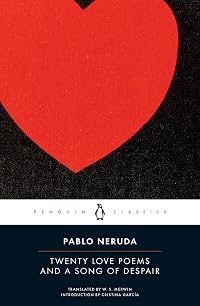
Twenty Love Poems and a Song of Despair
by Pablo Neruda
On This Page
Description
First published in 1924, Veinte Poemas de Amor y una Cancion Desesperada remains among Neruda's most popular work. Daringly metaphorical, these poems are based upon his own private associations. Their sensuous use of nature symbolism to celebrate love and to express grief has not been surpassed in the literature of our century. This edition offers the original Spanish text, with masterly translations by W.S. Merwin on facing pages.Tags
Recommendations













Member Recommendations

Member Reviews
Cuando tenía quince años y vivía enamorada hasta del aire , las palabras que repetía constantemente siempre estaban relacionadas con la tristeza . Cada vez que vivía un amor apasionado no correspondido , me sumergía en depresiones eternas y me regocijaba recitando cosas como "Es tan corto el amor y tan largo el olvido" . Siempre que sentía que iba a morirme de amor y escuchaba mi historia en cada poema , Neruda era el más importante .
Después crecí .Hace poco , en la facultad -hogar de los arrogantes -, un profesor muy INTELECTUAL-de esos que saben tanto que de lo único que no dudan es de sus propias palabras - nos las hizo corta a todas las locas de amor por Neruda :
-El poeta ese no vale nada - dijo con palabras un poco más show more elegantes - Uno no puede sentirse identificado con palabras de amor que alguien en otro tiempo escribió para una persona en especial . Es como robar . Nadie puede tomar prestada una declaración de amor que nada deja a la imaginación ,no te podés apropiar de eso . No son tuyas . Además - terminó - es poesía mal escrita .
Para mi profesor , hombre de mundo , de letras y de varios idiomas ,la poesía de Neruda y de tantos como él estaba sobrevalorada , era más comercial que otra cosa . En cambio , con mucho entusiasmo , nos recomendaba un poeta olvidado llamada Emeterio Cerro - creo - que jugaba con los sonidos . La poesía de ese decía así:
Mondonará , Mondonará
Fluyido Lamosol .
El truco , decía mi profesor , estaba en darle nuestro significado . Buscar en el juego inentendible , algo que tuviese sentido para nosotros . De eso si nos podíamos apropiar , eso si lo podíamos tomar prestado .
Demás está decir que odié el Mondonará tanto como odiaba las peliculas de Lynch . Estaba fuera de mi comprensin y requería mucha movilización de neuronas .
Sin embargo , Con el tiempo entendí lo que quería decir . Neruda es poesía popular . Cualquiera puede entenderla , cualquiera . Eso era lo que le molestaba a este intelectual de elite . El quería hacernos entrar en un círculo de poca gentey trataba a ese estilo de poetas como "la chusma" . Le daba fastidio , más que nada , que un popular hubiese sido premiado con el premio Nobel y a Borges se lo hubiera dejado de lado .
Nunca me dejó de gustar Pablito , pero si capté lo que quiso decir el profe . No es poesía muy complicada , no es Shakespeare ni Borges pero no deja de ser hermosa , no deja de contar una historia de vida , de amores y revoluciones. show less
Después crecí .Hace poco , en la facultad -hogar de los arrogantes -, un profesor muy INTELECTUAL-de esos que saben tanto que de lo único que no dudan es de sus propias palabras - nos las hizo corta a todas las locas de amor por Neruda :
-El poeta ese no vale nada - dijo con palabras un poco más show more elegantes - Uno no puede sentirse identificado con palabras de amor que alguien en otro tiempo escribió para una persona en especial . Es como robar . Nadie puede tomar prestada una declaración de amor que nada deja a la imaginación ,no te podés apropiar de eso . No son tuyas . Además - terminó - es poesía mal escrita .
Para mi profesor , hombre de mundo , de letras y de varios idiomas ,la poesía de Neruda y de tantos como él estaba sobrevalorada , era más comercial que otra cosa . En cambio , con mucho entusiasmo , nos recomendaba un poeta olvidado llamada Emeterio Cerro - creo - que jugaba con los sonidos . La poesía de ese decía así:
Mondonará , Mondonará
Fluyido Lamosol .
El truco , decía mi profesor , estaba en darle nuestro significado . Buscar en el juego inentendible , algo que tuviese sentido para nosotros . De eso si nos podíamos apropiar , eso si lo podíamos tomar prestado .
Demás está decir que odié el Mondonará tanto como odiaba las peliculas de Lynch . Estaba fuera de mi comprensin y requería mucha movilización de neuronas .
Sin embargo , Con el tiempo entendí lo que quería decir . Neruda es poesía popular . Cualquiera puede entenderla , cualquiera . Eso era lo que le molestaba a este intelectual de elite . El quería hacernos entrar en un círculo de poca gentey trataba a ese estilo de poetas como "la chusma" . Le daba fastidio , más que nada , que un popular hubiese sido premiado con el premio Nobel y a Borges se lo hubiera dejado de lado .
Nunca me dejó de gustar Pablito , pero si capté lo que quiso decir el profe . No es poesía muy complicada , no es Shakespeare ni Borges pero no deja de ser hermosa , no deja de contar una historia de vida , de amores y revoluciones. show less
Neruda's most famous collection, published when he was nineteen. Sometimes beautiful and surprising, sometimes loud and bombastic. The poet still seems to be at the stage in his life when love is essentially the same thing as football, a competition between young men (involving a lot of shouting and posturing) that women are meant to watch from the sidelines. The women in these poems don't speak — he prefers them when they are silent: "Me gustas quando callas porque estás como ausente" — and they don't seem to exist much except as sets of body parts, not always flatteringly described ("Se parecen tus senos a los caracoles blancos"). There's no way of knowing whether the poems are about one specific woman, a series of women, or a show more completely abstract female figure. Possibly the last of these, given how often he talks about dolls and statues.
But the images are always breathtaking, even though Neruda draws them from a fairly narrow range (maritime stuff like waves, nets, harbours, anchors, lighthouses, seagulls and mooring lines; bees and butterflies; ears of corn; weather).
I suspect that these are poems that grow on you when you read them aloud just for the sound of the words, without thinking too much about what they are supposed to mean. show less
But the images are always breathtaking, even though Neruda draws them from a fairly narrow range (maritime stuff like waves, nets, harbours, anchors, lighthouses, seagulls and mooring lines; bees and butterflies; ears of corn; weather).
I suspect that these are poems that grow on you when you read them aloud just for the sound of the words, without thinking too much about what they are supposed to mean. show less
Hay dias que no sé lo que me pasa.
Eu abro meu Neruda e apago o sol.
Misturo poesia com cachaça
e acabo discutindo futebol.
This, the first verse of the wonderful song “Cotidiano No. 2” by Toquinho and Vinicius de Moraes, was my first introduction to Neruda. A few years later, we read the poetry of W.S. Merwin in one of my college classes, and I found out that he’d also translated a lot of other people’s poetry, including Neruda. Since I was greatly fond of Merwin’s poetry, and the song “Cotidiano No. 2,” I made a mental note to look up this Neruda and read some of his poetry. It’s taken me over 40 years to follow up on that.
The poems are beautiful, with haunting but almost impenetrable, idiosyncratic metaphors. But so, so show more centered on the male gaze. I should probably have read these 40 years ago, when I might still have appreciated a woman being worshipped like a force of nature. But this jaded old woman can still appreciate lines like these:
I want to do with you what spring does with the cherry trees.
Nevertheless, heretic and jaded old woman that I am, I love the poetry of “Cotidiano No. 2” more. show less
Eu abro meu Neruda e apago o sol.
Misturo poesia com cachaça
e acabo discutindo futebol.
This, the first verse of the wonderful song “Cotidiano No. 2” by Toquinho and Vinicius de Moraes, was my first introduction to Neruda. A few years later, we read the poetry of W.S. Merwin in one of my college classes, and I found out that he’d also translated a lot of other people’s poetry, including Neruda. Since I was greatly fond of Merwin’s poetry, and the song “Cotidiano No. 2,” I made a mental note to look up this Neruda and read some of his poetry. It’s taken me over 40 years to follow up on that.
The poems are beautiful, with haunting but almost impenetrable, idiosyncratic metaphors. But so, so show more centered on the male gaze. I should probably have read these 40 years ago, when I might still have appreciated a woman being worshipped like a force of nature. But this jaded old woman can still appreciate lines like these:
I want to do with you what spring does with the cherry trees.
Nevertheless, heretic and jaded old woman that I am, I love the poetry of “Cotidiano No. 2” more. show less
As Cristina García says in her introduction, Neruda, in these love poems of his third book, “links his experience…to the natural world he loves,” to trees and specifically pines, to the rivers and ocean, to sun and twilight and darkness, and to the wind, usually blowing away dead leaves. The language is not often explicit and even when it is, metaphor infuses it, as in the first lines of the first poem:
Cuerpo de mujer, blancas colinas, muslos blancos,
Te pareces al mundo en tu actualidad de entrega.
Mi cuerpo de labriego salvaje te socava
Y hace saltar el hijo del fondo de la tierra.
In W. S. Merwin’s translation:
Body of a woman, white hills, white thighs,
You look like a world, lying in surrender.
My rough peasant’s body digs in show more you
And makes the son leap from the depth of the earth.
Neruda talks much about his customary sadness and hers. Sometimes his sadness is in feeling or knowing she is far away—“cuando me siente triste, y te siento lejana,” and sometimes it just seems to belong to him, “esa tristeza que tú me conoces.” Her sadness, too, seems often to be customary, though sometimes he suggests it is postcoital: “para qué tocarla ahora, para qué entristecerla.”
She is a “gray beret and the still heart,” a white bee, “what the wind was making with illuminated leaves,” or “like my soul, a butterfly of dream,” like a cloud or a “cloudless girl.” He talks about the difficulty, in “Para Que Tú Me Oigas,” of saying the right words, “to make you hear as I want you to hear me.” His desire is a metaphor: “Quiero hacer contigo / lo que la primavera hace con los cerezos.” When they are together, he imagines distance between them, or her absence; in “Me Gustas Cuando Callas,” he likes her to be still because then it is “as though you were absent.” This poem reminds me of Freud talking about the child playing “fort-da,” casting a toy with a string on it away—fort means gone—and reeling it back—da=there—as a way, Freud thinks, of trying to harden himself for the occasional absence of his mother.
In the last of the love poems, Neruda talks about the loss of his love, and oscillates between telling himself he does not love her and admitting he does: “Ya no la quiero, es cierto, pero tal vez la quiero.” The “Song of Despair” that concludes the book is about the despair of knowing she is lost to him. The metaphors are watery: “The river mingles its stubborn lament with the sea,” and he repeats her loss as a shipwreck: “todo en ti fue naufragio!” he says again and again. show less
Cuerpo de mujer, blancas colinas, muslos blancos,
Te pareces al mundo en tu actualidad de entrega.
Mi cuerpo de labriego salvaje te socava
Y hace saltar el hijo del fondo de la tierra.
In W. S. Merwin’s translation:
Body of a woman, white hills, white thighs,
You look like a world, lying in surrender.
My rough peasant’s body digs in show more you
And makes the son leap from the depth of the earth.
Neruda talks much about his customary sadness and hers. Sometimes his sadness is in feeling or knowing she is far away—“cuando me siente triste, y te siento lejana,” and sometimes it just seems to belong to him, “esa tristeza que tú me conoces.” Her sadness, too, seems often to be customary, though sometimes he suggests it is postcoital: “para qué tocarla ahora, para qué entristecerla.”
She is a “gray beret and the still heart,” a white bee, “what the wind was making with illuminated leaves,” or “like my soul, a butterfly of dream,” like a cloud or a “cloudless girl.” He talks about the difficulty, in “Para Que Tú Me Oigas,” of saying the right words, “to make you hear as I want you to hear me.” His desire is a metaphor: “Quiero hacer contigo / lo que la primavera hace con los cerezos.” When they are together, he imagines distance between them, or her absence; in “Me Gustas Cuando Callas,” he likes her to be still because then it is “as though you were absent.” This poem reminds me of Freud talking about the child playing “fort-da,” casting a toy with a string on it away—fort means gone—and reeling it back—da=there—as a way, Freud thinks, of trying to harden himself for the occasional absence of his mother.
In the last of the love poems, Neruda talks about the loss of his love, and oscillates between telling himself he does not love her and admitting he does: “Ya no la quiero, es cierto, pero tal vez la quiero.” The “Song of Despair” that concludes the book is about the despair of knowing she is lost to him. The metaphors are watery: “The river mingles its stubborn lament with the sea,” and he repeats her loss as a shipwreck: “todo en ti fue naufragio!” he says again and again. show less
In college, one of my professors gathered all the class readings up into a file and told us to get it printed and bound at the local print shop (cheaper than a textbook). Over the semester, we read plenty of short stories, crónicas, essays, and poems, but I never remember being assigned the page which just had the mysterious header POEMA XX.
I would learn it was by Neruda. And I just adored it. It's no great revelation that translated poetry sounds better in its native language, and this is no exception. I memorized the poem and it sounded like music. To this day I can recite my favorite passage:
It was all just so terrifically sad. I was depressed at the time and I think I envied that Neruda's sadness came from someplace. Mine seemed random and useless, producing nothing beautiful.
Now that I've finally read the rest of Veinte poemas, it might just be nostalgia that makes me uphold the opinion that XX is the best. But it's definitely not nostalgia that makes me say that the rest of the collection doesn't hold up.
I was surprised at how vague the object of Neruda's affection is. He seems to know, or at least to reveal, nearly nothing about her. Much of his lamentations stem from this, like in XVII which starts with
Tú también estás lejos, ah más lejos que nadie.
[You also are far away, oh farther than anyone.]
and ends with
Quién eres tú, quién eres?
[Who are you, who are you?]
I think the best love poems--and songs, and letters--are couched in specificity. A careful study of one's beloved. And that is utterly absent here, except maybe in XIX when we learn the color of the woman's hair (how intimate!).
Many times before the final two poems Neruda's love seems to have already deserted him in all but name, as in
Amo lo que no tengo. Estás tú tan distante.
[I love what I do not have. You are so distant.] (XVIII)
and
Por qué se me vendrá todo el amor de golpe
[Why does all the love rush in at once]
cuando me siento triste, y te siento lejana?
[when I feel sad, and I feel you are distant?] (X)
Maybe it is a sort of doomed love, where the mystery first attracts and then keeps the lover forever, agonizingly, at arms length. The dynamic we would call anxious/avoidant in our therapized modern parlance. Regardless, it's hard to call these all love poems when sadness and desperation cling to them so strongly. I wouldn't give this as a gift to your partner unless you wanted to send a very strange message.
I was glad to have a facing translation of this, which is always my preferred way to read Spanish poetry. That being said, all the lines in this review were translated by me. show less
I would learn it was by Neruda. And I just adored it. It's no great revelation that translated poetry sounds better in its native language, and this is no exception. I memorized the poem and it sounded like music. To this day I can recite my favorite passage:
Oir la noche inmensa, más inmensa sin ella.show more
[To hear the immense night, more immense without her.]
Y el verso cae al alma como al pasto el
rocío.
[And the verse falls to the soul like dew to grass.]
Qué importa que mi amor no puediera guardarla.
[What does it matter that my love could not keep her.]
La noche está estrellada y ella no está conmigo.
[The night is full of stars and she is not with me.]
Eso es todo. A lo lejos alguien canta. A lo lejos.
[That is all. In the distance someone sings. In the distance.]
It was all just so terrifically sad. I was depressed at the time and I think I envied that Neruda's sadness came from someplace. Mine seemed random and useless, producing nothing beautiful.
Now that I've finally read the rest of Veinte poemas, it might just be nostalgia that makes me uphold the opinion that XX is the best. But it's definitely not nostalgia that makes me say that the rest of the collection doesn't hold up.
I was surprised at how vague the object of Neruda's affection is. He seems to know, or at least to reveal, nearly nothing about her. Much of his lamentations stem from this, like in XVII which starts with
Tú también estás lejos, ah más lejos que nadie.
[You also are far away, oh farther than anyone.]
and ends with
Quién eres tú, quién eres?
[Who are you, who are you?]
I think the best love poems--and songs, and letters--are couched in specificity. A careful study of one's beloved. And that is utterly absent here, except maybe in XIX when we learn the color of the woman's hair (how intimate!).
Many times before the final two poems Neruda's love seems to have already deserted him in all but name, as in
Amo lo que no tengo. Estás tú tan distante.
[I love what I do not have. You are so distant.] (XVIII)
and
Por qué se me vendrá todo el amor de golpe
[Why does all the love rush in at once]
cuando me siento triste, y te siento lejana?
[when I feel sad, and I feel you are distant?] (X)
Maybe it is a sort of doomed love, where the mystery first attracts and then keeps the lover forever, agonizingly, at arms length. The dynamic we would call anxious/avoidant in our therapized modern parlance. Regardless, it's hard to call these all love poems when sadness and desperation cling to them so strongly. I wouldn't give this as a gift to your partner unless you wanted to send a very strange message.
I was glad to have a facing translation of this, which is always my preferred way to read Spanish poetry. That being said, all the lines in this review were translated by me. show less
A famed and lauded collection of love, obsession and longing. These poems hit different in my thirties. Although the language is beautiful, evocative and strikingly original, I found the poet's obsession overly focused on the body of the women he wrote about. In many of these poems the expressed love felt shallow and overly focused on the object's youth and physical beauty. To complement someone's beauty isn't necessarily wrong, but "love" is a strong word to ascribe to it. Desiring to possess a woman is an interesting subject for a poem, but again, I wouldn't call it love.
These perhaps pedantic criticisms aside, these verses are very much worth reading. The author's mastery of the form is clear and this collection is very rewarding to show more perused slowly, savoring each word for its own delights.
Favorite Poems: The Morning is Full, So That You Will Hear Me, I Remember You As You Were, We Have Lost Even, Almost Out of the Sky, Here I Love You show less
These perhaps pedantic criticisms aside, these verses are very much worth reading. The author's mastery of the form is clear and this collection is very rewarding to show more perused slowly, savoring each word for its own delights.
Favorite Poems: The Morning is Full, So That You Will Hear Me, I Remember You As You Were, We Have Lost Even, Almost Out of the Sky, Here I Love You show less
'I want to do with you what spring does with the cherry trees.'
'Leaning into the afternoons I cast my sad nets towards your oceanic eyes.'
What's there to say? Pablo Neruda is one of my favourite poets, and here's one of his masterpiece. Verse after verse reveal striking ideas after striking ideas, gathered altogether to make fleeting and eerie poetry among the best I have ever read. It can be bold. It can be quirky. It can be sweet. It can be rough. Always, though, it transpires of a powerful sensuality which is just luscious. One of the best poetry collection ever written.
Members
- Recently Added By
Lists

Books to Recommend to My Niece/Nephew (The late teenage years)
29 works; 3 members

Books Read in 2018
4,360 works; 110 members

Poetry volumes by single author
121 works; 8 members

Favorite Books in Translation
320 works; 133 members

Books Read in 2023
5,547 works; 145 members

Books With Numbers in the Title
308 works; 13 members

Best Late Night Poetry
11 works; 2 members

In and About the 1920s
181 works; 31 members

20th Century Literature
1,161 works; 55 members

Poetry Collections
79 works; 6 members

Favourite Books
1,819 works; 316 members
Harold Bloom - The Western Canon: D. The Chaotic Age
833 works; 24 members

Blue Pyramid 1,276 Best Books of All Time
1,248 works; 32 members

Latin American Literature
50 works; 11 members

Best of World Literature
434 works; 51 members

Books translated from Romance Languages into English
102 works; 7 members

Tonikat reading completed on Librarything journals
329 works; 2 members

el
1,139 works; 1 member
Author Information

Pablo Neruda was born Ricardo Eliecer Neftalí Reyes Basoalto in Ferral, Chile on July 12, 1904. In 1923 he sold all of his possessions to finance the publication of his first book, Crepusculario (Twilight), which he published under the pseudonym Pablo Neruda. Veinte Poemas de Amor y una Cancion Desesperada (Twenty Love Poems and a Song of show more Despair), which was published the following year, made him a celebrity and allowed him to stop his studies to devote himself to poetry. His other works include España en el Corazón, Canto General, Las Uvas y el Viento, and Para Nacer He Nacido. He received numerous awards including the World Peace Prize with Paul Robeson and Pablo Picasso in 1950, the Lenin Peace Prize and the Stalin Peace Prize in 1953, and the Nobel Prize for Literature for his poetry in 1971. He died of leukemia on September 23, 1973. (Bowker Author Biography) show less
Some Editions
Series
Belongs to Publisher Series
El bardo (10)
Work Relationships
Is contained in
Common Knowledge
- Canonical title
- Twenty Love Poems and a Song of Despair
- Original title
- 20 Poemas de amor y una Cancion desesperada; 20 Poemas de Amor y una Canción Desesperada
- Alternate titles
- Veinte poemas de amor y una canción desesperada
- Original publication date
- 1924
- People/Characters
- Pablo Neruda (1904-1973)
- First words
- Forward: A friend of mine, a Catalan poet, has told me that he once heard Pablo Neruda read his poetry in Venezuela in the 1960's to an audience of well over six hundred people.
- Last words
- (Click to show. Warning: May contain spoilers.)The Song of Despair:
It is the hour of departure. Oh abandoned one. - Original language
- Spanish
Classifications
Statistics
- Members
- 4,376
- Popularity
- 3,419
- Reviews
- 70
- Rating
- (4.20)
- Languages
- 18 — Catalan, Chinese, Danish, Dutch, English, French, German, Greek, Hebrew, Icelandic, Italian, Korean, Multiple languages, Portuguese, Russian, Spanish, Thai, Turkish
- Media
- Paper, Audiobook, Ebook
- ISBNs
- 167
- UPCs
- 2
- ASINs
- 34