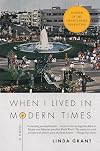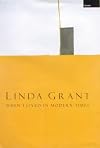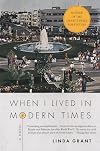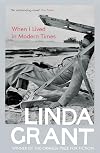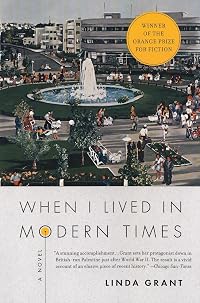
When I Lived in Modern Times
by Linda Grant
On This Page
Description
Evelyn Sert journeys to Tel Aviv, where Jewish refugees from Nazi Germany are determined to forge a modern consciousness in the heart of the Middle East. Her story weaves together national identity, terrorism, love and the art of hairdressing.Tags
Recommendations























Member Recommendations

Member Reviews
This book won the Orange/Women's Prize for fiction and it is easy to see why. The writing completely drew me in to a world that I never would have visited before. There are stories out there about Israel and Palestine, but few have had the power to pull me to one side of the issue without making me wonder what happens to the other side. That, of course, sounds bad, as if this book isn't well rounded or is one sided, but it is the type of story that really has to be one sided in order to be properly told.
I don't know that there is a way for me to properly describe the writing or how it was so powerfully true that you felt as if you honestly were the main character, going through life in a new country, fighting a struggle that she wasn't show more quite aware of until the end. When I put the book down I felt as if I had traveled to Israel in the time of the story, which is something that is sometimes very hard for writers to do. Getting the reader to a country is easy, getting them to that country through time itself isn't always as simple as it sounds. This book truly felt like a time machine. It is something that everyone should experience. show less
I don't know that there is a way for me to properly describe the writing or how it was so powerfully true that you felt as if you honestly were the main character, going through life in a new country, fighting a struggle that she wasn't show more quite aware of until the end. When I put the book down I felt as if I had traveled to Israel in the time of the story, which is something that is sometimes very hard for writers to do. Getting the reader to a country is easy, getting them to that country through time itself isn't always as simple as it sounds. This book truly felt like a time machine. It is something that everyone should experience. show less
29. When I Lived in Modern Times by Linda Grant (2000, 262 pages, read June 4-10)
Evelyn Sert was born and raised in England, but never felt English. Her mother was a Jewish immigrant from a Baltic Sea country, and she never met her father. Given a chance to go to British-controlled Palestine and help build the not-yet-independent Jewish state in 1946, she doesn’t hesitate, she has nothing to lose.
I read this as part of my prep for my soon-to-come travels to Israel. So, I was ready to learn, and mentally ready to be taken by this book; and I was, completely. But then what a world this was. The Jewish side is a world full of recent immigrants, a vast sea of Jewish refugees from around Europe all with different histories, many the show more darkest of dark. They include extreme and idealistic Russian communists, Holocaust survivors, old men shorn of their careers and their livelihoods, and the young anxious to push ahead, desperate to get the British out. In this Tel Aviv anyone looking backward is lost. The future has no past here. Instead, the nascent Israel is rearing to go forward, ready to show the world the mistake the Germans made, ready to make the perfect country, in so many distinct and contradictory ways of perfection.
On the British side are the imperial police of the fading empire manning an impossible place that Britain really doesn’t want anything to do with anyway. Many of Grant’s best characters are English. And, broken down to its bones, this is maybe more a novel about the English watching all this happen.
And out there somewhere, mostly outside of this book, are the Palestinians.
Linda Grant has a way of instantly creating atmosphere and I was simply lost in this book. The world would shut out, as I fell into Grant’s tour through all this, switching back and forth from English to various Jewish settings. I can now recommend Grant, but, as a caveat, I suspect few readers will get quite as into this book as I found myself, being Jewish and proactively curious specifically about Tel Aviv.
As a side note, the end is puzzling. I didn’t mind except that it took me away from Tel Aviv and left me wondering instead about Evelyn Sert. But she is quite a character here too.
2012
http://www.librarything.com/topic/138560#3472916
2014 re-read
https://www.librarything.com/topic/179643#4878433 show less
Evelyn Sert was born and raised in England, but never felt English. Her mother was a Jewish immigrant from a Baltic Sea country, and she never met her father. Given a chance to go to British-controlled Palestine and help build the not-yet-independent Jewish state in 1946, she doesn’t hesitate, she has nothing to lose.
I read this as part of my prep for my soon-to-come travels to Israel. So, I was ready to learn, and mentally ready to be taken by this book; and I was, completely. But then what a world this was. The Jewish side is a world full of recent immigrants, a vast sea of Jewish refugees from around Europe all with different histories, many the show more darkest of dark. They include extreme and idealistic Russian communists, Holocaust survivors, old men shorn of their careers and their livelihoods, and the young anxious to push ahead, desperate to get the British out. In this Tel Aviv anyone looking backward is lost. The future has no past here. Instead, the nascent Israel is rearing to go forward, ready to show the world the mistake the Germans made, ready to make the perfect country, in so many distinct and contradictory ways of perfection.
On the British side are the imperial police of the fading empire manning an impossible place that Britain really doesn’t want anything to do with anyway. Many of Grant’s best characters are English. And, broken down to its bones, this is maybe more a novel about the English watching all this happen.
And out there somewhere, mostly outside of this book, are the Palestinians.
Linda Grant has a way of instantly creating atmosphere and I was simply lost in this book. The world would shut out, as I fell into Grant’s tour through all this, switching back and forth from English to various Jewish settings. I can now recommend Grant, but, as a caveat, I suspect few readers will get quite as into this book as I found myself, being Jewish and proactively curious specifically about Tel Aviv.
As a side note, the end is puzzling. I didn’t mind except that it took me away from Tel Aviv and left me wondering instead about Evelyn Sert. But she is quite a character here too.
2012
http://www.librarything.com/topic/138560#3472916
2014 re-read
https://www.librarything.com/topic/179643#4878433 show less
Is there any end to the history of which I am completely unaware? Linda Grant’s evocative and fascinating coming of age story of both 20 year old Evelyn Sert as well as the state of Israel, had me furiously turning pages as I learned, at the feet of a masterful storyteller, about one year (1946) in the history of the country carved out of British-run Palestine after WWII.
Sert leaves Britain posing as a Christian tourist, visiting the Holy Land, because it’s the only way she can get a passport as the UK has severely limited the number of passports available to Jews headed for Palestine. After finding the grueling life on the kibbutz not to her liking, she ends up in the teeming metropolis of Tel Aviv where she takes on a job as a show more hairdresser utilizing the only skills she possesses. To appeal to the British nationals who frequent the shop, she assumes the identity of Priscilla Jones, and gives up her Jewish identity. Meanwhile, after work, she is Jewish Evelyn Sert and she hooks up with a Jewish man who is not exactly what he seems and soon involves Evelyn in providing information about the salon’s British customers. Her role as a spy in this underground army, fighting for the nation that is about to be born, results in circumstances that put her life in danger.
Grant is so adept at evoking this time and place in history that it proves to be quite breathtaking. Her description of Tel Aviv suggests the birth of a brand new city:
”I saw apartment buildings of two or three or occasionally four stories, all white, dazzling white, and against them the red flowers of oleander bushes. Flat-roofed white boxes, I saw, though sometimes their corners curved voluptuously like a woman’s hips and two buildings facing each other like this, on a corner, reminded me of a pair of ship’s prows sailing out into the dry waters of the street. They were houses like machines, built of concrete and glass, not houses at all, they were ideas. I saw walls erected not for privacy but as barriers against the blinding light; windows small and recessed, each with a balcony and each shaded by the shadow cast by the balcony above it; stairwells lit by portholes, reminding me that we were by the sea.” (Page 71)
Grant has written a book, in luminous prose, that is first and foremost a pursuit for understanding---of culture, of race, of patriotism, of sexuality---and has placed it side by side with a setting of raging chaos that grabs you by the throat and drags you along to witness the birth of Israel under a fading British regime. The fact that I knew so little about this bit of history was just icing on the cake. Very highly recommended. show less
Sert leaves Britain posing as a Christian tourist, visiting the Holy Land, because it’s the only way she can get a passport as the UK has severely limited the number of passports available to Jews headed for Palestine. After finding the grueling life on the kibbutz not to her liking, she ends up in the teeming metropolis of Tel Aviv where she takes on a job as a show more hairdresser utilizing the only skills she possesses. To appeal to the British nationals who frequent the shop, she assumes the identity of Priscilla Jones, and gives up her Jewish identity. Meanwhile, after work, she is Jewish Evelyn Sert and she hooks up with a Jewish man who is not exactly what he seems and soon involves Evelyn in providing information about the salon’s British customers. Her role as a spy in this underground army, fighting for the nation that is about to be born, results in circumstances that put her life in danger.
Grant is so adept at evoking this time and place in history that it proves to be quite breathtaking. Her description of Tel Aviv suggests the birth of a brand new city:
”I saw apartment buildings of two or three or occasionally four stories, all white, dazzling white, and against them the red flowers of oleander bushes. Flat-roofed white boxes, I saw, though sometimes their corners curved voluptuously like a woman’s hips and two buildings facing each other like this, on a corner, reminded me of a pair of ship’s prows sailing out into the dry waters of the street. They were houses like machines, built of concrete and glass, not houses at all, they were ideas. I saw walls erected not for privacy but as barriers against the blinding light; windows small and recessed, each with a balcony and each shaded by the shadow cast by the balcony above it; stairwells lit by portholes, reminding me that we were by the sea.” (Page 71)
Grant has written a book, in luminous prose, that is first and foremost a pursuit for understanding---of culture, of race, of patriotism, of sexuality---and has placed it side by side with a setting of raging chaos that grabs you by the throat and drags you along to witness the birth of Israel under a fading British regime. The fact that I knew so little about this bit of history was just icing on the cake. Very highly recommended. show less
I felt as if we were all half here and half somewhere else, deprived of our native languages, stumbling over an ugly ancient tongue. We knew that we were to be remade and reborn and we half did and half didjn't want to be. We were caught up in a plan to socially engineer our souls ... to emerge as molten, liquid, golden Jewish humanity. (p. 105)
In 1946, Evelyn Sert left London for Palestine, to be part of Israel's formation. Her first few weeks were spent on a kibbutz, but she quickly tired of the menial labor. She befriended a young man named Johnny, who took her to Tel Aviv. Once there, Evelyn found work as a hairdresser and moved between the Jewish and British communities, feeling uncomfortable in both. Meanwhile, as political events show more intensified, so did her relationship with Johnny. Evelyn lived in denial of Johnny's involvement in the political movement, unwittingly contributing information to support his cause and ultimately getting in over her head.
I enjoyed the first half of this book as Evelyn settled into a new life in a new country. But my enthusiasm waned as she moved aimlessly from one situation to the next. I found Evelyn & Johnny's relationship a bit of a stretch. It was not clear what she saw in him, or why he would be devoted to her. This book would be interesting to those wishing to learn more about the birth of Israel, and it puts today's events in historical context. However, I was hoping for a more character-driven novel and in that respect I was disappointed. show less
In 1946, Evelyn Sert left London for Palestine, to be part of Israel's formation. Her first few weeks were spent on a kibbutz, but she quickly tired of the menial labor. She befriended a young man named Johnny, who took her to Tel Aviv. Once there, Evelyn found work as a hairdresser and moved between the Jewish and British communities, feeling uncomfortable in both. Meanwhile, as political events show more intensified, so did her relationship with Johnny. Evelyn lived in denial of Johnny's involvement in the political movement, unwittingly contributing information to support his cause and ultimately getting in over her head.
I enjoyed the first half of this book as Evelyn settled into a new life in a new country. But my enthusiasm waned as she moved aimlessly from one situation to the next. I found Evelyn & Johnny's relationship a bit of a stretch. It was not clear what she saw in him, or why he would be devoted to her. This book would be interesting to those wishing to learn more about the birth of Israel, and it puts today's events in historical context. However, I was hoping for a more character-driven novel and in that respect I was disappointed. show less
I loved this book and recommend it whole-heartedly. I think it should take its place among the classics of English-language Jewish literature. It’s written beautifully: thoughtful, wry, occasionally poetic.
It’s the story of a young British woman coming to Israel after the war, before it was called Israel, before it was a country, when the British were running around in khaki shorts trying to govern it. The heroine, Evelyn Sert, is young, orphaned, and used to being different from the people around her. She’s not only Jewish, but illegitimate, with no clear family history. In order to reinvent herself, she goes to a country which is also in the process of inventing itself.
The atmosophere in this book is so powerful that you feel show more that you’re eating, drinking, smelling and touching Tel Aviv. Besides being a love song to the city, this novel has a gripping plot. And the author has a way of sketching a character in just a few words and making the person come alive. show less
It’s the story of a young British woman coming to Israel after the war, before it was called Israel, before it was a country, when the British were running around in khaki shorts trying to govern it. The heroine, Evelyn Sert, is young, orphaned, and used to being different from the people around her. She’s not only Jewish, but illegitimate, with no clear family history. In order to reinvent herself, she goes to a country which is also in the process of inventing itself.
The atmosophere in this book is so powerful that you feel show more that you’re eating, drinking, smelling and touching Tel Aviv. Besides being a love song to the city, this novel has a gripping plot. And the author has a way of sketching a character in just a few words and making the person come alive. show less
Another of my occasional longer term reading goals is to read all of the Women's Prize winners (when this book won in 2000 it was the Orange Prize), so this book was an obvious one to pick up when I saw it in my local library. It also made for an interesting comparison with another book I read recently, Muriel Spark's [b:The Mandelbaum Gate|120156|The Mandelbaum Gate|Muriel Spark|https://i.gr-assets.com/images/S/compressed.photo.goodreads.com/books/1171821151l/120156._SY75_.jpg|457517], as both help to explain how Israel became what it is today. Grant's setting is earlier, in the last years of the British mandate, the period that led up to Israel's independence, and it is written with much more hindsight.
Grant's choice of narrator is an show more interesting one - Evelyn is an orphaned Jew from London who decides to emigrate to the nascent Zionist project in Palestine, initially by deceit using a tourist visa. After a short and somewhat painful spell at a kibbutz, she moves to Tel Aviv and finds work as a hairdresser, and becomes involved in political intrigues and eventually gets drawn into helping a nationalist group who flirt with terrorism.
The writing and characterisation is strong, but I am not sure I found Evelyn's story entirely convincing. show less
Grant's choice of narrator is an show more interesting one - Evelyn is an orphaned Jew from London who decides to emigrate to the nascent Zionist project in Palestine, initially by deceit using a tourist visa. After a short and somewhat painful spell at a kibbutz, she moves to Tel Aviv and finds work as a hairdresser, and becomes involved in political intrigues and eventually gets drawn into helping a nationalist group who flirt with terrorism.
The writing and characterisation is strong, but I am not sure I found Evelyn's story entirely convincing. show less
I found this book interesting as it covered a time and place I'd not really read about before - life in Tel Aviv in the immediate aftermath of WWII. Evelyn is a a chameleonic character, adaptable to her circumstances, so able to float between different parts of society. I could probably have used a bit more historic context to get more out of this book, I don't know much about the history of Tel Aviv, but enjoyed it regardless.
Members
- Recently Added By
Lists

Top Five Books of 2014
1,064 works; 398 members

Women's Prize for Fiction
29 works; 5 members

BBC Radio 4 Bookclub
341 works; 13 members
Best winner of the Orange Broadband Prize for Fiction
13 works; 6 members

Middle East Fiction
179 works; 16 members
Talk Discussions
Past Discussions
When I Lived in Modern Times by Linda Grant in Orange January/July (October 2011)
Author Information

14+ Works 2,503 Members
Linda Grant is a novelist and journalist. She won the Orange Prize for Fiction in 2000 and the Lettre Ulysses Prize for the Art of Reportage in 2006. Her most recent novel, The Clothes on Their Back, was shortlisted for the Man Booker Prize in 2008. She writes for The Guardian, the Telegraph, and Vogue.
Awards and Honors
Common Knowledge
- Canonical title
- When I Lived in Modern Times
- Original title
- When I Lived in Modern Times
- Original publication date
- 2000
- People/Characters
- Evelyn Sert
- Important places
- Tel Aviv, Israel; Palestine
- Important events
- Establishment of Israel
- Dedication
- For Michele and John
- First words
- When I look back I see myself at twenty.
- Last words
- (Click to show. Warning: May contain spoilers.)I went into the kitchen and poured us both a cold drink, for whatever else changed, after fifty years it was still hot, even in spring, and being a Latvian I'll never get used to this damned climate.
Classifications
Statistics
- Members
- 535
- Popularity
- 55,987
- Reviews
- 14
- Rating
- (3.56)
- Languages
- 9 — Czech, Dutch, English, German, Italian, Polish, Spanish, Swedish, Turkish
- Media
- Paper, Ebook
- ISBNs
- 17
- ASINs
- 3