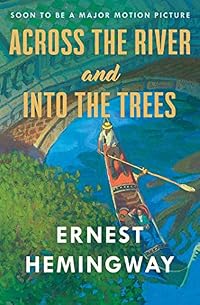
Across the River and Into the Trees
by Ernest Hemingway 
On This Page
Description
HEMINGWAY'S POIGNANT TALE OF A LOVE FOUND TOO LATE Set in Venice at the close of World War II, Across the River and into the Trees is the bittersweet story of a middle-aged American colonel, scarred by war and in failing health, who finds love with a young Italian countess at the very moment when his life is becoming a physical hardship to him. It is a love so overpowering and spontaneous that it revitalizes the man's spirit and encourages him to dream of a future, even though he knows that show more there can be no hope for long. Spanning a matter of hours, Across the River and into the Trees is tender and moving, yet tragic in the inexorable shadow of what must come. Ernest Hemingway did more to change the style of English prose than any other writer in the twentieth century, and for his efforts he was awarded the Nobel Prize for literature in 1954. Hemingway wrote in short, declarative sentences and was known for his tough, terse prose. Publication of The Sun Also Rises and A Farewell to Arms immediately established Ernest Hemingway as one of the greatest literary lights of the twentieth century. As part of the expatriate community in 1920s Paris, the former journalist and World War I ambulance driver began a career that lead to international fame. Hemingway was an aficionado of bullfighting and big-game hunting, and his main protagonists were always men and women of courage and conviction, who suffered unseen scars, both physical and emotional. He covered the Spanish Civil War, portraying it in fiction in his brilliant novel For Whom the Bell Tolls, and he subsequently covered World War II. His classic novella The Old Man and the Sea won the Pulitzer Prize in 1953. He died in 1961. show lessTags
Recommendations
















Member Recommendations
Member Reviews
At the end of WW2, a middle-aged American colonel meets a young Contessa in Venice. He spends his days reminiscing about the war, duck hunting, drinking and dining with the young lovely. He knows he’s dying, but she gives him one last season of love.
This is so typically Hemingway! I read The Old Man and the Sea when I was in eighth grade, and I’ve been a fan of his writing since.
This isn’t his best-known work, and I read it only to fulfill a challenge to read a book that was a bestseller the year I was born. Still, there is something about his writing that captures my attention. The short declarative sentences make the work immediate and bring this reader right into the story.
But the older I get the more I’m disturbed by the show more way the women are portrayed … or more accurately, but the way Hemmingway writes the male/female relationships. Knowing his own history of depression (and ultimate suicide), not to mention his four wives, I see him projecting his own character on the page, and I’m getting tired of it. show less
This is so typically Hemingway! I read The Old Man and the Sea when I was in eighth grade, and I’ve been a fan of his writing since.
This isn’t his best-known work, and I read it only to fulfill a challenge to read a book that was a bestseller the year I was born. Still, there is something about his writing that captures my attention. The short declarative sentences make the work immediate and bring this reader right into the story.
But the older I get the more I’m disturbed by the show more way the women are portrayed … or more accurately, but the way Hemmingway writes the male/female relationships. Knowing his own history of depression (and ultimate suicide), not to mention his four wives, I see him projecting his own character on the page, and I’m getting tired of it. show less
An intriguing little novel with many fine flourishes that unfortunately never manages to come into its own. It tells the story of a 50-year-old American colonel with a dicky heart visiting Venice in the years after World War Two. It recounts his love affair with a young Italian countess named Renata, set against the usual Hemingway backdrop of fine hotels and liquor, hunting (here, duck-shooting) and occasional commentary on war and literature.
What sets it apart from Hemingway's other lesser works is its vulnerability. The emotional driver of the novel is the Colonel's attempts to confront his impending death by poignantly looking back over his past and coming to terms with the inability to recapture lost youth. In this respect, the show more May/December romance with Renata is not as unbelievable as I had feared. I suppose she still is a bit of a fantasy wish-fulfilment: young and beautiful, with a sharp mind and stinking rich, she is also besotted with this older man and likes nothing better than to listen to his stories about the war. But it works because Hemingway does not deign to explain; he drops us straight into their affair and moves on. He is expecting us to accept it as a literary conceit and makes no apologies for this. The romance is there to serve the story, and it does serve. Furthermore, the Colonel, despite Hemingway's insistent disclaimer at the start of the book that the characters are all completely fictional, is clearly an avatar for the author himself. Like Hemingway, the colonel fought in Italy in the 'first war', was an observer in the Spanish Civil War, married and divorced a female journalist (Gellhorn) and was present at the liberation of Paris in 1944. When the Colonel is repeatedly insistent that he is most certainly not a writer on pages 96-8, it smacks of the author protesting too much.
But far from being a flaw; this pseudo-autobiographical approach is what gives the novel its poignancy. Hemingway was notoriously taut and muscular in his prose, presenting an image of hyper-masculinity to the world (one can even see the disclaimer at the start of the novel as a further defensive measure in this regard). But, through the Colonel, he is confronting death and defeat in a way that he would be reluctant to put his own name to. Consequently, in Across the River and Into the Trees we get a fascinating insight into a great artist at a time in his life when he wasn't at his greatest. At this time, he was dogged by self-doubt over his 'fading' literary powers; otherwise throwaway lines gain considerable meat when seen in this light. "Nobody would give you a penny for your thoughts, he thought. Not this morning. But I've seen them worth a certain amount of money when the chips are down." (pg. 130).
Hemingway was also fascinated by death, or rather, by how one should act when facing death: whether through physical courage in war or big-game hunting (a theme in many of his books) or through suicide (an understated but ever-present theme in his prose, and of course something that would eventually claim his life). Across the River and Into the Trees is all about knowing one's death is fairly imminent – for the Colonel, it is his dodgy heart – and getting one's affairs in order. It is about making peace with this reality and with one's past: for the Colonel, we are given the immediacy of his memories of World War Two, and it is his increasing willingness to relate these stories to Renata that determines the character's growth and acceptance of his fate.
The book does have its flaws; as Hemingway's first novel after the peerless war story For Whom the Bell Tolls and with the added experiences of World War Two to draw on, I would've expected more in-depth observations on those seismic events. Hemingway was right in responding to criticism that nothing 'happens' in the book by pointing out that both the breakthrough in Normandy and the liberation of Paris 'happen', but they don't happen emotionally. The Colonel talks about them, and Renata and the reader listen, but there's little said other than that Leclerc was a jerk and Eisenhower was a politician. Even when discussing the battle of the Hürtgen Forest, amongst the most merciless of the entire war, Hemingway says only that it was like "Passchendaele with tree bursts" (pg. 176). When one considers the emotive depth and evocative scene-setting for comparative examples in the earlier For Whom the Bell Tolls or A Farewell to Arms, Across the River and Into the Trees cannot but seem inferior.
Indeed, it seems that Hemingway is never able to fully exploit the imagery or the themes hinted at throughout the novel. Early on, there is a hint that the Colonel's yearning for his lost past is mirrored by the bombed-out, war-torn Italian towns trying to remember their former glory, but it remains only a hint. Similarly, there is an early Raymond Chandler-esque simile about how travelling to an Italian town was "like going to New York the first time you were ever there in the old days when it was shining, white and beautiful" (pg. 25), a beautiful line which is not given the emphasis or expansion that it so clearly demands. The ingredients are all there, as is the author's talent, but even by Hemingway's 'iceberg' standards we are not seeing enough above the waterline.
All told, however, the pros outweigh the cons and Across the River and Into the Trees deserves a greater reputation than it currently enjoys, or rather endures. There's plenty to chew on, even if the prey is elusive and you have to hunt down your kill. It shows a writer who was famous for building up a certain image of toughness at his most vulnerable and candid. It gives us a protagonist full of self-doubt, who wishes he "could fight it [the war] again... Knowing what I know now..." (pg. 33), an attitude one might apply not just to war but to life. It deserves to stand, if not amongst his best, then certainly first among the respectable second tier of Hemingway's works. show less
What sets it apart from Hemingway's other lesser works is its vulnerability. The emotional driver of the novel is the Colonel's attempts to confront his impending death by poignantly looking back over his past and coming to terms with the inability to recapture lost youth. In this respect, the show more May/December romance with Renata is not as unbelievable as I had feared. I suppose she still is a bit of a fantasy wish-fulfilment: young and beautiful, with a sharp mind and stinking rich, she is also besotted with this older man and likes nothing better than to listen to his stories about the war. But it works because Hemingway does not deign to explain; he drops us straight into their affair and moves on. He is expecting us to accept it as a literary conceit and makes no apologies for this. The romance is there to serve the story, and it does serve. Furthermore, the Colonel, despite Hemingway's insistent disclaimer at the start of the book that the characters are all completely fictional, is clearly an avatar for the author himself. Like Hemingway, the colonel fought in Italy in the 'first war', was an observer in the Spanish Civil War, married and divorced a female journalist (Gellhorn) and was present at the liberation of Paris in 1944. When the Colonel is repeatedly insistent that he is most certainly not a writer on pages 96-8, it smacks of the author protesting too much.
But far from being a flaw; this pseudo-autobiographical approach is what gives the novel its poignancy. Hemingway was notoriously taut and muscular in his prose, presenting an image of hyper-masculinity to the world (one can even see the disclaimer at the start of the novel as a further defensive measure in this regard). But, through the Colonel, he is confronting death and defeat in a way that he would be reluctant to put his own name to. Consequently, in Across the River and Into the Trees we get a fascinating insight into a great artist at a time in his life when he wasn't at his greatest. At this time, he was dogged by self-doubt over his 'fading' literary powers; otherwise throwaway lines gain considerable meat when seen in this light. "Nobody would give you a penny for your thoughts, he thought. Not this morning. But I've seen them worth a certain amount of money when the chips are down." (pg. 130).
Hemingway was also fascinated by death, or rather, by how one should act when facing death: whether through physical courage in war or big-game hunting (a theme in many of his books) or through suicide (an understated but ever-present theme in his prose, and of course something that would eventually claim his life). Across the River and Into the Trees is all about knowing one's death is fairly imminent – for the Colonel, it is his dodgy heart – and getting one's affairs in order. It is about making peace with this reality and with one's past: for the Colonel, we are given the immediacy of his memories of World War Two, and it is his increasing willingness to relate these stories to Renata that determines the character's growth and acceptance of his fate.
The book does have its flaws; as Hemingway's first novel after the peerless war story For Whom the Bell Tolls and with the added experiences of World War Two to draw on, I would've expected more in-depth observations on those seismic events. Hemingway was right in responding to criticism that nothing 'happens' in the book by pointing out that both the breakthrough in Normandy and the liberation of Paris 'happen', but they don't happen emotionally. The Colonel talks about them, and Renata and the reader listen, but there's little said other than that Leclerc was a jerk and Eisenhower was a politician. Even when discussing the battle of the Hürtgen Forest, amongst the most merciless of the entire war, Hemingway says only that it was like "Passchendaele with tree bursts" (pg. 176). When one considers the emotive depth and evocative scene-setting for comparative examples in the earlier For Whom the Bell Tolls or A Farewell to Arms, Across the River and Into the Trees cannot but seem inferior.
Indeed, it seems that Hemingway is never able to fully exploit the imagery or the themes hinted at throughout the novel. Early on, there is a hint that the Colonel's yearning for his lost past is mirrored by the bombed-out, war-torn Italian towns trying to remember their former glory, but it remains only a hint. Similarly, there is an early Raymond Chandler-esque simile about how travelling to an Italian town was "like going to New York the first time you were ever there in the old days when it was shining, white and beautiful" (pg. 25), a beautiful line which is not given the emphasis or expansion that it so clearly demands. The ingredients are all there, as is the author's talent, but even by Hemingway's 'iceberg' standards we are not seeing enough above the waterline.
All told, however, the pros outweigh the cons and Across the River and Into the Trees deserves a greater reputation than it currently enjoys, or rather endures. There's plenty to chew on, even if the prey is elusive and you have to hunt down your kill. It shows a writer who was famous for building up a certain image of toughness at his most vulnerable and candid. It gives us a protagonist full of self-doubt, who wishes he "could fight it [the war] again... Knowing what I know now..." (pg. 33), an attitude one might apply not just to war but to life. It deserves to stand, if not amongst his best, then certainly first among the respectable second tier of Hemingway's works. show less
When I first picked this up I almost put it straight back down. The main character, Colonel Cantwell, was shooting ducks, and the exquisite description of their flight and freedom, interspersed with their violent descent to earth, was a brutal juxtaposition. But I read on, lured by the setting: Venice. This story has been widely panned for its prose and lack of plot but this is Hemingway at his most honest, reflecting on the inhumanity of war and dealing with his ageing body and failing health.
In Across The River and Into the Trees, the fifty-year-old protagonist tries to come to terms with his past as a soldier in a city that couldn’t be more different than the war zone. The beauty and tranquillity of Venice is reflected in the show more personality of Renata, the Colonel’s eighteen-year-old girlfriend. The story oozes with the atmosphere of post-war Venice, with the Colonel staying at the Gritti Palace and frequenting the now-famous Harry’s Bar.
I couldn’t help but draw parallels with Hemingway’s real life, and that’s when I started to connect to the story more. Hemingway as an older man was infatuated with a girl of nineteen while staying in Venice. Rather than reading Renata’s character as a fantasy, I saw her as a mirror of Hemingway himself, a way to explore the youth and innocence he felt he had lost. Hemingway first went to war at eighteen, and then spent the rest of his life chasing death, through war or safaris. How do we make up for such loss of youth and idealism – where do we even start? This is a novel full of unspoken questions such as these, winding through the story like the canals that meander through Venice itself.
The Colonel switches between soldier and lover over and over again, telling himself to be better, failing, then trying once more, as he attempts to come to some understanding of the motives and urges he has carried with him all his life. Much of the story is a recount of the vicissitudes of war. Death is everywhere in this book. Killing has been the Colonel’s ‘trade’ and in a way it was Hemingway’s too – it forms the subject of many of his stories. In the end the ducks are shot again, their helpless eyes looking into his. After reading the Colonel's recounts of the horrors of war I saw, with fresh eyes, why such a scene was so brutally rendered. show less
In Across The River and Into the Trees, the fifty-year-old protagonist tries to come to terms with his past as a soldier in a city that couldn’t be more different than the war zone. The beauty and tranquillity of Venice is reflected in the show more personality of Renata, the Colonel’s eighteen-year-old girlfriend. The story oozes with the atmosphere of post-war Venice, with the Colonel staying at the Gritti Palace and frequenting the now-famous Harry’s Bar.
I couldn’t help but draw parallels with Hemingway’s real life, and that’s when I started to connect to the story more. Hemingway as an older man was infatuated with a girl of nineteen while staying in Venice. Rather than reading Renata’s character as a fantasy, I saw her as a mirror of Hemingway himself, a way to explore the youth and innocence he felt he had lost. Hemingway first went to war at eighteen, and then spent the rest of his life chasing death, through war or safaris. How do we make up for such loss of youth and idealism – where do we even start? This is a novel full of unspoken questions such as these, winding through the story like the canals that meander through Venice itself.
The Colonel switches between soldier and lover over and over again, telling himself to be better, failing, then trying once more, as he attempts to come to some understanding of the motives and urges he has carried with him all his life. Much of the story is a recount of the vicissitudes of war. Death is everywhere in this book. Killing has been the Colonel’s ‘trade’ and in a way it was Hemingway’s too – it forms the subject of many of his stories. In the end the ducks are shot again, their helpless eyes looking into his. After reading the Colonel's recounts of the horrors of war I saw, with fresh eyes, why such a scene was so brutally rendered. show less
A Cringey Death in Venice
Review of the Scribner’s Kindle eBook movie tie-in edition (February 1, 2024) of the Scribner’s hardcover original (1950).
I've read the cringey roman à clef of Across the River and Into the Trees several times without a review. When it came up as a Kindle Deal of the Day in May 2024 as part of the lead up to the expected 2024 release of the movie adaptation I decided to give it one more go. And I actually had a break-through this time.
It is still cringe of course, but I could understand show more what Hemingway was possibly doing. Perhaps you have heard of the practice of "mirroring"? It is when you are in conversation with someone and you adopt their method of speaking (i.e. you "mirror" them) due to thinking that a) they will better understand you, and b) that you create a bond of empathy with them. An example might be when you are speaking English with a non-native speaker and you start speaking a sort of broken English yourself.
Across... has post-WWII U.S. Army Colonel Richard Cantwell making a visit to Venice, Italy. He has been diagnosed with a fatal heart condition and wants to make a final trip to enjoy the city, his favoured Gritti Hotel and the company of his "best and last and only and one true love", the young Italian countess Renata. The cringe enters in several ways. At the Gritti the Colonel speaks with various hotel workers as if they were all part of a secret society "El Ordine Militar, Nobile y Espirituoso de los Caballeros de Brusadelli" (Spanish: The Military, Noble and Spiritual Order of the Knights of Brusadelli). With Renata, the dialogue is a sort of mirrored baby talk, as Renata is not a native English speaker. The further cringe is that Cantwell is 50 years old and Renata is 18 (almost 19 as she says).
See book cover at https://upload.wikimedia.org/wikipedia/en/f/f4/Hemingriver.jpg
The front cover of the original Scribner’s hardcover edition. Cover art by Adriana Ivancich. Image sourced from Wikipedia.
It is still cringe, but I can at least understand that much of Cantwell's manner of speaking is a "mirroring" of the speech of the non-English speaking of the Italians he encounters. Even among the cringe, there is still some of the old Hemingway magic that will peek through at times:
I wrote quite a bit about the roman à clef background to Across the River and Into the Trees when I reviewed Autumn in Venice: Ernest Hemingway and His Final Muse (2019), which was about the relationship between 49-year-old Hemingway and 18-year-old Adriana Ivancich (who was also the cover artist for the first hardcover edition, see above), so I won't repeat that here. Seeing the trailer for the movie adaptation, there is a chance that much of the cringe elements have been eliminated, so let us at least hope for that.
See the movie poster at https://tribunepictures.com/wp-content/uploads/2023/12/Untitled.jpg
Poster for the movie adaptation. Image sourced from Tribune Pictures.
Trivia and Links
The film adaptation directed by Paula Ortiz is expected to be released in August 2024. It stars Liev Schreiber as Col. Richard Cantwell and Matilda De Angelis as Renata. There isn't an English language trailer yet, but you can turn on subtitles in all languages (under Settings, then Auto-Translate) at the Spanish language trailer here.
If you still have free reads or are a subscriber to The New Yorker, you can read the rather vicious parody that E.B. White wrote after Hemingway's novel which was titled Across the Street and Into the Grill from October 6, 1950. show less
Review of the Scribner’s Kindle eBook movie tie-in edition (February 1, 2024) of the Scribner’s hardcover original (1950).
"Jackson," he said. "Do you know what General Thomas J. Jackson said on one occasion? On the occasion of his unfortunate death. ... Then he said, 'No, no let us cross over the river and rest under the shade of the trees.'"
I've read the cringey roman à clef of Across the River and Into the Trees several times without a review. When it came up as a Kindle Deal of the Day in May 2024 as part of the lead up to the expected 2024 release of the movie adaptation I decided to give it one more go. And I actually had a break-through this time.
It is still cringe of course, but I could understand show more what Hemingway was possibly doing. Perhaps you have heard of the practice of "mirroring"? It is when you are in conversation with someone and you adopt their method of speaking (i.e. you "mirror" them) due to thinking that a) they will better understand you, and b) that you create a bond of empathy with them. An example might be when you are speaking English with a non-native speaker and you start speaking a sort of broken English yourself.
Across... has post-WWII U.S. Army Colonel Richard Cantwell making a visit to Venice, Italy. He has been diagnosed with a fatal heart condition and wants to make a final trip to enjoy the city, his favoured Gritti Hotel and the company of his "best and last and only and one true love", the young Italian countess Renata. The cringe enters in several ways. At the Gritti the Colonel speaks with various hotel workers as if they were all part of a secret society "El Ordine Militar, Nobile y Espirituoso de los Caballeros de Brusadelli" (Spanish: The Military, Noble and Spiritual Order of the Knights of Brusadelli). With Renata, the dialogue is a sort of mirrored baby talk, as Renata is not a native English speaker. The further cringe is that Cantwell is 50 years old and Renata is 18 (almost 19 as she says).
See book cover at https://upload.wikimedia.org/wikipedia/en/f/f4/Hemingriver.jpg
The front cover of the original Scribner’s hardcover edition. Cover art by Adriana Ivancich. Image sourced from Wikipedia.
It is still cringe, but I can at least understand that much of Cantwell's manner of speaking is a "mirroring" of the speech of the non-English speaking of the Italians he encounters. Even among the cringe, there is still some of the old Hemingway magic that will peek through at times:
“When people talk listen completely. Don’t be thinking what you’re going to say. Most people never listen.”
I wrote quite a bit about the roman à clef background to Across the River and Into the Trees when I reviewed Autumn in Venice: Ernest Hemingway and His Final Muse (2019), which was about the relationship between 49-year-old Hemingway and 18-year-old Adriana Ivancich (who was also the cover artist for the first hardcover edition, see above), so I won't repeat that here. Seeing the trailer for the movie adaptation, there is a chance that much of the cringe elements have been eliminated, so let us at least hope for that.
See the movie poster at https://tribunepictures.com/wp-content/uploads/2023/12/Untitled.jpg
Poster for the movie adaptation. Image sourced from Tribune Pictures.
Trivia and Links
The film adaptation directed by Paula Ortiz is expected to be released in August 2024. It stars Liev Schreiber as Col. Richard Cantwell and Matilda De Angelis as Renata. There isn't an English language trailer yet, but you can turn on subtitles in all languages (under Settings, then Auto-Translate) at the Spanish language trailer here.
If you still have free reads or are a subscriber to The New Yorker, you can read the rather vicious parody that E.B. White wrote after Hemingway's novel which was titled Across the Street and Into the Grill from October 6, 1950. show less
One of the lesser known novels from Papa Hemingway, and I was interested because I saw that a new film version of the story is imminent.
Honestly, this is mostly wonderful book - the middle third of the book needed editing, as it grew tired. A scarred, old World War II vet, probably days from dying, decides to go on a duck shoot and tours the sites of some of his service in Italy. along the way The main character is also having a love affair with a woman young enough to be his granddaughter. That's the tiring part, the interaction between the lover's. But much of the vet's war story is told to the young lady as he pauses his trip to have one last fling with her. All of the vet's memories, and his regrets, are perfectly told. But all of show more the interaction between the lovers does not meet the Hemingway standard at all. Honestly, when the young lady goes to sleep in the narrative, things soar again.
4 stars!!!!
Cautiously Recommended, with caveats!!!! show less
Honestly, this is mostly wonderful book - the middle third of the book needed editing, as it grew tired. A scarred, old World War II vet, probably days from dying, decides to go on a duck shoot and tours the sites of some of his service in Italy. along the way The main character is also having a love affair with a woman young enough to be his granddaughter. That's the tiring part, the interaction between the lover's. But much of the vet's war story is told to the young lady as he pauses his trip to have one last fling with her. All of the vet's memories, and his regrets, are perfectly told. But all of show more the interaction between the lovers does not meet the Hemingway standard at all. Honestly, when the young lady goes to sleep in the narrative, things soar again.
4 stars!!!!
Cautiously Recommended, with caveats!!!! show less
I read this book a couple of years ago and have since considered it as one of Hemingway's masterpeices. Thinking about the book again I was surprised to find how many people hated it or at best thought it was average. More than that I haven't found anyone who understood the book in the way that I understood it, so perhaps I'm the one who's wrong, but this is how I always viewed the book.
The book is about a man who lead a crappy life mostly because he always was crappy to everyone around. In his eyes he was good having given over his life to the military and fighting in two world wars. But after giving all of that the army demoted him, an act which haunts him, and he now has been shunted to a desk job while he tries to maintain some sort show more of the dignity he thinks he should have. He is pulling toward the end of his life and he has nothing, his marriage ended long before, the army has no use for him and he knows it, no kids, no friends. He goes to the one place he thinks he's wanted, Venice, and reminisces with old "friends". These friends however are at best acquaintances from long past, but in reality are people who are nice to him because that's their job, but he can't see the difference because he does want to confront that last ugly truth. The big "love" affair is an absurd joke, he has to keep saying he loves her and she he so he can attempt to convince himself its true, but its obvious that what he has with her isn't close to the actual love that he has missed out on his entire life. So here he is a man whose facade of toughness and acceptance has long crumbled away running to the one place that if he tries really hard he can convince himself it's true. Venice of course is the perfect setting as so but about the place has to do with facades and masks and truth hidden by water. This is a story about a feeble attempt to arrange a ones own life story in such a way that he can be less of a failure in the eyes of himself, and failing. It's about dying unloved and forgotten but wishing it wasn't true.
Seen from this all of the sloppy dialogue isn't a failure of Hemingway but rather the characters failure. The absurdness of the love story is just that, absurd. The book as written is the perspective of the main character a crappy story that doesn't hold water under scrutiny. Hemingway wrote that this book is calculus compared to algebra, Hemingway didn't write the real story he was telling, he wrote a fake story who very flaws tell the real one. He wrote a book about a man's entire life, by relating how that man saw his last day. show less
The book is about a man who lead a crappy life mostly because he always was crappy to everyone around. In his eyes he was good having given over his life to the military and fighting in two world wars. But after giving all of that the army demoted him, an act which haunts him, and he now has been shunted to a desk job while he tries to maintain some sort show more of the dignity he thinks he should have. He is pulling toward the end of his life and he has nothing, his marriage ended long before, the army has no use for him and he knows it, no kids, no friends. He goes to the one place he thinks he's wanted, Venice, and reminisces with old "friends". These friends however are at best acquaintances from long past, but in reality are people who are nice to him because that's their job, but he can't see the difference because he does want to confront that last ugly truth. The big "love" affair is an absurd joke, he has to keep saying he loves her and she he so he can attempt to convince himself its true, but its obvious that what he has with her isn't close to the actual love that he has missed out on his entire life. So here he is a man whose facade of toughness and acceptance has long crumbled away running to the one place that if he tries really hard he can convince himself it's true. Venice of course is the perfect setting as so but about the place has to do with facades and masks and truth hidden by water. This is a story about a feeble attempt to arrange a ones own life story in such a way that he can be less of a failure in the eyes of himself, and failing. It's about dying unloved and forgotten but wishing it wasn't true.
Seen from this all of the sloppy dialogue isn't a failure of Hemingway but rather the characters failure. The absurdness of the love story is just that, absurd. The book as written is the perspective of the main character a crappy story that doesn't hold water under scrutiny. Hemingway wrote that this book is calculus compared to algebra, Hemingway didn't write the real story he was telling, he wrote a fake story who very flaws tell the real one. He wrote a book about a man's entire life, by relating how that man saw his last day. show less
Colonel Cantwell is in poor health. He takes some leave to go duck shooting near Venice and visit his teenage lover Countess Renata.
Venice and its littoral are well described, grey, treeless, windy and cold. The exchanges between lovers tend to pathos and soon become tedious. The colonel's wartime reminiscences are pointed and expertly written.
For any faults the novel may have, its story and lingering emotive power remain; and this was Hemingway's great gift.
Venice and its littoral are well described, grey, treeless, windy and cold. The exchanges between lovers tend to pathos and soon become tedious. The colonel's wartime reminiscences are pointed and expertly written.
For any faults the novel may have, its story and lingering emotive power remain; and this was Hemingway's great gift.
Members
- Recently Added By
Published Reviews
ThingScore 25
"The most important author living today, the outstanding author since the death of Shakespeare, has brought out a new novel.... After the patronizing travelog ... the colonel has the rendezvous with his girl.... The novel was written as a serial for Cosmopolitan, whose demands and restrictions are I should say, almost precisely those of the movies."
added by GYKM
Lists

Publisher's Weekly Bestsellers - Part II - 1940 - 1979
355 works; 5 members

Let's Tell a Story Using a Sequence of Titles
17 works; 15 members

A Novel Cure
742 works; 23 members
Author Information

655+ Works 173,198 Members
Ernest Miller Hemingway was born in the family home in Oak Park, Ill., on July 21, 1899. In high school, Hemingway enjoyed working on The Trapeze, his school newspaper, where he wrote his first articles. Upon graduation in the spring of 1917, Hemingway took a job as a cub reporter for the Kansas City Star. After a short stint in the U.S. Army as a show more volunteer Red Cross ambulance driver in Italy, Hemingway moved to Paris, and it was here that Hemingway began his well-documented career as a novelist. Hemingway's first collection of short stories and vignettes, entitled In Our Time, was published in 1925. His first major novel, The Sun Also Rises, the story of American and English expatriates in Paris and on excursion to Pamplona, immediately established him as one of the great prose stylists and preeminent writers of his time. In this book, Hemingway quotes Gertrude Stein, "You are all a lost generation," thereby labeling himself and other expatriate writers, including F. Scott Fitzgerald, T.S. Eliot, and Ford Madox Ford. Other novels written by Hemingway include: A Farewell To Arms, the story, based in part on Hemingway's life, of an American ambulance driver on the Italian front and his passion for a beautiful English nurse; For Whom the Bell Tolls, the story of an American who fought, loved, and died with the guerrillas in the mountains of Spain; and To Have and Have Not, about an honest man forced into running contraband between Cuba and Key West. Non-fiction includes Green Hills of Africa, Hemingway's lyrical journal of a month on safari in East Africa; and A Moveable Feast, his recollections of Paris in the Roaring 20s. In 1954, Hemingway won the Nobel Prize in Literature for his novella, The Old Man and the Sea. A year after being hospitalized for uncontrolled high blood pressure, liver disease, diabetes, and depression, Hemingway committed suicide on July 2, 1961, in Ketchum, Idaho. (Bowker Author Biography) show less
Ernest Hemingway has a Legacy Library. Legacy libraries are the personal libraries of famous readers, entered by LibraryThing members from the Legacy Libraries group.
Some Editions
Awards and Honors
Distinctions
Notable Lists
Series
Belongs to Publisher Series
Work Relationships
Common Knowledge
- Canonical title
- Across the River and Into the Trees
- Original title
- Across the River and into the Trees
- Original publication date
- 1950
- People/Characters
- Jackson
- Important places
- Venice, Veneto, Italy; Harry's Bar, Venice, Veneto, Italy; Gritti Palace Hotel, Venice, Veneto, Italy
- Important events
- World War II
- Dedication
- To Mary with love
- First words
- They started two hours before daylight, and at first, it was not necessary to break the ice across the canal as other boats had gone on ahead.
- Quotations*
- NO MORE QUOTATIONS since some unexpectedly disappeared
- Last words
- (Click to show. Warning: May contain spoilers.)"They'll return them all right, through channels," Jackson thought, and put the car in gear.
- Original language
- English
*Some information comes from Common Knowledge in other languages. Click "Edit" for more information.
Classifications
Statistics
- Members
- 2,238
- Popularity
- 8,934
- Reviews
- 27
- Rating
- (3.26)
- Languages
- 14 — Catalan, Danish, Dutch, English, Finnish, French, German, Hungarian, Italian, Norwegian (Bokmål), Polish, Portuguese, Spanish, Swedish
- Media
- Paper, Audiobook, Ebook
- ISBNs
- 72
- ASINs
- 72