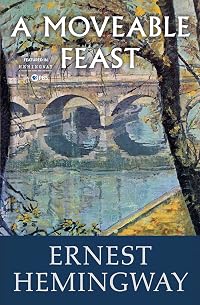
A Moveable Feast
by Ernest Hemingway 
On This Page
Description
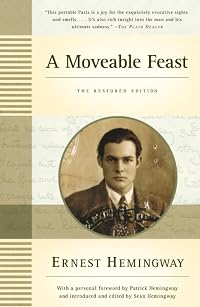
Published posthumously in 1964, A Moveable Feast remains one of Ernest Hemingway's most beloved works. It is his classic memoir of Paris in the 1920s, filled with irreverent portraits of other expatriate luminaries such as F. Scott Fitzgerald and Gertrude Stein; tender memories of his first wife, Hadley; and insightful recollections of his own early experiments with his craft. It is a literary feast, brilliantly evoking the exuberant mood of Paris after World War I and the youthful spirit, show more unbridled creativity, and unquenchable enthusiasm that Hemingway himself epitomized. show lessTags
Recommendations







Member Recommendations


Member Reviews
My god, they were so young. I mean, I know this intellectually, but to read this is to really get the full sense of literary boyishness. Your 20s are your 20s no matter what era, no matter which arondissement, and there is something very sweet about this book for just that reason. Boys bragging, boys fronting, boys writing. The whiff of youthful exuberance here is a little intoxicating, feels good; this is well worth reading, or rereading. I'm glad I didn't even think about the updated version.
This is a hardcover I bought for $2 or $3 on the street in 2009 or so, but I'd never looked inside until I opened it to read. I noticed that it had the original Book-of-the-Month Club insert inside, so I checked the front matter and hey! -- looks show more like I've got myself a first American BOMC edition (it came out in London a bit earlier in 1964). Not worth much, and it's in pretty lowly shape, but that still made me happy, and gave it a little extra gravitas. show less
This is a hardcover I bought for $2 or $3 on the street in 2009 or so, but I'd never looked inside until I opened it to read. I noticed that it had the original Book-of-the-Month Club insert inside, so I checked the front matter and hey! -- looks show more like I've got myself a first American BOMC edition (it came out in London a bit earlier in 1964). Not worth much, and it's in pretty lowly shape, but that still made me happy, and gave it a little extra gravitas. show less
Very entertaining, and totally bogus, at least as far as the emotions are concerned. The facts, likely enough, are probably as accurate as can be expected. The mystique had been painstakingly manufactured years before and is finely polished here. The little chapter on Ford Madox Ford is very funny; it's disconcerting sometimies just how bitchy Hemingway can be. The scene where he tries to console Fitzgerald about the size of the latter's penis is one of the most touching moments of 20th century literary history.
This has been one I'd meant to get to for some time and enjoyed most of the writing, capturing his time in Paris. As it's more memoir type this reflects his point of view, conversations and disputes reported with his bias.
I loved reading about the time he spent in cafes writing, meeting authors and poets, descriptions of the drinks from a lovely cold bottle of Sancerre, champagne, Rum St James and cafe au lait. His inspiration for writing about what he knows was interesting. When he speaks of writing a story about Michigan when he is in Paris, and surmises he'd probably be able to finsh a novel about Paris when he was elsewhere.
He was the masculine alpha dog of his associates befriending and defending Fitzgerald from his wife Zelda, show more eventually realizing, as he put it, "she is insane." Neither Fitzgerald or Hemingway (or probably anyone else during that time period) considered mental illness and how to handle it. The conversations with Ford Madox Ford were the direct opposite, Hem seeming to despise Ford for his artistocratic ways. Or was that jealousy? Again, it's from Hemingway's point of view.
I loved reading about the creative souls who rubbed elbows, shared stories, drank and sometimes traveled together. Hemingway's focus on writing was extreme, chasing friends and competitors from "his" cafe where he wrote. While it wouldn't be considered his style as it's a diary of sorts, it was enjoyable to read. 4.5
For a completely different take on Hemingways's time and other recollections please see my review on Untold Paris by John Baxter. show less
I loved reading about the time he spent in cafes writing, meeting authors and poets, descriptions of the drinks from a lovely cold bottle of Sancerre, champagne, Rum St James and cafe au lait. His inspiration for writing about what he knows was interesting. When he speaks of writing a story about Michigan when he is in Paris, and surmises he'd probably be able to finsh a novel about Paris when he was elsewhere.
He was the masculine alpha dog of his associates befriending and defending Fitzgerald from his wife Zelda, show more eventually realizing, as he put it, "she is insane." Neither Fitzgerald or Hemingway (or probably anyone else during that time period) considered mental illness and how to handle it. The conversations with Ford Madox Ford were the direct opposite, Hem seeming to despise Ford for his artistocratic ways. Or was that jealousy? Again, it's from Hemingway's point of view.
I loved reading about the creative souls who rubbed elbows, shared stories, drank and sometimes traveled together. Hemingway's focus on writing was extreme, chasing friends and competitors from "his" cafe where he wrote. While it wouldn't be considered his style as it's a diary of sorts, it was enjoyable to read. 4.5
For a completely different take on Hemingways's time and other recollections please see my review on Untold Paris by John Baxter. show less
This book should be called A Punchable Dick, since it is putatively about Paris but is actually always and only about Ernest Hemingway, but it is still absolutely worth reading. Let me explain.
Hemingway was a gifted writer, but unfortunately he mostly used his talent to write dull, men's issues novels. Many of his short stories are good, though, and in this book, his style absolutely shines. This is a series of vignettes, which was his natural, best writing length, about his life in Paris between WWI and WWII, and it's sentimental and sweet and sad, the fascinating memories of a sick old man. His gift was never great narrative; it was always great sentences, and the sentences here are gorgeous and beautifully turned, just incredibly show more well-crafted.
The book is also catty as hell, which I enjoyed. Hemingway was clearly, by the time he wrote this, a past master in character assassination, and he lays waste to almost everyone he mentions in this, from Gertrude Stein (who he had technically reconciled with, but wow, spare me from any reconcilations like that) to F. Scott Fitzgerald. The two people who he doesn't skewer are Evan Shipman and Ezra Pound, and both of them become far more fascinating for it.
The danger of writing a book of memoirs is that it reveals a lot about you, and that's where the Punchable Dick title comes in. Hemingway shows himself for who he really is: a weak, susceptible, wandering asshole, judgmental of everyone around him, in love with his own self-image. (Also sexist and homophobic as hell, but we all already knew that.) So to read this, you do have to spend time with a jerk, but trust me: it's worth it. His sentences are lovely. show less
Hemingway was a gifted writer, but unfortunately he mostly used his talent to write dull, men's issues novels. Many of his short stories are good, though, and in this book, his style absolutely shines. This is a series of vignettes, which was his natural, best writing length, about his life in Paris between WWI and WWII, and it's sentimental and sweet and sad, the fascinating memories of a sick old man. His gift was never great narrative; it was always great sentences, and the sentences here are gorgeous and beautifully turned, just incredibly show more well-crafted.
The book is also catty as hell, which I enjoyed. Hemingway was clearly, by the time he wrote this, a past master in character assassination, and he lays waste to almost everyone he mentions in this, from Gertrude Stein (who he had technically reconciled with, but wow, spare me from any reconcilations like that) to F. Scott Fitzgerald. The two people who he doesn't skewer are Evan Shipman and Ezra Pound, and both of them become far more fascinating for it.
The danger of writing a book of memoirs is that it reveals a lot about you, and that's where the Punchable Dick title comes in. Hemingway shows himself for who he really is: a weak, susceptible, wandering asshole, judgmental of everyone around him, in love with his own self-image. (Also sexist and homophobic as hell, but we all already knew that.) So to read this, you do have to spend time with a jerk, but trust me: it's worth it. His sentences are lovely. show less
In the early 1920s, Hemingway was a student of life in a magnificent city, and it's evident that he appreciated that to his core. Eating up his delicious experiences as if they were oysters at "a good cafe on the Place St.-Michel." A Movable Feast was far from what I expected given the history of Hemingway, one of the greatest American authors of modern times. His later life was rife with emotional conflict and physical torment. Uncontrolled depression. Alcoholism. Chronic pain. All leading to a life filled with broken relationships, internal doubt, paranoia, and self-destruction. But A Movable Feast shows Hemingway at perhaps his best. A romantic and lover of life. Young, broke and unknown. On observing a young woman "with show more rain-freshened skin" while writing in a small cafe, he wrote, "I've seen you, beauty, and you belong to me now, whoever you are waiting for and if I never see you again, I thought. You belong to me and all Paris belongs to me and I belong to this notebook and this pencil." A Moveable Feast was the last thing that Hemingway wrote before he took his life on July 2, 1961. show less
65. A Moveable Feast by Ernest Hemingway
OPD: 1964
format: 211-page Hardcover, dated 1964
acquired: 2006 read: Nov 20-24 time reading: 4:40, 1.3 mpp
rating: 5
genre/style: Memoir theme: TBR and Hemmingway
locations: Paris 1921-1926
about the author: (1899 – 1961, born in Oak Park, Illinois, outside Chicago) An American novelist, short-story writer, journalist, and the 1954 Nobel Prize Laureate.
This is such a terrific little book. A collection of sketches of his life in 1920's Paris among authors, cafes, his wife and horse racing. Poverty and hunger play a romantic role. The wine and spirits an evocative one, the way they are enjoyed and abused. This is Gertrude Stein's Lost Generation of American writers in Paris. And Hemmingway is in their show more midst, working with all of them. Stein, Ezra Pound, F. Scott Fitzgerald & Zelda, Ford Maddox Ford and others a brought to life with a permanence, with affection, humor and brutal critique. The sum affect was magical.
It's not a simple memoir. We don't know how much is factual, verse bad memory, vs outright fiction. And it's not nice. Hemmingway is pretty clear he's going to say what he says in a straightforward way, regardless of your feelings, or his own. What comes across is both mean and affectionate. He somehow creates a sense of brutal honesty that somehow comes out wonderful. There is magic whatever he's talking about. But when author's we know come up, it's riveting. It feels so honest. His affection for Fitzgerald feels so moving, that it was only after I finished the book that I realized how terribly he gutted the poor guy's personality. But the gutting was so thoroughly entertaining!
This book has come up a lot and reviews have a constant praise about them. So my commentary is just one of many before. I'll add one thing I missed in all those reviews - it's really short and flies by. You can read this on a lazy Sunday and never be bored until you put it down.
2023
https://www.librarything.com/topic/354226#8292413 show less
OPD: 1964
format: 211-page Hardcover, dated 1964
acquired: 2006 read: Nov 20-24 time reading: 4:40, 1.3 mpp
rating: 5
genre/style: Memoir theme: TBR and Hemmingway
locations: Paris 1921-1926
about the author: (1899 – 1961, born in Oak Park, Illinois, outside Chicago) An American novelist, short-story writer, journalist, and the 1954 Nobel Prize Laureate.
This is such a terrific little book. A collection of sketches of his life in 1920's Paris among authors, cafes, his wife and horse racing. Poverty and hunger play a romantic role. The wine and spirits an evocative one, the way they are enjoyed and abused. This is Gertrude Stein's Lost Generation of American writers in Paris. And Hemmingway is in their show more midst, working with all of them. Stein, Ezra Pound, F. Scott Fitzgerald & Zelda, Ford Maddox Ford and others a brought to life with a permanence, with affection, humor and brutal critique. The sum affect was magical.
It's not a simple memoir. We don't know how much is factual, verse bad memory, vs outright fiction. And it's not nice. Hemmingway is pretty clear he's going to say what he says in a straightforward way, regardless of your feelings, or his own. What comes across is both mean and affectionate. He somehow creates a sense of brutal honesty that somehow comes out wonderful. There is magic whatever he's talking about. But when author's we know come up, it's riveting. It feels so honest. His affection for Fitzgerald feels so moving, that it was only after I finished the book that I realized how terribly he gutted the poor guy's personality. But the gutting was so thoroughly entertaining!
This book has come up a lot and reviews have a constant praise about them. So my commentary is just one of many before. I'll add one thing I missed in all those reviews - it's really short and flies by. You can read this on a lazy Sunday and never be bored until you put it down.
2023
https://www.librarything.com/topic/354226#8292413 show less
I'm in that reading state of bliss when you finish a book you absolutely love. (It will be hard to move on to reading something else in the next few days because it won't live up to this.)
I'm speaking of Ernest Hemingway's A Moveable Feast of course.
I'm not a huge fan of short stories or of essays, but this collection makes me wish I had never said things like that. I loved every last piece in here.
Hemingway has a dry & sometimes brutal wit that pops out in the unexpected sentence or two, making his observations refreshing. And wonderful. He creates such vivid pictures of places & people that I felt like I was sitting in the cafes, skiing in the Alps & Dolomites, betting on the horses, watching the local fishermen, or tossing back a show more drink (or ten) with an artsy & writerly crowd.
The part of his tale about traveling with Scott Fitzgerald from Lyon in the car without a top was so wonderful that I read large chunks of it out loud to my husband & daughter. The three of us were howling with laughter in parts.
Some favorite quotes from the book...
-----------------------------------
Hemingway's description of an irritating acquaintance talking to him when he's trying to write in a cafe...
-----------------------------------
A chambermaid who finds books left behind, some in English, & sells them. Her opinion of books in English is that they are worthless.
A lovely picture of a Paris morning...
Re: the trip with Scott Fitzgerald that I mentioned earlier...
-----------------------------------
And...
-----------------------------------
I read this in tandem with a friend to honor Paris & celebrate their cafe culture after the terror attacks. (The idea to read this came from an NPR report saying that after the attacks, copies of A Moveable Feast have been selling out in Paris.) I can see why Parisians love this book; it paints a wonderful view of a Paris of hope, & art, & love, & good food & drink, & interesting friends. A completely wonderful book. show less
I'm speaking of Ernest Hemingway's A Moveable Feast of course.
I'm not a huge fan of short stories or of essays, but this collection makes me wish I had never said things like that. I loved every last piece in here.
Hemingway has a dry & sometimes brutal wit that pops out in the unexpected sentence or two, making his observations refreshing. And wonderful. He creates such vivid pictures of places & people that I felt like I was sitting in the cafes, skiing in the Alps & Dolomites, betting on the horses, watching the local fishermen, or tossing back a show more drink (or ten) with an artsy & writerly crowd.
The part of his tale about traveling with Scott Fitzgerald from Lyon in the car without a top was so wonderful that I read large chunks of it out loud to my husband & daughter. The three of us were howling with laughter in parts.
Some favorite quotes from the book...
"You got very hungry when you did not eat enough in Paris because all the bakery shops had such good things in the windows and people ate outside at tables on the sidewalk so that you saw and smelled the food."So true, not only in Paris but in Brussels too (with its proliferation of waffle stands)!
-----------------------------------
Hemingway's description of an irritating acquaintance talking to him when he's trying to write in a cafe...
"He was in full cry now and the unbelievable sentences were soothing as the noise of a plank being violated in the sawmill."(I guess Hemingway would know that noise since he apparently lived in an apartment above a sawmill for awhile in Paris. Lol.)
-----------------------------------
A chambermaid who finds books left behind, some in English, & sells them. Her opinion of books in English is that they are worthless.
"How do you tell a valuable French book?"-----------------------------------
"First there are the pictures. Then it is a question of the quality of the pictures. Then it is the binding. If a book is good, the owner will have it bound properly. All books in English are bound, but bound badly. There is no way of judging them."
A lovely picture of a Paris morning...
"In the spring mornings I would work early while my wife still slept. The windows were open wide and the cobbles of the street were drying after the rain. The sun was drying the wet faces of the houses that faced the window. The shops were still shuttered. The goatherd came up the street blowing his pipes and a woman who lived on the floor above us came out onto the sidewalk with a big pot. The goatherd chose one of the heavy-bagged, black milk-goats and milked her into the pot while his dog pushed the others onto the sidewalk. The goats looked around, turning their necks like sight-seers. The goatherd took the money from the woman and thanked her and went on up the street piping and the dog herded the goats on ahead, their horns bobbing. I went back to writing and the woman came up the stairs with the goat milk. She wore her felt-soled cleaning shoes and I only heard her breathing as she stopped on the stairs outside our door and then the shutting of her door. She was the only customer for goat milk in our building."-----------------------------------
Re: the trip with Scott Fitzgerald that I mentioned earlier...
"It was not a trip designed for a man easy to anger."Lol.
-----------------------------------
And...
"For a poet he threw a very accurate milk bottle."(Said when an angered acquaintance threw things at him, including a milk bottle. Lol.)
-----------------------------------
I read this in tandem with a friend to honor Paris & celebrate their cafe culture after the terror attacks. (The idea to read this came from an NPR report saying that after the attacks, copies of A Moveable Feast have been selling out in Paris.) I can see why Parisians love this book; it paints a wonderful view of a Paris of hope, & art, & love, & good food & drink, & interesting friends. A completely wonderful book. show less
Members
- Recently Added By
Published Reviews
ThingScore 40
Important note!: this review is of the edition that Hemingway's grandson revised because he didn't like the original's contents. Hotchner argues for ignoring this edition in favor of the original.
"The grandson has removed several sections of the book’s final chapter and replaced them with other writing of Hemingway’s that the grandson feels paints his grandma in a more sympathetic show more light. Ten other chapters that roused the grandson’s displeasure have been relegated to an appendix."
"All publishers, Scribner included, are guardians of the books that authors entrust to them. Someone who inherits an author’s copyright is not entitled to amend his work. There is always the possibility that the inheritor could write his own book offering his own corrections. Ernest was very protective of the words he wrote, words that gave the literary world a new style of writing. Surely he has the right to have these words protected against frivolous incursion, like this reworked volume that should be called “A Moveable Book.” I hope the Authors Guild is paying attention." show less
"The grandson has removed several sections of the book’s final chapter and replaced them with other writing of Hemingway’s that the grandson feels paints his grandma in a more sympathetic show more light. Ten other chapters that roused the grandson’s displeasure have been relegated to an appendix."
"All publishers, Scribner included, are guardians of the books that authors entrust to them. Someone who inherits an author’s copyright is not entitled to amend his work. There is always the possibility that the inheritor could write his own book offering his own corrections. Ernest was very protective of the words he wrote, words that gave the literary world a new style of writing. Surely he has the right to have these words protected against frivolous incursion, like this reworked volume that should be called “A Moveable Book.” I hope the Authors Guild is paying attention." show less
added by danielx
He is gentle, wistful, and almost nostalgic. One writer friend once described Hemingway to me as "that bully" and in many ways my friend was right. Hemingway had created his own public personae that included a brusque way of conducting himself; of a kind of machismo that would be called out for what it was these days; and an insensitivity to other people that bordered on the cruel. A lot of show more that 'Grace under pressure" is crap, and in his better moments, Heminway probably knew that. But the stories in A Moveable Feast belie all that. He remembers those days in Paris with a fondness and kindness that is remarkable, considering his usual public displays. show less
added by paradoxosalpha
Ernest was very protective of the words he wrote, words that gave the literary world a new style of writing. Surely he has the right to have these words protected against frivolous incursion, like this reworked volume that should be called “A Moveable Book.”
added by carport
Lists

100 Biographies & Memoirs to Read in a Lifetime
42 works; 18 members

Best Biographies, Autobiographies and Memoirs
465 works; 160 members

Best Autobiographies and Memoirs
370 works; 67 members
100 Biographies and Memoirs to Read in a (Single) Lifetime
98 works; 12 members

Favorite Memoirs
64 works; 13 members

Top Five Books of 2013
1,562 works; 721 members

Memoirs Heal the Soul
22 works; 1 member

Top Five Books of 2016
795 works; 228 members

Publisher's Weekly NON-Fiction list - 1912 - 1975
486 works; 4 members

Left Bank Lit - Paris in the Interwar Decades
20 works; 2 members

Books With the Most Memorable Titles
478 works; 158 members

My wishlist
89 works; 1 member

Pleasant Surprises: Books That Exceeded Our Expectations
418 works; 143 members

The Complete Rory Gilmore Reading List
506 works; 5 members

1960s, Best books published therein
254 works; 22 members

Books Read in 2017
4,249 works; 130 members

Books Read in 2025
4,128 works; 98 members

Classics you know you should have read but probably haven't
421 works; 409 members

Global Reads: Books Set in Western Europe
186 works; 10 members

Books Read in 2019
4,052 works; 110 members

Readable Classics
110 works; 15 members
Nobel Price Winners
222 works; 19 members

Books whose title names an object usually found in the kitchen
171 works; 14 members
Ten Books That Have Stayed With Me
160 works; 30 members

20th Century Literature
1,161 works; 55 members

Sense of place
156 works; 13 members

SantaThing 2014 Gifts
299 works; 17 members

Recommend the 20 best books you've read in the last five years
2,168 works; 608 members

Paris, City of Lights
103 works; 17 members

Carole's List
445 works; 13 members
French Books
102 works; 15 members

el
1,139 works; 1 member
Talk Discussions
Past Discussions
Hemingway's Finale. in George Macy devotees (September 2014)
Author Information

669+ Works 174,611 Members
Ernest Miller Hemingway was born in the family home in Oak Park, Ill., on July 21, 1899. In high school, Hemingway enjoyed working on The Trapeze, his school newspaper, where he wrote his first articles. Upon graduation in the spring of 1917, Hemingway took a job as a cub reporter for the Kansas City Star. After a short stint in the U.S. Army as a show more volunteer Red Cross ambulance driver in Italy, Hemingway moved to Paris, and it was here that Hemingway began his well-documented career as a novelist. Hemingway's first collection of short stories and vignettes, entitled In Our Time, was published in 1925. His first major novel, The Sun Also Rises, the story of American and English expatriates in Paris and on excursion to Pamplona, immediately established him as one of the great prose stylists and preeminent writers of his time. In this book, Hemingway quotes Gertrude Stein, "You are all a lost generation," thereby labeling himself and other expatriate writers, including F. Scott Fitzgerald, T.S. Eliot, and Ford Madox Ford. Other novels written by Hemingway include: A Farewell To Arms, the story, based in part on Hemingway's life, of an American ambulance driver on the Italian front and his passion for a beautiful English nurse; For Whom the Bell Tolls, the story of an American who fought, loved, and died with the guerrillas in the mountains of Spain; and To Have and Have Not, about an honest man forced into running contraband between Cuba and Key West. Non-fiction includes Green Hills of Africa, Hemingway's lyrical journal of a month on safari in East Africa; and A Moveable Feast, his recollections of Paris in the Roaring 20s. In 1954, Hemingway won the Nobel Prize in Literature for his novella, The Old Man and the Sea. A year after being hospitalized for uncontrolled high blood pressure, liver disease, diabetes, and depression, Hemingway committed suicide on July 2, 1961, in Ketchum, Idaho. (Bowker Author Biography) show less
Ernest Hemingway has a Legacy Library. Legacy libraries are the personal libraries of famous readers, entered by LibraryThing members from the Legacy Libraries group.
Some Editions
Awards and Honors
Distinctions
Notable Lists
Series
Belongs to Publisher Series
Keltainen pokkari (29)
Gli Oscar [Mondadori] (198)
Lanterne (L 150)
Privé-domein (290)
rororo (1438 / 22605)
Gallimard, Folio (465)
Work Relationships
Is contained in
Ernest Hemingway Book-of-the-Month-Club Set of 6: A Farewell to Arms, A Moveable Feast, For Whom the Bell Tolls, The Sun Also Rises, The Old Man and the Sea, The Complete Short Stories by Ernest Hemingway
Is abridged in
Is expanded in
Common Knowledge
- Canonical title*
- Amerikaan in Parijs
- Original title
- A Moveable Feast
- Alternate titles*
- Dag en nacht feest : herinneringen aan Parijs; Parijs is een feest
- Original publication date
- 1964 (original edition) (original edition)
- People/Characters
- Ernest Hemingway; F. Scott Fitzgerald; Ezra Pound; Gertrude Stein; Ford Madox Ford; Aleister Crowley (show all 19); Zelda Fitzgerald; James Joyce; Hadley Hemingway Mowrer; Pauline Pfeiffer; Sylvia Beach; Evan Shipman; Larry Gains; Mike Ward; Ernest Walsh; Ralph Cheever Dunning; Walther Lent; Larry Gains; Bumby Hemingway
- Important places
- Paris, France; Lyon, Rhône, Auvergne-Rhône-Alpes, France; Schruns, Vorarlberg, Austria
- Important events
- Interwar Period
- Epigraph
- If you are lucky enough to have lived in Paris as a young man, then wherever you go for the rest of your life, it stays with you, for Paris is a moveable feast. --Ernest Hemingway to a friend, 1950
- First words
- Then there was the bad weather.
- Quotations
- When I saw my wife again standing by the tracks...I wished I had died before I ever loved anyone but her.
But this is how Paris was in the early days when we were very poor and very happy.
Work could cure almost anything, I believed then, and I believe now. Then all I had to be cured of, I decided Miss Stein felt, was youth and loving my wife. - Last words
- (Click to show. Warning: May contain spoilers.)But this is how Paris was in the early days when we were very poor and very happy.
- Original language
- English
*Some information comes from Common Knowledge in other languages. Click "Edit" for more information.
Classifications
Statistics
- Members
- 10,211
- Popularity
- 971
- Reviews
- 214
- Rating
- (3.96)
- Languages
- 20 — Catalan, Chinese, Czech, Danish, Dutch, English, Estonian, Finnish, French, German, Galician, Hebrew, Hungarian, Italian, Portuguese, Russian, Spanish, Swedish, Turkish, Ukrainian
- Media
- Paper, Audiobook, Ebook
- ISBNs
- 143
- ASINs
- 125