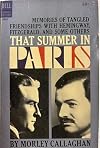
That Summer In Paris: Memories of Tangled Friendships with Hemingway, Fitzgerald, and Some Others
by Morley Callaghan
On This Page
Description
It was the fabulous summer of 1929 when the literary capital of North America moved to La Rive Gauche--the Left Bank of the Seine River--in Paris. Ernest Hemingway was reading proofs of "A Farewell to Arms," and a few blocks away F. Scott Fitzgerald was struggling with "Tender Is the Night." As his first published book rose to fame in New York, Morley Callaghan arrived in Paris to share the felicities of literary life, not just with his two friends, Hemingway and Fitzgerald, but also with show more fellow writers James Joyce, Ford Madox Ford, and Robert McAlmon. Amidst these tangled relations, some friendships flourished while others failed. This tragic and unforgettable story comes to vivid life in Callaghan's lucid, compassionate prose. show lessTags
Recommendations


















Member Recommendations
Member Reviews
Morley Callaghan's excellent memoir of the expatriate scene on Paris's left bank in 1929, THAT SUMMER IN PARIS, was first published in 1963. Callaghan wrote the book because he found he was deeply affected by the tragic suicide of his one-time friend, Ernest Hemingway, and memories of Paris from that long-ago summer began to float to the surface of his mind until he decided to write of it.
I 'discovered' Callaghan's memoir when I read of it in the recent scholarly and excellent book, STEIN AND HEMINGWAY, by Professor Lyle Larsen. THAT SUMMER IN PARIS was recently faithfully and stylishly reprinted by Exile Editions, which is the version I now own.
Callaghan, who was apparently well-known in Canada (he died in 1990), was a new writer to show more me, but now I may have to seek out some of his other work. I enjoyed this book that much. His style of writing is deceptively simple and straightforward and he doesn't appear to take himself overly seriously. He tells his readers right up front that writing should be about the thing itself, and not hidden in metaphors or symbolism, or something to that effect. This approach is certainly followed in THAT SUMMER, which offers a clear-eyed and moving portrait of his separate friendships with Hemingway and Fitzgerald. "Separate" because Callaghan makes clear that there was something between the two men which precluded a real and close friendship, something Callaghan himself is unclear on. As a young aspiring writer with just one book to his credit, Callaghan makes no secret of his enormous admiration for both men, but as he gets to know both of them better, he comes to feel sorry for Fitzgerald, a tortured soul, alcoholic and saddled with a wife who is mentally ill. There are also vague intimations that Fitzgerald may have been a repressed homosexual, which may have been the 'something' between him and Hemingway which precluded any lasting or close friendship. Moreover early in the narrative Callaghan muses that he was "half convinced that writers couldn't go on being friends. Something would always happen that would make them shy away from each other."
Perhaps there is indeed some jealousy or mean spiritedness in this difficulty between writers, as evidenced in an observation once by Oscar Wilde: "It isn't enough that I succeed. My friend has got to fail a little." (I feel compelled to confess that I got this Wilde quote from another writer acquaintance, Ward Just.) In any case, although Fitzgerald appeared to be hungry for Hemingway's friendship to an almost embarrasing extent, Ernest generally kept himself apart from Scott.
As a practical and extremely perceptive young man, Callaghan recognized these difficulties between the two men, and yet managed to remain friends with both of them. With Hemingway he donned boxing gloves and became a regular sparring partner, a macho kind of friendship initiated by Hemingway. His friendship with Fitzgerald was more cerebral and literary in nature, and he also acted, if unwillingly, as a liaison between the two men.
Callaghan was a man with strong opinions on writing and other writers and had no compunction about giving them. He admired Fitzgerald's work without reserve, but seemed to feel that Hemingway's A FAREWELL TO ARMS was his best work (an opinion I share), while he dismissed the fine Nick Adams takls as "his little Michigan stories" - an opinion I do not share. (But then I am from Michigan.) He is equally dismissive of the French writers of the time, Mallarme and Gide, for example. And of Henry James he writes -
"That style of his in those later books! I began to hate it. Not layers of extra subtleness - just evasion from the task of knowing exactly what to say. Always the fancied fastidiousness of sensibility. Bright and sharp as he had been in the earlier books, the fact was that James had got vulgar - like a woman who was always calling attention to her fastidiousness."
Of Gertrude Stein, Callaghan was equally scornful -
"I no longer had any curiosity about the grand lady ... Abstract prose was nonsense. The shrewd lady had found a trick, just as the naughty Dadaists had once found a trick. The plain truth was, as I saw it, Gertrude Stein now had nothing whatever to say."
Bravo, Morley! What you just said? Me too. However, the one thing that Callaghan and Stein might have agreed upon (from what I read in the Larsen book) was Hemingway's true nature. Both thought he was, in reality, a gentle and sensitive man very unlike the overly macho public persona he had created of himself, always bolstered enthusiastically by the press and rumor-mongers. Callaghan talks repeatedly about a "sweetness" in the man. Stein went even further, suspecting that Hemingway may have been a suppressed homosexual. This was, and continues to be, a cause for speculation, but could indeed explain the tension between Hemingway and Fitzgerald.
The truth is, Callaghan's very intimate and literary account of that memorable summer just before the stock market crash which would decimate the fortunes which allowed such lives of expatriate ease and decadence is an immensely sympathetic and readable portrait of his own development as a writer, as well as the excesses and tormented relationships between other prominent artists and writers of the time. More simply, Morley Callaghan was an extremely likeable guy and a wonderful writer. I cannot recommend this book highly enough. show less
I 'discovered' Callaghan's memoir when I read of it in the recent scholarly and excellent book, STEIN AND HEMINGWAY, by Professor Lyle Larsen. THAT SUMMER IN PARIS was recently faithfully and stylishly reprinted by Exile Editions, which is the version I now own.
Callaghan, who was apparently well-known in Canada (he died in 1990), was a new writer to show more me, but now I may have to seek out some of his other work. I enjoyed this book that much. His style of writing is deceptively simple and straightforward and he doesn't appear to take himself overly seriously. He tells his readers right up front that writing should be about the thing itself, and not hidden in metaphors or symbolism, or something to that effect. This approach is certainly followed in THAT SUMMER, which offers a clear-eyed and moving portrait of his separate friendships with Hemingway and Fitzgerald. "Separate" because Callaghan makes clear that there was something between the two men which precluded a real and close friendship, something Callaghan himself is unclear on. As a young aspiring writer with just one book to his credit, Callaghan makes no secret of his enormous admiration for both men, but as he gets to know both of them better, he comes to feel sorry for Fitzgerald, a tortured soul, alcoholic and saddled with a wife who is mentally ill. There are also vague intimations that Fitzgerald may have been a repressed homosexual, which may have been the 'something' between him and Hemingway which precluded any lasting or close friendship. Moreover early in the narrative Callaghan muses that he was "half convinced that writers couldn't go on being friends. Something would always happen that would make them shy away from each other."
Perhaps there is indeed some jealousy or mean spiritedness in this difficulty between writers, as evidenced in an observation once by Oscar Wilde: "It isn't enough that I succeed. My friend has got to fail a little." (I feel compelled to confess that I got this Wilde quote from another writer acquaintance, Ward Just.) In any case, although Fitzgerald appeared to be hungry for Hemingway's friendship to an almost embarrasing extent, Ernest generally kept himself apart from Scott.
As a practical and extremely perceptive young man, Callaghan recognized these difficulties between the two men, and yet managed to remain friends with both of them. With Hemingway he donned boxing gloves and became a regular sparring partner, a macho kind of friendship initiated by Hemingway. His friendship with Fitzgerald was more cerebral and literary in nature, and he also acted, if unwillingly, as a liaison between the two men.
Callaghan was a man with strong opinions on writing and other writers and had no compunction about giving them. He admired Fitzgerald's work without reserve, but seemed to feel that Hemingway's A FAREWELL TO ARMS was his best work (an opinion I share), while he dismissed the fine Nick Adams takls as "his little Michigan stories" - an opinion I do not share. (But then I am from Michigan.) He is equally dismissive of the French writers of the time, Mallarme and Gide, for example. And of Henry James he writes -
"That style of his in those later books! I began to hate it. Not layers of extra subtleness - just evasion from the task of knowing exactly what to say. Always the fancied fastidiousness of sensibility. Bright and sharp as he had been in the earlier books, the fact was that James had got vulgar - like a woman who was always calling attention to her fastidiousness."
Of Gertrude Stein, Callaghan was equally scornful -
"I no longer had any curiosity about the grand lady ... Abstract prose was nonsense. The shrewd lady had found a trick, just as the naughty Dadaists had once found a trick. The plain truth was, as I saw it, Gertrude Stein now had nothing whatever to say."
Bravo, Morley! What you just said? Me too. However, the one thing that Callaghan and Stein might have agreed upon (from what I read in the Larsen book) was Hemingway's true nature. Both thought he was, in reality, a gentle and sensitive man very unlike the overly macho public persona he had created of himself, always bolstered enthusiastically by the press and rumor-mongers. Callaghan talks repeatedly about a "sweetness" in the man. Stein went even further, suspecting that Hemingway may have been a suppressed homosexual. This was, and continues to be, a cause for speculation, but could indeed explain the tension between Hemingway and Fitzgerald.
The truth is, Callaghan's very intimate and literary account of that memorable summer just before the stock market crash which would decimate the fortunes which allowed such lives of expatriate ease and decadence is an immensely sympathetic and readable portrait of his own development as a writer, as well as the excesses and tormented relationships between other prominent artists and writers of the time. More simply, Morley Callaghan was an extremely likeable guy and a wonderful writer. I cannot recommend this book highly enough. show less
Who would have imagined that a Canadian author, virtually unknown in the U.S., had written a Lost Generation memoir twice as compelling as Hemingway's "Moveable Feast"? The book gave me chills when I first read it and has done so for more than a decade since - whenever I think of it. I don't expect ever to find another book of its kind that so convincingly deposits you in a similar time and place of renown, allowing you to rub shoulders with legends (albeit quirky, quirky legends). -Adam
Published first, in 1963, but makes for an excellent A Moveable Feast (1964) sequel.
"The Quarter was like a small town. It had little points of protocol, little indignities not to be suffered." - That Summer in Paris, page 109
"Look at it in this way. Scott didn’t like McAlmon. McAlmon no longer liked Hemingway. Hemingway had turned against Scott. I had turned up my nose at Ford. Hemingway liked Joyce. Joyce liked McAlmon." - That Summer in Paris, pg. 169
The above quotes give a good idea of the gossipy tone of Morley Callaghan's memoir. Callaghan first met Ernest Hemingway in Toronto, Canada in 1923 where they were both working for the Toronto Star and Callaghan's early short-story writing was encouraged and promoted by Hemingway. show more Callaghan was a Scribners published author along with Hemingway and F. Scott Fitzgerald by the time he and his wife Loretto came to live in Paris for the summer of 1929.
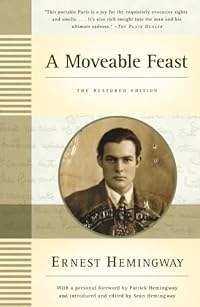
Hemingway's A Moveable Feast (published posthumously in 1964) centres on his 1921-1925 years in Paris and is a paean to the love of his first wife Hadley, but with a bitter tone towards many of his contemporaries. I get a sense that Callaghan's life-long love of Loretto (who is also the book's dedicatee) was what kept him balanced and made for the more good natured tone in his memoir which he wrote in response to Hemingway's death in 1961.
Callaghan had a wish-list of writers he hoped to meet in Paris and manages eventually to meet them all: F. Scott Fitzgerald, James Joyce and Robert McAlmon among them, as well as a then unknown John Glassco (with the nickname of Buffy, under which he appears several times as a couple with his fellow Montrealer Graeme Taylor). The book builds to a climax and crisis where the friendly sparring partners Callaghan and Hemingway were famously mis-timed in a round by Fitzgerald that resulted in Callaghan knocking down the heavier and taller Hemingway. The easily slighted Hemingway is not quick to make friends again afterwards but all ends relatively well.
This 2014 printing by Exile Editions has the bonus content of several reviews and articles by Callaghan about his contemporaries as well as an undated (1980's?) afterward which records a final return trip to Paris by the Callaghans.
Highly recommended if you are intrigued by this locale and this period.
A partial list of related 1920's Paris memoirs:
Kiki's Memoirs (1929) by Kiki de Montparnasse
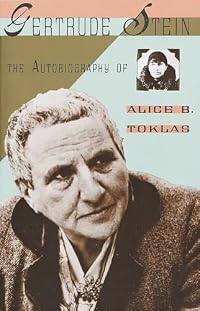
The Autobiography of Alice B. Toklas (1933) by Gertrude Stein
This Must be the Place (1934) by Jimmie (The Barman) Charters
A Moveable Feast (1964) by Ernest Hemingway
Being Geniuses Together, 1920 1930 (1970) by Robert McAlmon (1938 original) & Kay Boyle (1960’s additions)
Memoirs of Montparnasse (1973) by John Glassco
The Nightinghouls of Paris (2007) by Robert McAlmon
and one photography book:
Hemingway's Paris: A Writer's City in Words and Images (2015) by Robert Wheeler show less
"The Quarter was like a small town. It had little points of protocol, little indignities not to be suffered." - That Summer in Paris, page 109
"Look at it in this way. Scott didn’t like McAlmon. McAlmon no longer liked Hemingway. Hemingway had turned against Scott. I had turned up my nose at Ford. Hemingway liked Joyce. Joyce liked McAlmon." - That Summer in Paris, pg. 169
The above quotes give a good idea of the gossipy tone of Morley Callaghan's memoir. Callaghan first met Ernest Hemingway in Toronto, Canada in 1923 where they were both working for the Toronto Star and Callaghan's early short-story writing was encouraged and promoted by Hemingway. show more Callaghan was a Scribners published author along with Hemingway and F. Scott Fitzgerald by the time he and his wife Loretto came to live in Paris for the summer of 1929.
Hemingway's A Moveable Feast (published posthumously in 1964) centres on his 1921-1925 years in Paris and is a paean to the love of his first wife Hadley, but with a bitter tone towards many of his contemporaries. I get a sense that Callaghan's life-long love of Loretto (who is also the book's dedicatee) was what kept him balanced and made for the more good natured tone in his memoir which he wrote in response to Hemingway's death in 1961.
Callaghan had a wish-list of writers he hoped to meet in Paris and manages eventually to meet them all: F. Scott Fitzgerald, James Joyce and Robert McAlmon among them, as well as a then unknown John Glassco (with the nickname of Buffy, under which he appears several times as a couple with his fellow Montrealer Graeme Taylor). The book builds to a climax and crisis where the friendly sparring partners Callaghan and Hemingway were famously mis-timed in a round by Fitzgerald that resulted in Callaghan knocking down the heavier and taller Hemingway. The easily slighted Hemingway is not quick to make friends again afterwards but all ends relatively well.
This 2014 printing by Exile Editions has the bonus content of several reviews and articles by Callaghan about his contemporaries as well as an undated (1980's?) afterward which records a final return trip to Paris by the Callaghans.
Highly recommended if you are intrigued by this locale and this period.
A partial list of related 1920's Paris memoirs:
Kiki's Memoirs (1929) by Kiki de Montparnasse
The Autobiography of Alice B. Toklas (1933) by Gertrude Stein
This Must be the Place (1934) by Jimmie (The Barman) Charters
A Moveable Feast (1964) by Ernest Hemingway
Being Geniuses Together, 1920 1930 (1970) by Robert McAlmon (1938 original) & Kay Boyle (1960’s additions)
Memoirs of Montparnasse (1973) by John Glassco
The Nightinghouls of Paris (2007) by Robert McAlmon
and one photography book:
Hemingway's Paris: A Writer's City in Words and Images (2015) by Robert Wheeler show less
Morley Callaghan comes off as a name dropping chauvinist, taking an immediate dislike to the women he meets in Paris that summer. Sylvia Beach offends the great Callaghan because she refuses to give out the personal information of her writer friends. Zelda Fitzgerald he sneers at because she mentions that she too is a good writer (and having read both authors I agree; finding Zelda's letters profound, her prose beautiful and coherent) and also he feels her ballet is competing with Scott. Pauline Hemingway isn't impressed with Morley or his wife (Loretto, who is the only woman in the book who is 'approved' though her only actions are sitting, smiling, and when she speaks-parroting Morley) so she is brushed off as cold. He mentions every show more trivial encounter he can with any of the 1920s Paris names. It's like a summer spent celebrity spotting and is written up as well as any fifth grader writing "What I did on my summer vacation..." show less
I've read many books about Paris and the writers (and artists) who lived and thrived there in the 20s and 30s including Memoirs of Montparnasse by John Glassco, Being Geniuses Together by Robert McAlmon and Kay Boyle, The Last Time I Saw Paris by Elliot Paul (he didn't hang around with the others so this lovely book is really just about him and the colorful neighborhood he lived in which was off the expat/artist beaten track) and of course Hemingway's A Moveable Feast.
Except for Paul's book, which isn't really about the other writers or artists, this one seems to me to be the best -- well written, but mainly the least colored and most honest. I'm not familiar with Callaghan's other writing, so I can't judge him. But in this book he show more seems to give a fair, honest account with no ax to grind.
Callaghan has good and not so good things to say about his colleagues, mainly focusing on Hemingway and Fitzgerald. Now that I've read this account, I am going back to reread the others, starting with A Moveable Feast, and see how the different accounts of the same time and place and same cast of characters compares. Anyone interested in this period, I would advise you do the same. Because even though many of our best and most famous English-language writers were in the same place at the same time, they each seem to have a very different story to tell about it (as do their biographers). show less
Except for Paul's book, which isn't really about the other writers or artists, this one seems to me to be the best -- well written, but mainly the least colored and most honest. I'm not familiar with Callaghan's other writing, so I can't judge him. But in this book he show more seems to give a fair, honest account with no ax to grind.
Callaghan has good and not so good things to say about his colleagues, mainly focusing on Hemingway and Fitzgerald. Now that I've read this account, I am going back to reread the others, starting with A Moveable Feast, and see how the different accounts of the same time and place and same cast of characters compares. Anyone interested in this period, I would advise you do the same. Because even though many of our best and most famous English-language writers were in the same place at the same time, they each seem to have a very different story to tell about it (as do their biographers). show less
Morley Callaghan was only twenty-six years old when he spent the summer of 1929 in Paris with his wife. He had been encouraged by Ernest Hemingway when they were both journalists in Toronto and looked forward to seeing Hemingway again at his place in Paris. Along the way he stops in New York and meets Sinclair Lewis while establishing himself with the editor Maxwell Perkins at Scribner's who publishes his first book. But it is in Paris that he tries to make a home for that one summer. In addition to Hemingway there is Fitzgerald and McAlmon with whom he develops some rapport. He manages to meet with "Jimmy" Joyce and his wife in spite of the protectiveness of Sylvia Beach who is on a mission to guard the privacy of Joyce. This memoir is show more uneven but it is difficult to avoid some interest in the shenanigans of the trio of Scott, Ernest and Morley when the latter duo engage in boxing matches or when Morley and his wife encounter Scott and Zelda on the afternoon following a bender with them wasted in their apartment. Callaghan would go on to write unmemorable novels, but his summer in Paris reminds me that he was one a cluster of the twentieth century's greatest writers. show less
I don't recall where I heard about this book, but when it came in on hold at the library, I was immediately hooked. I am fond of Callaghan's writing, and I like his mixture of boyish enthusiasm and hard-headed Canadian common sense.
This book inspired me, as I saw much of myself in the author, and it was also interesting to learn about the private lives of men whose works I have held in such high esteem (Hemmingway and Fitzgerald). Both of them made sense, despite sounding utterly unappealing, and added a retrospective depth of enjoyment of their works.
This book inspired me, as I saw much of myself in the author, and it was also interesting to learn about the private lives of men whose works I have held in such high esteem (Hemmingway and Fitzgerald). Both of them made sense, despite sounding utterly unappealing, and added a retrospective depth of enjoyment of their works.
Members
- Recently Added By
Published Reviews
ThingScore 50
If one knows some of the people mentioned, or is obsessed with the period, then Morley Callaghan’s memoir will satisfy. But it is not a good book. It is in fact a modest bad dull book which contains a superb short story about Hemingway, Fitzgerald, and Callaghan. One can push so far as to say it is probably the most dramatic single story about Hemingway’s relation to Fitzgerald in the show more literature. If Callaghan had been ready to stop at this, he could have had a long short story or a short memoir which might have become a classic. Instead he attenuated his material over a run of 255 pages, and so reminds one of a remark Fitzgerald once made to Callaghan. Talking about The Great Gatsby, he said the book had done reasonably well but was hardly a best-seller. “It was too short a book,” Fitzgerald said. “Remember this, Morley. Never write a book under sixty thousand words.”...
As the vignettes, the memoirs, and the biographies of Hemingway proliferate, Callaghan’s summer in Paris may take on an importance beyond its literary merit, for it offers a fine clue to the logic of Hemingway’s mind, and tempts one to make the prediction that there will be no definitive biography of Hemingway until the nature of his personal torture is better comprehended. It is possible Hemingway lived every day of his life in the style of the suicide. What a great dread is that. It is the dread which sits in the silences of his short declarative sentences. At any instant, by any failure in magic, by a mean defeat, or by a moment of cowardice, Hemingway could be thrust back again into the agonizing demands of his courage. For the life of his talent must have depended on living in a psychic terrain where one must either be brave beyond one’s limit, or sicken closer into a bad illness, or, indeed, by the ultimate logic of the suicide, must advance the hour in which one would make another reconnaissance into one’s death. show less
As the vignettes, the memoirs, and the biographies of Hemingway proliferate, Callaghan’s summer in Paris may take on an importance beyond its literary merit, for it offers a fine clue to the logic of Hemingway’s mind, and tempts one to make the prediction that there will be no definitive biography of Hemingway until the nature of his personal torture is better comprehended. It is possible Hemingway lived every day of his life in the style of the suicide. What a great dread is that. It is the dread which sits in the silences of his short declarative sentences. At any instant, by any failure in magic, by a mean defeat, or by a moment of cowardice, Hemingway could be thrust back again into the agonizing demands of his courage. For the life of his talent must have depended on living in a psychic terrain where one must either be brave beyond one’s limit, or sicken closer into a bad illness, or, indeed, by the ultimate logic of the suicide, must advance the hour in which one would make another reconnaissance into one’s death. show less
added by SnootyBaronet
Lists

Top Five Books of 2013
1,562 works; 715 members
Author Information

77+ Works 1,247 Members
Morley Callaghan 1903-1990 Morley Callaghan was born on February 22, 1903 in Toronto, Canada. A master of the short story and author of several excellent novels, Callaghan has long been a writer of international reputation. He educated at St. Michael's College, University of Toronto, and Osgoode Hall Law school. Working as a reporter for the show more Toronto Daily Star, he met Ernest Hemingway who was also working with the newspaper. In 1929, the same year as his first volume of short stories, Native Argosy, was published, Callaghan traveled to Paris, where he became reacquainted with Hemingway and met James Joyce and F. Scott Fitzgerald. That Summer in Paris (1963) contains Callaghan's memoirs of his experiences with these famous expatriates. Morley Callaghan is renowned for the clarity and economy of his prose. While Callaghan's work appears forthright and uncomplicated, each of the novels focuses on a character who faces a crisis. How this turning point is handled determines the direction the character's life will take. Callaghan, who was a devout Catholic, saw himself as a moralist as well as one who gave "shape and form to human experience." Callaghan was awarded the Royal Society of Canada's Lorne Pierce Medal in 1960. In 1982 he was made a Companion of the Order of Canada. Callaghan's works include The Loved and the Lost (which won the Governor General's Award in 1951), The Many Colored robe, A Time for Judas, Our Lady of the Snows, and A Wild Old man Down the Road. He died at the age of 87 and was interred at Mount Hope Catholic Cemetery in Ontario. (Bowker Author Biography) show less
Series
Belongs to Publisher Series
Laurentian Library (40)
Common Knowledge
- Canonical title
- That Summer In Paris: Memories of Tangled Friendships with Hemingway, Fitzgerald, and Some Others
- Original publication date
- 1963
- People/Characters
- Morley Callaghan; Loretto Callaghan; Ernest Hemingway; James Joyce; Ford Madox Ford; F. Scott Fitzgerald (show all 11); Sinclair Lewis; Maxwell Perkins; Ezra Pound; Sherwood Anderson; Michael Arlen
- Important places
- Toronto, Ontario, Canada; Paris, France
- First words
- One September afternoon in 1960 I was having a drink with an old newspaper friend, Ken Johnstone, when unexpectedly he told me he had a message to pass on from Ronnie Jacques, the well-known New York photographer.
- Quotations
- What seems incredible now, almost mysterious, is that we would talk about Sherwood Anderson, James Joyce, Ezra Pound and Scott Fitzgerald—then at the height of his fame-all far away from me in Toronto, and yet it turned out... (show all) that we were talking about people I was to know and be with in a few short years.
- Last words
- (Click to show. Warning: May contain spoilers.)But I was glad to hear that in the last year of his life out in Sun Valley, he talked to the photographer so affectionately about those days in Paris with Scott and me, and sent me at last his warm regards.
Classifications
Statistics
- Members
- 207
- Popularity
- 157,340
- Reviews
- 12
- Rating
- (3.72)
- Languages
- English, French, Italian
- Media
- Paper, Ebook
- ISBNs
- 14
- ASINs
- 8