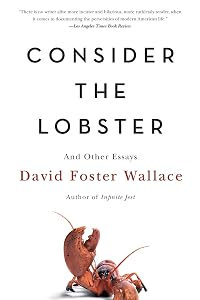
Consider the Lobster and Other Essays
by David Foster Wallace 
On This Page
Description
For this collection, Wallace immerses himself in the three-ring circus that is the presidential race in order to document one of the most vicious campaigns in recent history. Later he strolls from booth to booth at a lobster festival in Maine and risks life and limb to get to the bottom of the lobster question. Then he wheedles his way into an L.A. radio studio, armed with tubs of chicken, to get the behind-the-scenes view of a conservative talk show featuring a host with an unnatural show more penchant for clothing that looks good only on the radio. Do lobsters feel pain? Did Franz Kafka have a sick sense of humor? What is John Updike's deal anyway? And who won the Adult Video News' Female Performer of the Year Award the same year Gwyneth Paltrow won her Oscar? Wallace answers these questions and more.--From publisher description. show lessTags
Recommendations









Member Reviews
“If you are bored and disgusted by politics and don't bother to vote, you are in effect voting for the entrenched Establishments of the two major parties, who please rest assured are not dumb, and who are keenly aware that it is in their interests to keep you disgusted and bored and cynical and to give you every possible psychological reason to stay at home doing one-hitters and watching MTV on primary day. By all means stay home if you want, but don't bullshit yourself that you're not voting. In reality, there is no such thing as not voting: you either vote by voting, or you vote by staying home and tacitly doubling the value of some Diehard's vote.”
“Truly decent, innocent people can be taxing to be around.”
“It never once show more occurs to him, though, that the reason he's so unhappy is that he's an asshole.”
DFW may have been an asswipe during his 46 years on earth and he may have taken some liberties in his essays but there is no question that the dude could write. He may even be one of the best authors of his generation. This is the second essay collection I have read and loved and teaming that up with his massive masterwork, Infinite Jest, has sealed the deal for me. I just would have loved to have heard his voice during the Trump era. show less
“Truly decent, innocent people can be taxing to be around.”
“It never once show more occurs to him, though, that the reason he's so unhappy is that he's an asshole.”
DFW may have been an asswipe during his 46 years on earth and he may have taken some liberties in his essays but there is no question that the dude could write. He may even be one of the best authors of his generation. This is the second essay collection I have read and loved and teaming that up with his massive masterwork, Infinite Jest, has sealed the deal for me. I just would have loved to have heard his voice during the Trump era. show less
I lived less than twenty minutes south of where DFW taught at the Claremont Colleges the last half decade or so of his life. I often considered the dreamy idea of either just showing up at one of his classes, or calling his department and seeing if I could get through to him, not to be a worshipful lunatic fan looking to him as some messiah, but simply to ask him if he wanted to go hiking. In the mountains I know like the back of my hand literally just behind and to the north of his back yard. I thought a question like that might disarm him, and would allow me to explain to him quickly that I wasn't a stalker or serial killer, but simply loved to hike, and thought he might like to too; and then I'd tell him, once we were on the trail show more (Icehouse Canyon Trail probably) how the outdoors have been such an escape, a refuge and replenishment for my often overly wrought, too easily discouraged and depressed, stressed out, strung out mind. I may arrive at the trail head a tumult of anxiety and neurotic nerves, but that baggage of negative emotion sheds quick, once my lug-soled boots leave their first treads on that dusty trail. I figured David could use such a sanctuary, where, as John Muir wrote, "cares drop off like autumn leaves," and it would've been my joy to share my mountain sanctuary with him...
A couple times, I almost called. I had the number. But it was just, turns out, a timid fan's fantasy. Nothing more. I'd like to believe that reaching out to him might've helped avert what ultimately happened to him, but David Foster Wallace, by all accounts, was hard to get to know, shy even, and undoubtedly would have, at worst, thought me a hack upon approaching him or calling him; or at best, merely politely said to me, "no".
In lieu of standard review (supposedly a "review" I know I'll never write again),
Dude, it's just lobsters man, relax.
interspersed within whatever the hell this is (homage? tribute? unconscionable crap?) I’m presently composing now
Why do you care so deeply about lobsters? Don’t you think you maybe, just maybe, you might care a wee bit too much about bottom-dwellers?
are snippets from an imaginary one-sided conversation. a brief and hideous and non-existent interview, I had with the late DFW recently;
Can’t you just suck down some margaritas or marijuana and just enjoy the damn cruise?
said fantasy monologue acting, I believe, as curious catharsis, channeling my loss -- strangely personal,
You say lobsters’er basically gigantic insects, that folks on the coast of Maine call ‘em "bugs," so what are you...I don't see you being so obsessively loquacious concerning the unethical treatment of escargot!
though simultaneously distant and, I guess, vicarious?, if that’s even the right word, which I don't think it is (I mean, I obviously didn’t know DFW
I’ll admit I’ve never really considered the lobster like you have, Mr. Wallace, and if I’ve ever considered lobsters before buying your book (besides acknowledging that they taste mmm-mmm good, dip ‘em in butter, mmm), I’ve considered them disgustingly overgrown, underseawater cockroaches.
even though his writing spoke to me and untold others about everything and more, as in Moses-and-the-Burning-Bush-Speak, as if he were indeed (not necessarily Yahweh or Allah or Buddha -- labels he loathed) but my/our dearest most understanding friend) -- into, what?,
Remove their pincers, paint ‘em black – voila! -- you got yerself a ‘roided up sea salted cockroach -- yuck"
something “productive?”; nah, what the hell does that mean?, productive, that’s the sort of disingenuous drivel DFW chafed at;
I’m just jesting about the lobsters, Mr. Wallace, I admire your enriching, truly educational and edifying, disturbing even, ultra-linguistic meta-analysis of ethics/morality-Maine-Lobster-Festivalish
or, maybe channeling to maybe expunge the nebulous, hard to mentally grasp and accurately articulate, grief over DFWs death, (why it’s so painful to me when I didn’t literally know him beyond his books/interviews) out of my head, onto the page,
Forgive my sentimentality, Dave – and what’s so necessarily automatically wrong with being somewhat sentimental at times anyway?!”
so that my heart can maybe intervene and somehow translate these emotions in-transit through the oblivion between my brain and the page in order to …in order to what?...make sense of it?…find meaning?
But I’m already remembering you fondly, perhaps even sentimentally – despite your assumed omnipresent protestations of hyper-literary-vigilance against said syrupy nostalgia -- and despite what you did; noosed yourself, loosed yourself from life
make sense of the bewildering incomprehensibility of what you did?, explain that which will never be explained, only hinted at in posthumously published essays and fictions, or the retrospections of future biographers, because the only person who could possibly explain it to us, make us understand it, grasp it, is now dead? show less
A couple times, I almost called. I had the number. But it was just, turns out, a timid fan's fantasy. Nothing more. I'd like to believe that reaching out to him might've helped avert what ultimately happened to him, but David Foster Wallace, by all accounts, was hard to get to know, shy even, and undoubtedly would have, at worst, thought me a hack upon approaching him or calling him; or at best, merely politely said to me, "no".
In lieu of standard review (supposedly a "review" I know I'll never write again),
Dude, it's just lobsters man, relax.
interspersed within whatever the hell this is (homage? tribute? unconscionable crap?) I’m presently composing now
Why do you care so deeply about lobsters? Don’t you think you maybe, just maybe, you might care a wee bit too much about bottom-dwellers?
are snippets from an imaginary one-sided conversation. a brief and hideous and non-existent interview, I had with the late DFW recently;
Can’t you just suck down some margaritas or marijuana and just enjoy the damn cruise?
said fantasy monologue acting, I believe, as curious catharsis, channeling my loss -- strangely personal,
You say lobsters’er basically gigantic insects, that folks on the coast of Maine call ‘em "bugs," so what are you...I don't see you being so obsessively loquacious concerning the unethical treatment of escargot!
though simultaneously distant and, I guess, vicarious?, if that’s even the right word, which I don't think it is (I mean, I obviously didn’t know DFW
I’ll admit I’ve never really considered the lobster like you have, Mr. Wallace, and if I’ve ever considered lobsters before buying your book (besides acknowledging that they taste mmm-mmm good, dip ‘em in butter, mmm), I’ve considered them disgustingly overgrown, underseawater cockroaches.
even though his writing spoke to me and untold others about everything and more, as in Moses-and-the-Burning-Bush-Speak, as if he were indeed (not necessarily Yahweh or Allah or Buddha -- labels he loathed) but my/our dearest most understanding friend) -- into, what?,
Remove their pincers, paint ‘em black – voila! -- you got yerself a ‘roided up sea salted cockroach -- yuck"
something “productive?”; nah, what the hell does that mean?, productive, that’s the sort of disingenuous drivel DFW chafed at;
I’m just jesting about the lobsters, Mr. Wallace, I admire your enriching, truly educational and edifying, disturbing even, ultra-linguistic meta-analysis of ethics/morality-Maine-Lobster-Festivalish
or, maybe channeling to maybe expunge the nebulous, hard to mentally grasp and accurately articulate, grief over DFWs death, (why it’s so painful to me when I didn’t literally know him beyond his books/interviews) out of my head, onto the page,
Forgive my sentimentality, Dave – and what’s so necessarily automatically wrong with being somewhat sentimental at times anyway?!”
so that my heart can maybe intervene and somehow translate these emotions in-transit through the oblivion between my brain and the page in order to …in order to what?...make sense of it?…find meaning?
But I’m already remembering you fondly, perhaps even sentimentally – despite your assumed omnipresent protestations of hyper-literary-vigilance against said syrupy nostalgia -- and despite what you did; noosed yourself, loosed yourself from life
make sense of the bewildering incomprehensibility of what you did?, explain that which will never be explained, only hinted at in posthumously published essays and fictions, or the retrospections of future biographers, because the only person who could possibly explain it to us, make us understand it, grasp it, is now dead? show less
Credo di aver goduto poche volte nella mia vita come durante la lettura di Considera l'aragosta, e mai leggendo una raccolta di saggi.
David Foster Wallace è intelligente, brillante, divertente, acuto, gigione, abilissimo in quel gioco delle tre carte che è una scrittura che incolla il lettore alla pagina.
Nonostante i saggi che compongono la raccolta siano un po' datati, le conclusioni che trae e la sua capacità di tenere il lettore per mano anche quando lo spedisce su quelle piste di caccia che sono le note li rendono attuali ed esemplari.
Senza contare che, in quella perla che è Autorità e uso della lingua, ho finalmente trovato una definizione che calza a pennello a me e a quelli come me diversa da "cacacazzo" o "bastardo show more paranoico" :-D show less
David Foster Wallace è intelligente, brillante, divertente, acuto, gigione, abilissimo in quel gioco delle tre carte che è una scrittura che incolla il lettore alla pagina.
Nonostante i saggi che compongono la raccolta siano un po' datati, le conclusioni che trae e la sua capacità di tenere il lettore per mano anche quando lo spedisce su quelle piste di caccia che sono le note li rendono attuali ed esemplari.
Senza contare che, in quella perla che è Autorità e uso della lingua, ho finalmente trovato una definizione che calza a pennello a me e a quelli come me diversa da "cacacazzo" o "bastardo show more paranoico" :-D show less
This is my first introduction to DFW and I am not really sure what to make of this collection. Reading these essays is like sitting down with an incredibly erudite and loquacious friend for an all-night chat session to listen to her hold forth on any topic that catches her fancy complete with tangential ramblings, digressions and further digressions branching off from the main ones. When the topic is of interest to you (as in the essays on porn industry or John McCain), this fractal dialogue is intensely interesting and you stay up way later than you should listening to it. Come morning, you can remember only the vaguest outlines of the previous night's discussions but they leave you with a pleasant intellectual buzz. When you can't show more muster any interest ("Authority and American usage"), the conversation drags and you can't wait to get to bed. Perhaps the cause for this is that in some of the essays, DFW is really addressing serious (as in graduate-level) students of English literature and literary criticism and not the lay audience. I will be working up to "Infinite Jest" with his other works and hopefully, (would a SNOOT approve of the comma here?? Dammit, DFW...(what about this ellipsis???) you have made me more self-conscious than ever before) their tone would be more uniform.
As an aside, DFW is the ultimate stress test for an e-book reader. I read this in my Kindle/iphone app and navigating through the footnotes was a major pain. If the footnote appears at the edge of the screen, Kindle invariably interpreted a click on the FN icon as a page turn or pulled up the menu. Some of the FNs to the FNs lacked a back link leaving you stranded without an easy way to get back to what you were reading. Also, "sync to the last read page" feature basically became useless since the reader couldn't distinguish between the main text and the footnotes section. Not to mention the many lovely words DFW uses that the in-built dictionary has no idea about. Funny how an electronic reader has so much trouble with a hyper-textualized work. show less
As an aside, DFW is the ultimate stress test for an e-book reader. I read this in my Kindle/iphone app and navigating through the footnotes was a major pain. If the footnote appears at the edge of the screen, Kindle invariably interpreted a click on the FN icon as a page turn or pulled up the menu. Some of the FNs to the FNs lacked a back link leaving you stranded without an easy way to get back to what you were reading. Also, "sync to the last read page" feature basically became useless since the reader couldn't distinguish between the main text and the footnotes section. Not to mention the many lovely words DFW uses that the in-built dictionary has no idea about. Funny how an electronic reader has so much trouble with a hyper-textualized work. show less
I don't know much about Kafka or Dostoyevsky. I found the American Usage book review stodgy in parts. But this is undeniably a phenomenal set of essays, with DFW showing he wasn't just one of the best authors of his generation, but an equally excellent journalist as well. His pieces on McCain, talk radio and the titular lobster are all masterpieces.
Consider the Lobster and Other Essays was an up and down experience for me. This was my first David Foster Wallace book, and it is undeniable that the guy was brilliant. I now know much better what a huge loss his death was. But some of these essays were much more my cuppa than others, and his love of footnotes baffles me.
The first essay is his exhausting examination of the Adult Video Awards show, and I couldn't wait for it to end. A tip of the hat for his taking on a subject not often intelligently examined, but the content for me alternated between disgusting and boring, and way too few of the multitudinous footnotes were amusing enough to justify the hard work of reading them. On the other hand, the next essay, ripping an Updike show more book titled Toward the End of Time, was concise, on target, insightful, and hilarious. For example, after "guessing" that for many oldsters "Updike's evection of the libidinous self appeared refreshing and even heroic", he explains that "today's sub-forties" in age:
"many of whom are, of course, the children of all the impassioned infidelities and divorces Updike wrote about so beautifully, and who got to watch all this brave new individualism and sexual freedom deteriorate into the joyless and anomic self-indulgence of the Me Generation . . . have very different horrors, prominent among which are anomie and solipsism, and a peculiarly American loneliness: the prospect of dying without even once having loved something more than oneself."
As you can see, he wasn't shy about making bold pronouncements, and they certainly are thought-provoking.
He got me again with his Kafka essay: "For me, a signal frustration in trying to read Kafka with college students is it is next to impossible to get them to see that Kafka is funny." Yes! Kafka is funny; you need to appreciate the absurdity of what you're reading, even when the content is pitch dark. And Wallace's insights into trying to teach Standard Written English to college students, described in an ostensible review of A Dictionary of Modern English Usage, are similarly both entertaining and convincing as to their accuracy. Another highlight for me was the title essay, which has him as Gourmet magazine's on-the-spot reporter for the annual Maine Lobster Festival who nonetheless is preoccupied with the question of whether it is "all right to boil a sentient creature alive just for our gustatory pleasure."
On the 2000 presidential campaign trail in another essay, he becomes a fan of John McCain as a person while denouncing his "scary" right wing policies. He brings us vividly into McCain's four year's of POW camp suffering, including McCain's refusal, despite his torment, to be preferentially released before other POWs because of family connections: "Think about how diametrically opposed to your own self interest getting knifed in the nuts and having fractures set without a general {anaesthetic} would be, and then about getting thrown in a cell to just lie there and hurt, which is what happened. He was mostly delirious with pain for weeks, and his weight dropped to 100 pounds, and the other POWs were sure he would die . . ." His experience gave McCain a "moral authority"other candidates lacked. McCain was admired by journalists, and many voters, not only for his frankness and honesty, but for being, unlike the other candidates, able to behave "somewhat in the ballpark of a real human being". In the end his extreme views and Bush's successful negative ad campaign likely doomed his political chances.
Bibiophiles will enjoy the essay on Dostoevsky, and Wallace's strongly stated belief that "many of the novelists of our own place and time look so thematically shallow and lightweight, so morally impoverished, in comparison to Gogol or Dostoyevsky." There's a lot to like in his essay on right wing radio host John Ziegler, too, although I was horrified to see the dreaded footnotes climb up into the text, with boxes and arrows. No!!
I was glad I read this for the ups, and for the appreciation I gained of how brilliant this guy was. That brilliance means I'll read more of his work. I can recommend this book strongly, with the caveat that, if you're like me, there are parts you're going to have to tolerate rather than appreciate. show less
The first essay is his exhausting examination of the Adult Video Awards show, and I couldn't wait for it to end. A tip of the hat for his taking on a subject not often intelligently examined, but the content for me alternated between disgusting and boring, and way too few of the multitudinous footnotes were amusing enough to justify the hard work of reading them. On the other hand, the next essay, ripping an Updike show more book titled Toward the End of Time, was concise, on target, insightful, and hilarious. For example, after "guessing" that for many oldsters "Updike's evection of the libidinous self appeared refreshing and even heroic", he explains that "today's sub-forties" in age:
"many of whom are, of course, the children of all the impassioned infidelities and divorces Updike wrote about so beautifully, and who got to watch all this brave new individualism and sexual freedom deteriorate into the joyless and anomic self-indulgence of the Me Generation . . . have very different horrors, prominent among which are anomie and solipsism, and a peculiarly American loneliness: the prospect of dying without even once having loved something more than oneself."
As you can see, he wasn't shy about making bold pronouncements, and they certainly are thought-provoking.
He got me again with his Kafka essay: "For me, a signal frustration in trying to read Kafka with college students is it is next to impossible to get them to see that Kafka is funny." Yes! Kafka is funny; you need to appreciate the absurdity of what you're reading, even when the content is pitch dark. And Wallace's insights into trying to teach Standard Written English to college students, described in an ostensible review of A Dictionary of Modern English Usage, are similarly both entertaining and convincing as to their accuracy. Another highlight for me was the title essay, which has him as Gourmet magazine's on-the-spot reporter for the annual Maine Lobster Festival who nonetheless is preoccupied with the question of whether it is "all right to boil a sentient creature alive just for our gustatory pleasure."
On the 2000 presidential campaign trail in another essay, he becomes a fan of John McCain as a person while denouncing his "scary" right wing policies. He brings us vividly into McCain's four year's of POW camp suffering, including McCain's refusal, despite his torment, to be preferentially released before other POWs because of family connections: "Think about how diametrically opposed to your own self interest getting knifed in the nuts and having fractures set without a general {anaesthetic} would be, and then about getting thrown in a cell to just lie there and hurt, which is what happened. He was mostly delirious with pain for weeks, and his weight dropped to 100 pounds, and the other POWs were sure he would die . . ." His experience gave McCain a "moral authority"other candidates lacked. McCain was admired by journalists, and many voters, not only for his frankness and honesty, but for being, unlike the other candidates, able to behave "somewhat in the ballpark of a real human being". In the end his extreme views and Bush's successful negative ad campaign likely doomed his political chances.
Bibiophiles will enjoy the essay on Dostoevsky, and Wallace's strongly stated belief that "many of the novelists of our own place and time look so thematically shallow and lightweight, so morally impoverished, in comparison to Gogol or Dostoyevsky." There's a lot to like in his essay on right wing radio host John Ziegler, too, although I was horrified to see the dreaded footnotes climb up into the text, with boxes and arrows. No!!
I was glad I read this for the ups, and for the appreciation I gained of how brilliant this guy was. That brilliance means I'll read more of his work. I can recommend this book strongly, with the caveat that, if you're like me, there are parts you're going to have to tolerate rather than appreciate. show less
David Foster Wallace apparently could immerse himself into any topic, grasp a range of interesting truths (picking no favorites and pulling no punches) and emerge with a concise - and often witty - story to help us understand. This collection of essays includes topics spanning talk radio as a business and a medium, the adult film awards, proper usage of the English language, America in the days following 9/11, and a lobster festival in Maine. Wallace’s writing is masterful, based on a profound talent for insight and exceptionally relatable writing. If you routinely write a summary review of books, he’s one of those authors that you make reluctant about having to write something about and following THAT. On a personal note, whenever show more I’ve submitted my own writing samples into one of those algorithms that purport to tell you who you write like, David Foster Wallace has consistently been my match. I think I put off reading him for so long because of this. Now I know why. If this is who my style emulates, I’m both flattered and deeply intimidated. show less
Members
- Recently Added By
Lists

Best "Foodie" Books
114 works; 40 members

Hulk's Essential Reading List
38 works; 1 member

Fake Top 100 Nonfiction
79 works; 3 members

scav
54 works; 2 members

Non-Fiction
68 works; 1 member

The Complete Rory Gilmore Reading List
506 works; 5 members

.
184 works; 1 member
Author Information

89+ Works 47,713 Members
Writer David Foster Wallace was born in Ithaca, New York on February 21, 1962. He received a B.A. from Amherst College in Massachusetts. He was working on his master's degree in creative writing at the University of Arizona when he published his debut novel The Broom of the System (1987). Wallace published his second novel Infinite Jest (1996) show more which introduced a cast of characters that included recovering alcoholics, foreign statesmen, residents of a halfway house, and high-school tennis stars. He spent four years researching and writing this novel. His first collection of short stories was Girl with Curious Hair (1989). He also published a nonfiction work titled Signifying Rappers: Rap and Race in the Urban Present. He committed suicide on September 12, 2008 at the age of 46 after suffering with bouts of depression for 20 years. (Bowker Author Biography) show less
David Foster Wallace has a Legacy Library. Legacy libraries are the personal libraries of famous readers, entered by LibraryThing members from the Legacy Libraries group.
Awards and Honors
Distinctions
Series
Belongs to Publisher Series
Work Relationships
Is contained in
Contains
Is abridged in
Common Knowledge
- Canonical title
- Consider the Lobster and Other Essays
- Original title
- Consider the Lobster and Other Essays
- Original publication date
- 2005
- People/Characters
- John McCain; Tracy Austin; John Ziegler
- Important places
- Bloomington, Illinois, USA
- Important events
- September 11 Attacks (2001-09-11)
- Dedication
- For Bonnie Nadell
- Quotations*
- Se siete annoiati e disgustati dalla politica e non vi disturbate a votare, di fatto votate per gli arroccati establishment dei due principali partiti, i quali … hanno una consapevolezza profonda di quanto gli convenga mant... (show all)enervi in una condizione di disgusto e noia e cinismo … Sia chiaro: avete tutto il diritto di stare a casa, se volete, ma non prendetevi in giro pensando di non votare. In realtà, non votare è impossibile: si può votare votando, oppure votare rimanendo a casa e raddoppiando tacitamente il valore del voto di un irriducibile.
Essere turisti di massa, per me, significa diventare puri americani dell'ultimo tipo: alieni, ignoranti, smaniosi di qualcosa che non si potrà mai avere, delusi come non si potrà mai ammettere di essere … Significa imporr... (show all)e la propria presenza in luoghi che sarebbero, in tutti i sensi non-economici, migliori e più veri senza di noi … come turisti, diventiamo economicamente rilevanti ma esistenzialmente deprecabili, insetti su una cosa morta.
[John Powers]: «… la proliferazione di blurb nei trailer cinematografici ha fatto sembrare tutti i critici o degli idioti o degli agenti pubblicitari …»
La domanda sconvolgente … è perché mai dovrebbe essere divertente ascoltare gente che viene portata con l'inganno a offendersi e agitarsi sempre più. Non sembra esserci una risposta valida. A un certo punto bisogna sempl... (show all)icemente chinare la testa e accettare che certi americani si divertono con cose per le quali a qualsiasi persona sana di mente vorrebbe voglia di tagliarsi le vene. Ci sono, dopotutto, adulti statunitensi del tutto efficienti cui piace la televisione evangelica, il canale delle televendite e la musica per ascensori. Si chiama Avventura democratica. - Publisher's editor
- Pietsch, Michael
- Blurbers
- Eugenides, Jeffrey
*Some information comes from Common Knowledge in other languages. Click "Edit" for more information.
Classifications
Statistics
- Members
- 4,869
- Popularity
- 2,907
- Reviews
- 85
- Rating
- (4.14)
- Languages
- 5 — English, French, German, Italian, Spanish
- Media
- Paper, Audiobook, Ebook
- ISBNs
- 26
- ASINs
- 16