On This Page
Description
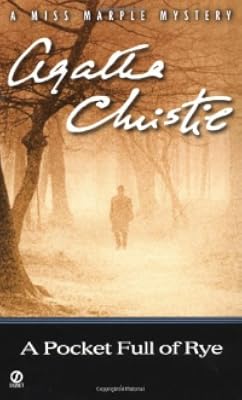
Rex Fortescue, king of a financial empire, was sipping tea in his "counting house" when he suffered an agonizing and sudden death. On later inspection, the pockets of the deceased were found to contain traces of cereals. Yet, it was the incident in the parlor which confirmed Miss Marple's suspicion that here she was looking at a case of crime by rhyme. . . .Tags
Recommendations















Member Reviews
Sing a song of sixpence, a pocket full of rye...
Businessman Rex Fortescue is found dead in his office after drinking his morning tea. It doesn’t take long to determine that he’s been poisoned. But the really puzzling thing is the handful of rye that was found in his pocket. What purpose did it serve? Inspector Neele is on the case, and of course he’s interested in finding out who would gain by Fortescue’s death. His much younger widow, who doesn’t play golf yet has lots of golf dates with a handsome young man? His son and junior business partner? His daughter, who is in love with a young man with socialist views? Or his estranged son who has just reappeared on the scene from exile in Africa? Or maybe the murderer will be found show more among the household help, including the secretive housekeeper, Miss Dove, the butler, Crump, the cook, Mrs. Crump, or the young maid, Gladys? More deaths make it even more urgent to find the killer. Inspector Neele finally gets the breakthrough he needs once Miss Marple arrives on the scene.
This is one of my favorite Miss Marple novels. I had read it years ago and still remembered the solution. What I didn’t remember is that Miss Marple doesn’t show up until about halfway through the book. As usual, she makes the most of her limited page time. Her insights into human nature from decades of village life help her spot individuals with character flaws that just might lead to murder under the right circumstances. show less
Businessman Rex Fortescue is found dead in his office after drinking his morning tea. It doesn’t take long to determine that he’s been poisoned. But the really puzzling thing is the handful of rye that was found in his pocket. What purpose did it serve? Inspector Neele is on the case, and of course he’s interested in finding out who would gain by Fortescue’s death. His much younger widow, who doesn’t play golf yet has lots of golf dates with a handsome young man? His son and junior business partner? His daughter, who is in love with a young man with socialist views? Or his estranged son who has just reappeared on the scene from exile in Africa? Or maybe the murderer will be found show more among the household help, including the secretive housekeeper, Miss Dove, the butler, Crump, the cook, Mrs. Crump, or the young maid, Gladys? More deaths make it even more urgent to find the killer. Inspector Neele finally gets the breakthrough he needs once Miss Marple arrives on the scene.
This is one of my favorite Miss Marple novels. I had read it years ago and still remembered the solution. What I didn’t remember is that Miss Marple doesn’t show up until about halfway through the book. As usual, she makes the most of her limited page time. Her insights into human nature from decades of village life help her spot individuals with character flaws that just might lead to murder under the right circumstances. show less
Agatha Christie for beginners. Point One: don't trust anyone recently returned from the colonies. Point Two: anyone who buys a new pair a nylons is going to die.
To criticise Agatha Christie of being formulaic is like criticising Anne Rice of being obsessed with sexually ambiguous vampires. The truth of the charge can't be denied but the accuser is missing the point. The genius of Agatha Christie lies in threading a believable motive through a morass of misdirection. Her murders work, not because they are particulary realistic or 'gritty' (the adjective of the hour for contemporary crime writing) but because they place incredible events in a mudane and credible setting. The fact that she got away with using the same narrative structure show more over the course of hundreds of novels, without her twists becoming transparent or her books lacking that vital page-turning ability is testament to her very great skill. Perfect sofa reading for those who enjoy sudoku, mulling over the poularity of Miley Cyrus or any other of life's great enigmas. show less
To criticise Agatha Christie of being formulaic is like criticising Anne Rice of being obsessed with sexually ambiguous vampires. The truth of the charge can't be denied but the accuser is missing the point. The genius of Agatha Christie lies in threading a believable motive through a morass of misdirection. Her murders work, not because they are particulary realistic or 'gritty' (the adjective of the hour for contemporary crime writing) but because they place incredible events in a mudane and credible setting. The fact that she got away with using the same narrative structure show more over the course of hundreds of novels, without her twists becoming transparent or her books lacking that vital page-turning ability is testament to her very great skill. Perfect sofa reading for those who enjoy sudoku, mulling over the poularity of Miley Cyrus or any other of life's great enigmas. show less
When Rex Fortescue is discovered to have been murdered by poison in his office, Inspector Neele of Scotland Yard is quite sure he knows exactly who's behind it. But when two more members of Fortescue's household are also found dead, Neele is suddenly left quite perplexed. When Miss Marple arrives to aid the investigation due to her knowledge of one of the victims, the astute insights of the innocuous-looking old woman are likely to set everything on its ear.
Yet another thoroughly satisfying Miss Marple outing. As ever, she had me fully stumped on the whodunnit and her ability to create fantastic characters who feel utterly real from the moment they appear on the page is astounding. Christie continues her run of being unable to disappoint.
Yet another thoroughly satisfying Miss Marple outing. As ever, she had me fully stumped on the whodunnit and her ability to create fantastic characters who feel utterly real from the moment they appear on the page is astounding. Christie continues her run of being unable to disappoint.
I really enjoyed Murder with Mirrors, so I jumped right into the next Miss Marple mystery as soon as I finished it. And, I was not disappointed.
Rex Fortescue dies while in the office at his firm. He was poisoned by taxine, a derivative of the Yew Tree. Weirdly, some grains of rye are found in his coat pocket. Rex’s 30 year younger wife Adele is the prime suspect. However, the day prodigal son Lancelot returns home, Adele dies from Cyanide poisoning and the young maid is found strangled. Inspector Neele is hard at work on the case when Miss Marple arrives – she knew the maid, Gladys, and could perhaps throw some light on the matter. It is she who zeroes in on an old children's rhyme, “Sing a Song of Sixpence” wherein the show more pocketful of rye and other clues come in. There are several suspects including Rex’s sons, their wives, the house manager Miss Dove, and even the maid’s boyfriend. Money was a motive for killing Rex, but why the wife and maid?
The mystery here was solid, but what I really enjoyed most was the scandalous, family drama. The conclusion was also interesting in that the culprit is identified by Miss Marple & the Inspector but is not classically revealed. They know who it is but cannot prove it – leading to an epilogue that wraps it all up.
My only minor complaint, and it is one I have found in many of the Miss Marple mysteries, is that her appearance is highly contrived. And, as with many mysteries from this era, the police investigator welcomes her (a complete stranger) and shares details of the case with her. I couldn’t suspend my disbelief if this were a modern mystery, but it’s manageable for the time it is set and was written in. And Miss Marple is delightful, so I can live with a little contrivance. show less
Rex Fortescue dies while in the office at his firm. He was poisoned by taxine, a derivative of the Yew Tree. Weirdly, some grains of rye are found in his coat pocket. Rex’s 30 year younger wife Adele is the prime suspect. However, the day prodigal son Lancelot returns home, Adele dies from Cyanide poisoning and the young maid is found strangled. Inspector Neele is hard at work on the case when Miss Marple arrives – she knew the maid, Gladys, and could perhaps throw some light on the matter. It is she who zeroes in on an old children's rhyme, “Sing a Song of Sixpence” wherein the show more pocketful of rye and other clues come in. There are several suspects including Rex’s sons, their wives, the house manager Miss Dove, and even the maid’s boyfriend. Money was a motive for killing Rex, but why the wife and maid?
The mystery here was solid, but what I really enjoyed most was the scandalous, family drama. The conclusion was also interesting in that the culprit is identified by Miss Marple & the Inspector but is not classically revealed. They know who it is but cannot prove it – leading to an epilogue that wraps it all up.
My only minor complaint, and it is one I have found in many of the Miss Marple mysteries, is that her appearance is highly contrived. And, as with many mysteries from this era, the police investigator welcomes her (a complete stranger) and shares details of the case with her. I couldn’t suspend my disbelief if this were a modern mystery, but it’s manageable for the time it is set and was written in. And Miss Marple is delightful, so I can live with a little contrivance. show less
It was Miss Somers' turn to make the tea. Miss Somers was the newest and the most inefficient of typists. She was no longer young and had a mild worried face like a sheep. The kettle was not quite boiling when Miss Somers poured the water on the tea, but poor Miss Somers was never quite sure when a kettle was boiling. It was one of the many worries that afflicted her in life.
She poured out the tea and took the cups round with a couple of limp, sweet biscuits in each saucer.
That quote has very little to do with the plot of A Pocket Full of Rye, but it does set the tone of this story. There is something edgy and sinister about A Pocket Full of Rye. This is not a "cozy" mystery. Sure, there is not blood or gore, but there is darkness, show more thirst for revenge, and calculating human horribleness.
And that's what I see in the mention of tepid tea and limp biscuits. No, I kid. But I do see in this opening that there is something just not right, and it is this feeling that runs through this story.
I can't say that I liked this story a lot, and I can't even put my finger on why this is. Maybe it is because of the murder method causes me to have questions, maybe it because the police investigation misses the mark so often, or maybe it is because of that horrible children's rhyme that is the basis for this story, but it is not a story that I enjoy re-reading a lot.
Nevertheless, I recommend it. The different relationship angles in this story are fascinating. Dark, but benefiting from Christie's acute eye for suffering that can be caused by family.
Approach with strong tea, and sweet, rich, fresh biscuits. show less
She poured out the tea and took the cups round with a couple of limp, sweet biscuits in each saucer.
That quote has very little to do with the plot of A Pocket Full of Rye, but it does set the tone of this story. There is something edgy and sinister about A Pocket Full of Rye. This is not a "cozy" mystery. Sure, there is not blood or gore, but there is darkness, show more thirst for revenge, and calculating human horribleness.
And that's what I see in the mention of tepid tea and limp biscuits. No, I kid. But I do see in this opening that there is something just not right, and it is this feeling that runs through this story.
I can't say that I liked this story a lot, and I can't even put my finger on why this is. Maybe it is because of the murder method causes me to have questions, maybe it because the police investigation misses the mark so often, or maybe it is because of that horrible children's rhyme that is the basis for this story, but it is not a story that I enjoy re-reading a lot.
Nevertheless, I recommend it. The different relationship angles in this story are fascinating. Dark, but benefiting from Christie's acute eye for suffering that can be caused by family.
Approach with strong tea, and sweet, rich, fresh biscuits. show less
Rex Fortescue is poisoned one day in his office but the type of poison used and when it must have been administered mean that suspicion falls on those at home rather than anyone in the office. Christie is very good at creating an atmosphere of deep unease and 'something wrong but can't quite put my finder on what' in what should otherwise be a well-off upper middle-class household. Miss Marple arrives to assist with this one fairly late in the day and is described as 'tall' in defiance of every TV adaptation (never noticed this before).
The link to the nursery rhyme feels less contrived than in some of Christie's other books (possibly becauseit's deliberately done by the murderer to cast suspicion elsewhere ).
"I don't believe this was show more ever a happy house. I don't believe anybody was ever happy in it, in spite of all the money they spent and the things they had." show less
The link to the nursery rhyme feels less contrived than in some of Christie's other books (possibly because
"I don't believe this was show more ever a happy house. I don't believe anybody was ever happy in it, in spite of all the money they spent and the things they had." show less
Very good, especially so because it's one of only a handful of Christie books that shows a servant with a life besides serving. More often than not, Christie's servants barely have a name (when it can be remembered), much less a personality fleshed out beyond the stereotypical uneducated emotional girl who either stole something or saw something. I found the end particularly moving in that regard - here and I believe for the first time, the police enters a servant's room to search her belongings and Miss Marple has a strong connection to this character which leads to a very bittersweet finale. The murderer made a lot of sense personality-wise and I thought Mary, the housekeeper, was quite an incredible character. Interesting plot too, show more I've always thought Christie's use of common proverbs and nursery rhymes to be really clever.
Definitely one of her better ones. show less
Definitely one of her better ones. show less
Members
- Recently Added By
Lists

Crime and Mysteries to Read
746 works; 31 members

British Mystery
469 works; 14 members

Anthony Boucher's Best Crime Fiction of the Year
115 works; 5 members
Books With Nursery Rhyme Titles
37 works; 8 members

Agatha Christie Miss Marple
12 works; 1 member

Books About Murder
313 works; 7 members

Top Five Books of 2020
982 works; 350 members

Detective Stories
343 works; 5 members

Favorite Books from the 1950s
33 works; 2 members
Must Read Detective Stories (Nick Fuller)
278 works; 2 members

TBR
77 works; 1 member

Books Read in 2023
5,638 works; 147 members

Biggest Disappointments
606 works; 168 members

Books Read in 2020
4,379 works; 123 members

Books available on Open Library
171 works; 4 members

Books whose title names an object usually found in the kitchen
171 works; 14 members

Books Read in 2019
4,052 works; 110 members

Nifty Fifties
129 works; 14 members

Books Read in 2010
631 works; 11 members

Agatha Christie Chronology
93 works; 1 member
Author Information

2,205+ Works 443,067 Members
One of the most successful and beloved writer of mystery stories, Agatha Mary Clarissa Christie was born in 1890 in Torquay, County Devon, England. She wrote her first novel, The Mysterious Affair at Styles, in 1920, launching a literary career that spanned decades. In her lifetime, she authored 79 crime novels and a short story collection, 19 show more plays, and six novels written under the name of Mary Westmacott. Her books have sold over a billion copies in the English language with another billion in 44 foreign languages. Some of her most famous titles include Murder on the Orient Express, Mystery of the Blue Train, And Then There Were None, 13 at Dinner and The Sittaford Mystery. Noted for clever and surprising twists of plot, many of Christie's mysteries feature two unconventional fictional detectives named Hercule Poirot and Miss Jane Marple. Poirot, in particular, plays the hero of many of her works, including the classic, The Murder of Roger Ackroyd (1926), and Curtain (1975), one of her last works in which the famed detective dies. Over the years, her travels took her to the Middle East where she met noted English archaeologist Sir Max Mallowan. They married in 1930. Christie accompanied Mallowan on annual expeditions to Iraq and Syria, which served as material for Murder in Mesopotamia (1930), Death on the Nile (1937), and Appointment with Death (1938). Christie's credits also include the plays, The Mousetrap and Witness for the Prosecution (1953; film 1957). Christie received the New York Drama Critics' Circle Award for 1954-1955 for Witness. She was also named Dame Commander of the Order of the British Empire in 1971. Christie died in 1976. (Bowker Author Biography) show less
Some Editions
Awards and Honors
Distinctions
Series

Belongs to Publisher Series
Work Relationships
Is contained in
A Miss Marple Quartet: The Body in the Library, A Pocket Full of Rye, A Murder Is Announced, The Moving Finger by Agatha Christie
The Nursery Rhyme Murders: Crooked House / Hickory Dickory Dock / A Pocket Full of Rye by Agatha Christie
Agatha Christie Collection: They Do it with Mirrors, a Pocket Full of Rye, Murder on the Orient Express, Evil Under the Sun, Death on the Nile by Agatha Christie
Agatha Christie Crime Collection: Destination Unknown, The Murder on the Links, A Pocket Full of Rye by Agatha Christie
4.50 From Paddington / Murder in Mesopotamia / A Pocket Full of Rye / Lord Edgware Dies by Agatha Christie
Hickory Dickory Death / Murder on the Orient Express / The Mystery of the Blue Train / A Pocket Full of Rye by Agatha Christie
Miss Marple Novels: The Murder at the Vicarage / The Body in the Library / A Pocket Full of Rye / Sleeping Murder by Agatha Christie
Common Knowledge
- Canonical title
- A Pocket Full of Rye
- Original title
- A Pocket Full of Rye
- Alternate titles
- Das Geheimnis der Goldmine; The Secret of the Goldmine (English Translation of above) (English Translation of above); A pocketful of rye
- Original publication date
- 1953-11-09
- People/Characters
- Jane Marple; Rex Fortescue; Inspector Neele; Crump; Mary Dove; Sergeant Hay (show all 19); Gladys Martin; Mrs. Crump; Lancelot Fortescue; Pat Fortescue; Adele Fortescue; Vivian Dubois; Jennifer Fortescue; Ellen; Miss Ramsbottom; Elaine Fortescue; Percival Fortescue; Gerald Wright; Miss Marple
- Important places
- Yewtree Lodge, Baydon Heath, England, UK
- Related movies
- A Pocket Full of Rye (1985 | IMDb); Marple: A Pocket Full of Rye (2008 | IMDb)
- Dedication
- For
BRUCE INGRAM
who liked and published
my first stories - First words
- It was Miss Somers's turn to make the tea.
- Last words
- (Click to show. Warning: May contain spoilers.)And then, displacing both these emotions, there came a surge of triumph--the triumph some specialist might feel who has successfully reconstructed an extinct animal from a fragment of jawbone and a couple of teeth.
- Original language*
- Anglès
- Disambiguation notice
- This is the Agatha Christie book A Pocket Full of Rye featuring Miss Jane Marple. It is not the same work as the Agatha Christie short story "Sing a Song of Sixpence", nor is it the same as the Agatha Christie short st... (show all)ory "Four and Twenty Blackbirds" featuring Hercule Poirot.
It is the same work as Das Geheimnis der Goldmine (The Secret of the Goldmine), which is its German title, but it is not the same as the Poirot short story "The Secret of the Lost Mine".
*Some information comes from Common Knowledge in other languages. Click "Edit" for more information.
Classifications
Statistics
- Members
- 4,290
- Popularity
- 3,543
- Reviews
- 82
- Rating
- (3.73)
- Languages
- 26 — Arabic, Bulgarian, Catalan, Chinese, Czech, Danish, Dutch, English, Estonian, Finnish, French, German, Greek, Hungarian, Italian, Latvian, Norwegian (Bokmål), Norwegian, Polish, Serbian, Croatian, Slovenian, Spanish, Swedish, Turkish, Portuguese (Portugal)
- Media
- Paper, Audiobook, Ebook
- ISBNs
- 162
- UPCs
- 2
- ASINs
- 79