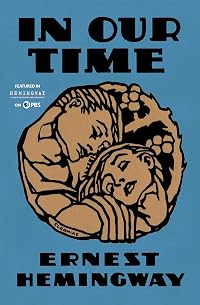
In Our Time
by Ernest Hemingway 
On This Page
Description
Published in 1925, Ernest Hemingway's collection of short stories focuses on alienation, grief, separation, and loss. Nick, his semi-autobiographical character, appears in multiple stories throughout and is used to explore themes of male comradery, early love, and marriage problems. Known as Hemingway's most experimental book, In Our Time is considered one of Hemingway's early masterpieces.Tags
Recommendations






Member Recommendations
Member Reviews
Although I've never been a fan of Hemingway the man, I do like a lot of his work, because his style is so uncompromisingly him. I think this style of short, declarative sentences and simple prose statements is most successful in the Nick Adams stories. Even though the character of Nick isn't one I particularly like (or dislike), the stories are evocative -- there's so much going on under the surface, even if what exactly that is isn't clear to the reader. I find those stories to be exceptionally vivid, even though the description isn't particularly lush or long.
The other stories in this collection are, for me, less successful. They just don't resonate as much and are less interesting. "My Old Man" might be the exception, although that show more is a longer story than any of the others and actually drags a little bit. I feel like this collection is Hemingway finding his voice, which is sometimes clear and sometimes muffled.
However, despite the literary value of his work, there is a fair amount of racism and sexism evident in Hemingway's stories. Where characters who are not white men appear, they are portrayed as shallow and uninteresting. Racist terms abound. These stories are definitely reflective of the time they were written. show less
The other stories in this collection are, for me, less successful. They just don't resonate as much and are less interesting. "My Old Man" might be the exception, although that show more is a longer story than any of the others and actually drags a little bit. I feel like this collection is Hemingway finding his voice, which is sometimes clear and sometimes muffled.
However, despite the literary value of his work, there is a fair amount of racism and sexism evident in Hemingway's stories. Where characters who are not white men appear, they are portrayed as shallow and uninteresting. Racist terms abound. These stories are definitely reflective of the time they were written. show less
Hemingway’s collection of short fiction, [In Our Time] was his first published work, coming in 1925, just a year before [The Sun Also Rises] was published. He wrote the stories between 1921 and 1925, during his stay in Paris with those of the ‘Lost Generation.’ What everyone suspects about the autobiographical nature of the stories contained in the book could only be clear decades later. They are deeply personal and foreshadow the conflict within Hemingway’s soul that he would write about throughout his life.
The book is arranged in chronological fashion, mostly following the life of Nick Adams, a figure that is a thinly veiled iteration of Hemingway himself. Even the stories that don’t mention Nick, seem to be told from his show more perspective as he observes life around him. The early stories feature Nick in his home territory in Michigan, fishing, drinking, and observing the people and the nature of his home. What shines through these stories is Nick’s, and Hemingway’s, emerging unease and disaffection. The stories are broken by vignettes, what would be called flash fiction today, featuring later events in Nick’s life. Each of the vignettes leading up to Nick’s departure from Michigan, and then the United States, are violent episodes from war and bull-fighting; the physical violence of each a projection of the interior conflict in the longer stories. Nick goes to war, is wounded, and then returns to the United States. Eventually, he returns to the nature of his home, alone, finding peace only there in nature. Among the most personal stories is “A Very Short Story” that tells of Nick, and Hemingway, falling in love with a nurse during his convalescence. Anyone familiar with Hemingway’s work and life will see the story that became [A Farewell to Arms].
As personal as these stories are, they are basted in universal elements of the human condition. And as easy as it is to recognize Hemingway in them, it is easy to find yourself in them as well. They are so boldly honest when you least expect them to be. These stories haunt.
Bottom Line: Personal stories that translate to themes for all.
5 bones!!!!!
A favorite for the year. show less
The book is arranged in chronological fashion, mostly following the life of Nick Adams, a figure that is a thinly veiled iteration of Hemingway himself. Even the stories that don’t mention Nick, seem to be told from his show more perspective as he observes life around him. The early stories feature Nick in his home territory in Michigan, fishing, drinking, and observing the people and the nature of his home. What shines through these stories is Nick’s, and Hemingway’s, emerging unease and disaffection. The stories are broken by vignettes, what would be called flash fiction today, featuring later events in Nick’s life. Each of the vignettes leading up to Nick’s departure from Michigan, and then the United States, are violent episodes from war and bull-fighting; the physical violence of each a projection of the interior conflict in the longer stories. Nick goes to war, is wounded, and then returns to the United States. Eventually, he returns to the nature of his home, alone, finding peace only there in nature. Among the most personal stories is “A Very Short Story” that tells of Nick, and Hemingway, falling in love with a nurse during his convalescence. Anyone familiar with Hemingway’s work and life will see the story that became [A Farewell to Arms].
As personal as these stories are, they are basted in universal elements of the human condition. And as easy as it is to recognize Hemingway in them, it is easy to find yourself in them as well. They are so boldly honest when you least expect them to be. These stories haunt.
Bottom Line: Personal stories that translate to themes for all.
5 bones!!!!!
A favorite for the year. show less
In Our Time is a collection of short stories and vignettes written by Ernest Hemingway during his Paris years in the 1920s. (In fact, the book is dedicated to Hadley of The Paris Wife fame.) While the pieces in the volume vary in topic from war scenes to personal relationships between men and women to bullfighting, the connecting theme throughout is the author’s effort to make sense of his experiences in World War I. Deploying his legendarily terse Modernist writing style, Hemingway explores the nature of bravery and fear, love and loss, physical action and introspection. There is a melancholy feeling that pervades the entire work as Hemingway comes to grips with the loss of innocence that accompanied the “Great War” in much the show more same way that Tim O’Brien chronicled his experiences in Viet Nam almost a century later in the equally compelling The Things They Carried.
The stories themselves are all very brief—they range in length from just a single page to eight or ten pages—but they are, for the most part, all remarkably powerful. My favorites involved the exploits of Nick Adams, Hemingway’s alter ego, before, during, and after the war. The strongest pieces were “Indian Camp,” “The End of Something,” “The Three-Day Blow,” “My Old Man,” and “Big Two-Hearted River, Parts I and II”. I know that Hemingway’s reputation has suffered in recent years as some of the more sordid details of his personal life have emerged, but there is no denying that he was an incredibly talented writer with a deep understanding of human nature. Although better known for his longer works, these short stories stand as great examples of a world-class author finding his voice. Indeed, this is the book that put Hemingway on the literary map and it was an absolute pleasure to read. show less
The stories themselves are all very brief—they range in length from just a single page to eight or ten pages—but they are, for the most part, all remarkably powerful. My favorites involved the exploits of Nick Adams, Hemingway’s alter ego, before, during, and after the war. The strongest pieces were “Indian Camp,” “The End of Something,” “The Three-Day Blow,” “My Old Man,” and “Big Two-Hearted River, Parts I and II”. I know that Hemingway’s reputation has suffered in recent years as some of the more sordid details of his personal life have emerged, but there is no denying that he was an incredibly talented writer with a deep understanding of human nature. Although better known for his longer works, these short stories stand as great examples of a world-class author finding his voice. Indeed, this is the book that put Hemingway on the literary map and it was an absolute pleasure to read. show less
In truth, I've already read In Our Time twice before. The first was back in 2013 when I read The Snows of Kilimanjaro, which grouped all the stories of In Our Time with two of Hemingway's best stories, 'The Snows of Kilimanjaro' and 'Up in Michigan'. The second time was in 2018, when I read The First-Forty Nine Stories, which contained those of In Our Time and plenty more besides. But as a long-time fan of Hemingway's writing, I wanted to have read every title, so I picked up In Our Time for the first time with great familiarity.
The good thing is that you grow more appreciative of Hemingway's short stories the more you read them. When I read that Snows of Kilimanjaro collection back in 2013, I was fairly new to Hemingway and much show more preferred his novels. His style was difficult to crack in short doses, where as a reader you lack the weight of a novel to break through your ignorance, and I remember describing 'Big Two-Hearted River' as "dull". By 2018, I had cracked it, and The First Forty-Nine Stories was like a revelation to me. The exquisiteness of many of the pieces became evident.
In Our Time, Hemingway's first major work, does not contain the best of his short stories. Those came later, as he honed his craft, and some of those in In Our Time can seem folksy and redundant. Some, like 'The Battler' and 'Cross-Country Snow', remain unmemorable to me even after reading them for a third iteration. But others like 'Indian Camp' and 'Soldier's Home', are stellar, and nowhere is my earlier point about growing appreciative of Hemingway's writing more apparent than in 'Big Two-Hearted River'. Having first thought this dull, an undynamic story of a young man on a fishing trip, casting for trout and brewing coffee, I've come to recognise it as a prime example of Hemingway's style. Hemingway wrote that he was "trying to do the country like Cézanne" did in his paintings, and when you read the story you do get that same rich, restful feeling you get from contemplating a fine landscape painting. As a collection, In Our Time isn't the most consistent example of the quality in Hemingway's writing, but it has plenty of moments that show excellent craft and the writer's fledgling genius. show less
The good thing is that you grow more appreciative of Hemingway's short stories the more you read them. When I read that Snows of Kilimanjaro collection back in 2013, I was fairly new to Hemingway and much show more preferred his novels. His style was difficult to crack in short doses, where as a reader you lack the weight of a novel to break through your ignorance, and I remember describing 'Big Two-Hearted River' as "dull". By 2018, I had cracked it, and The First Forty-Nine Stories was like a revelation to me. The exquisiteness of many of the pieces became evident.
In Our Time, Hemingway's first major work, does not contain the best of his short stories. Those came later, as he honed his craft, and some of those in In Our Time can seem folksy and redundant. Some, like 'The Battler' and 'Cross-Country Snow', remain unmemorable to me even after reading them for a third iteration. But others like 'Indian Camp' and 'Soldier's Home', are stellar, and nowhere is my earlier point about growing appreciative of Hemingway's writing more apparent than in 'Big Two-Hearted River'. Having first thought this dull, an undynamic story of a young man on a fishing trip, casting for trout and brewing coffee, I've come to recognise it as a prime example of Hemingway's style. Hemingway wrote that he was "trying to do the country like Cézanne" did in his paintings, and when you read the story you do get that same rich, restful feeling you get from contemplating a fine landscape painting. As a collection, In Our Time isn't the most consistent example of the quality in Hemingway's writing, but it has plenty of moments that show excellent craft and the writer's fledgling genius. show less
His first published book. This is a very good collection of shorts by a young man clearly confident in his own style and with an ability to write stories that have a straight and clear voice, and that I think (with one or two cultural exceptions) has aged really well.
The book's structure in itself has a modern feel to it - the stories alternate with very short bursts of what would probably now be called micro-fiction. There are tales here covering subject matter that would become especially familiar to followers of his writing: of soldiers returning home from battle; vagrants on the road; young Americans at leisure in Europe; assorted 'butch' pursuits that you'd wear a cosy plaid shirt for: hunting, fishing, skiing, boozing, etc. I show more enjoyed most of the stories, but the stand-outs for me were: "The Battler"(I wanted more of those characters!), "The Three-Day Blow", "Soldier's Home", and "Big Two-Hearted River" (both parts).
Hemingway introduces his character Nick Adams in many of these stories. From boyhood to manhood we see the character grow, passing through the horrors of service in the First World War, returning back home to small town America. The writing is really very good. Hemingway's skill as a nature writer alone is remarkable - his ability to describe with such clarity - yet without verbosity - and so beautifully, precisely what the reader needs to 'see' in their mind's eye, has very few equals. Very hard to believe that this collection is not far off being a hundred years old! Well worth reading. show less
The book's structure in itself has a modern feel to it - the stories alternate with very short bursts of what would probably now be called micro-fiction. There are tales here covering subject matter that would become especially familiar to followers of his writing: of soldiers returning home from battle; vagrants on the road; young Americans at leisure in Europe; assorted 'butch' pursuits that you'd wear a cosy plaid shirt for: hunting, fishing, skiing, boozing, etc. I show more enjoyed most of the stories, but the stand-outs for me were: "The Battler"(I wanted more of those characters!), "The Three-Day Blow", "Soldier's Home", and "Big Two-Hearted River" (both parts).
Hemingway introduces his character Nick Adams in many of these stories. From boyhood to manhood we see the character grow, passing through the horrors of service in the First World War, returning back home to small town America. The writing is really very good. Hemingway's skill as a nature writer alone is remarkable - his ability to describe with such clarity - yet without verbosity - and so beautifully, precisely what the reader needs to 'see' in their mind's eye, has very few equals. Very hard to believe that this collection is not far off being a hundred years old! Well worth reading. show less
This is a powerful work - an unconventional grouping of stories that marked Hemingway's first major success as a writer. I believe these are the stories he is writing in A Moveable Feast and this time in his life when he is writing these is well covered in Paula McLain's The Paris Wife. In some ways the success that started here doomed his marriage to Hadley Richardson. One can also see many elements of Hemingway's life so far within these stories and the creation of the post WWI 'Lost Generation'. Stuff like this is why Hemingway is one of my favorite writers.
I thought that (roughly) the first half of the book was the strongest with some hard hitting sketches and stories. Towards the middle I felt there was a small slump, a fumble lets show more call it as well as a story or two where Hemingway lays on that Hemingway style just a little too thick, which on reflection keeps me from rating this higher than 4 stars. The Nick Adams stories in here were my favorites overall, but I like how Hemingway broke things up in a very interesting manner.
A few of these stories might bother a sensitive reader for the language, topics and sensibilities of the times (1920's).
This was a reread for me - first read sometime in the early to mid 90's. show less
I thought that (roughly) the first half of the book was the strongest with some hard hitting sketches and stories. Towards the middle I felt there was a small slump, a fumble lets show more call it as well as a story or two where Hemingway lays on that Hemingway style just a little too thick, which on reflection keeps me from rating this higher than 4 stars. The Nick Adams stories in here were my favorites overall, but I like how Hemingway broke things up in a very interesting manner.
A few of these stories might bother a sensitive reader for the language, topics and sensibilities of the times (1920's).
This was a reread for me - first read sometime in the early to mid 90's. show less
Hmm, what to say about the book that supposedly marked Hemingway's USA debut and launched his career? Umm, it was ok. This was the first time I've ever read Hemingway, and maybe I need to talk to an English professor or something, but I don't get the allure. Eh, I guess it's not that I don't get the allure, it was a good book, I read it in one night. But I guess I just don't get what all the fuss is about. It was interesting, it was entertaining, but was it amazing, I don't think so. I remember being on a cruise for spring break one year, and we stopped in Key West for the day, and my friend and I were walking around and we saw Hemingway's house. If they preserve your house, and nickname you Papa, and all the other accolades and stuff, show more you must have been doing something right. What makes him so different from every other author out there. I hope someone can tell me, because I don't understand what makes him so special. His writing style was strange, almost like quick hit sentences. They were all very short and rapid fire. Is his style what does it? He was very descriptive, I could really visualize everything he wrote about it, is that it?
What can I say, besides all this rambling, I just don't get the fuss. Don't get me wrong, I really liked the book and it was good and fun and all that, I just don't get what makes Hemingway so beloved and all. show less
What can I say, besides all this rambling, I just don't get the fuss. Don't get me wrong, I really liked the book and it was good and fun and all that, I just don't get what makes Hemingway so beloved and all. show less
Members
- Recently Added By
Lists

Radcliffe's 100 Best Novel of the 20th Century
100 works; 32 members
1920s
141 works; 6 members
American Lit for Eng 11 Research Project
368 works; 6 members

Authors from the United States
245 works; 3 members

Mustich's 1000 Books to Read Before You Die: A Life Changing List
1,001 works; 19 members
Author Information

660+ Works 173,717 Members
Ernest Miller Hemingway was born in the family home in Oak Park, Ill., on July 21, 1899. In high school, Hemingway enjoyed working on The Trapeze, his school newspaper, where he wrote his first articles. Upon graduation in the spring of 1917, Hemingway took a job as a cub reporter for the Kansas City Star. After a short stint in the U.S. Army as a show more volunteer Red Cross ambulance driver in Italy, Hemingway moved to Paris, and it was here that Hemingway began his well-documented career as a novelist. Hemingway's first collection of short stories and vignettes, entitled In Our Time, was published in 1925. His first major novel, The Sun Also Rises, the story of American and English expatriates in Paris and on excursion to Pamplona, immediately established him as one of the great prose stylists and preeminent writers of his time. In this book, Hemingway quotes Gertrude Stein, "You are all a lost generation," thereby labeling himself and other expatriate writers, including F. Scott Fitzgerald, T.S. Eliot, and Ford Madox Ford. Other novels written by Hemingway include: A Farewell To Arms, the story, based in part on Hemingway's life, of an American ambulance driver on the Italian front and his passion for a beautiful English nurse; For Whom the Bell Tolls, the story of an American who fought, loved, and died with the guerrillas in the mountains of Spain; and To Have and Have Not, about an honest man forced into running contraband between Cuba and Key West. Non-fiction includes Green Hills of Africa, Hemingway's lyrical journal of a month on safari in East Africa; and A Moveable Feast, his recollections of Paris in the Roaring 20s. In 1954, Hemingway won the Nobel Prize in Literature for his novella, The Old Man and the Sea. A year after being hospitalized for uncontrolled high blood pressure, liver disease, diabetes, and depression, Hemingway committed suicide on July 2, 1961, in Ketchum, Idaho. (Bowker Author Biography) show less
Ernest Hemingway has a Legacy Library. Legacy libraries are the personal libraries of famous readers, entered by LibraryThing members from the Legacy Libraries group.
Some Editions
Awards and Honors
Notable Lists
Series
Belongs to Publisher Series
The Inquest (6)
Warbler Classics (sun also rises hemingway)
Westvaco American Classics (1998)
rororo (278)
Work Relationships
Is contained in
Ernest Hemingway Book-of-the-Month-Club Set of 6: A Farewell to Arms, A Moveable Feast, For Whom the Bell Tolls, The Sun Also Rises, The Old Man and the Sea, The Complete Short Stories by Ernest Hemingway (indirect)
The Complete Short Stories of Ernest Hemingway: The Finca Vigía Edition by Ernest Hemingway (indirect)
The Sun Also Rises / A Farewell to Arms / For Whom the Bell Tolls / The Old Man and the Sea / The Complete Short Stories by Ernest Hemingway (indirect)
The Short Stories of Ernest Hemingway: The First Forty-Nine Stories and the Play The Fifth Column by Ernest Hemingway (indirect)
6 Volume Set: Death in the Afternoon / A Farewell to Arms / The Fifth Column and the First 49 Stories / For Whom the Bell Tolls / The Sun Also Rises / To Have and to Have Not by Ernest Hemingway (indirect)
Contains
Is parodied in
Has as a commentary on the text
Common Knowledge
- Canonical title
- In Our Time
- Original title
- In Our Time; in our time
- Original publication date
- 1925; 1930: On the Quai at Smyrna
- People/Characters
- Nick Adams
- Epigraph
- A Girl in Chicago: Tell us about the French women, Hank. What are they like?
Bill Smith: How old are the French women, Hank? - Dedication
- To Hadley Richardson Hemingway
to robert mcalmon and william bird publishers of the city of paris and to captain edward dorman-smith m.c., of his majesty’s fifth fusiliers this book is respectfully dedicated. - First words
- The strange thing was, he said, how they screamed every night at midnight.
Everybody was drunk. - Last words
- (Click to show. Warning: May contain spoilers.)Like all Greeks he wanted to go to America.
- Blurbers
- Anderson, Sherwood; Ford, Ford Madox; Frank, Waldo; O'Brien, Edward J.; Seldes, Gilbert; Steward, Donald Ogden (show all 8); Passos, John Dos; Wilson, Edmund
- Original language
- English
- Disambiguation notice
- This edition of "in our time" (lower case) is for copies of the 1924 original edition of 170 copies or the 1977 facsimile edition of 1,700 copies or other facsimiles containing only the original 18 vignettes on 32 pages. This... (show all) edition should not be combined with the later 1925 or 1930 editions where the 18 vignettes became the 16 inter-chapters to the longer short stories of "In Our Time" (upper case) and vignette Chapter 10 became "A Very Short Story" and vignette Chapter 11 became "The Revolutionist".
Classifications
Statistics
- Members
- 3,701
- Popularity
- 4,342
- Reviews
- 37
- Rating
- (3.69)
- Languages
- 10 — Bulgarian, Danish, Dutch, English, French, German, Japanese, Russian, Spanish, Swedish
- Media
- Paper, Audiobook, Ebook
- ISBNs
- 79
- ASINs
- 56