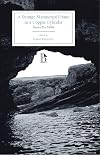
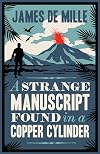
A Strange Manuscript Found in a Copper Cylinder
by James De Mille
On This Page
Description
With its curious mixture of adventure, natural history and satire this early Canadian novel has become a landmark work of fantasy and science fiction.Tags
Recommendations

























Member Reviews
A man lost at sea gets caught up in a mysterious Antarctic current and discovers a lost, isolated civilization. On the surface it appears remarkably friendly and welcoming, but soon he discovers its darker side. It is somewhat a Canadian analogue for Jules Verne and H.G. Wells as it posits quasi-scientific mysteries in a far corner of the Earth. Obvious parallels with H. Rider Haggard led to De Mille's being accused of following Haggard's model too closely. In fact, although this was published (posthumously and somewhat unfinished) after H. Rider Haggard's more famous and comparable works, it was written prior. The setting and monsters described here are more fantastical than in Haggard's more famous novels, the culture encountered even show more more unlikely. There's derring-do and haphazard accidental travels, odd tribal peoples and strange natural phenomena - and a sad degree of racism, portraying a civilized white man revolted by the primitive black man, and the peculiar suggestion that Semitic culture might lend itself to death-worship.
The most intriguing chapters were those belonging to the framing story, occasionally intruding to comment on the likelihood of this found manuscript's truth. They provide the author an opportunity to criticize his own work, examine different emphasis it might have entertained, and to suggest what its themes might be. I was pleased there is no consistent, clear line of argument among these debaters; they read very much like an actual group of people who each maintain and defend their own views of the matter without consensus. But it does leave an actual critic at sea (pun!) as to the author's real intentions. If it's an allegory, it would make Ayn Rand proud for its depiction of where extremist altruism will take you. If it's a satire, as Chapter 26 suggests, then it is nihilist and depressing. Its already weak scientific plausibility is only a ghost now. If it was intended as a harmless adventure, the dated racism introduces harm. Even speaking as a Canadian and finding this an interesting curiosity, I'm not sorry for its low profile. show less
The most intriguing chapters were those belonging to the framing story, occasionally intruding to comment on the likelihood of this found manuscript's truth. They provide the author an opportunity to criticize his own work, examine different emphasis it might have entertained, and to suggest what its themes might be. I was pleased there is no consistent, clear line of argument among these debaters; they read very much like an actual group of people who each maintain and defend their own views of the matter without consensus. But it does leave an actual critic at sea (pun!) as to the author's real intentions. If it's an allegory, it would make Ayn Rand proud for its depiction of where extremist altruism will take you. If it's a satire, as Chapter 26 suggests, then it is nihilist and depressing. Its already weak scientific plausibility is only a ghost now. If it was intended as a harmless adventure, the dated racism introduces harm. Even speaking as a Canadian and finding this an interesting curiosity, I'm not sorry for its low profile. show less
A seemingly usual tale of lost civilization and rescue the princess, avoid the dinosaurs type story, but those are mostly background details.
Its a look at a civilization which truly embraces the self-sacrifice teachings of many religious orders, which turns out to be pretty terrifying when you see it in practice. As this single concept can't sustain an entire book and things start to drag, a love triangle appears (not unlike the one in the 80's Flash Gordon movie, with Ming's daughter) which keeps it interesting until the finale.
A very odd thing about all this is the occasional interruption by those reading the found manuscript. These characters feel like they were written by P.G. Wodehouse and are completely at odds tonally with the show more rather dark story. They also analysis and criticize the texts language, geography and descriptions as if the author was a bit desperate to justify himself.
It started to lose me a few times but kept dragging me back in. show less
Its a look at a civilization which truly embraces the self-sacrifice teachings of many religious orders, which turns out to be pretty terrifying when you see it in practice. As this single concept can't sustain an entire book and things start to drag, a love triangle appears (not unlike the one in the 80's Flash Gordon movie, with Ming's daughter) which keeps it interesting until the finale.
A very odd thing about all this is the occasional interruption by those reading the found manuscript. These characters feel like they were written by P.G. Wodehouse and are completely at odds tonally with the show more rather dark story. They also analysis and criticize the texts language, geography and descriptions as if the author was a bit desperate to justify himself.
It started to lose me a few times but kept dragging me back in. show less
A group of wealthy Victorian gentlemen, out sailing recreationally, find the eponymous strange manuscript and read it in instalments.
This is the narrative of one Adam More, cast ashore near the south Pole and chancing upon a strange subterranean world, where the inhabitants yearn for all we deem bad- death and privation being the greatest glories.
With human sacrifice and dinosaurs part of the tale (I wondered if the author of that kids book Dinotopia had been influenced by this?)...and love...it keeps you reading.
The gentlemen sailors interject every so often....theyre unable to decide if it's a true account or some kind of allegory...
This is the narrative of one Adam More, cast ashore near the south Pole and chancing upon a strange subterranean world, where the inhabitants yearn for all we deem bad- death and privation being the greatest glories.
With human sacrifice and dinosaurs part of the tale (I wondered if the author of that kids book Dinotopia had been influenced by this?)...and love...it keeps you reading.
The gentlemen sailors interject every so often....theyre unable to decide if it's a true account or some kind of allegory...
Published posthumously, and very possibly unfinished. Relatively pacey with moments of genuine suspense. Interesting intersections of scientific detail, particularly as regards linguistics. There is a satirical quality to De Mille's Kosekin civilisation, as explained by one off his narrators: even where a people's desires are entirely inverted, they remain tormented by desire itself. The plot's chief premise (what lurks at the south pole) was rapidly and entirely overtaken by advances in geographical knowledge, as the blank spaces in our maps were completed, but then the same could be said of most nineteenth century novels of this particular sub-genre, several of which enjoy greater reputations.
(A laughable review has been posted by a show more Canadian reader on this site, accusing the author, who died in 1880, of "dated racism", presumably for inventing two fictional tribal peoples who were less advanced than the average European. God save us. Canada too was once a fine country, not so long ago.) show less
(A laughable review has been posted by a show more Canadian reader on this site, accusing the author, who died in 1880, of "dated racism", presumably for inventing two fictional tribal peoples who were less advanced than the average European. God save us. Canada too was once a fine country, not so long ago.) show less
The title really tells us a lot about the book. Four English gentlemen found a copper cylinder floating in the sea. When they opened it up they found a document purporting to be from an English sailor by the name of Adam More. More tells of becoming separated from his ship and his little boat being carried along a current in the sea near the Antarctic Circle. Eventually he ends up in a strange land which is the antithesis in all things to the society he is used to.
The four gentlemen read the document aloud and discuss it when they take breaks. This gives the reader a chance to think about the story and about the philosophy of the society in which More found himself. At times the writing is heavy-handed but probably did not seem so in show more 1888 when this book was first published (8 years after De Mille's death).
I found myself thinking of the novels of Jules Verne while reading the book and thinking that De Mille was probably influenced by those stories. Then, when I read the introduction after finishing the book (I try never to read introductions before reading a book because they invariably spoil the story) I found that Verne's novels were not translated into English until the 1880's after De Mille's death. The other book I was reminded of was Gulliver's Travels. Here I was probably closer to the mark according to the author of the introduction:
The antecedents to which De Mille was possibly indebted...were such satirical masterworks as Swift's Gulliver's Travels and Samuel Butler's Erewhon...
This book is meant to make you think and it does that. It is also entertaining. show less
The four gentlemen read the document aloud and discuss it when they take breaks. This gives the reader a chance to think about the story and about the philosophy of the society in which More found himself. At times the writing is heavy-handed but probably did not seem so in show more 1888 when this book was first published (8 years after De Mille's death).
I found myself thinking of the novels of Jules Verne while reading the book and thinking that De Mille was probably influenced by those stories. Then, when I read the introduction after finishing the book (I try never to read introductions before reading a book because they invariably spoil the story) I found that Verne's novels were not translated into English until the 1880's after De Mille's death. The other book I was reminded of was Gulliver's Travels. Here I was probably closer to the mark according to the author of the introduction:
The antecedents to which De Mille was possibly indebted...were such satirical masterworks as Swift's Gulliver's Travels and Samuel Butler's Erewhon...
This book is meant to make you think and it does that. It is also entertaining. show less
I read this and "The Narrative of Arthur Gordon Pym of Nantucket" by E.A. Poe, in the same year, and I confuse them in my mind; both involve sea travelers who reach a new and mysterious world. But where Poe's is a classical suspense/thriller/horror tale, "A Strange Manuscript" is more a social study, of idle gentlemen looking for adventure at first, and of a utopian/dystopian (depending on your political leanings...) society for most of the book.
I always enjoy "alternate universe" or "other worlds" stories, and this one was not an exception. However, it is liable to feel dated, because the personalities and concerns of the characters are rather victorian. A "retro" read if you like dystopia/utopia.
I always enjoy "alternate universe" or "other worlds" stories, and this one was not an exception. However, it is liable to feel dated, because the personalities and concerns of the characters are rather victorian. A "retro" read if you like dystopia/utopia.
This is different. We picked it out at half priced books by accident. I liked how the story is told by the people on the boat and they interrupt at various times to put in what they think of it and what the story could possibly mean. It felt like as the reader, you're a part of the people that are on the boat and you get to participate in their discussion on it.
Members
- Recently Added By
Lists

501 Must-Read Books
529 works; 72 members

KayStJ's to-read list
1,616 works; 11 members

New Canadian Library
191 works; 7 members

Welcome to Ruritania!
22 works; 5 members

Found manuscripts
35 works; 2 members
Author Information

25+ Works 836 Members
Some Editions
Awards and Honors
Series
Belongs to Publisher Series
Work Relationships
Common Knowledge
- Canonical title
- A Strange Manuscript Found in a Copper Cylinder
- Original publication date
- 1888
- First words
- It occurred as far back as 15th February 1850.
- Last words
- (Click to show. Warning: May contain spoilers.)"That's enough for today," said he. "I'm tired and can't read any more. It's time for supper."
Classifications
Statistics
- Members
- 364
- Popularity
- 86,950
- Reviews
- 9
- Rating
- (3.39)
- Languages
- English, Italian
- Media
- Paper, Audiobook, Ebook
- ISBNs
- 61
- ASINs
- 10