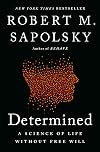
Determined: A Science of Life without Free Will
by Robert M. Sapolsky
On This Page
Description
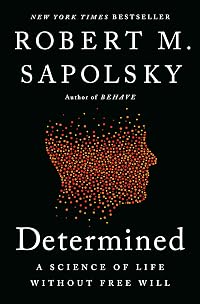
"One of our great behavioral scientists plumbs the depths of the science and philosophy of decision-making to mount a devastating case against free will, an argument with profound consequences. Robert Sapolsky's "Behave," his now classic account of why humans do good and why they do bad, pointed toward an unsettling conclusion: We may not grasp the precise marriage of nature and nurture that creates the physics and chemistry at the base of human behavior, but that doesn't mean it doesn't show more exist. Now, in "Determined," Sapolsky takes his argument all the way, mounting a brilliant (and in his inimitable way, delightful) full-frontal assault on the pleasant fantasy that there is some separate self telling our biology what to do. This book offers a marvelous synthesis of what we know about how consciousness works--the tight weave between reason and emotion and between stimulus and response in the moment and over a life. One by one, Sapolsky tackles all the major arguments for free will and takes them out, cutting a path through the thickets of chaos and complexity science and quantum physics, as well as touching ground on some of the wilder shores of philosophy. He shows us that the history of medicine is in no small part the history of learning that fewer and fewer things are somebody's "fault"; for example, for centuries we thought seizures were a sign of demonic possession. Yet, as he acknowledges, it's very hard, and at times impossible, to uncouple from our zeal to judge others and to judge ourselves. Sapolsky applies the new understanding of life beyond free will to some of our most essential questions around punishment, morality, and living well together. By the end, Sapolsky argues that while living our daily lives recognizing that we have no free will is going to be monumentally difficult, doing so is not going to result in anarchy, pointlessness, and existential malaise. Instead, it will make for a much more humane world"-- show lessTags
Recommendations


Member Reviews
By now Sapolsky is rightly regarded as one of the greatest communicators in modern science. Crucially he doesn't think that intelligent and complex prose need be obfuscatory or boring, and his wit lightens the load here as elsewhere. In this book he outlines the many ways in which who we are, and how we behave and think, is a result of our environment and biology, and after outlining the terrain one finds that it doesn't leave room to shoe-horn in a magical non-physical thing called 'free will'.
Even for those of us who know quite a bit about psychology this is a great read, including as it does some very recent research results. Sapolsky finds that his argument against free will leads to a view of seeing criminals as humans who need to show more be quarantined from the wider population to stop them hurting others, but not vilified as supernaturally 'evil' (they are acting in ways we would if we had their genes and brains and backgrounds, etc). This is the best science book of 2023 in my opinion: funny, powerful conclusions, and a hugely wide purvey surveying different domains of knowledge.
So, no free will, however like even the author of this book, I will continue to act and think in ways in which free will is assumed in human life - that's just how we're made and its hard to go through life thinking otherwise. On the other hand, when I am at a function and well paid people are sipping white wine and lowly paid waiters are picking up empty glasses, I won't think that those waiters should just show more 'grit' to get ahead and become the ones with the suits and the wine glasses. I won't think that the well heeled are extra deserving of their high salaries because of their free will and good choices. They were determined to be there, in that besuited position, and should stop gloating. show less
Even for those of us who know quite a bit about psychology this is a great read, including as it does some very recent research results. Sapolsky finds that his argument against free will leads to a view of seeing criminals as humans who need to show more be quarantined from the wider population to stop them hurting others, but not vilified as supernaturally 'evil' (they are acting in ways we would if we had their genes and brains and backgrounds, etc). This is the best science book of 2023 in my opinion: funny, powerful conclusions, and a hugely wide purvey surveying different domains of knowledge.
So, no free will, however like even the author of this book, I will continue to act and think in ways in which free will is assumed in human life - that's just how we're made and its hard to go through life thinking otherwise. On the other hand, when I am at a function and well paid people are sipping white wine and lowly paid waiters are picking up empty glasses, I won't think that those waiters should just show more 'grit' to get ahead and become the ones with the suits and the wine glasses. I won't think that the well heeled are extra deserving of their high salaries because of their free will and good choices. They were determined to be there, in that besuited position, and should stop gloating. show less
There are many things to like about Robert Sapolsky, and about this book. I’ll start with what I like about the book, and then I’ll get into what I find confounding about it.
Sapolsky says he has two goals, at least for the bulk of the book — one is to convince us that free will does not exist, and the second is, if we are not convinced that free will doesn’t exist, to convince us that we have far less free will than we thought.
I’ll buy the latter.
Sapolsky argues that biologically-based factors, ranging from the neuronal events and environmental factors of the last few seconds all the way back through our adolescence and childhood and to our genetic endowments, strongly influence the decisions we make and the actions we take. show more An abused child will suffer stresses that, relative to other children, stunt the growth of its pre-frontal cortex. That stunted growth will inhibit the child’s ability to override flashes of anger and other emotional impulses arising in its amygdala. Self-control will be harder for such a child.
Sapolsky describes numerous behavioral issues — criminality, learning disabilities, psychologically based problems like schizophrenia, . . . — in similarly biological terms, where the culprit is not weakness of will or a depraved soul, but rather such influences as traumatic injury, poor nutrition (including prenatal), genetic endowment, . . . — all biological in nature.
His argument is convincing in that it should influence our policies and behavior regarding childhood health, medicine, our systems of punishment and rehabilitation, our treatments for everything from alcoholism to criminal sociopathy.
Sapolsky argues for a more compassionate system, in fact, in the second half of the book, sketching out a potential replacement of the institution of punishment with a kind of minimally punitive quarantine, to protect society from the damage potentially wrought by damaged people. This goes hand in hand with his claims that we are far less responsible for our actions than we think we are, and that moral condemnation is misplaced.
As a reader, you probably already have fairly strong leanings on this question of the extent of personal responsibility. Although Sapolsky’s biological arguments in support of his claims are impressive, I’m afraid they aren’t going to change a lot of minds. But I’m glad he’s making the argument, maybe in support of a slow pace of change.
Now on to the part of the book I’m confounded by — the argument that free will simply does not exist. Let’s be clear this is both a theoretical point (which is the point I’m going to focus on) and a practical one (in that if he’s right that free will does not exist, then moral responsibility either doesn’t exist or has to be reconstructed in a different way than tradition has given us).
I’m going to try to stick to theory, at least for now.
Sopolsky describes decisions, especially decisions to act one way or another, as the consequence of causal neuronal interactions, as I referred to above.
In ordinary conversation, we describe those same decisions in various ways, sometimes invoking social pressures, moral values, or reasons.
The latter involve a mix of “free” choice and compulsion by external forces.
Sopolsky wants to convince us that free choices, the results of weighing alternatives, applying reason, looking out for desired outcomes is illusory. It’s not that we don’t do those things, it’s just that the conscious experience of doing them, the conscious weighing and considering, are not what produces behavior — behavior is produced entirely at the biological level of neuron interactions, interactions that we are not consciously aware of.
I have to think about this via an example.
I’m deciding today how to vote in various local elections. What do I do? I consciously weigh alternatives, apply reason, look out for desired outcomes. Regardless of the description of what I’m doing in terms of causal neuronal interactions, that’s what I do — I weigh alternatives, apply reason, look out for desired outcomes, etc.
I think it’s important in this example that the experience of choice, and the potential to choose among alternatives, is not just one among many properties of the experience. It’s defining of the experience. What I experience is defined by choosing.
What’s more, that choosing seems inescapable. I’m going to choose to mark my ballot one way or another, or I’m going to choose not to do it at all. Telling me that my freely choosing is illusory, that in fact, I can’t effectively choose either alternative, that I’m bound by casual influences to choose one or another, that is not going to help me make my choice. In fact, I may well take into account all of the social influences and biases that I think are influencing me toward one choice, and I could on principle or just out of pure perversity choose the other.
There’s a difference between the biological description and the one based on conscious experience, obviously. One is in the terms of biology and causation. The other is in the terms of reason, values, outcomes, and choices.
Can both be valid? Why would one be valid and the other not?
On his determinist side, Sapolsky’s best argument is what he calls the “turtle” argument. If you ask where one bit of behavior (including mental actions) came from, it came from neuron interactions that happened moments ago. If you ask where those interactions came from, they came from more neuron interactions moments before that. And so on, and so on, again reaching back beyond my own neurons to behaviors by others that causally interact with my brain chemistry, where those behaviors of others have analogous causal histories. “It’s turtles all the way down.”
We should note at least in passing that what would actually constitute a “complete” causal history of my action isn’t something that Sapolsky or anybody else can produce, at least on the level of complex decisions and behaviors. That would require knowing, at the fine level of casual interaction, all the factors that influence my genetics, my childhood, my parents’ own influences, my behavioral history, and on and on. It would be a chain of mechanical causation reaching far into past states and events that are not accessible to us in the present. So Saposlky’s claim of “turtles all the way down” is more a statement of a program of explanation than a demonstration of it.
Sapolsky’s challenge to free will defenders is to point out where in that chain of interactions there is a non-causal interaction, one not determined by the state of things previous to it — an uncaused neuronal interaction, for example.
As another aside, that doesn’t sound like a challenge to provide evidence of “free will” so much as simply an uncaused event — nothing necessarily to do with will, at least in the ordinary sense, as might be meant by the kind of free choice that appears in my description of deciding how to mark my election ballot.
In the story of casual chains, you’re not going to find free choice or free will — I think Sapolsky is almost certainly right about that. Free choice or free will don’t live in those causal chains. They live in another, potentially competing way of describing behavior — the one involving reasons, conscious considerations weighing of alternatives, etc.
The latter, as I’m trying to convey, is inescapable in situations of choice, like choosing who to mark my ballot for. I HAVE to do those things, or something like them (even if I just decide to close my eyes and mark my ballot). I certainly can’t just wait to see what happens — nothing happens without my undertaking my reasoning, considering, etc. That conscious experience is in the path, inextricably.
Sapolsky’s response would of course be that, describe it how I want, it’s really just neurons interacting — more turtles — with the illusion of free choice. But the necessity of choice, the fact that I’m faced with a decision I have to make, that doesn’t make itself, says there’s something else going on that Sapolsky’s description misses.
Talk of the conscious experience of free will, or decision or choice, may invoke the “pixie dust” derision from Sapolsky, as do invocations of non-material wills and minds. But consciousness is not pixie dust. It’s ubiquitous, it’s always there, we bear a closer relationship to consciousness than we do to solid objects like toes, or arguably even to neurons.
The only thing that makes consciousness “mysterious” is that our dominant theories of how brains work do not account for it well. But the fact that a theory doesn’t account for a thoroughly familiar and constant phenomenon is not good reason for throwing the phenomenon out. It’s arguably, at the least, an argument for the limitations of the theory (I say “limitations” purposely rather than “inaccuracies” — the dominant theories may well be accurate but limited in scope).
Sapolsky gives little attention to consciousness itself. His most extensive discussion runs just a couple of pages, within a larger discussion of Libet’s and related experiments that seem to indicate that actions based on decisions, at least in simple actions (pushing a button), are initiated at the biological level before conscious decisions are made.
Just exactly what is established by the Libet experiments is a little unclear. In any case, in the example above, the conscious decision I’m talking about is not actually the decision itself, but rather the conscious consideration of a choice before a decision is made, and the accompanying experience of a freedom to chose one or another alternative.
To get back to my reaction to the book, the reason I said that Sapolsky’s claim against the very existence of free will was confounding to me is that he doesn’t seem to have bought the claim himself. After all he’s writing a book with the intention of influencing us to change our minds, through rational means, about moral responsibility, therapeutic intervention, and punishment.
In his defense, we could say, well yes exactly, the key term there is “influencing,” and influencing happens just the way he says it does — causal interactions, turtles all the way down. So, okay, he’s trying through rational argument to cause neuronal interactions that will result in his readers thinking and acting differently. After all, “rational argument” is, again, to be described as neuronal (and other) causal interactions.
But he is trying to do something. He made a decision to do it. Surely, in his own experience of making that decision, he could have done otherwise. In fact, he says that he struggled for years to write or not write this book. His experience is of a kind with mine, sitting down to decide how to mark my ballot. I could mark it one way or another. To say that that “freedom” to do either one thing or another is illusion is entirely idle — I’m in a situation where I must decide, and the choices are there in front of me requiring it.
As I write this, I imagine a reader somewhere saying, “You missed the whole point! You’re describing an illusion! You think you are choosing freely, that you could choose one or another candidate, but really, you’re going to do what you’re determined to do. How you imagine it, with the freedom to choose, isn’t real.”
But my response is always, “But there is nothing more real than that experience of choice, where I could in fact decide one way or another. That’s inescapable, and to deny it is to deny what makes our experience what it is.”
All of this ventures into questions about the validity of scientific realism and the limits of scientific understanding. I don't think Sapolsky likes to talk about things like that, but to make the kinds of claims and arguments he makes about determinism and free will, I'm afraid he needs to. show less
Sapolsky says he has two goals, at least for the bulk of the book — one is to convince us that free will does not exist, and the second is, if we are not convinced that free will doesn’t exist, to convince us that we have far less free will than we thought.
I’ll buy the latter.
Sapolsky argues that biologically-based factors, ranging from the neuronal events and environmental factors of the last few seconds all the way back through our adolescence and childhood and to our genetic endowments, strongly influence the decisions we make and the actions we take. show more An abused child will suffer stresses that, relative to other children, stunt the growth of its pre-frontal cortex. That stunted growth will inhibit the child’s ability to override flashes of anger and other emotional impulses arising in its amygdala. Self-control will be harder for such a child.
Sapolsky describes numerous behavioral issues — criminality, learning disabilities, psychologically based problems like schizophrenia, . . . — in similarly biological terms, where the culprit is not weakness of will or a depraved soul, but rather such influences as traumatic injury, poor nutrition (including prenatal), genetic endowment, . . . — all biological in nature.
His argument is convincing in that it should influence our policies and behavior regarding childhood health, medicine, our systems of punishment and rehabilitation, our treatments for everything from alcoholism to criminal sociopathy.
Sapolsky argues for a more compassionate system, in fact, in the second half of the book, sketching out a potential replacement of the institution of punishment with a kind of minimally punitive quarantine, to protect society from the damage potentially wrought by damaged people. This goes hand in hand with his claims that we are far less responsible for our actions than we think we are, and that moral condemnation is misplaced.
As a reader, you probably already have fairly strong leanings on this question of the extent of personal responsibility. Although Sapolsky’s biological arguments in support of his claims are impressive, I’m afraid they aren’t going to change a lot of minds. But I’m glad he’s making the argument, maybe in support of a slow pace of change.
Now on to the part of the book I’m confounded by — the argument that free will simply does not exist. Let’s be clear this is both a theoretical point (which is the point I’m going to focus on) and a practical one (in that if he’s right that free will does not exist, then moral responsibility either doesn’t exist or has to be reconstructed in a different way than tradition has given us).
I’m going to try to stick to theory, at least for now.
Sopolsky describes decisions, especially decisions to act one way or another, as the consequence of causal neuronal interactions, as I referred to above.
In ordinary conversation, we describe those same decisions in various ways, sometimes invoking social pressures, moral values, or reasons.
The latter involve a mix of “free” choice and compulsion by external forces.
Sopolsky wants to convince us that free choices, the results of weighing alternatives, applying reason, looking out for desired outcomes is illusory. It’s not that we don’t do those things, it’s just that the conscious experience of doing them, the conscious weighing and considering, are not what produces behavior — behavior is produced entirely at the biological level of neuron interactions, interactions that we are not consciously aware of.
I have to think about this via an example.
I’m deciding today how to vote in various local elections. What do I do? I consciously weigh alternatives, apply reason, look out for desired outcomes. Regardless of the description of what I’m doing in terms of causal neuronal interactions, that’s what I do — I weigh alternatives, apply reason, look out for desired outcomes, etc.
I think it’s important in this example that the experience of choice, and the potential to choose among alternatives, is not just one among many properties of the experience. It’s defining of the experience. What I experience is defined by choosing.
What’s more, that choosing seems inescapable. I’m going to choose to mark my ballot one way or another, or I’m going to choose not to do it at all. Telling me that my freely choosing is illusory, that in fact, I can’t effectively choose either alternative, that I’m bound by casual influences to choose one or another, that is not going to help me make my choice. In fact, I may well take into account all of the social influences and biases that I think are influencing me toward one choice, and I could on principle or just out of pure perversity choose the other.
There’s a difference between the biological description and the one based on conscious experience, obviously. One is in the terms of biology and causation. The other is in the terms of reason, values, outcomes, and choices.
Can both be valid? Why would one be valid and the other not?
On his determinist side, Sapolsky’s best argument is what he calls the “turtle” argument. If you ask where one bit of behavior (including mental actions) came from, it came from neuron interactions that happened moments ago. If you ask where those interactions came from, they came from more neuron interactions moments before that. And so on, and so on, again reaching back beyond my own neurons to behaviors by others that causally interact with my brain chemistry, where those behaviors of others have analogous causal histories. “It’s turtles all the way down.”
We should note at least in passing that what would actually constitute a “complete” causal history of my action isn’t something that Sapolsky or anybody else can produce, at least on the level of complex decisions and behaviors. That would require knowing, at the fine level of casual interaction, all the factors that influence my genetics, my childhood, my parents’ own influences, my behavioral history, and on and on. It would be a chain of mechanical causation reaching far into past states and events that are not accessible to us in the present. So Saposlky’s claim of “turtles all the way down” is more a statement of a program of explanation than a demonstration of it.
Sapolsky’s challenge to free will defenders is to point out where in that chain of interactions there is a non-causal interaction, one not determined by the state of things previous to it — an uncaused neuronal interaction, for example.
As another aside, that doesn’t sound like a challenge to provide evidence of “free will” so much as simply an uncaused event — nothing necessarily to do with will, at least in the ordinary sense, as might be meant by the kind of free choice that appears in my description of deciding how to mark my election ballot.
In the story of casual chains, you’re not going to find free choice or free will — I think Sapolsky is almost certainly right about that. Free choice or free will don’t live in those causal chains. They live in another, potentially competing way of describing behavior — the one involving reasons, conscious considerations weighing of alternatives, etc.
The latter, as I’m trying to convey, is inescapable in situations of choice, like choosing who to mark my ballot for. I HAVE to do those things, or something like them (even if I just decide to close my eyes and mark my ballot). I certainly can’t just wait to see what happens — nothing happens without my undertaking my reasoning, considering, etc. That conscious experience is in the path, inextricably.
Sapolsky’s response would of course be that, describe it how I want, it’s really just neurons interacting — more turtles — with the illusion of free choice. But the necessity of choice, the fact that I’m faced with a decision I have to make, that doesn’t make itself, says there’s something else going on that Sapolsky’s description misses.
Talk of the conscious experience of free will, or decision or choice, may invoke the “pixie dust” derision from Sapolsky, as do invocations of non-material wills and minds. But consciousness is not pixie dust. It’s ubiquitous, it’s always there, we bear a closer relationship to consciousness than we do to solid objects like toes, or arguably even to neurons.
The only thing that makes consciousness “mysterious” is that our dominant theories of how brains work do not account for it well. But the fact that a theory doesn’t account for a thoroughly familiar and constant phenomenon is not good reason for throwing the phenomenon out. It’s arguably, at the least, an argument for the limitations of the theory (I say “limitations” purposely rather than “inaccuracies” — the dominant theories may well be accurate but limited in scope).
Sapolsky gives little attention to consciousness itself. His most extensive discussion runs just a couple of pages, within a larger discussion of Libet’s and related experiments that seem to indicate that actions based on decisions, at least in simple actions (pushing a button), are initiated at the biological level before conscious decisions are made.
Just exactly what is established by the Libet experiments is a little unclear. In any case, in the example above, the conscious decision I’m talking about is not actually the decision itself, but rather the conscious consideration of a choice before a decision is made, and the accompanying experience of a freedom to chose one or another alternative.
To get back to my reaction to the book, the reason I said that Sapolsky’s claim against the very existence of free will was confounding to me is that he doesn’t seem to have bought the claim himself. After all he’s writing a book with the intention of influencing us to change our minds, through rational means, about moral responsibility, therapeutic intervention, and punishment.
In his defense, we could say, well yes exactly, the key term there is “influencing,” and influencing happens just the way he says it does — causal interactions, turtles all the way down. So, okay, he’s trying through rational argument to cause neuronal interactions that will result in his readers thinking and acting differently. After all, “rational argument” is, again, to be described as neuronal (and other) causal interactions.
But he is trying to do something. He made a decision to do it. Surely, in his own experience of making that decision, he could have done otherwise. In fact, he says that he struggled for years to write or not write this book. His experience is of a kind with mine, sitting down to decide how to mark my ballot. I could mark it one way or another. To say that that “freedom” to do either one thing or another is illusion is entirely idle — I’m in a situation where I must decide, and the choices are there in front of me requiring it.
As I write this, I imagine a reader somewhere saying, “You missed the whole point! You’re describing an illusion! You think you are choosing freely, that you could choose one or another candidate, but really, you’re going to do what you’re determined to do. How you imagine it, with the freedom to choose, isn’t real.”
But my response is always, “But there is nothing more real than that experience of choice, where I could in fact decide one way or another. That’s inescapable, and to deny it is to deny what makes our experience what it is.”
All of this ventures into questions about the validity of scientific realism and the limits of scientific understanding. I don't think Sapolsky likes to talk about things like that, but to make the kinds of claims and arguments he makes about determinism and free will, I'm afraid he needs to. show less
The first thing to say is that Sapolsky's book is wonderfully enjoyable. His ebullience is infectious. It's worth pursuing him in his podcasts to get the full savour of his book. There is a strange paradox here. In his enthusiastic promotion of determinism Sapolsky appears to be the living refutation of his thesis that he is a 'biological machine' without meaning or purpose. The paradox is pervasive. Sapolsky is hugely informative on the neurobiology he deploys in support of this thesis that science shows that determinism and free will are incompatible. But the thesis itself is is not sustained by his evidence.
Sapolsky’s title, 'Determined, Life without Free Will' is meant to convey two messages. The first is obvious. He argues that show more we have no free will because everything we do is determined by our biology and environmental interactions with the world. As individuals and as a species ‘we are nothing more or less than the cumulative biological and environmental luck, over which we had no control, that has brought us to any moment.’[4] The causal network that brought each of us to the present moment goes back to the beginning of time. There is no space in Sapolsky’s vision for free will, which he dismisses as an imaginary entity. He calls it ‘fairy dust’, arguing that free will and determinism are simply incompatible. His second message, advanced with far less assurance, is that we will be better off and that we will be better people, if we can learn to live in the world without free will. He concedes that it won’t be easy. Towards the end of his extended argument that the absence of free will precludes responsibility, praise, blame or punishment for the best or worst that human kind can do, Sapolsky steps back for a moment and reflects, ‘Perhaps when done with the writing, I should read this book.’[384] To persuade himself again, perhaps.
Similarly disarming asides, mostly in footnotes, provide an accompanying obbligato to the argument in the text. In an early example Sapolsky insists that he is ‘really, really, really trying not to sound like a combative jerk in the book’.[8] He anticipates opposition. His Introduction suggests that only 5-10% of people will agree with his stance of ‘hard incompatibilism”. Most philosophers and legal scholars, 90% of them he says, are compatibilists who accept determinism but consider it unnecessary to scrap free will. The philosopher Daniel Dennett serves as Sapolsky’s exemplary combatant throughout. They are well matched. In their recent televised debate, Dennett and Sapolsky, both abundantly hirsute, resemble a pair of contending prophets from the Old Testament.
My own view is that the issue between Sapolsky and Dennett is never joined. They do not mean the same thing when they refer to ‘free will’. Sapolsky indeed makes no serious attempt to explain what he means by it. His exhaustive compendium of the biological, neurological and environmental sources of human action, valuable in itself, is meant to leave no space in the mix for anything that could be called free will. It is ‘fairy dust’, invisible in any version of science-based reality. Daniel Dennett, on the other hand, argues that ‘free will’ is a product of our social and linguistic evolution and an essential element in the determinist mix that governs the conduct of our lives.
The Graduate and the Garbage Collector
Sapolsky tells a story at the beginning of the book to illustrate his argument with the compatibilists. He asks his readers to imagine a university graduation ceremony. Parents, siblings, relatives and friends are there to celebrate the graduates’ success as they clutch their parchment scrolls and wait their turn with the photographer. Their bright futures beckon. Now Sapolsky asks you to look beyond the cluster of approbation surrounding the graduates to a wall at the back of the auditorium where there are garbage bins and a man is filling the bins with debris from the afternoon celebrations. Pick a random graduate says Sapolsky and ‘do some magic so that this garbage collector started life with the graduate’s genes’, the same uterine environment as a fetus and every other cultural, familial and educational benefit that nurtured the graduate’s progress. And now, with the same magic wand, inflict the graduate with the garbage collector’s miserable childhood and impoverished physical and cultural environment. ‘Trade every factor over which they had no control and you will switch who will be in the graduation robe and who will be hauling garbage cans. This is what I mean by determinism’.[17]
In Sapolsky’s world without free will, where outcomes are unavoidable, the graduate and the garbage collector are equally undeserving of their positions in the social pecking order. The difference between them is nothing but luck. So far as the graduates are concerned, the successful future that awaits them should be undercut by the deflating consciousness that their success now and in prospect is mere luck and completely undeserved. Their pleasurable consciousness of their success should be tempered by humility. Sapolsky’s brief evocation of the garbage collector at the back of the auditorium can be extended to provide a corresponding negative tale of deprivation that will culminate in disaster. After finishing his shift at the graduation ceremony, the garbage collector goes to a bar to drink. Towards the end of the night when he is very drunk, a random remark by a companion enrages him. He smashes his glass on zinc counter and jabs the sharp end into his companion’s neck several times, severing the carotid artery, so that he dies. The garbage conductor is charged with murder; in some American jurisdictions he will be a candidate for the death penalty.
Sapolsky is familiar with such cases; he is not infrequently called as an expert witness on the question of criminal fault in trials for murder. He will be asked to give his opinion on the question whether the garbage collector intended to cause death or serious injury. In a court of law the answer to that question will determine whether he garbage collector is guilty of murder. As an expert witness Sapolsky must play the lawyer’s game and do the best he can with the question of intention. In his world of reality-based science outside the courtroom however, there can be no rational ground for a finding of criminal responsibility or the punishment that will follow that finding. The garbage collector’s barroom attack, whatever his ‘intention’, was the ineluctable product of biological and environmental events that stretch into an immemorial past. There are no gaps for free will in the causal net that determined his fatal attack. Moral condemnation for killing his companion like praise for the graduates’ achievements is accordingly unjustified. In an interview he refers with rueful resignation that the evidence he has given in nine cases similar to the imaginary garbage collector has only once induced a jury to acquit of murder.
The current state of American criminal law, with its cruel and wasteful encouragement of vengeance, is the moral driver for much of Sapolsky’s polemic. In the second half of his book, where he argues the ethical case for a world without free will, the courts would have a preventive rather than punitive role; dangerous individuals would be quarantined until they could be safely released. As an alternative to American penal practice he discusses the case of Anders Breivik, the Norwegian neo-Nazi terrorist who murdered 77 people in 2011 and now resides in spartan comfort in a secure three room complex with a small gymnasium, television, computer access for his university studies and three budgerigars. Breivik was sentenced to 21 years imprisonment, the maximum possible in Norwegian law. He will be released in 2033 unless he continues to be dangerous, a finding that would allow one or more extensions of his sentence. Breivik’s custodial containment is consistent with Sapolsky’s proposal for ‘quarantine’ to contain danger, rather than punishment for wrongdoing.
The excesses of American criminal law, ‘barbaric’ by comparison with Norwegian practice, play a central but distracting role in Sapolsky’s polemic. There are ample grounds for reform of American criminal law, punishment and penology without wholesale abandonment of the concept of criminal responsibility. It is, moreover, an argument unlikely to win support for reform, if one accepts Sapolsky’s concession that the great majority of lawyers and philosophers reject his hard incompatibilism. The case of Anders Breivik on which he places such reliance cuts the other way. Though Sapolsky tries to deflect the point by calling it ‘funishment’, Breivik is currently serving a penal sentence for an atrocious crime. His attempt to avoid criminal responsibility on the ground of insanity failed. He was convicted of mass murder and the penalty of 21 years for mass murder, served in moderate comfort with opportunities for recreation, represents the maximum punishment for his crime. Penal reform can proceed without embracing hard incompatibilism.
Determinism and the Architecture of Choice
Sapolsky’s constant recourse to the law of homicide and violent killers in making his case against free will is misleading in its focus. Most of our laws are not concerned with the regulation of individuals who may be biologically incapable of containing their violent impulses Consideration of the ordinary lives of ordinary people provides a more realistic appreciation of the nature of free will in a determinist universe.
Let’s return to Sapolsky’s thought experiment and ask what his graduate will do, after the ceremony. The graduate - call him Paul - applies for a junior lectureship at Sandstone College Inc. He does well in his interview and the corporation offers him an $80,000pa contract as a lecturer. He takes a chance and asks for something more. He wants a reduced teaching load with one day off, when he can take his share of childminding. After negotiation the corporation agrees with his request and renews its offer without reduction of his initial salary. There is a standard probation period with an option for renewal of his contract. With the assurance of employment Paul and his wife decide to buy a house and move out of rental accommodation. They compile a check list of desiderata and spend some weeks house-hunting. After several unsuccessful bids at auctions they find a house that matches their checklist and finances. Most other people in their street will have followed a similar trajectory in making their choices to settle there.
These events occur in a world composed predominantly in what John Searle called ‘institutional facts’. The contracts, the corporation, the $80,000 salary, the option to renew and the contract for the house and ownership title that Paul acquired are all real things. Institutional facts like these form part of an extensive architecture of choice enabling people to lead a conventionally happy life in an ordered society. If we could descend to the level of biology and electronics we would find these institutional facts – the contracts, corporations, options, property titles, salary entitlements - instantiated in computer codes and in the neuronal pathways of the individuals who negotiate their way through these legal structures. Institutional facts are different from what Searle calls ‘brute’ facts. Institutional facts only exist because our society collectively agrees that they exist and accepts their status and significance in a connected network of regulation. In Searle’s classic example, a dollar note only counts as negotiable currency because of our collective recognition of the monetary status of that palpable object, the dollar ‘note’ - polymer in Australia, paper or cotton fibre in other nations. In similar fashion, the 'corporation' with which Paul makes his contract is a ‘fictional person’, distinct from the human beings who fill its executive positions from time to time. It only exists because of our collective recognition that an organisation of people can count as a ‘legal person’. So also, with the contracts and other elements in Paul’s plan to pursue his academic career and family life. They constitute the institutional framework within which he will exercise his freedom of choice as he negotiates with personnel managers, agents and owners, drawing on whatever resources of rationality and self-assurance he can command. This is all compatible with determinism: there’s no ‘fairy dust’ here.
The architecture of choice that enables Paul to negotiate his contracts has evolved over centuries. It is embedded in his brain and in our brains together with the entirety of the past that has brought him to the negotiating table. The compatibilist accepts that Paul’s choices are completely determined by preceding events at the point where he signs each of his contracts.. If he is ordinarily fortunate and if he and his wife were sensible in setting their goals and recognising their constraints on expenditure and so on, they should find that they have done about as well as they could expect in achieving what they wanted. It is no objection to the compatibilist that their wants were determined by the entirety of their preceding lives and the lives of their ancestors. Unless something has gone wrong, and it usually doesn’t, these are exercises of free will that are embedded in their transactions. This is the modest essence of the compatibilist case for a freedom of will worth having.
The choices Paul made in the preceding sketch were all enabled by the civil law. But the same pattern of ordered opportunities for choice prevails in our more informal social engagements where the law is usually an indiscernible presence in the architecture of choice. There is no bright line between law and life. Outside formal contracts and the like, the potential applications of law are often uncertain and disputable. As, for example in the uncertain penumbra of laws that have a potential bearing on the ways in which individuals choose to express their sexuality.
And the garbage collector? Compared with Paul, it is less likely that he will achieve what most people would consider a good life. He might not be able to buy a house but settles instead for rental accommodation. Statistically, he is more likely to be charged with a serious criminal offence than Paul and more likely to be imprisoned. Paul’s children are more likely than his to receive schooling that will equip them to achieve the same modest level of social and economic success as Paul and his wife. The garbage collector’s access to the architecture of choice is more restricted and more biassed towards potentially criminal choices. But advocates for free will, whatever their stripe, do not claim the freedom to do whatever you want without constraint. The case against unjustifiable inequality is compelling, but it is not advanced by the elimination of free will.
Sapolsky’s Malaise
In an interview promoting 'Determinism' Sapolsky was asked if he would take a pill that would convert him to believe in free will. He said he would take it without hesitation. Believing the myth might relieve his lifelong depression. He thought that people who believe in some varieties of free will are generally more fun to be around. ‘Maybe some of their peace would rub off on me’.(8) His answer to the interviewer’s question will serve to introduce the strange set of paradoxes at the end of his book, when he presents a peculiarly American vision of a modern dystopia. I will quote liberally to give its flavour.
Sapolsky’s hard incompatibilism has brought him to the realisation that ‘there’s no place for meaning or purpose’ in our lives. Research has revealed that we are simply ‘biological machines’,[391-2] That’s a ‘bummer’, as he remarks in a footnote.(389) Whatever your achievements in your life, they are undeserved, your self-discipline is merely a consequence of the way ‘your cortex was constructed when you were a fetus’.(392).
If that realisation makes you feel deflated, you should take comfort says Sapolsky, ‘you are one of the lucky ones. You are privileged enough to have success in your life that was not of your own doing, and to cloak yourself with myths of freely willed choices. Heck, it probably means that you have both found love and have clean running water. That your town wasn’t once a prosperous place where people manufactured things but is now filled with shuttered factories and no jobs, that you didn’t grow up in the sort of neighbourhood where it was nearly impossible to “Just Say No” to drugs because there were so few healthy things to say yes too, that your mother wasn’t working three jobs and barely making the rent when she was pregnant with you, that the pounding on the door is not from US Customs and Immigration…’
If you are one of these lucky ones, one of those ‘benighted’ individuals who still believe in ‘myths of free willed choices’ and believe that they ‘deserve their superyacht’ then good luck to you: the ‘ultimate implications of this book don’t concern you’.
So – whose concerns are being addressed? They are the concerns of the ‘unwashed majority who need to be convinced that it’s not their fault’ that they fall somewhere below average as individual human beings who will never get to own a superyacht. Unhappily, as Sapolsky remarks in several interviews, this unwashed majority is unlikely to be educated to a level of literacy sufficient to read 'Determinism' and benefit from his reassuring message that their below average performances in life are really not their fault.
Sometimes Sapolsky does sound like a jerk show less
Sapolsky’s title, 'Determined, Life without Free Will' is meant to convey two messages. The first is obvious. He argues that show more we have no free will because everything we do is determined by our biology and environmental interactions with the world. As individuals and as a species ‘we are nothing more or less than the cumulative biological and environmental luck, over which we had no control, that has brought us to any moment.’[4] The causal network that brought each of us to the present moment goes back to the beginning of time. There is no space in Sapolsky’s vision for free will, which he dismisses as an imaginary entity. He calls it ‘fairy dust’, arguing that free will and determinism are simply incompatible. His second message, advanced with far less assurance, is that we will be better off and that we will be better people, if we can learn to live in the world without free will. He concedes that it won’t be easy. Towards the end of his extended argument that the absence of free will precludes responsibility, praise, blame or punishment for the best or worst that human kind can do, Sapolsky steps back for a moment and reflects, ‘Perhaps when done with the writing, I should read this book.’[384] To persuade himself again, perhaps.
Similarly disarming asides, mostly in footnotes, provide an accompanying obbligato to the argument in the text. In an early example Sapolsky insists that he is ‘really, really, really trying not to sound like a combative jerk in the book’.[8] He anticipates opposition. His Introduction suggests that only 5-10% of people will agree with his stance of ‘hard incompatibilism”. Most philosophers and legal scholars, 90% of them he says, are compatibilists who accept determinism but consider it unnecessary to scrap free will. The philosopher Daniel Dennett serves as Sapolsky’s exemplary combatant throughout. They are well matched. In their recent televised debate, Dennett and Sapolsky, both abundantly hirsute, resemble a pair of contending prophets from the Old Testament.
My own view is that the issue between Sapolsky and Dennett is never joined. They do not mean the same thing when they refer to ‘free will’. Sapolsky indeed makes no serious attempt to explain what he means by it. His exhaustive compendium of the biological, neurological and environmental sources of human action, valuable in itself, is meant to leave no space in the mix for anything that could be called free will. It is ‘fairy dust’, invisible in any version of science-based reality. Daniel Dennett, on the other hand, argues that ‘free will’ is a product of our social and linguistic evolution and an essential element in the determinist mix that governs the conduct of our lives.
The Graduate and the Garbage Collector
Sapolsky tells a story at the beginning of the book to illustrate his argument with the compatibilists. He asks his readers to imagine a university graduation ceremony. Parents, siblings, relatives and friends are there to celebrate the graduates’ success as they clutch their parchment scrolls and wait their turn with the photographer. Their bright futures beckon. Now Sapolsky asks you to look beyond the cluster of approbation surrounding the graduates to a wall at the back of the auditorium where there are garbage bins and a man is filling the bins with debris from the afternoon celebrations. Pick a random graduate says Sapolsky and ‘do some magic so that this garbage collector started life with the graduate’s genes’, the same uterine environment as a fetus and every other cultural, familial and educational benefit that nurtured the graduate’s progress. And now, with the same magic wand, inflict the graduate with the garbage collector’s miserable childhood and impoverished physical and cultural environment. ‘Trade every factor over which they had no control and you will switch who will be in the graduation robe and who will be hauling garbage cans. This is what I mean by determinism’.[17]
In Sapolsky’s world without free will, where outcomes are unavoidable, the graduate and the garbage collector are equally undeserving of their positions in the social pecking order. The difference between them is nothing but luck. So far as the graduates are concerned, the successful future that awaits them should be undercut by the deflating consciousness that their success now and in prospect is mere luck and completely undeserved. Their pleasurable consciousness of their success should be tempered by humility. Sapolsky’s brief evocation of the garbage collector at the back of the auditorium can be extended to provide a corresponding negative tale of deprivation that will culminate in disaster. After finishing his shift at the graduation ceremony, the garbage collector goes to a bar to drink. Towards the end of the night when he is very drunk, a random remark by a companion enrages him. He smashes his glass on zinc counter and jabs the sharp end into his companion’s neck several times, severing the carotid artery, so that he dies. The garbage conductor is charged with murder; in some American jurisdictions he will be a candidate for the death penalty.
Sapolsky is familiar with such cases; he is not infrequently called as an expert witness on the question of criminal fault in trials for murder. He will be asked to give his opinion on the question whether the garbage collector intended to cause death or serious injury. In a court of law the answer to that question will determine whether he garbage collector is guilty of murder. As an expert witness Sapolsky must play the lawyer’s game and do the best he can with the question of intention. In his world of reality-based science outside the courtroom however, there can be no rational ground for a finding of criminal responsibility or the punishment that will follow that finding. The garbage collector’s barroom attack, whatever his ‘intention’, was the ineluctable product of biological and environmental events that stretch into an immemorial past. There are no gaps for free will in the causal net that determined his fatal attack. Moral condemnation for killing his companion like praise for the graduates’ achievements is accordingly unjustified. In an interview he refers with rueful resignation that the evidence he has given in nine cases similar to the imaginary garbage collector has only once induced a jury to acquit of murder.
The current state of American criminal law, with its cruel and wasteful encouragement of vengeance, is the moral driver for much of Sapolsky’s polemic. In the second half of his book, where he argues the ethical case for a world without free will, the courts would have a preventive rather than punitive role; dangerous individuals would be quarantined until they could be safely released. As an alternative to American penal practice he discusses the case of Anders Breivik, the Norwegian neo-Nazi terrorist who murdered 77 people in 2011 and now resides in spartan comfort in a secure three room complex with a small gymnasium, television, computer access for his university studies and three budgerigars. Breivik was sentenced to 21 years imprisonment, the maximum possible in Norwegian law. He will be released in 2033 unless he continues to be dangerous, a finding that would allow one or more extensions of his sentence. Breivik’s custodial containment is consistent with Sapolsky’s proposal for ‘quarantine’ to contain danger, rather than punishment for wrongdoing.
The excesses of American criminal law, ‘barbaric’ by comparison with Norwegian practice, play a central but distracting role in Sapolsky’s polemic. There are ample grounds for reform of American criminal law, punishment and penology without wholesale abandonment of the concept of criminal responsibility. It is, moreover, an argument unlikely to win support for reform, if one accepts Sapolsky’s concession that the great majority of lawyers and philosophers reject his hard incompatibilism. The case of Anders Breivik on which he places such reliance cuts the other way. Though Sapolsky tries to deflect the point by calling it ‘funishment’, Breivik is currently serving a penal sentence for an atrocious crime. His attempt to avoid criminal responsibility on the ground of insanity failed. He was convicted of mass murder and the penalty of 21 years for mass murder, served in moderate comfort with opportunities for recreation, represents the maximum punishment for his crime. Penal reform can proceed without embracing hard incompatibilism.
Determinism and the Architecture of Choice
Sapolsky’s constant recourse to the law of homicide and violent killers in making his case against free will is misleading in its focus. Most of our laws are not concerned with the regulation of individuals who may be biologically incapable of containing their violent impulses Consideration of the ordinary lives of ordinary people provides a more realistic appreciation of the nature of free will in a determinist universe.
Let’s return to Sapolsky’s thought experiment and ask what his graduate will do, after the ceremony. The graduate - call him Paul - applies for a junior lectureship at Sandstone College Inc. He does well in his interview and the corporation offers him an $80,000pa contract as a lecturer. He takes a chance and asks for something more. He wants a reduced teaching load with one day off, when he can take his share of childminding. After negotiation the corporation agrees with his request and renews its offer without reduction of his initial salary. There is a standard probation period with an option for renewal of his contract. With the assurance of employment Paul and his wife decide to buy a house and move out of rental accommodation. They compile a check list of desiderata and spend some weeks house-hunting. After several unsuccessful bids at auctions they find a house that matches their checklist and finances. Most other people in their street will have followed a similar trajectory in making their choices to settle there.
These events occur in a world composed predominantly in what John Searle called ‘institutional facts’. The contracts, the corporation, the $80,000 salary, the option to renew and the contract for the house and ownership title that Paul acquired are all real things. Institutional facts like these form part of an extensive architecture of choice enabling people to lead a conventionally happy life in an ordered society. If we could descend to the level of biology and electronics we would find these institutional facts – the contracts, corporations, options, property titles, salary entitlements - instantiated in computer codes and in the neuronal pathways of the individuals who negotiate their way through these legal structures. Institutional facts are different from what Searle calls ‘brute’ facts. Institutional facts only exist because our society collectively agrees that they exist and accepts their status and significance in a connected network of regulation. In Searle’s classic example, a dollar note only counts as negotiable currency because of our collective recognition of the monetary status of that palpable object, the dollar ‘note’ - polymer in Australia, paper or cotton fibre in other nations. In similar fashion, the 'corporation' with which Paul makes his contract is a ‘fictional person’, distinct from the human beings who fill its executive positions from time to time. It only exists because of our collective recognition that an organisation of people can count as a ‘legal person’. So also, with the contracts and other elements in Paul’s plan to pursue his academic career and family life. They constitute the institutional framework within which he will exercise his freedom of choice as he negotiates with personnel managers, agents and owners, drawing on whatever resources of rationality and self-assurance he can command. This is all compatible with determinism: there’s no ‘fairy dust’ here.
The architecture of choice that enables Paul to negotiate his contracts has evolved over centuries. It is embedded in his brain and in our brains together with the entirety of the past that has brought him to the negotiating table. The compatibilist accepts that Paul’s choices are completely determined by preceding events at the point where he signs each of his contracts.. If he is ordinarily fortunate and if he and his wife were sensible in setting their goals and recognising their constraints on expenditure and so on, they should find that they have done about as well as they could expect in achieving what they wanted. It is no objection to the compatibilist that their wants were determined by the entirety of their preceding lives and the lives of their ancestors. Unless something has gone wrong, and it usually doesn’t, these are exercises of free will that are embedded in their transactions. This is the modest essence of the compatibilist case for a freedom of will worth having.
The choices Paul made in the preceding sketch were all enabled by the civil law. But the same pattern of ordered opportunities for choice prevails in our more informal social engagements where the law is usually an indiscernible presence in the architecture of choice. There is no bright line between law and life. Outside formal contracts and the like, the potential applications of law are often uncertain and disputable. As, for example in the uncertain penumbra of laws that have a potential bearing on the ways in which individuals choose to express their sexuality.
And the garbage collector? Compared with Paul, it is less likely that he will achieve what most people would consider a good life. He might not be able to buy a house but settles instead for rental accommodation. Statistically, he is more likely to be charged with a serious criminal offence than Paul and more likely to be imprisoned. Paul’s children are more likely than his to receive schooling that will equip them to achieve the same modest level of social and economic success as Paul and his wife. The garbage collector’s access to the architecture of choice is more restricted and more biassed towards potentially criminal choices. But advocates for free will, whatever their stripe, do not claim the freedom to do whatever you want without constraint. The case against unjustifiable inequality is compelling, but it is not advanced by the elimination of free will.
Sapolsky’s Malaise
In an interview promoting 'Determinism' Sapolsky was asked if he would take a pill that would convert him to believe in free will. He said he would take it without hesitation. Believing the myth might relieve his lifelong depression. He thought that people who believe in some varieties of free will are generally more fun to be around. ‘Maybe some of their peace would rub off on me’.(8) His answer to the interviewer’s question will serve to introduce the strange set of paradoxes at the end of his book, when he presents a peculiarly American vision of a modern dystopia. I will quote liberally to give its flavour.
Sapolsky’s hard incompatibilism has brought him to the realisation that ‘there’s no place for meaning or purpose’ in our lives. Research has revealed that we are simply ‘biological machines’,[391-2] That’s a ‘bummer’, as he remarks in a footnote.(389) Whatever your achievements in your life, they are undeserved, your self-discipline is merely a consequence of the way ‘your cortex was constructed when you were a fetus’.(392).
If that realisation makes you feel deflated, you should take comfort says Sapolsky, ‘you are one of the lucky ones. You are privileged enough to have success in your life that was not of your own doing, and to cloak yourself with myths of freely willed choices. Heck, it probably means that you have both found love and have clean running water. That your town wasn’t once a prosperous place where people manufactured things but is now filled with shuttered factories and no jobs, that you didn’t grow up in the sort of neighbourhood where it was nearly impossible to “Just Say No” to drugs because there were so few healthy things to say yes too, that your mother wasn’t working three jobs and barely making the rent when she was pregnant with you, that the pounding on the door is not from US Customs and Immigration…’
If you are one of these lucky ones, one of those ‘benighted’ individuals who still believe in ‘myths of free willed choices’ and believe that they ‘deserve their superyacht’ then good luck to you: the ‘ultimate implications of this book don’t concern you’.
So – whose concerns are being addressed? They are the concerns of the ‘unwashed majority who need to be convinced that it’s not their fault’ that they fall somewhere below average as individual human beings who will never get to own a superyacht. Unhappily, as Sapolsky remarks in several interviews, this unwashed majority is unlikely to be educated to a level of literacy sufficient to read 'Determinism' and benefit from his reassuring message that their below average performances in life are really not their fault.
Sometimes Sapolsky does sound like a jerk show less
This is an amazing book; I don't think I have ever learned as much from one book as I did from this one. As a non-scientist, it was not an easy read, despite an eminently readable (and frequently very funny) prose style. It was well worth the effort, however. So much for the matter of the book, what about the conclusion? That is very challenging, as the author acknowledges. I find myself in the odd position of intellectually accepting his arguments, but emotionally ignoring them. I think the idea of no free will may take quite a while to move from my head to my heart, if it ever does.
Pitched as an exploration of whether free will exists and what to do about it if it doesn't, but really a broader neuroscience review about the genetic and environmental influences on behavior. I deeply enjoy Sapolsky, who is accessible, funny and opinionated (and uses musicals for examples!) but I think some of his conclusions were a little over-argued without truly discussing what does "free will" mean and can we have a sense of self while also having a high degree of biological determinism? He agrees that environment influences behavior extensively, but in the discussion about how we mete out justice, he doesn't really follow through with that to the obvious conclusion that we should identify environmental factors that will more show more positively shape behavior and then do those things, for example. Some of the digressions through chaos theory feel not very on-topic and Sapolsky admits he isn't an expert in this topic.
Still, an amazing book, especially first third with heavy incorporation of modern neuroscience research, including neuroendocrinology, where Sapolsky particularly shines. show less
Still, an amazing book, especially first third with heavy incorporation of modern neuroscience research, including neuroendocrinology, where Sapolsky particularly shines. show less
Is this fellow on some intoxicating substance? Always a lively read but here Sapolsky has become manic, hysterical, hyper. His thesis: free will is an illusion. What is the relevance of detailed, lengthy descriptions of various torture and executions over the centuries? The difference between hanging/ drawing/quartering versus electrocution versus lethal injection? He spends quite a lot of space on brain scans research showing that most of our decisions can be seen coming some fractions of a second before we actually do them. How that makes a difference to free will is not clear to me. It’s still my decision even if I don’t know about it and it happened a moment ago. Lurking somewhere in there is a confusion between free will and show more consciousness which he doesn’t really explore. The breadth of his reading is impressive and the whole thing gallops along in quite a fun way with the occasional joke lighting it up. And al fin y al colmo, I agree with him. well, that's what I've decided. show less
I don't think I've read anything by the author before. I heard him on Sam Harris' podcast. There doesn't seem to be anything philosophically new here (I wrote the same thing in an Anthropology blue book in 1972 and the TA gave me a D and wrote a vulgar comment.); macroscopic determinism excludes free will. But what I enjoyed so much was the author's careful development of his argument and the huge number of small neuroscientific, behavioral, psychological, and evolutionary facts that he uses. I liked his use of epilepsy, schizophrenia, autism, and obesity as examples of the progression of our understanding of these conditions (and I was reminded that tuberculosis was considered a disease of artists, wayward women, and Jews before the show more discovery of Mycobacteria, and that gastric ulcers were considered a stress-related illness common in white bankers before the re-discovery of Helicobacter pylori).
The second part of the book is Sapolsky's look at the consequences of living in a world in which the absence of free will was accepted. Although he shows that some changes might be possible, especially in his review of the Norwegian penal system, changing the view of other aspects of our life, e.g. Are we really ready to say that all of our personal achievements are due to chance?, are enormously challenging. To say nothing of the effect on Hollywood if revenge movies were seen as ridiculous. show less
The second part of the book is Sapolsky's look at the consequences of living in a world in which the absence of free will was accepted. Although he shows that some changes might be possible, especially in his review of the Norwegian penal system, changing the view of other aspects of our life, e.g. Are we really ready to say that all of our personal achievements are due to chance?, are enormously challenging. To say nothing of the effect on Hollywood if revenge movies were seen as ridiculous. show less
Members
- Recently Added By
Published Reviews
ThingScore 50
In tutta la tua vita non decidi mai nulla
Libero arbitrio. Robert Sapolsky, scienziato di fama mondiale, sostiene che non abbiamo il controllo o la responsabilità di pensieri e azioni che sono invece determinate da catene causali.
Il filosofo William James, dopo aver attraversato una delle frequenti e dolorose depressioni, scriveva nel diario, il 30 aprile 1870: «Credo che ieri sia avvenuta show more una crisi nella mia vita. Ho finito la prima parte dei secondi Essais di Renouvier e non vedo perché la sua definizione di libero arbitrio - il sostenere un pensiero perché lo scelgo quando potrei avere altri pensieri – debba essere la definizione di un’illusione. In ogni caso, per il momento – fino all’anno prossimo - supporrò che non si tratti di un’illusione. Il mio primo atto di libero arbitrio sarà quello di credere nel libero arbitrio». James è citato di sfuggita nell’ultimo libro di Robert Sapolsky, neuroendocrinologo divenuto scrittore famoso dopo il bellissimo Perché le zebre non si ammalano di ulcera (1994, seguito da ben due edizioni). Si nota soprattutto l’assenza di Spinoza. La tesi di Sapolsky sul libero arbitrio è una versione aggiornata di quella di Spinoza, noi crediamo illusoriamente nel libero arbitrio perché siamo ignoranti sulle catene causali che determinano ogni nostro stato mentale. Peraltro, entrambi hanno avuto un’istruzione ebraica ortodossa, abbandonata intorno ai tredici anni. Dopodiché, con argomenti diversi, sono diventati campioni di ateismo.
Determined oscilla tra l’ambizioso obiettivo di cancellare tutti gli argomenti che difendono l’esistenza del libero arbitrio una volta per tutte, al trasmettere il senso di fastidio dell’autore per dover scrivere di idee ridicole. Si tratta di un libro in gran parte costruito assemblando pagine di riassunti e commenti di articoli e tesi altrui. La sua è comunque una strategia scientifica: tracciare ogni anello delle catene causali che culminano nei comportamenti, a partire da ciò che accade nel cervello negli ultimi millisecondi prima di agire, su su fino a come il nostro cervello viene plasmato dalle prime esperienze, e anche prima, a livello di neurotrasmettitori e geni. Se qualcuno mi dimostra, osserva Sapolski, che qualcosa può essere causato da «nulla» o che un neurone si attiva senza che si possa identificare una causa, allora prenderò in considerazione il libero arbitrio.
Determined è libro di qualità che riprende anche idee già presenti un altro capolavoro dell’autore, Behave (2018). Non è chiaro se egli pensi che il ricco e istruttivo inventario delle cause del comportamento umano che squaderna al lettore cambierà la posizione di qualcuno sul libero arbitrio. La maggior parte di chi lo difende si basa su argomentazioni a priori, che non dipendono da specifiche scoperte scientifiche. Mentre se l’intero stato attuale del mondo è stato causato dall’intero stato del mondo precedente, e così via, allora i dettagli di ciò che sta causando cosa, non sembrano avere troppa importanza.
I compatibilisti, che mettono d’accordo determinismo e libero arbitrio, hanno fatto pace con l’idea che tutto sia causato e insistono sul fatto che questo non mette in discussione il libero arbitrio. Ma sono spaventati dall’incompatibilismo, – e Sapolsky si definisce un «incompatibilista duro» – che giudicano pericoloso. Numerosi filosofi credono sia meglio ritenere che le persone vanno trattate come agenti responsabili, dato che se fossero determinati come automi, non vi sarebbe neppure motivo per rispettare le opinioni, le volontà, i voti elettorali, etc.
Se le persone smettessero di credere nel libero arbitrio, sarebbe davvero una tragedia? Si scatenerebbero tutti a fare le peggiori cose, sostenendo di non poter essere ritenuti responsabili, perché è tutto biologico e il libero arbitrio è un mito? Sono stati pubblicati studi da cui si evincerebbe che quando si inducono le persone a credere di meno nel libero arbitrio, il loro comportamento diventa più rigido o intollerante. Altri studi suggeriscono che il loro comportamento diventa più immorale nei giochi economici (es. ultimatum game). Nondimeno le persone giudicano i reati ai danni delle persone, non meno gravi in un universo privo del libero arbitrio rispetto a uno indeterministico.
Sapolsky non è preoccupato che il mondo vada a rotoli. Perché c’è una parte di persone che ha una visione unica della responsabilità: quelli che pensano che non esista un essere onnipotente che li ritenga responsabili delle loro trasgressioni. Un’ampia letteratura, osserva il neuroendocrinologo, dimostra che il comportamento degli atei è etico almeno quanto quello dei teisti.
Il «determinismo» evoca associazioni errate. Tipo la dottrina calvinista della predestinazione. Una parola più adatta sarebbe: «causato». Tutto ciò che accade è causato da qualcosa che lo precede, che obbedisce alle regole della biologia e alle leggi dell’universo fisico. Detto così, non c’è niente di controverso ed è più accettabile: a meno che non si voglia invocare la magia e non si scelga di continuare a vivere nella mentalità tribale o medievale. E per come sappiamo che funziona la biologia c’è ampio spazio perché le esperienze, come l’educazione, cambino in meglio le persone.
Se vogliamo agire sulla base di ciò che dice la biologia, punizione o castigo sono solo strumenti occasionali di deterrenza. È l’unica conclusione logica, dato che siamo macchine biologiche. Se i freni di un’auto sono guasti, non si può guidare, altrimenti si farà male a qualcuno. Se si possono riparare i freni, ottimo. Ma se non è possibile, l’auto deve essere messa in un garage per rimanerci. Quando si guarda alla criminalità umana, il modello di un’auto i cui freni rotti non possono essere riparati dalla scienza delle riparazioni, ha infinitamente più senso di modelli costruiti intorno a superstizioni come le «anime» o il «male». show less
added by AntonioGallo
Sapolsky’s summaries are pithy and pacy, his spoiling-for-a-fight tone enjoyably provocative.
Sapolsky’s long-standing convictions on the subject notwithstanding, he admits to being a normal guy with a normal guy’s feelings. “It’s been a moral imperative for me to view humans without judgment or the belief that anyone deserves anything special, to live without a capacity for hatred show more or entitlement,” he writes. “And I just can’t do it.” He’s in permanent misalignment with his theory of the world: “Sure, sometimes I can sort of get there, but it is rare that my immediate response to events aligns with what I think is the only acceptable way to understand human behavior; instead, I usually fail dismally.” If even the archest of skeptics cannot live out his skepticism, how serious an alternative is it? show less
Sapolsky’s long-standing convictions on the subject notwithstanding, he admits to being a normal guy with a normal guy’s feelings. “It’s been a moral imperative for me to view humans without judgment or the belief that anyone deserves anything special, to live without a capacity for hatred show more or entitlement,” he writes. “And I just can’t do it.” He’s in permanent misalignment with his theory of the world: “Sure, sometimes I can sort of get there, but it is rare that my immediate response to events aligns with what I think is the only acceptable way to understand human behavior; instead, I usually fail dismally.” If even the archest of skeptics cannot live out his skepticism, how serious an alternative is it? show less
added by waitingtoderail
Sapolsky’s conclusions about morality and politics stand on nothing beyond his personal tastes. His book was marketed with such authoritative headlines as “Stanford scientist, after decades of study, concludes: We don’t have free will.” In contrast to the hype, Determined is ultimately a collection of partial arguments, conjoined incoherently. And Robert Sapolsky is to blame.
added by rybie2
Lists

Free Will
6 works; 1 member

The Venus Project Recommended Books - Contemporary sources
53 works; 2 members
Author Information

55+ Works 7,265 Members
Robert M. Sapolsky is a Professor of Biology & Neurology at Stanford & a Research Associate with the Institute of Primate Research, National Museums of Kenya. He is the author of "The Trouble with Testosterone" & "Why Zebras Don't Get Ulcers", both Los Angeles Times Book Award finalists. A regular contributor to Discover & The Sciences & a show more recipient of a MacArthur Foundation genius grant, Sapolsky lives in San Francisco, California. (Bowker Author Biography) show less
Awards and Honors
Awards
Distinctions
The Guardian Book of the Day (2023-10-24)
Common Knowledge
- Original publication date
- 2023
- Dedication
- To L., and to B & R, Who make it all seem worth it. Who make it worth it.
- Last words
- (Click to show. Warning: May contain spoilers.)But it need not be inevitable that they also view us as heartless.
- Original language
- English US
- Canonical DDC/MDS
- 123/.5
- Canonical LCC
- BJ1461
Classifications
Statistics
- Members
- 562
- Popularity
- 52,740
- Reviews
- 11
- Rating
- (4.16)
- Languages
- English, Spanish
- Media
- Paper, Audiobook, Ebook
- ISBNs
- 11
- ASINs
- 4