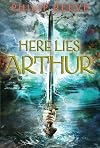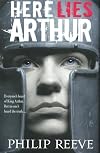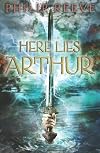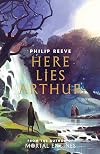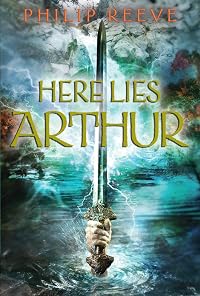
Here Lies Arthur
by Philip Reeve
On This Page
Description
When her village is attacked and burned, Gwyna seeks protection from the bard Myrddin, who uses Gwyna in his plan to transform young Arthur into the heroic King Arthur.Tags
Recommendations





Member Recommendations
Member Reviews
Here’s a Dark Ages Arthurian story; no magic, no high romanticism, and no chivalrous Lancelot. The story of Arthur is told through Gwyna’s voice, a young girl who is apprenticed to Myrddin. Gwyna is disguised as a boy for safety early in the story, and as the story unfolds she switches between male and female in response to changing circumstance. She becomes the ‘Lady in the Lake’ for Myrddin, and learns how easy it is to manufacture magical stories that grow with each retelling.
It is Myrddin’s role as bard to embellish the everyday tales of reality until they become mythical and majestic – and this is such a powerful theme carried right through this story. The ill-fated romance between the lovely character of Bedwyr and show more Arthur’s wife Gwenhwyfar, emphasizes the price of deceit and betrayal.
There’s a harsh feel to this story - life is tough, and battles are full of mud and blood and wounds and death. This Arthur is a brutal war-lord, and it is left to his bard to make his exploits presentably ‘heroic’ for the commoners.
An interesting and thoughtful reworking of the Arthurian tale. show less
It is Myrddin’s role as bard to embellish the everyday tales of reality until they become mythical and majestic – and this is such a powerful theme carried right through this story. The ill-fated romance between the lovely character of Bedwyr and show more Arthur’s wife Gwenhwyfar, emphasizes the price of deceit and betrayal.
There’s a harsh feel to this story - life is tough, and battles are full of mud and blood and wounds and death. This Arthur is a brutal war-lord, and it is left to his bard to make his exploits presentably ‘heroic’ for the commoners.
An interesting and thoughtful reworking of the Arthurian tale. show less
An absolutely outstanding take on the Arthurian legend. Arthur's a bandit chief, Merlin's a sleight-of-hand magician with a touch of the con artist, and the narrator is a teenage girl whose village is pillaged by Arthur's bandits. It's a study on the origins of a society's founding myths, written for young adults but very much readable by older readers.
I loved this retelling of Arthur as kind of a brute, Merlin as his storyteller/ public relations huckster. the language of the writing itself was exquisite.
A great take on the King Arthur story, Arthur here is a unpleasant bully, being guided by Merlin and his half brother into being a symbol of unity. Told though the eyes of Gwyna, a slave girl rescued by Myrrdin (Merlin), this is a story about the power of story, about spin, and about how heroes don't exist until their stories are told by a warm fire and with plenty of ale.
I'd give this to fantasy fans, historical fiction fans, and also to anyone watching the new BBC series about teenaged Merlin.
I'd give this to fantasy fans, historical fiction fans, and also to anyone watching the new BBC series about teenaged Merlin.
Picked up purely off the back of Nymeth’s review and because I’m having a bit of an Arthurian (and other mediaeval/middle ages/historical literature!) year, Philip Reeve’s Here Lies Arthur did not disappoint.
This tale of the legendary Arthur shies away from glossy cliché, portraying him as a brutish and not particularly intelligent warlord, who travels around the country with his thuggish band of fighters, ravaging villages, seizing gold and land, and generally taking whatever he wants.
The tale is told by Gwyna, a slave and one of the victims of such attacks, who flees in terror from her burning village and escapes by diving into a frozen stream. She is rescued by a mysterious man, who turns out to be none other than Myrddin, show more Arthur’s bard, who soon factors her into his mischievous plans. Myrddin explains that what others see as magic, are simply tricks and stories weaved from half truths, into something far grander, the stuff of legends. He uses Gwyna to help him weave the tale of the lady in the lake, passing the sword Caliburn (Excalibur!) to Arthur, who himself falls for the trick. Myrddin is then forced to hide Gwyna in plain sight, dressing and passing her off as a boy, Gwyn, who spends several years working for the bard and learning to live as a boy. She finds the life far better than that she had known, and becomes accustomed to male ways, until she is forced to experience the reality of war firsthand. Soon though, she becomes too old for Myrddin to hide her as such, and she is forced to rediscover her womanly ways, in a life she finds boring in contrast.
To say much else would begin to give away some of the fabulously creative ways that Reeve has incorporated the other characters from Arthurian myth. Most notably Guinevere, who is recognisable as Gwenhwyfar, a middle-aged widow, but whose fall from grace is not entirely the tale you will remember.
Although aimed at children and young adults, Here Lies Arthur is incredibly realistic and astute, dealing with the horrors that children of the age would indeed have experienced. Reeve treats his young readers with maturity and respect, and in return creates something I found to be a joy to read. It is work like this that can inspire so many young people to read, especially in this age of videogames and television. This maturity also makes the novel a fantastic read for adults and I found myself completely absorbed in Gwyna’s tale.
Although primarily an excellent spin on the Arthurian legend, the subplots of gender identity and the lines between what makes a story legend or truth, make this tale that bit more unique. But it is Reeve’s writing and storytelling that make this particular tale something special. Highly recommended. show less
This tale of the legendary Arthur shies away from glossy cliché, portraying him as a brutish and not particularly intelligent warlord, who travels around the country with his thuggish band of fighters, ravaging villages, seizing gold and land, and generally taking whatever he wants.
The tale is told by Gwyna, a slave and one of the victims of such attacks, who flees in terror from her burning village and escapes by diving into a frozen stream. She is rescued by a mysterious man, who turns out to be none other than Myrddin, show more Arthur’s bard, who soon factors her into his mischievous plans. Myrddin explains that what others see as magic, are simply tricks and stories weaved from half truths, into something far grander, the stuff of legends. He uses Gwyna to help him weave the tale of the lady in the lake, passing the sword Caliburn (Excalibur!) to Arthur, who himself falls for the trick. Myrddin is then forced to hide Gwyna in plain sight, dressing and passing her off as a boy, Gwyn, who spends several years working for the bard and learning to live as a boy. She finds the life far better than that she had known, and becomes accustomed to male ways, until she is forced to experience the reality of war firsthand. Soon though, she becomes too old for Myrddin to hide her as such, and she is forced to rediscover her womanly ways, in a life she finds boring in contrast.
To say much else would begin to give away some of the fabulously creative ways that Reeve has incorporated the other characters from Arthurian myth. Most notably Guinevere, who is recognisable as Gwenhwyfar, a middle-aged widow, but whose fall from grace is not entirely the tale you will remember.
Although aimed at children and young adults, Here Lies Arthur is incredibly realistic and astute, dealing with the horrors that children of the age would indeed have experienced. Reeve treats his young readers with maturity and respect, and in return creates something I found to be a joy to read. It is work like this that can inspire so many young people to read, especially in this age of videogames and television. This maturity also makes the novel a fantastic read for adults and I found myself completely absorbed in Gwyna’s tale.
Although primarily an excellent spin on the Arthurian legend, the subplots of gender identity and the lines between what makes a story legend or truth, make this tale that bit more unique. But it is Reeve’s writing and storytelling that make this particular tale something special. Highly recommended. show less
I love novels based on Arthurian myths and legends and this one is a great read. Reeve's book for teens presents a totally different take on the stories that is highly original, and uses the Welsh Mabinogion as the basis for the tale rather than Mallory or any of the later romances. What's more this interpretation of the story could so easily be the real thing!
The land it portrays is one of warring tribes; Arthur could be the one to pull the tribes of the west together to face the Saxons, and Myrddin (Merlin) is doing his best to make it so. However, Myrddin's chief weapon is not Earth magic - it's spin! Yes, you heard me right, 'twas ever thus.
Myrddin comes from the bardic tradition and is a master story-teller, embellishing and show more embroidering Arthur's exploits to the masses to put his man forward as the natural leader.
He's also good at creating illusions and using any opportunity to promote his master. As the novel opens, a young servant girl Gwyna, is hiding from the Arthur and his war-band who have just slashed and burned her master's home. She swims to avoid them, and is spotted by Myrrdin who immediately sees that he can use her to shine light on Arthur, and persuades her to become the Lady of the Lake and present him with a new sword (here named Caliburn). As all eyes will be on Arthur, no-one will notice that the Lady is just a girl who can swim like a fish. Gwynna is a bright girl and does well, and Myrrdin could use an assistant, so she joins him - dressed as a boy for safety.
And thus begins the story - told almost entirely from Gwynna/Gwynn's point of view. It takes us from the episode of the Lady of the Lake through to the deaths of Merlin and Arthur. All is seen from the slightly removed perspective which reveals the politics and spin underneath and the legacy it creates. show less
The land it portrays is one of warring tribes; Arthur could be the one to pull the tribes of the west together to face the Saxons, and Myrddin (Merlin) is doing his best to make it so. However, Myrddin's chief weapon is not Earth magic - it's spin! Yes, you heard me right, 'twas ever thus.
Myrddin comes from the bardic tradition and is a master story-teller, embellishing and show more embroidering Arthur's exploits to the masses to put his man forward as the natural leader.
He's also good at creating illusions and using any opportunity to promote his master. As the novel opens, a young servant girl Gwyna, is hiding from the Arthur and his war-band who have just slashed and burned her master's home. She swims to avoid them, and is spotted by Myrrdin who immediately sees that he can use her to shine light on Arthur, and persuades her to become the Lady of the Lake and present him with a new sword (here named Caliburn). As all eyes will be on Arthur, no-one will notice that the Lady is just a girl who can swim like a fish. Gwynna is a bright girl and does well, and Myrrdin could use an assistant, so she joins him - dressed as a boy for safety.
And thus begins the story - told almost entirely from Gwynna/Gwynn's point of view. It takes us from the episode of the Lady of the Lake through to the deaths of Merlin and Arthur. All is seen from the slightly removed perspective which reveals the politics and spin underneath and the legacy it creates. show less
Philip Reeve mentioned in a Reddit chat a while ago that he considers Here Lies Arthur to be his “favourite” of the books he’s written, and since I personally consider his Mortal Engines series to be some of the best books I’ve ever read, I thought that was a claim worth investigating. Here Lies Arthur is a children’s historical fiction novel based around Arthurian legend, but rather than a rehashing of the same old stories, it portrays Arthur as a typical power-hungry Celtic chieftan whose myth, legend and reputation is deliberately manufactured and disseminated by Merlin, who in Reeve’s version is not a wizard but merely a crafty bard. The novel is narrated by Gwyna, a slave girl adopted by Merlin after Arthur pillages her show more town.
The concept is a good one, allowing Reeve to explore the many conflicting stories of the Arthurian cycle, and examining further ideas about the role of stories in general and the longevity of myths. Reeve wisely uses Celtic names for the characters, adding a degree of separation from the more well-known names, so that we have “Gwenhwyfar” instead of “Guinevere” and “Myrddin” rather than “Merlin.” Despite Celtic being fairly unwieldy as a language (and yes, I know “Celtic” isn’t a language per se), it doesn’t break up the flow of the eye across the page at all, and there were a number of characters whom I didn’t realise were Arthurian analogues until their actions later in the novel. (It’s interesting that, when you read in your mind, you simply recognise the shape of the letters in a name rather than actually sounding it out. Or I do, anyway.)
How much you appreciate Here Lies Arthur and its original take on Arthurian mythology probably depends on how familiar you are with Arthurian mythology in the first place. As an uncouth colonial lad, whose knowledge of the topic stems mainly from John Boorman’s ‘Excalibur’ and Monty Python’s ‘Search for the Holy Grail’, I probably didn’t take as much away from it as a British reader, who would have spent plenty of their primary school childhood learning about Arthur while I was learning about Simpson and his bloody donkey.
Speaking of childhoods, though, I also spent much of mine reading post-apocalyptic fiction, and it was only relatively recently that I realised Western society already had an apocalyptic event followed by a post-apocalyptic period: the fall of the Roman Empire, and the Dark Ages. Reeve mentioned this himself, saying that it made a historical novel much easier to conceive, because it was “almost undocumented , so lots of freedom for a writer.” There’s quite a bit of this in Here Lies Arthur, with Myrddin reminiscing about the old days when the Roman legions ruled Britain with peace and prosperity, and ruined Roman towns like Aquae Sulis where the burghers still go about clad in togas, clinging to the past. It’s a neat idea – probably not wholly accurate, but fun.
There are a few technical issues with the presentation of the book as a whole. For some reason Reeve chose to write it in first person, which presents a number of troubling scenes where Gwyna describes events (in great detail) she couldn’t really know about, and the first person narration doesn’t really accomplish anything third person couldn’t have. While I personally love Reeve’s elaborate descriptive prose and creative metaphors, they don’t work as well when they’re slotted in amongst a solid, no-nonsense slave girl narration. There were also quite a few moments where he slips back and forth between present tense and past tense.
While we’re on the nuts and bolts of the book, because there’s no better place to bring it up, it’s probably aimed at older readers than I thought it was; I was thinking 9-12, at the beginning, but then there are a couple of relatively graphic scenes and the words “piss” and “shit.” I mean, I was dropping “fuck” amongst my friends on a regular basis when I was 11, but I always figured that what kids were ready for was several years ahead of what their parents and teachers thought they were ready for. But what would I know? Categorising books by age group is a dubious idea anyway.
Is Here Lies Arthur the best book Philip Reeve has written? He thinks so, and according to Wikipedia, so do British libraries, since they stock more copies of this than any of his other books. I haven’t read all his books, but I don’t think this is the best of them. He’s entitled to his view (well, duh) but I personally enjoyed the Mortal Engines series better than Here Lies Arthur. Despite all the violence and calamity and pollution in the Mortal Engines series, flying a swashbuckling airship through the Himalaya is still amazingly enticing for a young reader, whereas Gwyna’s cold and muddy Dark Ages aren’t as much fun to visit. (I have a theory that the appeal of young adult fiction hinges on escapism; relatable characters and all that, but still characters having a better time than you.)
Mind you, it’s become fairly clear that my regard for the Mortal Engines series is at least partly fuelled by overwhelming nostalgia and fierce established loyalty, so don’t take my word for it. Besides, I liked Here Lies Arthur quite a bit; it’s just comparing silver with platinum. Read them both and decide yourself. show less
The concept is a good one, allowing Reeve to explore the many conflicting stories of the Arthurian cycle, and examining further ideas about the role of stories in general and the longevity of myths. Reeve wisely uses Celtic names for the characters, adding a degree of separation from the more well-known names, so that we have “Gwenhwyfar” instead of “Guinevere” and “Myrddin” rather than “Merlin.” Despite Celtic being fairly unwieldy as a language (and yes, I know “Celtic” isn’t a language per se), it doesn’t break up the flow of the eye across the page at all, and there were a number of characters whom I didn’t realise were Arthurian analogues until their actions later in the novel. (It’s interesting that, when you read in your mind, you simply recognise the shape of the letters in a name rather than actually sounding it out. Or I do, anyway.)
How much you appreciate Here Lies Arthur and its original take on Arthurian mythology probably depends on how familiar you are with Arthurian mythology in the first place. As an uncouth colonial lad, whose knowledge of the topic stems mainly from John Boorman’s ‘Excalibur’ and Monty Python’s ‘Search for the Holy Grail’, I probably didn’t take as much away from it as a British reader, who would have spent plenty of their primary school childhood learning about Arthur while I was learning about Simpson and his bloody donkey.
Speaking of childhoods, though, I also spent much of mine reading post-apocalyptic fiction, and it was only relatively recently that I realised Western society already had an apocalyptic event followed by a post-apocalyptic period: the fall of the Roman Empire, and the Dark Ages. Reeve mentioned this himself, saying that it made a historical novel much easier to conceive, because it was “almost undocumented , so lots of freedom for a writer.” There’s quite a bit of this in Here Lies Arthur, with Myrddin reminiscing about the old days when the Roman legions ruled Britain with peace and prosperity, and ruined Roman towns like Aquae Sulis where the burghers still go about clad in togas, clinging to the past. It’s a neat idea – probably not wholly accurate, but fun.
There are a few technical issues with the presentation of the book as a whole. For some reason Reeve chose to write it in first person, which presents a number of troubling scenes where Gwyna describes events (in great detail) she couldn’t really know about, and the first person narration doesn’t really accomplish anything third person couldn’t have. While I personally love Reeve’s elaborate descriptive prose and creative metaphors, they don’t work as well when they’re slotted in amongst a solid, no-nonsense slave girl narration. There were also quite a few moments where he slips back and forth between present tense and past tense.
While we’re on the nuts and bolts of the book, because there’s no better place to bring it up, it’s probably aimed at older readers than I thought it was; I was thinking 9-12, at the beginning, but then there are a couple of relatively graphic scenes and the words “piss” and “shit.” I mean, I was dropping “fuck” amongst my friends on a regular basis when I was 11, but I always figured that what kids were ready for was several years ahead of what their parents and teachers thought they were ready for. But what would I know? Categorising books by age group is a dubious idea anyway.
Is Here Lies Arthur the best book Philip Reeve has written? He thinks so, and according to Wikipedia, so do British libraries, since they stock more copies of this than any of his other books. I haven’t read all his books, but I don’t think this is the best of them. He’s entitled to his view (well, duh) but I personally enjoyed the Mortal Engines series better than Here Lies Arthur. Despite all the violence and calamity and pollution in the Mortal Engines series, flying a swashbuckling airship through the Himalaya is still amazingly enticing for a young reader, whereas Gwyna’s cold and muddy Dark Ages aren’t as much fun to visit. (I have a theory that the appeal of young adult fiction hinges on escapism; relatable characters and all that, but still characters having a better time than you.)
Mind you, it’s become fairly clear that my regard for the Mortal Engines series is at least partly fuelled by overwhelming nostalgia and fierce established loyalty, so don’t take my word for it. Besides, I liked Here Lies Arthur quite a bit; it’s just comparing silver with platinum. Read them both and decide yourself. show less
Members
- Recently Added By
Lists

Best Arthurian Fiction
104 works; 33 members

Puffin Books 70th anniversary handbook recommendations
537 works; 10 members

Reading history in Children's Books
78 works; 3 members

Carnegie Medal Winners In Order
85 works; 1 member

Kindle Fantasy/Science Fiction
204 works; 1 member
Author Information

102+ Works 16,779 Members
Philip Reeve was born in Brighton, England, and worked in a bookshop for many years before breaking out and becoming the illustrator of children's book He has also produced and directed several no-budget theater productions, and cowrote a musical, The Ministry of Biscuits. Mr. Reeve and his wife and son now live in a hamlet high above the moorland show more in Devon, England show less
Awards and Honors
Awards
Distinctions
Common Knowledge
- Canonical title
- Here Lies Arthur
- Original publication date
- 2008
- People/Characters
- King Arthur; Gwyna; Myddrin; Gwynhwyfar; Cai; Bedwyr (show all 8); Medrawt; Peredur
- Important places
- Aquae Sulis
- Epigraph
- "Here lies Arthur- King that was, that will be again."
-Sir Thomas Malory, Le Morte d'Arthur - Dedication
- For Geraldine McCaughrean
- First words
- Even the woods are burning.
Classifications
Statistics
- Members
- 686
- Popularity
- 41,706
- Reviews
- 28
- Rating
- (3.79)
- Languages
- Dutch, English, French, German
- Media
- Paper, Audiobook, Ebook
- ISBNs
- 23
- ASINs
- 4