
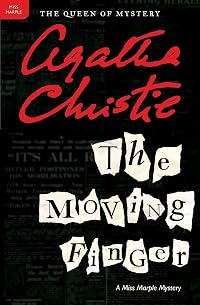
On This Page
Description
Lymstock is a town with more than its share of shameful secrets-a town where even a sudden outbreak of anonymous hate mail causes only a minor stir. But all that changes when one of the recipients, Mrs. Symmington, commits suicide. Her final note says "I can't go on," but Miss Marple questions the coroner's verdict of suicide. Soon nobody is sure of anyone-as secrets stop being shameful and start becoming deadly.Tags
Recommendations













Member Recommendations
Porua The narrator of The Moving Finger, Jerry Barton, reminds me of the narrator of another Agatha Christie book. Mark Easterbrook from The Pale Horse. In both of these stories the urban hero goes to a small town and gets entangled in a spine chilling mystery. Another thing that these two books have in common is an unconventional old lady named Mrs. Dane Calthrop, one of the more unique creations of Christie.
80
Member Reviews
Taken on its own terms, I think this is one of Christie's strongest mysteries. It's clever, well-written, populated with strong characters, truly devious in its construction and it features, almost as a cameo, a Jane Marple so clear-sighted and so fierce and remorseless that when I saw her knitting, I thought not of some nice old lady but of Atropos with her scissors, bringing final judgement.
In many ways, this is Christie at her best. She effortlessly makes the middle-class brother and sister, Jerry and Joanna, at the centre of this story engaging and energetic without needing to make them either perfect or particularly nice. She immersed me in the life of the notables in this very small town, bringing them alive through the dual lens show more of the reaction of the brother and sister as newcomers meeting people for the first time and through the gossip, sometimes solicited, often proffered as a sort of 'welcome to our town' gift to the young couple. Having established gossip as cherished currency in the town, Christie then adds the poison letters which slowly taint the atmosphere of the town like ink dropped into water. By the time the first death occurred, Christie had leashed my imagination and my curiosity and I needed to know who was behind it all.
The plot was twisty enough that I made no progress at all on figuring out what was going on but instead lurched from one moment of misleading clarity to another, following Jerry's footsteps as he keeps involving himself in the police investigation.
I liked that the police were both smart and thorough and made steady progress but moved too slowly to keep everyone safe. So, in the final quarter of the book, the rather remarkable and I thought very likeable vicar's wife calls in Miss Marple as 'an expert in evil'. I loved that description.
Quietly and with the ruthless efficiency of a gardener dead-heading roses, Miss Marple sorted it all out. The solution left me slapping myself for not having foreseen it.
The main plot point that I disliked is that Christie once again insisted on introducing an insta-love scenario so that those who survived could live happily ever after. It was, I thought, unconvincing and unnecessary.
If I had read this when it was published in 1946 (and no, even I'm not old enough to have done that) that would probably be the end of my remarks other than saying that I much prefer Marple's surgical dispassion to Poirot's self-aggrandising method.
Reading it today though, I kept being distracted from the plot by my dislike of the values, attitudes and behaviour of the middle-class protagonists, especially Jerry, from whose point of view the story is told.
Jerry Burton is sexist. He assesses every woman he meets against a set of standards he seems to assume they should either have been built to or should be amending themselves to achieve. He is frightened of intelligent women who say what they think because it makes them disquietingly unpredictable. He treats the woman he is most attracted to as if she were a lost dog that he wants to take home and look after. His only solid relationship with a woman is with his sister and it seems to me that that works because he barely thinks of her as a woman at all. At one point, he physically grabs a woman significantly younger than him, whisks her away to London and indulges in what today would be seen as grooming. He acknowledges that his behaviour was 'a little mad' but sees no harm in it and admits to no fault in himself beyond being impetuous.
This would have been my major source of anger with the book had not been for the way Jerry and all the other notables in the book treated their female servants. These women are not seen as real people. They are lesser beings. They are treated like farm dogs, useful if they are biddable and well-trained. Those servants who try to use order and formality to define the standard of their work and to set clear boundaries between themselves and their employers are made fun of for being stuffy. The young ones are ridiculed for being ignorant as if being uneducated was their fault. Their lives or deaths are of much less consequence than those of any of the notables in the story.
I don't blame Christie for any of this. I'm certain that she's describing attitudes and behaviours that her readers would have recognised and accepted as normal. This means that what's making me angry here isn't Christie's fiction but England's history. show less
In many ways, this is Christie at her best. She effortlessly makes the middle-class brother and sister, Jerry and Joanna, at the centre of this story engaging and energetic without needing to make them either perfect or particularly nice. She immersed me in the life of the notables in this very small town, bringing them alive through the dual lens show more of the reaction of the brother and sister as newcomers meeting people for the first time and through the gossip, sometimes solicited, often proffered as a sort of 'welcome to our town' gift to the young couple. Having established gossip as cherished currency in the town, Christie then adds the poison letters which slowly taint the atmosphere of the town like ink dropped into water. By the time the first death occurred, Christie had leashed my imagination and my curiosity and I needed to know who was behind it all.
The plot was twisty enough that I made no progress at all on figuring out what was going on but instead lurched from one moment of misleading clarity to another, following Jerry's footsteps as he keeps involving himself in the police investigation.
I liked that the police were both smart and thorough and made steady progress but moved too slowly to keep everyone safe. So, in the final quarter of the book, the rather remarkable and I thought very likeable vicar's wife calls in Miss Marple as 'an expert in evil'. I loved that description.
Quietly and with the ruthless efficiency of a gardener dead-heading roses, Miss Marple sorted it all out. The solution left me slapping myself for not having foreseen it.
The main plot point that I disliked is that Christie once again insisted on introducing an insta-love scenario so that those who survived could live happily ever after. It was, I thought, unconvincing and unnecessary.
If I had read this when it was published in 1946 (and no, even I'm not old enough to have done that) that would probably be the end of my remarks other than saying that I much prefer Marple's surgical dispassion to Poirot's self-aggrandising method.
Reading it today though, I kept being distracted from the plot by my dislike of the values, attitudes and behaviour of the middle-class protagonists, especially Jerry, from whose point of view the story is told.
Jerry Burton is sexist. He assesses every woman he meets against a set of standards he seems to assume they should either have been built to or should be amending themselves to achieve. He is frightened of intelligent women who say what they think because it makes them disquietingly unpredictable. He treats the woman he is most attracted to as if she were a lost dog that he wants to take home and look after. His only solid relationship with a woman is with his sister and it seems to me that that works because he barely thinks of her as a woman at all. At one point, he physically grabs a woman significantly younger than him, whisks her away to London and indulges in what today would be seen as grooming. He acknowledges that his behaviour was 'a little mad' but sees no harm in it and admits to no fault in himself beyond being impetuous.
This would have been my major source of anger with the book had not been for the way Jerry and all the other notables in the book treated their female servants. These women are not seen as real people. They are lesser beings. They are treated like farm dogs, useful if they are biddable and well-trained. Those servants who try to use order and formality to define the standard of their work and to set clear boundaries between themselves and their employers are made fun of for being stuffy. The young ones are ridiculed for being ignorant as if being uneducated was their fault. Their lives or deaths are of much less consequence than those of any of the notables in the story.
I don't blame Christie for any of this. I'm certain that she's describing attitudes and behaviours that her readers would have recognised and accepted as normal. This means that what's making me angry here isn't Christie's fiction but England's history. show less
First sentence: I have often recalled the morning when the first of the anonymous letters came.
Jerry Burton, our hero, has taken a house in the country with his sister, Joanna. He's recuperating from an injury, and his doctor has definitely suggested some rest and relaxation. As for Joanna, she's recuperating from a broken heart. But rural village life isn't as uneventful and peaceful as he expected. For soon after his arrival, an anonymous "poison pen" begins a nasty letter campaign. Which is unpleasant enough, he supposes, but things turn deadly after a woman's "suicide" after receiving a vile letter. The victim leaves behind two young sons, an older daughter from her first marriage, a husband, and a rather pretty governess. Megan, show more the daughter from the first marriage, soon becomes a major player in this Miss Marple mystery. This "suicide" becomes a bit suspicious when a second death occurs--that of a maid--within the home. The question becomes did this maid--on her day off--see something?
I loved this one. I just LOVED it. It wasn't a purely pleasant read for me. I wouldn't exactly say I was praying throughout, but I was certainly wishful with my repeated pleas, please don't let it be Megan, please don't let it be Megan, please don't let it be Megan. Never have I gotten that involved with a mystery. Who is Megan? For better or worse, she's the young woman our hero described thusly, "She looked much more like a horse than a human being. In fact, she would have been a very nice horse with a little grooming" (17). She's largely ignored not only by the village but by her family as well. But there is something about her that Jerry, our hero, can't ignore. He goes out of his way--time and time and time again--to include her. He even invites her to stay with him and his sister after her mother's death. He is the one person, she's found, willing to listen to her.
While Jerry is making friends with Megan--not always an easy task--Joanna, his sister, is trying to make friends with the local doctor. That is an uphill battle. Joanna has never, ever had to work this hard to get a guy to like her.
So this mystery has a romantic element to it which I just loved. It also stars Miss Marple, though she doesn't enter the case until after the second death occurs. Miss Marple finds Jerry Burton a great help in this one! The details he's observed through his stay, makes solving this one so much easier for her! It gives her quite the lead. But she still has to *prove* it.
The Moving Finger is very compelling! I loved it for so many different reasons.
My favorite quotes:
Emily Barton, I think, has a mental picture of men as interminably consuming whisky-and-sodas and smoking cigars, and in the intervals dropping out to do a few seductions of village maidens, or to conduct a liaison with a married woman.
When I said this to Joanna later, she replied that it was probably wishful thinking, that Emily Barton would have liked to come across such a man, but alas, had never done so. (85)
"The police are doing their best."
"If Agnes could be killed yesterday, their best isn't good enough."
"So you know better than they do?"
"Not at all. I don't know anything at all. That's why I'm going to call in an expert."
I shook my head. "You can't do that. Scotland Yard will only take over on a demand from the chief constable of the county. Actually they have sent Graves."
"I don't mean that kind of an expert. I don't mean someone who knows about anonymous letters or even about murder. I mean someone who knows people. Don't you see? We want someone who knows a great deal about wickedness!"
It was a queer point of view. But it was, somehow, stimulating. (141)
"Yes, it was dangerous, but we are not put into this world, Mr. Burton, to avoid danger when an innocent fellow creature's life is at stake. You understand me?"
I understood. (199) show less
Jerry Burton, our hero, has taken a house in the country with his sister, Joanna. He's recuperating from an injury, and his doctor has definitely suggested some rest and relaxation. As for Joanna, she's recuperating from a broken heart. But rural village life isn't as uneventful and peaceful as he expected. For soon after his arrival, an anonymous "poison pen" begins a nasty letter campaign. Which is unpleasant enough, he supposes, but things turn deadly after a woman's "suicide" after receiving a vile letter. The victim leaves behind two young sons, an older daughter from her first marriage, a husband, and a rather pretty governess. Megan, show more the daughter from the first marriage, soon becomes a major player in this Miss Marple mystery. This "suicide" becomes a bit suspicious when a second death occurs--that of a maid--within the home. The question becomes did this maid--on her day off--see something?
I loved this one. I just LOVED it. It wasn't a purely pleasant read for me. I wouldn't exactly say I was praying throughout, but I was certainly wishful with my repeated pleas, please don't let it be Megan, please don't let it be Megan, please don't let it be Megan. Never have I gotten that involved with a mystery. Who is Megan? For better or worse, she's the young woman our hero described thusly, "She looked much more like a horse than a human being. In fact, she would have been a very nice horse with a little grooming" (17). She's largely ignored not only by the village but by her family as well. But there is something about her that Jerry, our hero, can't ignore. He goes out of his way--time and time and time again--to include her. He even invites her to stay with him and his sister after her mother's death. He is the one person, she's found, willing to listen to her.
While Jerry is making friends with Megan--not always an easy task--Joanna, his sister, is trying to make friends with the local doctor. That is an uphill battle. Joanna has never, ever had to work this hard to get a guy to like her.
So this mystery has a romantic element to it which I just loved. It also stars Miss Marple, though she doesn't enter the case until after the second death occurs. Miss Marple finds Jerry Burton a great help in this one! The details he's observed through his stay, makes solving this one so much easier for her! It gives her quite the lead. But she still has to *prove* it.
The Moving Finger is very compelling! I loved it for so many different reasons.
My favorite quotes:
Emily Barton, I think, has a mental picture of men as interminably consuming whisky-and-sodas and smoking cigars, and in the intervals dropping out to do a few seductions of village maidens, or to conduct a liaison with a married woman.
When I said this to Joanna later, she replied that it was probably wishful thinking, that Emily Barton would have liked to come across such a man, but alas, had never done so. (85)
"The police are doing their best."
"If Agnes could be killed yesterday, their best isn't good enough."
"So you know better than they do?"
"Not at all. I don't know anything at all. That's why I'm going to call in an expert."
I shook my head. "You can't do that. Scotland Yard will only take over on a demand from the chief constable of the county. Actually they have sent Graves."
"I don't mean that kind of an expert. I don't mean someone who knows about anonymous letters or even about murder. I mean someone who knows people. Don't you see? We want someone who knows a great deal about wickedness!"
It was a queer point of view. But it was, somehow, stimulating. (141)
"Yes, it was dangerous, but we are not put into this world, Mr. Burton, to avoid danger when an innocent fellow creature's life is at stake. You understand me?"
I understood. (199) show less
I wasn't sure what to think of this at first, since it's a Miss Marple story told from the POV of a man we haven't met before in these books. However, Miss Marple turned up at the end and solved everything, even though the police got the credit, and I really enjoyed seeing the story from a single perspective. I think this one would have been weakened by splitting the focus up into multiple characters.
The fourth Miss Marple mystery, The Moving Finger, introduces brother and sister, Jerry and Joanna Burton who move to the small village of Lymstock and manage to get themselves caught up in a nasty anonymous letter scandal and then right in the center of a murder investigation.
I really enjoyed this. Joanna and Jerry were funny and interesting and were good choices to base the narrative around. I was disappointed not to see Miss Marple until well towards the end, but I liked the other characters enough that it didn't matter too much. The friendship between Jerry and Megan was nice and I liked the drama of Mr Pym (he reminded me a lot of Mr Satterthwaite from the Harley Quin series). The snarky banter between Joanna and Jerry was amusing, show more it was easy to tell they were related. And I liked the competent police force. It was refreshing seeing Jerry bumble into plans that were already in place, rather than leading the police around by the nose.
The mystery was good. Well plotted, with lots of twists and turns and misdirects. I definitely didn't see the ending coming. The husband? I mean, yeah I guess I should've suspected that. But I so didn't. It was laid out so logically though and I was like oh, that makes total sense but damn if I didn't see it. I liked the romances that sprung up as well.
Overall a decently paced, complex mystery with amusing characters. 3.5 stars, rounded up to 4. show less
I really enjoyed this. Joanna and Jerry were funny and interesting and were good choices to base the narrative around. I was disappointed not to see Miss Marple until well towards the end, but I liked the other characters enough that it didn't matter too much. The friendship between Jerry and Megan was nice and I liked the drama of Mr Pym (he reminded me a lot of Mr Satterthwaite from the Harley Quin series). The snarky banter between Joanna and Jerry was amusing, show more it was easy to tell they were related. And I liked the competent police force. It was refreshing seeing Jerry bumble into plans that were already in place, rather than leading the police around by the nose.
The mystery was good. Well plotted, with lots of twists and turns and misdirects. I definitely didn't see the ending coming.
Overall a decently paced, complex mystery with amusing characters. 3.5 stars, rounded up to 4. show less
Lymstock is the quintessential definition of the peaceful English countryside: just ask any of its inhabitants. Everything is so utterly uneventful here, that one might be tempted to attribute its inhabitants' main cause of death to boredom, rather than old age. In other words: the perfect place for Jerry Burton's rehabilitation needs. Doctor's orders. So when the first libel-induced suicide happens, our hero is obviously first in line to flex his sleuthing muscles.
In true Agatha Christie fashion, we get one heck of a convoluted story, without too much action, but enough mystery to twist around even the most logical of us. Or is it just me, who's never able to guess the criminal? I especially enjoyed the grand reveal, when it turned show more out that I had never even suspected the culprit. Now that's what good murder mysteries are made of.
Yet with all its well-crafted mysteries, wild speculation, and half-way decent romantic subplots, my overall impression was still that of disappointment. This was supposed to be a Miss Marple novel! So why doesn't the lovable old lady make its appearance until the 80% mark?! Yes that's correct: EIGHTY.EFFING.PERCENT!!
Score: 3/5 stars
Objectively speaking, there's nothing too egregiously wrong here. Except for the sudden flowery turn towards the end, but I'm willing to give it a pass. I have to, after finding myself shedding a tear or two at one point.
As much as I feel cheated, I kind of suspect the fault may lie mostly at my feet. I shouldn't have assumed stuff just because GR marks this book as being part of a series. *continues to sulk nonetheless*
==============
Review of Murder at the Vicarage
Review of The Thirteen Problems
Review of The Body in the Library
Review of A Murder is Announced show less
In true Agatha Christie fashion, we get one heck of a convoluted story, without too much action, but enough mystery to twist around even the most logical of us. Or is it just me, who's never able to guess the criminal? I especially enjoyed the grand reveal, when it turned show more out that I had never even suspected the culprit. Now that's what good murder mysteries are made of.
Yet with all its well-crafted mysteries, wild speculation, and half-way decent romantic subplots, my overall impression was still that of disappointment. This was supposed to be a Miss Marple novel! So why doesn't the lovable old lady make its appearance until the 80% mark?! Yes that's correct: EIGHTY.EFFING.PERCENT!!
Score: 3/5 stars
Objectively speaking, there's nothing too egregiously wrong here. Except for the sudden flowery turn towards the end, but I'm willing to give it a pass. I have to, after finding myself shedding a tear or two at one point.
As much as I feel cheated, I kind of suspect the fault may lie mostly at my feet. I shouldn't have assumed stuff just because GR marks this book as being part of a series. *continues to sulk nonetheless*
==============
Review of Murder at the Vicarage
Review of The Thirteen Problems
Review of The Body in the Library
Review of A Murder is Announced show less
This is probably the least satisfactory Christie novel I have read. While a Miss Marple novel, she was not even mentioned until two thirds of the way through, and barely participated until challenging the final verdict. The story is narrated by Jerry Burton, a pilot who has been injured in a crash landing, and who settles with his sister Joanna in the supposedly quiet village of Lymstock to recover physically and psychologically. Soon however, they and many other villagers face an epidemic of poison pen letters, and needless to say everyone has their own ideas who is responsible. There is the usual range of Christie village characters. I found the final revealed killer’s actions as exposed by Miss Marple rather unconvincing, and I show more cared for few of the characters, except for the misunderstood Megan. show less
Pointing Fingers
Agatha Christie's swift, slim 1942 novel The Moving Finger is a Miss Marple mystery which very nearly does not have Miss Marple.
In my version (the spiffy new Black Dog & Leventhal edition), the grandmotherly detective makes her first appearance on page 144 of the book's 201 pages. That's like Bruce Willis making his first appearance in a Bruce Willis movie twenty minutes before the end credits roll. Fifty-seven pages do not allow very much time for a detective to solve a case.
However, even though she has what can best be described as an extended cameo role in The Moving Finger, Miss Jane Marple pulls it off in grand fashion, as always.
The story is told through the eyes of Jerry Burton who has come to the little village show more of Lymstock with his younger sister Joanna after he's been injured in a wartime plane crash. His doctor has advised him to "lead the life of a vegetable" in a place where he can find peace and quiet.
At first, Lymstock seems like the perfect haven. Sure, the residents are a little eccentric-but who isn't when they live in Agatha Christie Land, right? From the first page of the novel, we're told that something is amiss and it centers around a series of anonymous letters which have been sent to several people living in the village.
As Jerry tells us after he receives the first crude message, It seems odd, now, to remember that Joanna and I were more amused by the letter than anything else. We hadn't, then, the faintest inkling of what was to come-the trail of blood and violence and suspicion and fear.
That first letter accuses Jerry and Joanna of engaging in sexual activity most unbecoming of a brother and sister. Agatha never discloses the contents of the letters, but lets our imagination dance around the possibilities of what it says. I have a feeling that what we imagine is much more graphic than how readers in 1942 would have filled in the blanks. Whatever we guess the letters to say, the language would not have been suitable for World War Two era readers.
During a visit to the local doctor, Jerry happens to mention the letter (which he impetuously burned in the fireplace). Dr. Griffith drops his bag and exclaims, "Do you mean to say that you've had one of them?"
The epidemic of anonymous poison letters has been spreading around Lymstock for some time, Griffith tells Jerry, all of them "harping on the sex theme." The local solicitor Symmington was accused of illicit relations with his secretary ("Miss Ginch, who's forty at least, with pince-nez and teeth like a rabbit"), and even the doctor himself has received a letter which claims to have knowledge of him sleeping with some of his lady patients.
"What is this place?" Joanna wonders. "It looks the most innocent, sleepy harmless little bit of England you can imagine."
That is Agatha's forte, of course-ripping away the thin skin of gentility and good manners to reveal the gory, pestilential truth beneath. What reader hasn't known a two-faced, scheming liar who gets his or her jollies out of seeing innocent people suffer? Agatha knew how to craft a clever, often outlandish plot around an ordinary truth.
Eventually, the venomous accusations become too much to bear and one character commits suicide-ah, but was it really suicide? Perhaps there's something deeper, darker at work in Lymstock than just flooding the mail with wicked letters. Maybe there's more to it than just "sex and spite." Soon, paranoia is gripping the town: There was a half-scared, half-avid gleam in almost everybody's eye. Neighbor looked at neighbor.
The police are called in as more bodies begin to pile up and while the investigators do their best to sort through the psychological patterns they find in the letters, it isn't until Miss Marple makes her late entrance in the novel that we know the village residents can breathe a sigh of relief. It won't be long before this "tame elderly maiden lady" will unmask the letter writer.
Sandwiched chronologically between The Body in the Library and Murder in Retrospect, The Moving Finger is a fine addition to the Christie library. Agatha herself was partial to it, as she wrote in her Autobiography, "I find that another one I am really pleased with is The Moving Finger. It is a great test to reread what one has written some seventeen or eighteen years before. One's view changes. Some do not stand the test of time, others do."
With its keen psychological probing of rumor and paranoia, this Christie mystery certainly stands the test of time. show less
Agatha Christie's swift, slim 1942 novel The Moving Finger is a Miss Marple mystery which very nearly does not have Miss Marple.
In my version (the spiffy new Black Dog & Leventhal edition), the grandmotherly detective makes her first appearance on page 144 of the book's 201 pages. That's like Bruce Willis making his first appearance in a Bruce Willis movie twenty minutes before the end credits roll. Fifty-seven pages do not allow very much time for a detective to solve a case.
However, even though she has what can best be described as an extended cameo role in The Moving Finger, Miss Jane Marple pulls it off in grand fashion, as always.
The story is told through the eyes of Jerry Burton who has come to the little village show more of Lymstock with his younger sister Joanna after he's been injured in a wartime plane crash. His doctor has advised him to "lead the life of a vegetable" in a place where he can find peace and quiet.
At first, Lymstock seems like the perfect haven. Sure, the residents are a little eccentric-but who isn't when they live in Agatha Christie Land, right? From the first page of the novel, we're told that something is amiss and it centers around a series of anonymous letters which have been sent to several people living in the village.
As Jerry tells us after he receives the first crude message, It seems odd, now, to remember that Joanna and I were more amused by the letter than anything else. We hadn't, then, the faintest inkling of what was to come-the trail of blood and violence and suspicion and fear.
That first letter accuses Jerry and Joanna of engaging in sexual activity most unbecoming of a brother and sister. Agatha never discloses the contents of the letters, but lets our imagination dance around the possibilities of what it says. I have a feeling that what we imagine is much more graphic than how readers in 1942 would have filled in the blanks. Whatever we guess the letters to say, the language would not have been suitable for World War Two era readers.
During a visit to the local doctor, Jerry happens to mention the letter (which he impetuously burned in the fireplace). Dr. Griffith drops his bag and exclaims, "Do you mean to say that you've had one of them?"
The epidemic of anonymous poison letters has been spreading around Lymstock for some time, Griffith tells Jerry, all of them "harping on the sex theme." The local solicitor Symmington was accused of illicit relations with his secretary ("Miss Ginch, who's forty at least, with pince-nez and teeth like a rabbit"), and even the doctor himself has received a letter which claims to have knowledge of him sleeping with some of his lady patients.
"What is this place?" Joanna wonders. "It looks the most innocent, sleepy harmless little bit of England you can imagine."
That is Agatha's forte, of course-ripping away the thin skin of gentility and good manners to reveal the gory, pestilential truth beneath. What reader hasn't known a two-faced, scheming liar who gets his or her jollies out of seeing innocent people suffer? Agatha knew how to craft a clever, often outlandish plot around an ordinary truth.
Eventually, the venomous accusations become too much to bear and one character commits suicide-ah, but was it really suicide? Perhaps there's something deeper, darker at work in Lymstock than just flooding the mail with wicked letters. Maybe there's more to it than just "sex and spite." Soon, paranoia is gripping the town: There was a half-scared, half-avid gleam in almost everybody's eye. Neighbor looked at neighbor.
The police are called in as more bodies begin to pile up and while the investigators do their best to sort through the psychological patterns they find in the letters, it isn't until Miss Marple makes her late entrance in the novel that we know the village residents can breathe a sigh of relief. It won't be long before this "tame elderly maiden lady" will unmask the letter writer.
Sandwiched chronologically between The Body in the Library and Murder in Retrospect, The Moving Finger is a fine addition to the Christie library. Agatha herself was partial to it, as she wrote in her Autobiography, "I find that another one I am really pleased with is The Moving Finger. It is a great test to reread what one has written some seventeen or eighteen years before. One's view changes. Some do not stand the test of time, others do."
With its keen psychological probing of rumor and paranoia, this Christie mystery certainly stands the test of time. show less
Members
- Recently Added By
Lists

Books I've Read More Than Once
602 works; 49 members

Crime and Mysteries to Read
746 works; 31 members

British Mystery
469 works; 14 members

Agatha Christie Miss Marple
12 works; 1 member

Books About Murder
313 works; 7 members

Detective Stories
343 works; 5 members

Favorite Books from the 1940s
38 works; 3 members

Books With Body Parts in the Title
153 works; 9 members
Books Read in 2018
4,360 works; 110 members

Books Read in 2010
631 works; 10 members

Books Read in 2020
4,379 works; 123 members

Books Read in 2022
5,166 works; 114 members

Books Read in 2023
5,547 works; 145 members

Best Mysteries With a Historical Setting
292 works; 160 members

TBR
77 works; 1 member

Books Read in 2024
4,623 works; 126 members

Books Set in Small Towns and Villages
278 works; 16 members

Agatha Christie Chronology
93 works; 1 member

Books Read in 2026
1,858 works; 66 members
Author Information

2,146+ Works 439,767 Members
One of the most successful and beloved writer of mystery stories, Agatha Mary Clarissa Christie was born in 1890 in Torquay, County Devon, England. She wrote her first novel, The Mysterious Affair at Styles, in 1920, launching a literary career that spanned decades. In her lifetime, she authored 79 crime novels and a short story collection, 19 show more plays, and six novels written under the name of Mary Westmacott. Her books have sold over a billion copies in the English language with another billion in 44 foreign languages. Some of her most famous titles include Murder on the Orient Express, Mystery of the Blue Train, And Then There Were None, 13 at Dinner and The Sittaford Mystery. Noted for clever and surprising twists of plot, many of Christie's mysteries feature two unconventional fictional detectives named Hercule Poirot and Miss Jane Marple. Poirot, in particular, plays the hero of many of her works, including the classic, The Murder of Roger Ackroyd (1926), and Curtain (1975), one of her last works in which the famed detective dies. Over the years, her travels took her to the Middle East where she met noted English archaeologist Sir Max Mallowan. They married in 1930. Christie accompanied Mallowan on annual expeditions to Iraq and Syria, which served as material for Murder in Mesopotamia (1930), Death on the Nile (1937), and Appointment with Death (1938). Christie's credits also include the plays, The Mousetrap and Witness for the Prosecution (1953; film 1957). Christie received the New York Drama Critics' Circle Award for 1954-1955 for Witness. She was also named Dame Commander of the Order of the British Empire in 1971. Christie died in 1976. (Bowker Author Biography) show less
Some Editions
Awards and Honors
Distinctions
Series

Belongs to Publisher Series
Work Relationships
Is contained in
Five Classic Murder Mysteries: The Murder of Roger Ackroyd / The Secret Adversary / The Boomerang Clue / The Moving Finger / Death Comes as the End by Agatha Christie
A Miss Marple Quartet: The Body in the Library, A Pocket Full of Rye, A Murder Is Announced, The Moving Finger by Agatha Christie
Common Knowledge
- Canonical title
- The Moving Finger
- Original title
- The Moving Finger
- Original publication date
- 1942-07-01
- People/Characters
- Jane Marple; Jerry Burton; Joanna Burton; Megan Hunter; Mrs. Dane Calthrop; Owen Griffith (show all 10); Aimée Griffith; Elsie Holland; Richard Symmington; Emily Barton
- Important places
- Lymstock, England, UK
- Related movies
- The Moving Finger (1985 | IMDb); Marple: The Moving Finger (2006 | IMDb)
- Dedication
- To my Friends
Sydney and Mary Smith - First words
- I have often recalled the morning when the first of the anonymous letters came.
When at last I was taken out of the plaster, and the doctors had pulled me about to their hearts' content, and nurses had wheedled me into cautiously using my limbs, and I had been nauseated by their practically using baby ta... (show all)lk to me, Marcus Kent told me I was to go and live in the country. - Last words
- (Click to show. Warning: May contain spoilers.)"That," I said, "is Joanna's little joke."
- Blurbers
- Coben, Harlan; James, P.D.; Lathen, Emma
- Original language
- English
Classifications
Statistics
- Members
- 4,693
- Popularity
- 3,055
- Reviews
- 128
- Rating
- (3.72)
- Languages
- 22 — Chinese, Czech, Danish, Dutch, English, Estonian, Finnish, French, German, Greek, Hungarian, Italian, Japanese, Norwegian (Bokmål), Norwegian, Polish, Portuguese, Russian, Serbian, Spanish, Swedish, Turkish
- Media
- Paper, Audiobook, Ebook
- ISBNs
- 155
- UPCs
- 4
- ASINs
- 97