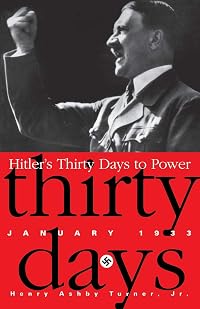
Thirty Days
by Henry Ashby Turner
On This Page
Description
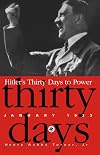
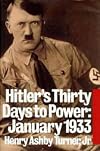
On January 1, 1933, Hitler seemed destined to return to obscurity. Having suffered devastating blows in the previous November's election, the National Socialist Party was pronounced politically dead by its opponents. Three days later, however, Hitler met clandestinely with ex-chancellor Franz von Papen, who thought he could use the Nazi leader in an alliance to oust then-Chancellor Kurt von Schleicher. Thus began a month of intrigue in which Hitler, though having less than a third of the show more popular vote, nevertheless successfully pursued an all-or-nothing strategy to become leader of Germany. On January 30, amidst rumors, confusion, and several thwarted attempts to stop the event, Hitler was sworn in as Chancellor, and Germany turned its future over to a madman. Drawing on a lifetime of studying the Nazi regime, and newly available documents, Henry Turner shows how luck, political brinksmanship, and the personal weaknesses of his opponents helped Hitler come to power. He paints vivid portraits of Hitler and the other main players in this political drama - President and aging war hero Marshal Paul von Hindenburg; the miscalculating General von Schleicher (whom Hitler would later murder); and the devious von Papen. Through these characters - and a final brilliant chapter on historical contingency and responsibility - Turner re-establishes the importance of individual actors in the unfolding of historical events. show lessTags
Recommendations












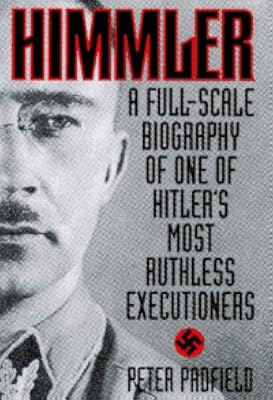
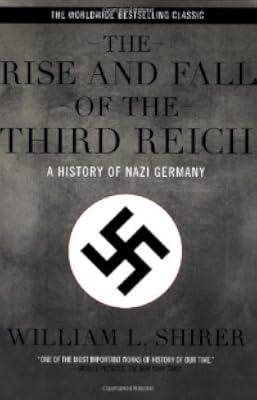

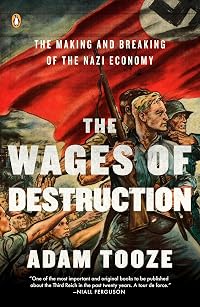
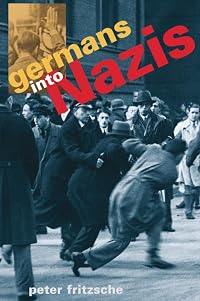





Member Recommendations


Member Reviews
The end of the Third Reich was certainly a dramatic and (if we can call it that) a spectacular event. The beginning of that dark period, however, was, in my opinion, a much more interesting time. Its very beginnings, what one could call its pre-history, consisting in the last few weeks of Weimar's regime, is probably the most extraordinary (and extraordinarily catastrophic) piece of political intrigue in recorded history. This book presents in detail the amazing chain of events, clandestine meetings, blunders and blindness of a very small number of individuals, at the very top of Weimar's regime, that rescued Adolf Hitler and his Party at a time when both were beginning to show clear signs of a desaggregation process that could have led show more to the return of the Nazis to the radical fringe of the political spectrum and to the marginal political (in)significance they enjoyed three years previously. A pointed indictment of von Papen, the Hindenburgs, Scleicher, and a few other individuals that, with appaling ineptitude and disregard for the amply clear signs the Nazis would not play by the rules, had tried to co-opt Hitler to a nationalistic, conservative, autoritarian, government just to be sidestepped by a maelstrom of uncontrolable proportions. A great book of history that can be read as a thriller. Anyone interested, not only in the history of the Nazi regime but also in politics in the largest sense of the word, should read and meditate upon it. show less
I found this book fascinating and hard to put down. I believe it is essential reading for anyone wishing to understand the fall of the Weimar Republic.
I also strongly agree with much of Mr. Turner's conclusion that Hitler's appointment was not inevitable, but rather the result of luck and of the flaws and mistakes of a handful of men. In that respect, Mr. Taylor agrees, at least in part, with William Shirer's belief that so much of history is random.
And yet in one crucial way I found this book lacking: its portrayal of two of the principal players: Hindenburg and Schleicher, both of whom reluctantly accepted political power not to fulfill a love of power, like so many politicians do, but to save the Weimar Republic and to stop Hitler. show more
And so, here's my two cents:
Part of the problem is that Mr. Turner's devotes so little time to what happened before the crucial month of January 1933. For example, he hardly mentions that Germany faced very real threats from a civil war, a communist takeover and an invasion on their Easter border. (Because of the last threat, Schleicher felt he had no choice but to try to use the Nazi paramilitary to strengthen German's small military.)
Also, Mr. Turner states that Hindenburg's military career, before the World War One, was unexceptional. From what I read, Hindenburg was very well-respected in the military. Also, he was one of the few generals who predicted that, if Russia invaded, they would do so in the Masurian Lakes region. He therefore he studied the terrain, and railroads of the region and was well prepared when he arrived and took command at Tannenberg. (During the Great War he proved to be a very capable, defensive commander who, unlike other generals, cared for the lives of his men.) Furthermore, Mr. Turner ignores the reality that Hindenburg hated being forced to govern by presidential decree, which he properly felt was a threat to the republic.
Schleicher, on the other hand, hated Hitler and deeply cared about the working man and their economic plight; yet we never read about his compassion in this book. (Yes, Mr. Turner is right: Because of a lack of documentation, we know relatively little about Schleicher. I don't believe we should, therefore, assume almost the worst about him and view him in a one-dimensional light.(His plan to try to bring Strasser into the government and hopefully split the Nazis was realistic and almost worked.)
During the final years of the republic Hindenburg and Schleicher were lodged between rocks and hard places, especially because they had to work with so many petty partisan politicians.
IMHO, to truly understand history we must look beyond events and into the often complex personalities of the men and women who shaped and lived it. Settling for simple characterizations, and then for easy answers to the predicaments they faced, limits our understanding.
Yes, Hindenburg and Schleicher were flawed - like most of us - and made crucial mistakes. After all, they had no playbook to go by. So, in light of what unfolded, should they be forgiven?
Mr. Turner and most people don't think so. I'm, however, not so sure. show less
I also strongly agree with much of Mr. Turner's conclusion that Hitler's appointment was not inevitable, but rather the result of luck and of the flaws and mistakes of a handful of men. In that respect, Mr. Taylor agrees, at least in part, with William Shirer's belief that so much of history is random.
And yet in one crucial way I found this book lacking: its portrayal of two of the principal players: Hindenburg and Schleicher, both of whom reluctantly accepted political power not to fulfill a love of power, like so many politicians do, but to save the Weimar Republic and to stop Hitler. show more
And so, here's my two cents:
Part of the problem is that Mr. Turner's devotes so little time to what happened before the crucial month of January 1933. For example, he hardly mentions that Germany faced very real threats from a civil war, a communist takeover and an invasion on their Easter border. (Because of the last threat, Schleicher felt he had no choice but to try to use the Nazi paramilitary to strengthen German's small military.)
Also, Mr. Turner states that Hindenburg's military career, before the World War One, was unexceptional. From what I read, Hindenburg was very well-respected in the military. Also, he was one of the few generals who predicted that, if Russia invaded, they would do so in the Masurian Lakes region. He therefore he studied the terrain, and railroads of the region and was well prepared when he arrived and took command at Tannenberg. (During the Great War he proved to be a very capable, defensive commander who, unlike other generals, cared for the lives of his men.) Furthermore, Mr. Turner ignores the reality that Hindenburg hated being forced to govern by presidential decree, which he properly felt was a threat to the republic.
Schleicher, on the other hand, hated Hitler and deeply cared about the working man and their economic plight; yet we never read about his compassion in this book. (Yes, Mr. Turner is right: Because of a lack of documentation, we know relatively little about Schleicher. I don't believe we should, therefore, assume almost the worst about him and view him in a one-dimensional light.(His plan to try to bring Strasser into the government and hopefully split the Nazis was realistic and almost worked.)
During the final years of the republic Hindenburg and Schleicher were lodged between rocks and hard places, especially because they had to work with so many petty partisan politicians.
IMHO, to truly understand history we must look beyond events and into the often complex personalities of the men and women who shaped and lived it. Settling for simple characterizations, and then for easy answers to the predicaments they faced, limits our understanding.
Yes, Hindenburg and Schleicher were flawed - like most of us - and made crucial mistakes. After all, they had no playbook to go by. So, in light of what unfolded, should they be forgiven?
Mr. Turner and most people don't think so. I'm, however, not so sure. show less
En este ensayo el autor intenta explicar cuáles fueron las circunstancias que concurrieron en un determinado momento de la historia para que Adolf Hitler llegara al poder. Analizando por primera vez algunas conversaciones e informes inéditos hasta ahora, Turner logra trasmitir toda la tensión y el dramatismo de unos días cruciales en la historia de Europa.
Feb 14, 2023Spanish
Ratings
Members
- Recently Added By
Author Information

17 Works 419 Members
Historian Henry Ashby Turner, Jr. was born in Atlanta, Georgia in 1932. He received a bachelor's degree from Washington and Lee University in 1954. He attended the University of Munich and the Free University of Berlin on his way to receiving a Ph.D. from Princeton University in 1960. He taught at Yale University for 44 years. He wrote numerous show more books about Germany including Stresemann and the Politics of the Weimar Republic (1963), German Big Business and the Rise of Hitler (1985), Hitler's Thirty Days to Power (1996), and General Motors and the Nazis: The Struggle for Control of Opel, Europe's Biggest Carmaker (2005). He died from complications of melanoma on December 17, 2008 at the age of 76. (Bowker Author Biography) show less
Some Editions
Common Knowledge
- Canonical title
- Thirty Days
- Original publication date
- 1996
- People/Characters
- Adolf Hitler; Paul von Hindenburg; Franz von Papen; Kurt von Schleicher; Joseph Goebbels; Hermann Göring (show all 7); Gregor Strasser
- Important places
- Berlin, Germany
- Important events
- Hitler made Chancellor
- Dedication
- To Patrick Herbst
- First words
- Every one has heard of Hitler.
- Quotations
- Only through the political blindness of and blunders of others did Adolf Hitler gain the opportunity to put his criminal intentions into effect between 1933 and 1945.
Classifications
- Genres
- Nonfiction, History, General Nonfiction, Biography & Memoir
- DDC/MDS
- 943.086 — History & geography History of Europe Central Europe: Germany, Austria, Switzerland, Czech, Poland, Hungary Historical periods of Germany Germany 1866- Third Reich 1933-1945
- LCC
- DD247 .H5 .T79 — History of Europe, Asia, Africa and Oceania Germany History of Germany History By period Modern, 1519- 19th-20th centuries Revolution and Republic, 1918-
- BISAC
Statistics
- Members
- 194
- Popularity
- 167,824
- Reviews
- 3
- Rating
- (4.25)
- Languages
- English, French, German, Spanish
- Media
- Paper, Ebook
- ISBNs
- 15
- ASINs
- 2