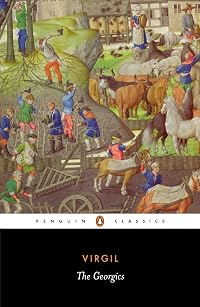
The Georgics [translated text]
by Virgil
On This Page
Description
Part agricultural manual, part political poem and allegory, the Georgics' scenes are real and vivid, and the poet-farmer Peter Fallon restores to life the sights, sounds, and textures of the ancient Italian landscape. - ;'A countryman cleaves earth with his crooked plough. Such is the labour. of his life. So he sustains his native land ...'. Virgil's affectionate poem of the land does not admit brief excerpts, any more than the labour of the farmer can easily be shortened. His verse, show more descriptive and narrative, brings us the disappointments as well as the rewards of the countryman's year-round show lessTags
Recommendations














Member Reviews
It took a couple of readings before the implications of this work sank in, but the implications are kind of incredible now that I think I can see them.
On the surface, The Georgics is a poem written about agrarian themes in an epic style. The four books take the reader through various topics pertaining to the preparation and care for the land, for crops, for livestock, and (wonderfully) about bees. I gather that the agrarian advice is somewhat suspect and probably wouldn’t be helpful to the DIY farmer, but it would be a mistake to read this poem simply as a manual anyway. These points about agrarian life are shot through with references to the gods and mythological figures. There are also not-so-subtle allegorical references to show more political topics and shout outs to Augustus and other members of his inner circle, all of which show that there is much more going on.
One of the implications of this work that I find most compelling is the suggestion that farming and statecraft can be talked about together. The very connection of these topics suggest that the knowledge of farming comes from the same place that political and state building knowledge comes (i.e., the gods). The parallel suggests an affinity between the wisdom applied in both settings, but it also both humbles the grandness of statecraft while elevating the humble stature of knowing and caring for the land. Not only do both kinds of wisdom come from the same source, they also reflect their common origin in the grand unified oneness the world of the gods. Not only do these kinds of wisdom come from the same place, they may be different articulations of the same underlying truth.
If these kinds of wisdom have some connection to each other, then there is no question that one can be an allegory for the other. But rather than saying that eradicating pests is like driving back one’s enemies, that breaking up clods of dirt or removing stones from a field are like identifying and eliminating opposition, or that cultivating and enriching the soil is like instituting reforms and starting beneficial public works projects, the verse invites the reader to engage with the activity of care that goes with all of those acts. The verse invites and elongates contemplation about the activities, how they unfold in time, how they require attention, and both a kind of practical and ideal wisdom to guide them.
It is also incredible to me to see the audacity (if that’s the right word) of someone like Virgil speaking to power in such a direct manner through a means that is as once topically humble (animals and crops) and structurally grand (epic poetry). And that is setting aside the implication that a poet would deign to tell Caesar Augustus how to govern. Even if Virgil was beloved by Augustus, the position he takes is kind of amazing.
The poem also seems to reveal something about the function of poetry in Rome and the tradition that it comes out of an existing tradition of epic poetry. Poems simply do not have this kind of force today. Neither do novels, nor music, nor art of any kind. There is an argument to made that by pulling from a Greek tradition of epic poetry Virgil’s invocation of the gods is maybe meant to elevate the importance of The Georgics by making it a place where one encounters the words of the gods, perhaps making the status of the poem more like modern religious texts, but think about how much sway even those have in modern politics except as stage props. show less
On the surface, The Georgics is a poem written about agrarian themes in an epic style. The four books take the reader through various topics pertaining to the preparation and care for the land, for crops, for livestock, and (wonderfully) about bees. I gather that the agrarian advice is somewhat suspect and probably wouldn’t be helpful to the DIY farmer, but it would be a mistake to read this poem simply as a manual anyway. These points about agrarian life are shot through with references to the gods and mythological figures. There are also not-so-subtle allegorical references to show more political topics and shout outs to Augustus and other members of his inner circle, all of which show that there is much more going on.
One of the implications of this work that I find most compelling is the suggestion that farming and statecraft can be talked about together. The very connection of these topics suggest that the knowledge of farming comes from the same place that political and state building knowledge comes (i.e., the gods). The parallel suggests an affinity between the wisdom applied in both settings, but it also both humbles the grandness of statecraft while elevating the humble stature of knowing and caring for the land. Not only do both kinds of wisdom come from the same source, they also reflect their common origin in the grand unified oneness the world of the gods. Not only do these kinds of wisdom come from the same place, they may be different articulations of the same underlying truth.
If these kinds of wisdom have some connection to each other, then there is no question that one can be an allegory for the other. But rather than saying that eradicating pests is like driving back one’s enemies, that breaking up clods of dirt or removing stones from a field are like identifying and eliminating opposition, or that cultivating and enriching the soil is like instituting reforms and starting beneficial public works projects, the verse invites the reader to engage with the activity of care that goes with all of those acts. The verse invites and elongates contemplation about the activities, how they unfold in time, how they require attention, and both a kind of practical and ideal wisdom to guide them.
It is also incredible to me to see the audacity (if that’s the right word) of someone like Virgil speaking to power in such a direct manner through a means that is as once topically humble (animals and crops) and structurally grand (epic poetry). And that is setting aside the implication that a poet would deign to tell Caesar Augustus how to govern. Even if Virgil was beloved by Augustus, the position he takes is kind of amazing.
The poem also seems to reveal something about the function of poetry in Rome and the tradition that it comes out of an existing tradition of epic poetry. Poems simply do not have this kind of force today. Neither do novels, nor music, nor art of any kind. There is an argument to made that by pulling from a Greek tradition of epic poetry Virgil’s invocation of the gods is maybe meant to elevate the importance of The Georgics by making it a place where one encounters the words of the gods, perhaps making the status of the poem more like modern religious texts, but think about how much sway even those have in modern politics except as stage props. show less
71. The Georgics by Virgil
composed: 29 bce
format: 92 page Kindle public domain e-book (translator unknown)
acquired: from amazon in November
read: Nov 27 - Dec 3
rating: ??
This was much easier on me than the Eclogues. I could follow at the sentence level, and could follow the general themes, and, occasionally, get the references. And there is a nice story at the end on Aristaeus (a god I had never heard of), that includes a wonderful take on Orpheus and Eurydice, and that somehow made the whole book better. But, on the other hand, reading without notes (and reading a public domain translation without even knowing the translator), I was constantly lost. Names and nicknames and place names all passed me by, and somewhat odd English didn't show more help. Sometimes I would read a sentence several times until concluding that I just didn't understand enough of the words to make any sense of it.
About halfway through this I was able to get a translation by [[L. P. Wilkinson]] from my library. So the first half I read very slowly, struggling the whole way...and still mostly missing whatever points there were. The second half I steamed through, thinking I'll just re-read through Wilkinson. Oddly, that worked better for me...or maybe I just really liked Orpheus.
I'm finding this difficult to review without thinking on the introduction by [[L. P. Wilkinson]] in his translation, which I read after I read this.... in brief Virgil was doing a lot of things here, but mainly he is playing off [[Hesiod]]'s [Works and Days], and heavily under the influence of [[Lucretius]]'s epicurean manifesto - [The Nature of Things] (which I haven't read). The four books of poems form a romantic notion of farm life. Noxious things, like absentee landlords and slaves, aren't mentioned. This is about an idealized farmer running his own farm, and it's very much a celebration of this kind of life. Each book covers a topic - Book 1 farms and fields, Book 2 trees, Book 3 livestock (first large, then smaller), and Book 4 beekeeping. From Hesiod is the idea of giving advice directly to a person on farm management and from Hesiod, somewhat, is the method of how Virgil presents it. Book 1 takes heavily from Hesiod. From Lucretius is a love of extensive details and description - and this is where Virgil excels. The Georgics is considered the first descriptive poem.
It's not, however, a very good farm manual. One might kindly call it a simplification as it lacks critical detail, while giving some ridiculously fanciful advice. Virgil likely grew up on a farm, but he didn't go out and study farming, he studied literature. And it seems almost all his ideas come from the literary pool, as he references freely. That seems to be an important point. But the sense within the descriptions and the charm of them seems to be mostly Virgil's own, and maybe reflects his own experiences.
I read this while thinking about how Virgil might have related to his childhood farms and how, in the Eclogues, he openly mourned the farmers who lost their land. That is, after different stages in the various Roman civil wars, farmers were evicted from their land, and it was handed over veterans in reward for their service. This happened in the exact area, near modern Mantua, where Virgil was from. I like to think that Virgil saw these new comers coming in and taking over land they didn't know and thinking how they must be trying to figure out how to work this land. Could he, perhaps, have thought to give them a book of facetious and obvious advice, sometimes ridiculous, to sort of mock their ignorance of their poorly acquired land? Just my own silly idea....probably better left unsaid.
2016
public domain e-book (translator unknown) https://www.librarything.com/topic/226898#5822200
L. P. Wilkinson translation: https://www.librarything.com/topic/226898#5841962 show less
composed: 29 bce
format: 92 page Kindle public domain e-book (translator unknown)
acquired: from amazon in November
read: Nov 27 - Dec 3
rating: ??
This was much easier on me than the Eclogues. I could follow at the sentence level, and could follow the general themes, and, occasionally, get the references. And there is a nice story at the end on Aristaeus (a god I had never heard of), that includes a wonderful take on Orpheus and Eurydice, and that somehow made the whole book better. But, on the other hand, reading without notes (and reading a public domain translation without even knowing the translator), I was constantly lost. Names and nicknames and place names all passed me by, and somewhat odd English didn't show more help. Sometimes I would read a sentence several times until concluding that I just didn't understand enough of the words to make any sense of it.
About halfway through this I was able to get a translation by [[L. P. Wilkinson]] from my library. So the first half I read very slowly, struggling the whole way...and still mostly missing whatever points there were. The second half I steamed through, thinking I'll just re-read through Wilkinson. Oddly, that worked better for me...or maybe I just really liked Orpheus.
I'm finding this difficult to review without thinking on the introduction by [[L. P. Wilkinson]] in his translation, which I read after I read this.... in brief Virgil was doing a lot of things here, but mainly he is playing off [[Hesiod]]'s [Works and Days], and heavily under the influence of [[Lucretius]]'s epicurean manifesto - [The Nature of Things] (which I haven't read). The four books of poems form a romantic notion of farm life. Noxious things, like absentee landlords and slaves, aren't mentioned. This is about an idealized farmer running his own farm, and it's very much a celebration of this kind of life. Each book covers a topic - Book 1 farms and fields, Book 2 trees, Book 3 livestock (first large, then smaller), and Book 4 beekeeping. From Hesiod is the idea of giving advice directly to a person on farm management and from Hesiod, somewhat, is the method of how Virgil presents it. Book 1 takes heavily from Hesiod. From Lucretius is a love of extensive details and description - and this is where Virgil excels. The Georgics is considered the first descriptive poem.
It's not, however, a very good farm manual. One might kindly call it a simplification as it lacks critical detail, while giving some ridiculously fanciful advice. Virgil likely grew up on a farm, but he didn't go out and study farming, he studied literature. And it seems almost all his ideas come from the literary pool, as he references freely. That seems to be an important point. But the sense within the descriptions and the charm of them seems to be mostly Virgil's own, and maybe reflects his own experiences.
I read this while thinking about how Virgil might have related to his childhood farms and how, in the Eclogues, he openly mourned the farmers who lost their land. That is, after different stages in the various Roman civil wars, farmers were evicted from their land, and it was handed over veterans in reward for their service. This happened in the exact area, near modern Mantua, where Virgil was from. I like to think that Virgil saw these new comers coming in and taking over land they didn't know and thinking how they must be trying to figure out how to work this land. Could he, perhaps, have thought to give them a book of facetious and obvious advice, sometimes ridiculous, to sort of mock their ignorance of their poorly acquired land? Just my own silly idea....probably better left unsaid.
2016
public domain e-book (translator unknown) https://www.librarything.com/topic/226898#5822200
L. P. Wilkinson translation: https://www.librarything.com/topic/226898#5841962 show less
I knew going in that this wasn't going to be action packed, like, say, The Aeneid, and it isn't. Actually, that's not quite true. In some places there is plenty of action – where the plague is setting in and everything is dying, where the cattle and horses are going mad with desire (not for each other, thankfully), where the young bull is being pulverized so that he will spontaneously combust into a swarm of bees, where Orpheus is very nearly rescuing Eurydice from Hades... there is really quite a lot of drama here. The drama is broken up, though, by sections in which we are milking goats, arranging shrubberies for bees, and grafting fruit trees. Disease, muck, and war alternate with idyllic stretches of lambs frolicking, bees buzzing show more among the flowers, and happy farmers resting under shady trees. I picked this up looking for more of the beautiful nature imagery I loved in the Aeneid, and I definitely found that, but the back and forth, between farming lessons, country-living fantasies, myths, and death & destruction kept things interesting. The different sections did not hold together particularly well for me, but I only read this once, with no explanatory material aside from the introduction, and I expect I'd have gotten more out of it if I'd put more in.
There were a few places where I found Fallon's modern colloquialisms and word choices jarring, but mostly the poetry was really lovely. Since I'm not competent to read Latin poetry, I've no idea how this is as a translation, but I do plan to keep an eye out for a different version – Fitzgerald's Aeneid had a more formal feel to it, and this felt a little to “folksy” to me, but maybe the two poems are just very different beasts. The language is very readable, anyway, and the footnotes are good (though I wish they'd been put at the foot of the pages). show less
There were a few places where I found Fallon's modern colloquialisms and word choices jarring, but mostly the poetry was really lovely. Since I'm not competent to read Latin poetry, I've no idea how this is as a translation, but I do plan to keep an eye out for a different version – Fitzgerald's Aeneid had a more formal feel to it, and this felt a little to “folksy” to me, but maybe the two poems are just very different beasts. The language is very readable, anyway, and the footnotes are good (though I wish they'd been put at the foot of the pages). show less
It's a good, solid translation, in accessible English. Book 4 in particular is very Virgilian in style; he really hits his stride in the epic-mythic stuff. The first three books just didn't sound like him at all, and I don't think it's an issue of the translator. Clearly he was still a young poet and polishing his style. Still, a good read.
This is just a completely awesome poem. I always thought of Latin poetry as being sort of Gorey-esque: cool but heavy, dusty, and brocaded, replete with busts of dead Great Figures. This is nothing like that: refreshing, natural; I read it every Spring.
Beautiful didactic poem, especially attractive section on bee-keeping
This was the hardest book to read. I don't know why it was worse than any of the other classics, but it about killed me. Even illustrating the margins didn't help. Good luck
Members
- Recently Added By
Published Reviews
ThingScore 75
Virgil's "poem of the land" has shaped the way that English poets write about nature and the countryside since the Renaissance.
added by hf22
Lists

Western Canon
206 works; 2 members

Book Titles Mentioned In Newberry Medal And Honor Books
884 works; 3 members

el
1,139 works; 1 member

In Our Time books
4,934 works; 2 members
Author Information

538+ Works 38,583 Members
Virgil was born on October 15, 70 B.C.E., in Northern Italy in a small village near Mantua. He attended school at Cremona and Mediolanum (Milan), then went to Rome, where he studied mathematics, medicine and rhetoric, and finally completed his studies in Naples. He entered literary circles as an "Alexandrian," the name given to a group of poets show more who sought inspiration in the sophisticated work of third-century Greek poets, also known as Alexandrians. In 49 BC Virgil became a Roman citizen. After his studies in Rome, Vergil is believed to have lived with his father for about 10 years, engaged in farm work, study, and writing poetry. After the battle of Philippi in 42 B.C.E. Virgil¿s property in Cisalpine Gaul, was confiscated for veterans. In the following years Virgil spent most of his time in Campania and Sicily, but he also had a house in Rome. During the reign of emperor Augustus, Virgil became a member of his court circle and was advanced by a minister, Maecenas, patron of the arts and close friend to the poet Horace. He gave Virgil a house near Naples. Between 42 and 37 B.C.E. Virgil composed pastoral poems known as Bucolic or Eclogues and spent years on the Georgics. The rest of his life, from 30 to 19 B.C., Virgil devoted to The Aeneid, the national epic of Rome, and the glory of the Empire. Although ambitious, Virgil was never really happy about the task. Virgil died in 19 B. C. (Bowker Author Biography) show less
Some Editions
Awards and Honors
Notable Lists
Series
Belongs to Publisher Series
Work Relationships
Is contained in
Contains
Is abridged in
Common Knowledge
- Canonical title
- The Georgics [translated text]
- Original title
- Georgica
- Alternate titles
- Les Georgiques de Virgile
- Original publication date
- 29 BCE
- First words
- What makes the cornfield smile; beneath what star Maecenas, it is meet to turn the sod; Or marry elm with vine; how tend the steer; What pains for cattle-keeping, or what proof; Of patient trial serves for thrifty bees;- Such... (show all) are my themes.
- Last words
- (Click to show. Warning: May contain spoilers.)So sang I of the tilth of furrowed fields, Of flocks and trees, while Caesar's majesty Launched forth the levin-bolts of war by deep
Euphrates, and bare rule o'er willing folk Though vanquished, and essayed the heights of heaven. I Virgil then, of sweet Parthenope The nursling, wooed the flowery walks of peace
Inglorious, who erst trilled for shepherd-wights The wanton ditty, and sang in saucy youth. - Original language
- Latin
- Disambiguation notice
- This is Virgil’s Georgics in translation only. Do not combine with editions containing a Latin text.
Classifications
- Genres
- Poetry, Fiction and Literature
- DDC/MDS
- 873.01 — Literature & rhetoric Latin & Italic literatures Latin epic poetry and fiction to ca. 499, Roman period
- LCC
- PA6807 .G4 .W48 — Language and Literature Greek language and literature. Latin language and literature Roman literature Individual authors Vergilius Maro, Publius (Virgil)
- BISAC
Statistics
- Members
- 1,160
- Popularity
- 21,643
- Reviews
- 12
- Rating
- (3.71)
- Languages
- 14 — Catalan, Czech, Dutch, English, Finnish, French, German, Greek (Ancient), Italian, Latin, Lithuanian, Spanish, Swedish, Portuguese (Portugal)
- Media
- Paper, Audiobook, Ebook
- ISBNs
- 84
- UPCs
- 1
- ASINs
- 55