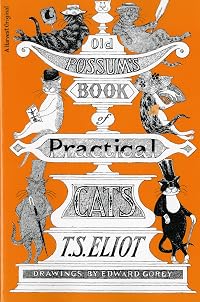
Old Possum's Book of Practical Cats
by T. S. Eliot
On This Page
Description
These playful verses by a celebrated poet have delighted readers and cat lovers around the world ever since they were gathered for publication in 1939. As Valerie Eliot has pointed out, there are a number of references to cats in T.S. Eliot's work, but it was to his godchildren, particularly Tom Faber and Alison Tandy, in the 1930s, that he first revealed himself as "Old Possum" and for whom he composed his poems.Tags
Recommendations















Member Recommendations
Member Reviews
You know, I thought I'd read this before, in my youth, but apparently I'd only read one or two of the poems somewhere, as I'm quite sure most of them were new to me. Well, I'm glad to have finally made their acquaintance! This is a fun little collection of delightful, interestingly rhymed nonsense, with perhaps a slightly extra appeal for us cat lovers, who can look with fond recognition on felines like Rum Tum Tugger, who is always on the wrong side of every door. I was smiling a lot through most of it, and (with, admittedly, the exception of a couple of unfortunate terms used for Chinese people -- er, cats) it holds up really well.
I have no idea, though, how or why anybody managed to make a musical out of this, never mind that waking show more nightmare of a movie I regret having watched the trailer for. But let us not speak of that again. show less
I have no idea, though, how or why anybody managed to make a musical out of this, never mind that waking show more nightmare of a movie I regret having watched the trailer for. But let us not speak of that again. show less
What's there not to like? It's poetry about cats with names such as Rumpleteazer, Deutoronomy and Skimbleshanks, with wonderful illustrations by Edward Gorey. I was enjoying it enough, but then started reading aloud to my little menagerie and our combined enjoyment was tenfold. Now I'm wondering if I should rename my own cats. 'Mimi' and 'Ezra' just seem so ordinary and are missing a few syllables besides... But how could I forget? Mr. Eliot has already provided the answer:
"The Naming of Cats is a difficult matter,
It isn't just one of your holiday games;
You may think at first I'm as mad as a hatter
When I tell you, a cat must have THREE DIFFERENT NAMES."
So, confession: I’ve read this one before, but not recently. I have fond memories of it being delightfully silly and bouncy (and somehow … longer?). It certainly is fun and has excellent rhyme and meter and all those proper poetic traits. It’s also very much a love letter to cats—from the ones who sleep all day and are terrible mousers to the neighbourhood tom who beats up dogs to the ones who are happy to steal your steak off the counter and then deny it while licking off their paws. However, reading it as an adult there are … um. Let’s just say it’s pretty clear this was written in the early parts of the 20th century and that Pekinese dogs and Siamese cats aren’t portrayed positively. Despite that, I enjoyed the spirit show more of the poems, if not always the content, and admire Eliot’s grasp on technique. Would recommend to cat lovers still, but with reservations.
7/10 show less
7/10 show less
Short, clever book of jazzy, doggerel-style rhymes about cats, accompanied by delightful illustrations. Some readers complain about the use of racial epithets, and while they have a point, TSE has written worse.
Old Possum's Book of Practical Cats by T.S. Eliot is the most charming little book of poetry I've ever read. Roni directed me to it when we were in Adams Avenue Books for which I am VERY grateful. I read the poems aloud to my husband, which added to the pleasure because they are better when read aloud and because the pleasure was shared. Besides the charming poems, the book also is filled with charming drawings. Such a win-win. Here's a stanza from one of my favorites: "Skimbleshanks: the Railway Cat". If you read it aloud you will discover that it has the rhythm of an old steam train leaving the station.
You may say that by and large it is Skimble who's in charge
Of the Sleeping Car Express.
From the driver to the guards to the bagmen show more playing cards
He will supervise them all, more or less.
Down the corridor he paces and examines all the faces
Of the travellers in the First and in the Third.
He establishes control by a regular patrol
And he'd know at once if anything occurred.
He will watch you without winking and he sees what you are thinking
And it's certain that he doesn't approve
Of hilarity and riot, so the folk are very quiet
When Skimble is about and on the move. show less
You may say that by and large it is Skimble who's in charge
Of the Sleeping Car Express.
From the driver to the guards to the bagmen show more playing cards
He will supervise them all, more or less.
Down the corridor he paces and examines all the faces
Of the travellers in the First and in the Third.
He establishes control by a regular patrol
And he'd know at once if anything occurred.
He will watch you without winking and he sees what you are thinking
And it's certain that he doesn't approve
Of hilarity and riot, so the folk are very quiet
When Skimble is about and on the move. show less
This was one of those interesting yard sale finds when I was in high school that talked to my reading heart and never let it go. Whether I had read of T.S. Eliot's works before coming upon this book I don't remember but whenever I hear his name this is what I start thinking about.
Where to start on the praises of this book? First of all the majority of the poems are rhyming with an almost musical quality to it. To keep the reading flowing the wording is easy to understand and follow along.
Furthermore for the cat-lover and to those who know a cat T.S. Eliot has done a wonderful job in capturing their essence. His characters are strong, individualistic and with zany quirks all too real to a home of a cat(s) while his poem "The show more Ad-dressing of Cats" reminds the reader this was one person who knew his cats. show less
Where to start on the praises of this book? First of all the majority of the poems are rhyming with an almost musical quality to it. To keep the reading flowing the wording is easy to understand and follow along.
Furthermore for the cat-lover and to those who know a cat T.S. Eliot has done a wonderful job in capturing their essence. His characters are strong, individualistic and with zany quirks all too real to a home of a cat(s) while his poem "The show more Ad-dressing of Cats" reminds the reader this was one person who knew his cats. show less
This book had been on my shelves for a VERY long time, so I decided to make this the first book I read for National Poetry Month.
I was so impossibly charmed by the first poem, "The Naming of Cats!" Especially the lines:
Listen. Ineffable has been one of my top ten favorite words ever since reading Good Omens back in my college days. But effanineffable!
After that poem, the rest were cute enough. I can see how they were designed to charm children, but the passage of time and dislocation of place has soften the corners of some of the particulars. Especially some of the tired Asian stereotypes.
But the illustrations by Edward Gorey won me back over any time my interest show more started to dim. show less
I was so impossibly charmed by the first poem, "The Naming of Cats!" Especially the lines:
His ineffable effable
Effanineffable
Deep and inscrutable singular Name.
Listen. Ineffable has been one of my top ten favorite words ever since reading Good Omens back in my college days. But effanineffable!
After that poem, the rest were cute enough. I can see how they were designed to charm children, but the passage of time and dislocation of place has soften the corners of some of the particulars. Especially some of the tired Asian stereotypes.
But the illustrations by Edward Gorey won me back over any time my interest show more started to dim. show less
Members
- Recently Added By
Lists

Favorite Animal Fiction
359 works; 156 members

1001 Children's Books You Must Read Before You Grow Up
774 works; 101 members

Brilliant poetry collections for kids
51 works; 18 members

Cats in Fiction
209 works; 9 members

Children's Classics Worth Reading
68 works; 9 members

Books for Cat Lovers
16 works; 4 members

Books Read in 2019
4,052 works; 110 members

Books Read in 2022
5,168 works; 114 members

Novels/Poems/Short Stories/Anything Storytelling Related
112 works; 2 members

Books Read in 2016
4,666 works; 199 members

1930s
262 works; 5 members

Nobel Price Winners
222 works; 20 members

Best Books Set in London
157 works; 42 members

In or About the 1930s
198 works; 27 members

Tonikat reading completed on Librarything journals
329 works; 2 members

Animals in the Title
498 works; 11 members

American Lit for Eng 11 Research Project
368 works; 6 members

Poetry Corner
187 works; 15 members
Children's Books by Adult Authors
26 works; 2 members

Books Read in 2014
2,343 works; 89 members

20th Century Literature
1,161 works; 55 members
Edward Gorey Covers
150 works; 8 members

Poetry Collections
79 works; 6 members

Books We'd Want on a Desert Island
203 works; 131 members
Author Information

504+ Works 47,900 Members
T. S. Eliot is considered by many to be a literary genius and one of the most influential men of letters during the half-century after World War I. He was born on September 26, 1888, in St. Louis, Missouri. Eliot attended Harvard University, with time abroad pursuing graduate studies at the Sorbonne, Marburg, and Oxford. The outbreak of World War show more I prevented his return to the United States, and, persuaded by Ezra Pound to remain in England, he decided to settle there permanently. He published his influential early criticism, much of it written as occasional pieces for literary periodicals. He developed such doctrines as the "dissociation of sensibility" and the "objective correlative" and elaborated his views on wit and on the relation of tradition to the individual talent. Eliot by this time had left his early, derivative verse far behind and had begun to publish avant-garde poetry (including "The Love Song of J. Alfred Prufrock" (1915), which exploited fresh rhythms, abrupt juxtapositions, contemporary subject matter, and witty allusion. This period of creativity also resulted in another collection of verse (including "Gerontian") and culminated in The Waste Land, a masterpiece published in 1922 and produced partly during a period of psychological breakdown while married to his wife, Vivienne Haigh-Wood Eliot. In 1922, Eliot became a director of the Faber & Faber publishing house, and in 1927 he became a British citizen and joined the Church of England. Thereafter, his career underwent a change. With the publication of Ash Wednesday in 1930, his poetry became more overtly Christian. As editor of the influential literary magazine The Criterion, he turned his hand to social as well as literary criticism, with an increasingly conservative orientation. His religious poetry culminated in Four Quartets, published individually from 1936 onward and collectively in 1943. This work is often considered to be his greatest poetic achievement. Eliot also wrote poetry in a much lighter vein, such as Old Possum's Book of Practical Cats (1939), a collection that was used during the early 1980s as the basis for the musical, Cats. In addition to his contributions in poetry and criticism, Eliot is the pivotal verse dramatist of this century. He followed the lead of William Butler Yeats in attempting to revive metrical language in the theater. But, unlike Yeats, Eliot wanted a dramatic verse that would be self-effacing, capable of expressing the most prosaic passages in a play, and an insistent, undetected presence capable of elevating itself at a moment's notice. His progression from the pageant The Rock (1934) and Murder in the Cathedral (1935), written for the Canterbury Festival, through The Family Reunion (1939) and The Cocktail Party (1949), a West End hit, was thus a matter of neutralizing obvious poetic effects and bringing prose passages into the flow of verse. Recent critics have seen Eliot as a divided figure, covertly attracted to the very elements (romanticism, personality, heresy) he overtly condemned. His early attacks on romantic poets, for example, often reveal him as a romantic against the grain. The same divisions carry over into his verse, where violence struggles against restraint, emotion against order, and imagination against ironic detachment. This Eliot is more human and more attractive to contemporary taste. During his lifetime, Eliot received many honors and awards, including the Nobel Prize for literature in 1948. (Bowker Author Biography) show less
Some Editions
Awards and Honors
Series
Belongs to Publisher Series
Bibliothek Suhrkamp (10)
Work Relationships
Is contained in
Contains
Common Knowledge
- Canonical title
- Old Possum's Book of Practical Cats
- Original title
- Old Possum's Book of Practical Cats
- Original publication date
- 1939-10
- People/Characters
- The Rum Tum Tugger; Skimbleshanks; The Old Gumbie Cat; Growltiger; Mungojerrie; Rumpleteazer (show all 12); Old Deuteronomy; Mr. Mistoffelees; Great Rumpuscat; Macavity; Gus; Bustopher Jones
- Important places
- London, England, UK; Gravesend, Kent, England, UK; Oxford, Oxfordshire, England, UK; River Thames, England, UK; Rotherhithe, Southwark, London, England, UK; Hammersmith, London, England, UK (show all 15); Putney, England, UK; Molesey, Elmbridge, Surrey, England, UK; Hampton, Richmond-upon-Thames, London, England, UK; Wapping, London, England, UK; Maidenhead, Berkshire, England, UK; Henley-on-Thames, Oxfordshire, England, UK; Brentford, London, England, UK; Royal Victoria Dock, Docklands, London, England, UK; Bangkok, Thailand
- Related movies
- "Great Performances": Cats (1998 | IMDb); Cats (2019 | IMDb)
- Dedication
- This Book is respectfully dedicated to those friends who have assisted its composition by their encouragement, criticism and suggestions: and in particular to Mr. T. E. Faber, Miss Alison Tandy, Miss Susan Wolcott, Miss Susan... (show all)na Morley, and the Man in White Spats.
O. P. - First words
- The Naming of Cats is a difficult matter,
It isn't just one of your holiday games;
You may think at first I'm as mad as a hatter
When I tell you, a cat must have THREE DIFFERENT NAMES. - Last words
- (Click to show. Warning: May contain spoilers.)So if you ’ave business with Faber—or Faber—
I'll give you this tip, and it's worth a lot more:
You'll save yourself time, and you'll spare yourself labour
If jist you make friends with the Cat at the door.
MORGAN. - Original language
- English
- Disambiguation notice
- This is a work by T.S. Eliot. Please do not combine with the Diary-Calendar of the same name. Thank you!
Classifications
Statistics
- Members
- 7,558
- Popularity
- 1,523
- Reviews
- 102
- Rating
- (4.00)
- Languages
- 18 — Chinese, Czech, Danish, Dutch, English, Finnish, French, German, Greek, Hungarian, Italian, Norwegian (Bokmål), Norwegian, Russian, Spanish, Swedish, Ukrainian, Portuguese (Portugal)
- Media
- Paper, Audiobook, Ebook
- ISBNs
- 103
- ASINs
- 68