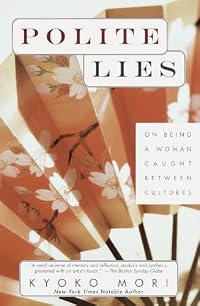
Polite Lies: On Being a Woman Caught Between Cultures
by Kyoko Mori
On This Page
Description
Twelve essays by a Japanese-American writer about being caught between past and present, old country and new.Tags
Recommendations


















Member Reviews
I found this to be a beautiful and moving, but deeply sad, book. In it, the author compares the two cultures in which she has lived. She was born in Japan and lived there as a child. At age 12, her mother committed suicide in reaction to a husband, the author's father, who had a mistress. Following her mother's death, her dad married his mistress, both of whom were abusive to the author as a teenager. At age 20, the author left for the United States and made Green Bay, Wisconsin, her permanent home. When her father died, years later, she traveled back to Japan to visit family and friends. Then returning to the United States, she felt as if she would never again return to Japan.
That is only the back story. The author talks about various show more differences between Japanese and American cultures. Her reflections about both cultures are more negative toward the Japanese culture. I believe all of this is colored by her sad childhood in Japan. She realizes this and explains this in detail.
The title of this book, Polite Lies, alludes to the situation, mostly of Japanese women, who have to be polite at all costs and never embarrass themselves or their family. This often entails a certain dishonesty to oneself and others. . show less
That is only the back story. The author talks about various show more differences between Japanese and American cultures. Her reflections about both cultures are more negative toward the Japanese culture. I believe all of this is colored by her sad childhood in Japan. She realizes this and explains this in detail.
The title of this book, Polite Lies, alludes to the situation, mostly of Japanese women, who have to be polite at all costs and never embarrass themselves or their family. This often entails a certain dishonesty to oneself and others. . show less
Having escaped the public annihilation of self that she saw for the women in Kobe among whom she grew up, Kyoko Mori examines aspects of her life with contrasts and comparisons of Japanese and Midwest norms and does a complete hatched job on her father and step-mother.
I enjoyed the cultural contrasts the author highlights. It has opened my eyes to the things I see while here in Japan. I wouldn't base my entire opinion of Japanese people and culture on this one book, but it does help create a more complete picture.
More than fifty pages in, and I'm not sure I'll finish this book.
The author - a Japanese woman living and teaching in the Midwestern US - had a depressing childhood. When she was twelve, her mother committed suicide. Her father, who was already having an affair, married his girlfriend less than a year later. Her brother (who was eight at the time) latched onto the stepmom, doesn't really remember his natural mother, and by the time the book was written the siblings have stopped speaking to each other.
With all of this, it's no wonder the author "escaped" to the US at age twenty, now dreads her infrequent visits to Japan, and seems to dislike everything about the land of her birth.
The author - a Japanese woman living and teaching in the Midwestern US - had a depressing childhood. When she was twelve, her mother committed suicide. Her father, who was already having an affair, married his girlfriend less than a year later. Her brother (who was eight at the time) latched onto the stepmom, doesn't really remember his natural mother, and by the time the book was written the siblings have stopped speaking to each other.
With all of this, it's no wonder the author "escaped" to the US at age twenty, now dreads her infrequent visits to Japan, and seems to dislike everything about the land of her birth.
I really loved this book and I am now very interested in reading Mori's fiction works. She has a great voice.
Ratings
Members
- Recently Added By
Author Information
9+ Works 901 Members
Born in Kobe, Japan, Kyoko Mori settled in Wisconsin at the age of sixteen. Now a Briggs-Copeland Lecturer in creative writing at Harvard University, she is the author of the prizewinning "Shizuko's Daughter" & four other books. (Bowker Author Biography)
Common Knowledge
- People/Characters
- Akiko; Jumpei (Kyoko’s brother); Kenichi; Keiko; Mariko; Michiko (show all 9); Mr. Maeshiba; Takako; Hiroshi (Kyoko’s father)
- First words
- When my third grade teacher told us that the universe was infinite and endless, I wrote down her words in my notebook, but I did not believe her.
- Quotations
- Institutions that influence our health or financial well-being—and people who work for them—have an obligation to tell the truth.
Mourning is a way of placing boundaries on our grief, creating a miniature replica of sorrow that we can manage.
In Japan—as I learned from American friends who lived there—individuals don’t leave wills; they express their wishes in vague and polite terms, but nothing is written down.
We would rather string beaded crosses inside an aquarium or worship at a doll-house altar and believe that we are doing something for the dead than admit the truth—that there is nothing we can do for them, no explanations a... (show all)bout where they have gone, whether they even exist anymore. In our grief, we cannot leap into the unknown or accept inexpressible truths. Even if our rituals seem false, clichéd or in bad taste, they are the polite lies we need.
They “start” a family, and in five or six years when they have too many children to fit comfortably into a two-bedroom house, move on to a bigger place. The expression makes people sound like sourdough bread. The house is... (show all) a lot or package for multiplying dinner rolls.
...after my mother died, no one in my family ever took a photograph of me.
The year of the Kobe earthquake Kazumi received a letter from her ie Advising students to rent a good kimono to attend the annual ceremony if theirs had been destroyed in the earthquake.
I don’t know how to bridge the polite lies people tell one another and the harsh criticisms they make in private. What I want is something between these two extremes: courteous and constructive criticism. - Last words
- (Click to show. Warning: May contain spoilers.)All these years later, my conviction remains the same: I speak her words though I speak them in another language.
- Blurbers
- Robert Olen Butler; Shirlee Taylor Haizlip
Classifications
- Genres
- Nonfiction, Biography & Memoir, General Nonfiction
- DDC/MDS
- 305.488956073092 — Society, Government, and Culture Social sciences, sociology & anthropology Social group - Age, Gender, Ethnicity Women Specific groups of women Indigenous women
- LCC
- F358.2 .J3 .M67 — Local History of the United States, Canada and Latin America United States local history
- BISAC
Statistics
- Members
- 149
- Popularity
- 219,044
- Reviews
- 5
- Rating
- (3.80)
- Languages
- English
- Media
- Paper, Ebook
- ISBNs
- 3
- ASINs
- 3