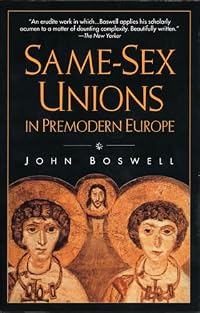
Same-Sex Unions in Premodern Europe
by John Boswell
On This Page
Description
Both highly praised and intensely controversial, this brilliant book produces dramatic evidence that at one time the Catholic and Eastern Orthodox churches not only sanctioned unions between partners of the same sex, but sanctified them--in ceremonies strikingly similar to heterosexual marriage ceremonies.Tags
Recommendations





















Member Reviews
Both highly praised and intensely controversial, this brilliant book produces dramatic evidence that at one time the Catholic and Eastern Orthodox churches not only sanctioned unions between partners of the same sex, but sanctified them--in ceremonies strikingly similar to heterosexual marriage ceremonies.
Someone once asked me what this book was about, and went on to ask whether I was persuaded by it. I had to say then, and I still think now: I rather wish it were true - but I can't quite think that these liturgies which look to me as if they are consecrations of some kind of 'missionary companionship' bear any very obvious comparison with whatever we might mean by 'gay marriage'. I do believe in equality: but whether we should all want equality within the confines of 'marriage' seems to me to be a question worth asking in itself.
This huge work of scholarship brings to light pre-modern documents concerning heterosexual marriages and same-sex unions. Don't be fooled by the title! Our modern sense of the phrase "same-sex unions" sometimes gets interpreted as "same-sex marriages," which really isn't the case with this book.
Sure, there may have been same-sex unions that entailed more than strong friendship or spiritual unity, but reading this book made me realize how diluted our sense of friendship - and how uneducated our knowledge of marriage - can be.
This book covers ancient attitudes on men and women, as well as the history of marriages and ceremonies, from the pre-Christian era through to modern times and would be of great interest to heterosexuals wanting to show more know more about the strange history of wives, concubines, prostitutes, slaves, and everything in between. This work includes how attitudes have differed between ancient civilizations concerning love, marriage, and the distinctions (and sometimes non-distinctions) between hetero- and homosexual love and unions.
As with all of Boswell's work, there is a tremendous amount of footnotes - well worth reading - and many different languages are brought into the entire discussion (as well as thoughts on proper translations), all incredibly fascinating. In the back, there are pre-modern Christian ceremonies for both heterosexual marriages and same-sex unions that have been translated and could actually be used for anyone interested. This is another piece of Boswell's work that leaves you with an incredible depth of knowledge and appreciation. Highly recommended. show less
Sure, there may have been same-sex unions that entailed more than strong friendship or spiritual unity, but reading this book made me realize how diluted our sense of friendship - and how uneducated our knowledge of marriage - can be.
This book covers ancient attitudes on men and women, as well as the history of marriages and ceremonies, from the pre-Christian era through to modern times and would be of great interest to heterosexuals wanting to show more know more about the strange history of wives, concubines, prostitutes, slaves, and everything in between. This work includes how attitudes have differed between ancient civilizations concerning love, marriage, and the distinctions (and sometimes non-distinctions) between hetero- and homosexual love and unions.
As with all of Boswell's work, there is a tremendous amount of footnotes - well worth reading - and many different languages are brought into the entire discussion (as well as thoughts on proper translations), all incredibly fascinating. In the back, there are pre-modern Christian ceremonies for both heterosexual marriages and same-sex unions that have been translated and could actually be used for anyone interested. This is another piece of Boswell's work that leaves you with an incredible depth of knowledge and appreciation. Highly recommended. show less
Men bonded differently in premodern Europe. Boswell (RIP) looked at ways they joined together in dyads. Were they sexual in nature? Well, many apparently were, though sexual lines were more fluid then than today. It's been a while since I've read it. When I did, I was moved.
Despite a certain amount of enlightenment, I did not enjoy reading this book one bit. It was too academic for me and how could it be anything other than that seeing as it contained 20 pages of ancient Greek text, pages and pages of translated documents and hundreds and hundreds and hundreds of footnotes.
A large part of this book was about trying to understand the meaning of words, such as brother or sister, in the context that they were used and attempting to put aside the modern meaning. It also had to deal with previous interpretations of the subject and explain how they came to the wrong conclusion in certain circumstances.
This book is not for the casual reader.
Although the sub-title of this book claims it to be an examination of show more same-sex unions it also looks at the entire topic of marriage, heterosexual and homosexual, plus all the other forms of relationships. Combine this with an unclear writing structure, this book is just one hard slog and there were many occasions I just wanted to through it out the bus window.
Has it changed my out look on things? Not really and may have re-enforced the views I currently have about religions in general. Here is the place to express those views.
It is hard to recommend this to anyone other than those doing an in-depth examination of the subject of same-sex unions or marriages. show less
A large part of this book was about trying to understand the meaning of words, such as brother or sister, in the context that they were used and attempting to put aside the modern meaning. It also had to deal with previous interpretations of the subject and explain how they came to the wrong conclusion in certain circumstances.
This book is not for the casual reader.
Although the sub-title of this book claims it to be an examination of show more same-sex unions it also looks at the entire topic of marriage, heterosexual and homosexual, plus all the other forms of relationships. Combine this with an unclear writing structure, this book is just one hard slog and there were many occasions I just wanted to through it out the bus window.
Has it changed my out look on things? Not really and may have re-enforced the views I currently have about religions in general. Here is the place to express those views.
It is hard to recommend this to anyone other than those doing an in-depth examination of the subject of same-sex unions or marriages. show less
Really amazing research, especially for those looking for an historical review of medieval homosexuality and the church. surprising religious-sexual findings, indeed.
Boswell contributes a view of same-sex unions / marriages which if not entirely objective is at least not overly polemical or impassioned. This book offers a calm voice of basic information in the context of the culture wars.
Members
- Recently Added By
Lists

LQW Research Reading List
75 works; 1 member
Author Information

John Boswell (1947-94) was the A. Whitney Griswold Professor of History at Yale University and the author of The Royal Treasure, The Kindness of Strangers, and Same-Sex Unions in Premodern Europe.
Awards and Honors
Awards
Work Relationships
Has as a commentary on the text
Common Knowledge
- Original publication date
- 1994
- People/Characters
- Aaron, the Levite, older brother of Moses; Moses; Abelard; Abraham, son of Terah, father of Issac, husband of Sarai, lived 175 years "Abram"; Sarah, wife of Abraham, mother of Isaac "Sarai"; Hans Achelis (show all 537); Achilles; Patroclus; Achilles Tatius; Adam, father of Cain, Abel, Seth, he lived 930 years; Eve, wife of Adam, mother of Cain, Abel, Seth; A.W.H. Adkins; M. Adontz; Aelred of Rievaulx; Aeschines; Agapitus; F.R.P. Akehurst; Alcibiades; Alexander the Great; Bagoas the Younger; Alfonso the Wise; Gaiane Alibegashvili; Paul Allard; Alypius; St. Ambrose; Ammianus Marcellinus; Amnon, son of David; Tamar; Hans Christian Andersen; Andrew, the Apostle, Simon Peter's brother, crucified; Peter, the Apostle, "Simon Peter" "Cephas", d. 60; Simon; Saint Andronicus; Antinous; Hadrian; Apollonia; Philiscus; Apuleius; Thomas Aquinas; Aristogeiton; Harmodius; Aristotle, 384-322; Aseneth, wife of Joseph; Joseph, son of Jacob and Rachel, brother of Benjamin; Ann Astell; Athanasius; Athenaeus; Atticus of Constantinople; B. Aubé; Aufilenus; Aufilena; Augustine of Hippo; Augustus Caesar; Aulus Gellius; Aurelia Attiaena of Oxyrhynchus; Bacchus; Serge; Guiseppe Baldanza; Theodore Balsamon; Philip, the Apostle; Bartholomew, the Apostle "Nathaniel"; Basil the Great, 329-379; Basil I the Macedonian; Basil of Caesarea or Basil the Great; D.G. Bates; Norman Baynes; Bede, 673-735; P. Bedjan; I. Bekker; Benedict; Joseph, son of Jacob and Rachel, brother of Benjamin; Benjamin, son of Jacob and Rachel, brother of Joseph; Hans Dieter Betz; Matthew Blastares; Philip Blumstein; Giovanni Boccaccio; Mary Bodden; Charles Borromeo; John Boswell; J. Eugene Botha; Keith Bradley; Francesco Brandileone; Peter Brown; James Brundage; Karl George Bruns; Edward Burbidge; J. B. Bury; Lord Byron; Augustus Caesar; Caesarius of Heisterbach; Julius Caesar; Titus Calpurnius Siculus; Salvatore Cammarano; Eva Cantarella; Caphisodorus; Epaminondas; Caracalla; P.A. Cartledge; Castor; Pollux; Catullus; Charles the Bold, Duke of Burgundy; Antoine Chavasse; Émile Chénon; John Chrysostom; Cicero; Stanislaus Ciszewski; Elizabeth A. Clark; Clement of Alexandria; Cnosion; Demosthenes; Cobbo; Lantfrid; Esther Cohen; Marion M. Coleman; Constantine the Great; Constantine V, Byzantine Emperor; Constantine VII Porphyrogenitus, Byzantine Emperor; F.C. Conybeare; James Fenimore Cooper; Thomas Corneille; Cosmas; Damian; V.M. Crawford; Patricia Crone; Gheorghe Cront; Pál Csillag; Cupid; Curio the Elder; Cyril of Alexandria; Cyril of Jerusalem; Cyrus; John; Danilo Dalla; Georges Dalmeyda; O.M. Dalton; Danelis; Dante; David; Jonathan; Glenys Davis; Elizabeth Dawes; Carl Gotthard De Boor; Hippolyte Delehaye; Demetrius Chomatinus; Demetrius of Thessaloniki; George of Lydda; Demosthenes; Keith DeVries; Peter Didaz; Cassius Dio; Diocletian; Kelley Ditmar; Suzanne Dixon; Alexei Dmitrievskij; Gaetano Donizetti; Graham Douthwaite; Kenneth J. Dover; R. Dozy; Charles DuCange; Andrew Duggan; Mary E. Durham; C.C. Edgar; Elagabalus; Hierocles; Dyan Elliott; Pelopidas; Epiphanius of Salamis; Etheldreda; Euryalus; Nisus; Eusebius of Caesarea; Eustathios Rhomaios; Eutropius; Evagrius; Tit; Judith Evans-Grubbs; J. Evenou; Febronia; Felicitas; Perpetua; Pavel Florenskij; Jean Flori; Wayne Fontana; Alberto Fortis; Michel Foucault; Anthime Fourrier; Michael Fox; Hieronymus Frank; Jean Frček; Chiara Frugoni; Galeron; Ille; Ganymede; Zeus; Saadia Gaon; Yvon Garlan; Geoffrey of Trani; George the Monk; Gerald of Wales; Giton; Encolpius; Pope Gjuro of Njegushi; Jacques Goar; Mark Golden; Arthur Goldhammer; Jack Goody; Lord Byron; Claire Gottlieb; André Grabar; Gratian; David Greenberg; Réginald Grégoire; Gregory of Nyssa; Gregory of Tours; Jasper Griffin; Matt Groening; Paul Guérin; Antoine Guillaumont; Guntram; Joseph Gutmann; Jacob Gutmann; S. Guyer; François Halkin; David Halperin; Harmenopolous; Judith Hauptman; Thomas Head; W.C. Helmbold; Gilbert Herdt; David Herlihy; Herodotus; Hesiod; Hesychius of Jerusalem; Ralph Hexter; Alfons Hilka; Hincmar of Reims; Eduardo de Hinojosa; Keith Hopkins; Elliott Horowitz; Diane Hughs; Hugh of St. Victor; Michel Humbert; A.S. Hunt; Ignatius of Antioch; Ignatius of Loyola; Pope Innocent IV; Iolaus; Irenaeus of Lyons; Christopher Isherwood; Isidore of Seville; St. Isidore the Farmer; Isis; Osiris; V.M. Istrin; Jerome; Romilly J.H. Jenkins; James; John; Jacob, husband of Rachel, son of Isaac "Israel"; Rachel, daughter of Laban, wife of Jacob; Jacob; André Jacob; Theophilos Joannou; John Sigismund Zápolya; Elton John; Saint John; John of Perales; John the Almsgiver; John the Faster; Robert Joly; H.L. Jones; Mary; Juliana; Jupiter; Juno; Justinian I, Emperor; Ernest Kantorowicz; Jonathan Katz; Richard Kay; Alexander Kazhdan; Kekaumenos; Christiane Klapisch-Zuber; Fabyan KLonowicz; Otto Koegel; Robert Koehl; Paul Koschaker; Friedrich Krauss; Leopold Kretzenbacher; Pierre Labriolle; Lactantius; Angliki Laiou; W.R.M. Lamb; Lampridius; Lantfrid; Cobbo; R.A. Lattimore; Pope Leo III; C.S. Lewis; Libanius; Liudprand, Bishop of Cremona; Enzo Lodi; Peter Lombard; King Louis IX, France; Lucian; Lucius Verus; Martin Luther; Cora Lutz; Ramsay MacMullen; Jo Ann McNamara; Henry Maguire; John Malalas; A. von Maltzew; Cyril Mango; J.D. Mansi; Marcus Aurelius; Marko the Gravedigger; Gérard de Martel; Edmond Martène; Aimé Georges Martimort; Mary; Oliver Masson; Maximian; Maximin; Juventin; Metaphrastes; Georgios Michaelidos-Nouaros; Michael III; Minucius Felix; Mishnah; Christine Mohrmann; Richard Mohr; Jean-Baptiste Molin; Michel de Montaigne; R.I. Moore; Gyula Moravcsik; Robert Morris; Sephora; Zipporah, wife of Moses; Moses Maimonides; René Mouterde; Iziaslav II of Kiev; Herbert Musurillo; Protais Mutembe; Nachmanides; N.A. Nachov; Paul Näcke; Rajko Nahtigal; Carlo Alfonso Nallino; Ruth; Naomi; Polyeuct; Nearchus; Nero Claudius Caesar Augustus Germanicus; Sporus; Pope Nicholas I; John Noonan; Franz Oehler; Hermann Oesterley; Nikolas Oikonomides; De Lacy O'Leary; Pylades; Orestes; Origen; Osiris; Isis; George Ostrogorsky; Everard Otto; Edward Charles Owen; Manuel II Palaiologos; Robert Palmer; Papinian; Gaetano Passarelli; Evelyne Patlagean; Paulinus of Nola; Paul the Apostle; Paulus; Paul Peeters; Garcia de Perales; Felicitas; Perpetua; Bernadotte Perrin; Peter Ordinski; Saint Peter; W.L. Peterson; Caius Petronius Arbiter; Petrus Alphonsi; Manuel Philes; Philip of Macedon; Lou Phillips; Philostratus; Photius; Jean-Baptiste Pitra; Henri Platelle; Plato; Plautus; Pliny the Elder; Plutarch; Antoine Poidebard; Polybius; Polyeuct; Marvin Pope; Potiphar; Theodore Preger; Friedrich Prinz; Probus; Procopius; Prudentius; Ptolemy II "Mikros" Philadelphos; Pulcheria of Constantinople; Pylades; Orestes; L. Raditsa; G.G. Ramsay; James Redfield; Louis Reekman; Korbinian Ritzer; Will Rosco; Samuel Rosenblatt; Morris Rosenblum; Norman Roth; Musonius Rufus; Guido Ruggiero; Steven Runciman; Eduard Sachau; Sacred Band of Thebes; Richard Saller; J. Schirmann; J.A. Schmeller; Friedrich Scholz; O. Schumann; Pepper Schwartz; Anne Schwerdtfeger; Robin Scroggs; Roland Seboldt; Severus of Antioch; William Shakespeare; H.A. Shapiro; Brent Shaw; Saint Simon, Bishop of Vladimir and Suzdal; Giulia Sissa; Walter W. Skeat; John Skylizes; Alvian Smirensky; Paul Smither; Morton Smith; Society of Jesus; Socrates; Meletius Michael Solovey; Sophronius of Jerusalem; R.W. Southern; H. Spanner; Jonathan Spence; P. Spicq; Sporus; Brigitte Spreizer; P. Srećković; Thomas Stehling; Christopher August Stempel; Saint Stephen; Kenneth Stevenson; Matilda Coxe Stevenson; Strabo; Karl Strecker; Anselm Strittmatter; Ulrich Stutz; Suetonius; Suleiman the Magnificent; N. Suvorov; Charles Swan; Symeon Logothete; Symeon of Thessalonica; Tacitus; Giovanni Tamassia; Tarachus; Raphael Taubenschlag; Bernie Taupin; Ter Israel; Tertullian; Sacred Band of Thebes; Theocritus; Theodore of Studium; Theodore of Sykeon; Theodores; Theodoret of Cyrus; Theodosius; Theophanes; H. Thierfelder; Patriarch Thomas; Tiberius; Tibullus; Antonio Tiepolo; Tobias; Tobit; Dinko Tomasic; Pierre Toubert; Toxaris; Lucian; W. Treadgold; Susan Trggiari; Richard Trexler; S. Troianos; John Tzimiskes; Ulpian; Vacarius; R.P.S. Vailhé; Munio Vandilaz; Thorkil Vanggaard; Graecus Vaticanus; Athos Vatoped; Venantius Fortunatus; Venus; Vulcan; Vergil; August Vinson; Patrick Viscuso; Cyrille Vogel; Arthur Võõbus; Christopher Walter; Benjamin Warfield; Judith Romney Wegner; Kurt Weitzmann; Raymond Westbrook; We'wha; Walt Whitman; William of Blois; Craig Williams; Gordon Williams; Hans Julius Wolff; J. Wright; Thomas Wright; Xenophon of Ephesus; Zaxarija; Zeno; Zeus; Zizonus; Zoticus
- Important places
- Albania; Boeotia, Greece; Bulgaria; Constantinople; Crete, Greece; Egypt (show all 21); Episcopal Church; Germany; St. Panteleimon Monastery; Office of Same Sex Union; Paris Bsibliothèque Nationale de France; Romania; Serbia; Sinai; Sodom; Spain; Sparta, Greece; Ireland; Istanbul, Turkey; Italy; Kievan Caves Monastery
- Important events
- Alexandrian Neo-Platonism; Middle Ages
- Dedication
- This book is dedicated with gratitude and affection to James Meehan, without whom it would not have been completed. And with sadness to Mac and David, and all the others who did not live to see it finished.
- First words
- Three peculiar features of the psychological landscape of the modern West particularly influence any modern reader's understanding and perception of romantic love and coupling patterns (for either or both genders) in ancient ... (show all)societies.
- Last words
- (Click to show. Warning: May contain spoilers.)Recognizing that many -- probably most -- earlier Western societies institutionalized some form of romantic same-sex union gives us a much more accurate view of the immense variety of human romantic relationships and social responses to them than does the prudish pretense that such "unmentionable" things never happened.
Classifications
- Genres
- LGBTQ+, History, Nonfiction, Religion & Spirituality, Sexuality and Gender Studies, General Nonfiction
- DDC/MDS
- 306.766094 — Society, Government, and Culture Social sciences, sociology & anthropology Social Behavior - Dating, Marriage, Divorce Sexual relations Sexual orientation, transgender identity, intersexuality Homosexuality Biography And History Europe
- LCC
- HQ76.3 .E8 .B68 — Social sciences The family. Marriage, Women and Sexuality The Family. Marriage. Women Sexual life Homosexuality. Lesbianism
- BISAC
Statistics
- Members
- 1,084
- Popularity
- 23,476
- Reviews
- 9
- Rating
- (3.82)
- Languages
- English, French, Spanish
- Media
- Paper, Ebook
- ISBNs
- 10
- ASINs
- 4