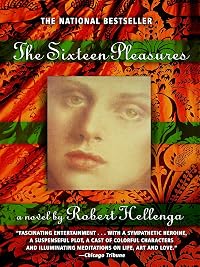
On This Page
Description
I was twenty-nine years old when the Arno flooded its banks on Friday, 4 November 1966. On Tuesday I decided to go to Italy, to offer my services as a humble book conservator, to save whatever could be saved, including myself. The Italians called them "Mud Angels," the young foreigners who came to Florence in 1966 to save the city's treasured art from the Arno's flooded banks. American volunteer Margot Harrington was one of them, finding her niche in the waterlogged library of a Carmelite show more convent. Within its walls she discovered a priceless Renaissance masterwork: a sensuous volume of sixteen erotic poems and drawings. Inspired to sample each of the ineffable sixteen pleasures, Margot embarks on the intrigue of a lifetime with a forbidden lover and the contraband volume-a sensual, life-altering journey of loss and rebirth in this exquisite novel of spiritual longing and earthly desire. show lessTags
Recommendations


Member Reviews
The Sixteen Pleasures – Robert Hellenga
4 stars
“What is amazing is how intensely you care about this woman” – The New Yorker
That quote appears on the back cover of my battered paperback copy of The Sixteen Pleasures. It’s true. I did come to care a great deal about Margot Harrington and her 1966 sojourn of self-discovery in flood stricken Florence. However, the truly amazing thing is how accurately Robert Hellenga managed to capture the inner voice and personality of a young woman.
Margot is 29 and dissatisfied with her life. Her mother’s death interrupted the future she thought she would have and seems to have set her adrift. In the aftermath of the flood, she takes her skills as a book conservator to Florence to help with show more the clean-up. She ends up in a convent, helping the sisters rescue their library. In the convent library, they find a Renaissance masterpiece of erotic verse with pictures. Margot restores the book, and helps the convent realize the profits form its sale.
Margot finds a book of erotica, but her story, as told by Hellenga, is not erotic. Oh yes, she does fall in love and has an affair, but it is not overly graphic. Mostly this story is played out through Margot’s inner reflections about her life and her relationships. Hellenga also gives us a peek into the thoughts of her lover, the likable, deceitful, Dottor Sandro Postiglione. My favorite character was the Mother Superior of the convent. I would have enjoyed more of her pithy, insightful comments. I also enjoyed the beautiful descriptions of the art and the details of the restorations. I would have liked a great deal more of that.
Margot may discover many things about her own sexuality in Florence, but she also spends much time reflecting on her relationships to other women. In the end, when she finally takes control of her own life, (and I wondered if she would ever get there) her loyalty to her sisters, both biological and metaphorical, is the overriding factor. It is so much a woman’s story. I’m looking forward to reading more of Hellenga’s writing to see what other amazing things he can do. show less
4 stars
“What is amazing is how intensely you care about this woman” – The New Yorker
That quote appears on the back cover of my battered paperback copy of The Sixteen Pleasures. It’s true. I did come to care a great deal about Margot Harrington and her 1966 sojourn of self-discovery in flood stricken Florence. However, the truly amazing thing is how accurately Robert Hellenga managed to capture the inner voice and personality of a young woman.
Margot is 29 and dissatisfied with her life. Her mother’s death interrupted the future she thought she would have and seems to have set her adrift. In the aftermath of the flood, she takes her skills as a book conservator to Florence to help with show more the clean-up. She ends up in a convent, helping the sisters rescue their library. In the convent library, they find a Renaissance masterpiece of erotic verse with pictures. Margot restores the book, and helps the convent realize the profits form its sale.
Margot finds a book of erotica, but her story, as told by Hellenga, is not erotic. Oh yes, she does fall in love and has an affair, but it is not overly graphic. Mostly this story is played out through Margot’s inner reflections about her life and her relationships. Hellenga also gives us a peek into the thoughts of her lover, the likable, deceitful, Dottor Sandro Postiglione. My favorite character was the Mother Superior of the convent. I would have enjoyed more of her pithy, insightful comments. I also enjoyed the beautiful descriptions of the art and the details of the restorations. I would have liked a great deal more of that.
Margot may discover many things about her own sexuality in Florence, but she also spends much time reflecting on her relationships to other women. In the end, when she finally takes control of her own life, (and I wondered if she would ever get there) her loyalty to her sisters, both biological and metaphorical, is the overriding factor. It is so much a woman’s story. I’m looking forward to reading more of Hellenga’s writing to see what other amazing things he can do. show less
Set in Florence after the Arno flood of 1966, this is the story of Margot Harrington, 29-year-old American book conservator, who travels to Italy to volunteer in the restoration of books damaged in the flood. Margot has experienced a number of disappointments, and she hopes Florence will help set a positive course for her future. She has trouble finding a place to stay and is directed to a Carmelite convent. The nuns discover a rare Renaissance manuscript of sixteen erotic poems and drawings. The abbess asks Margot to get involved in selling the manuscript to raise funds to save the convent’s beloved library. Margot meets and falls in love with the married cousin of the abbess, Dottor Alessandro Postiglione, an art restorer. The show more storyline revolves around Margot’s journey of self-discovery.
There are many interwoven threads in this novel, which are addressed in lengthy detailed passages, such as techniques of book and art restoration, reflections on convent life, and the methods by which a canonical court decides whether to grant an annulment. At the same time, we follow Margot’s initial thoughts of joining a convent, then veering into a sexual relationship with Alessandro. We learn about her family’s history.
I enjoyed very much the manner in which Margot (eventually) resists being controlled by men who want to take advantage of her and get their hands on the manuscript. My favorite parts were the descriptions of life in the convent. I was less enamored of the sexual relationship with a much older man. Hellenga’s writing is elegant and witty. It is a novel of devotion to craft, passion, and the fortitude to change one’s life for the better. show less
There are many interwoven threads in this novel, which are addressed in lengthy detailed passages, such as techniques of book and art restoration, reflections on convent life, and the methods by which a canonical court decides whether to grant an annulment. At the same time, we follow Margot’s initial thoughts of joining a convent, then veering into a sexual relationship with Alessandro. We learn about her family’s history.
I enjoyed very much the manner in which Margot (eventually) resists being controlled by men who want to take advantage of her and get their hands on the manuscript. My favorite parts were the descriptions of life in the convent. I was less enamored of the sexual relationship with a much older man. Hellenga’s writing is elegant and witty. It is a novel of devotion to craft, passion, and the fortitude to change one’s life for the better. show less
Set in Florence after the Arno flood of 1966, this is the story of Margot Harrington, 29-year-old American book conservator, who travels to Italy to volunteer in the restoration of books damaged in the flood. Margot has experienced a number of disappointments, and she hopes Florence will help set a positive course for her future. She has trouble finding a place to stay and is directed to a Carmelite convent. The nuns discover a rare Renaissance manuscript of sixteen erotic poems and drawings. The abbess asks Margot to get involved in selling the manuscript to raise funds to save the convent’s beloved library. Margot meets and falls in love with the married cousin of the abbess, Dottor Alessandro Postiglione, an art restorer. The show more storyline revolves around Margot’s journey of self-discovery.
There are many interwoven threads in this novel, which are addressed in lengthy detailed passages, such as techniques of book and art restoration, reflections on convent life, and the methods by which a canonical court decides whether to grant an annulment. At the same time, we follow Margot’s initial thoughts of joining a convent, then veering into a sexual relationship with Alessandro. We learn about her family’s history.
I enjoyed very much the manner in which Margot (eventually) resists being controlled by men who want to take advantage of her and get their hands on the manuscript. My favorite parts were the descriptions of life in the convent. I was less enamored of the sexual relationship with a much older man. Hellenga’s writing is elegant and witty. It is a novel of devotion to craft, passion, and the fortitude to change one’s life for the better. show less
There are many interwoven threads in this novel, which are addressed in lengthy detailed passages, such as techniques of book and art restoration, reflections on convent life, and the methods by which a canonical court decides whether to grant an annulment. At the same time, we follow Margot’s initial thoughts of joining a convent, then veering into a sexual relationship with Alessandro. We learn about her family’s history.
I enjoyed very much the manner in which Margot (eventually) resists being controlled by men who want to take advantage of her and get their hands on the manuscript. My favorite parts were the descriptions of life in the convent. I was less enamored of the sexual relationship with a much older man. Hellenga’s writing is elegant and witty. It is a novel of devotion to craft, passion, and the fortitude to change one’s life for the better. show less
A well-written and engaging novel about an American woman, Margot, who goes to Italy to restore books after a flood. While she is working in a convent, a priceless, erotic Renaissance manuscript is discovered there. The book tells the story of Margot's conservation work and what happens to the manuscript, and also of her relationships with another conservator, with her family, and above all with herself. The blurb and reviews variously describe it as a thriller (it isn't), a mystery (it isn't), a romance (nope, not that either) and as funny (not a word I'd use) and erotic (you guessed it - another no - 0 out of 5 there, then). Anyone reading the opening this book in expectation of any or all of these elements will be disappointed. There show more are a number of scenes which could be categorised as earthy, vaguely humorous or mildly suspenseful, but this is as far as it goes.
What this book is, is an engaging exploration of Margot's personal growth, relationships and sexuality, and also of Italy, Roman Catholicism, literature and the importance of the preservation of literary heritage. Some of these themes are handled extremely well, while the resolution of others is a little less satisfying - but on whole these themes are tackled both deftly and sympathetically. show less
What this book is, is an engaging exploration of Margot's personal growth, relationships and sexuality, and also of Italy, Roman Catholicism, literature and the importance of the preservation of literary heritage. Some of these themes are handled extremely well, while the resolution of others is a little less satisfying - but on whole these themes are tackled both deftly and sympathetically. show less
I hated this book! I have never read a travel book that made me want to stay so far away from another country. But I thought the protagonist was a twit and her taste in men appalling, her adventures low-key, her friends boring. Even the author's descriptions of the sensuous Italian lifestyle left me rolling my eyes. This book made illicit sex, great art, and the city of Florence sound like a total waste of time. One of my least favorite novels, ever.
Needing a change and some adventure in her life, Margot Harrington felt a calling to travel to Florence in 1966 to aid in the restoration of art and books after the famous flood. Many foreigners arrived in the city, but Margot was a little removed from the other “Mud Angels” because she was an experienced antique book restorer and she was very familiar with Florence, having lived there for several years as a child. Circumstance leads her to end up living at and working in the library of an impoverished abbey. The nuns entrusted to help her rescue the waterlogged books come across an old prayer book, but this was no ordinary prayer book. This book is bound together with another small book – the banned (thought lost) erotic poems of show more Aretino.
Margot first lovingly restores the book and then entrusted by the, surprisingly worldly, Abbess attempts to sell the volume to help the abbey. Her lover tries to undermine her sale to make a profit for himself. The Abbot, to whom the Abbess reports, forbids her to sell the banned book and life itself seems to be throwing out roadblocks every step of Margot’s way. Never one to be daunted, Margot persists with her quest leading to some interesting adventures.
From the title of the book and the “blurb” I read describing it I expected this book to be an “erotic” adventure. And, in a small way it was, but it was mostly about Margot finding herself. I enjoyed the story but as so often happens in works of historical fiction, I enjoyed the descriptions of Florence, the flood and the restorations even more, particularly the book restorations and the “peeling” of the water damaged frescoes. show less
Margot first lovingly restores the book and then entrusted by the, surprisingly worldly, Abbess attempts to sell the volume to help the abbey. Her lover tries to undermine her sale to make a profit for himself. The Abbot, to whom the Abbess reports, forbids her to sell the banned book and life itself seems to be throwing out roadblocks every step of Margot’s way. Never one to be daunted, Margot persists with her quest leading to some interesting adventures.
From the title of the book and the “blurb” I read describing it I expected this book to be an “erotic” adventure. And, in a small way it was, but it was mostly about Margot finding herself. I enjoyed the story but as so often happens in works of historical fiction, I enjoyed the descriptions of Florence, the flood and the restorations even more, particularly the book restorations and the “peeling” of the water damaged frescoes. show less
Margot is lost. She is 29 years old, working as a book conservator in a local library, her mother is dead of cancer, and her father is a shell of his former self. So when the Arno floods Florence, she goes to Italy to help recover and restore whatever she can, including herself. While there, she comes into possession of a very rare Renaissance book of erotica, bound within a religious book of prayer. This book takes her on a journey she never expected.
While I really enjoyed the concept of this novel, I didn't feel it lived up to it's potential. I never really connected with Margot, and the other characters seemed to be very two-dimensional. The best part of the book for me was the descriptions of Florenece and the Italian countryside, show more with the explinations of the conservation of the books and art a close second. However I think these lengthy descriptions of the conservation techniques could get tedious for many readers. This book won't keep me from reading more of Robert Hellenga, but he's not going to be at the top of my list either. show less
While I really enjoyed the concept of this novel, I didn't feel it lived up to it's potential. I never really connected with Margot, and the other characters seemed to be very two-dimensional. The best part of the book for me was the descriptions of Florenece and the Italian countryside, show more with the explinations of the conservation of the books and art a close second. However I think these lengthy descriptions of the conservation techniques could get tedious for many readers. This book won't keep me from reading more of Robert Hellenga, but he's not going to be at the top of my list either. show less
Members
- Recently Added By
Lists

Books set in Firenze (Florence, Italy)
35 works; 1 member

a picture or a thousand words
39 works; 5 members
Author Information

9+ Works 2,545 Members
Robert Hellenga received a Bachelor's degree in English from the University of Michigan in 1963 and a Ph.D. in English from Princeton University in 1969. After graduation, he taught English literature at Knox College. He has written several novels including The Sixteen Pleasures, The Fall of a Sparrow, Philosophy Made Simple, and Snakewoman of show more Little Egypt. Hellenga was one of 12 writers selected to participate in the first Illinois Arts Council Statewide Reading Series in 1991. Some of his other awards include the 1988 PEN Syndicated Fiction award, the National Endowment for the Arts Artists Fellowship in 1989, the Illinois Arts Council Artist's grant in 1990, and the Society of Midland Authors 1995 Award for Fiction. (Bowker Author Biography) show less
Awards and Honors
Awards
Series

Common Knowledge
- Canonical title
- The Sixteen Pleasures
- Original title
- The Sixteen Pleasures
- Original publication date
- 1994
- People/Characters
- Margot Harrington
- Important places
- Florence, Tuscany, Italy
- Important events
- Arno River flood (November 1966)
- Dedication
- To Virginia, Rachel, Heather and Caitrine
- First words
- I was twenty-nine years old when the Arno flooded its banks on Friday 4 November 1966.
- Last words
- (Click to show. Warning: May contain spoilers.)Of all the places I might have been at 7:34 p.m. on 20 giugno 1967, it was where I wanted to be.
- Blurbers
- Olsen, Tillie; Casey, John; Selzer, Richard; Kumin, Maxine
Classifications
- Genres
- Fiction and Literature, General Fiction, Historical Fiction, Romance
- DDC/MDS
- 813.54 — Literature & rhetoric American literature in English American fiction in English 1900-1999 1945-1999
- LCC
- PS3558 .E4753 .S58 — Language and Literature American literature American literature Individual authors 1961-
- BISAC
Statistics
- Members
- 1,225
- Popularity
- 20,197
- Reviews
- 31
- Rating
- (3.47)
- Languages
- 5 — Dutch, English, French, German, Italian
- Media
- Paper, Audiobook, Ebook
- ISBNs
- 20
- ASINs
- 4