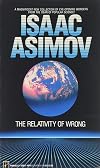
The Relativity of Wrong
by Isaac Asimov
Science essays for The Magazine of Fantasy and Science Fiction (24), Essay Collections
On This Page
Description
Seventeen essays reprinted from the Magazine of fantasy and science fiction, 1986-1987.Tags
Recommendations

















Member Reviews
When is right wrong? What will fuel interstellar space ships? How are new stars born?
In the pages of this book, readers embark on a fascinating journey that takes them from the center of the human brain to the outer reaches of the universe. Brimming with the legendary Asimov wit, this sweeping collection of real-life wonders is a delightful potpourri of conundrums, puzzles, and awesome astronomical anomalies, all guaranteed to thrill readers who long to comprehend the incomprehensible.
Highly recommended.
In the pages of this book, readers embark on a fascinating journey that takes them from the center of the human brain to the outer reaches of the universe. Brimming with the legendary Asimov wit, this sweeping collection of real-life wonders is a delightful potpourri of conundrums, puzzles, and awesome astronomical anomalies, all guaranteed to thrill readers who long to comprehend the incomprehensible.
Highly recommended.
I've decided to read this collection of essays after a person recommended that I read Asimov's article: 'The Relativity of Wrong' since I loved this quote of his and used it many times:
"When people thought the Earth was flat, they were wrong. When people thought the Earth was spherical they were wrong. But if you think that thinking the Earth is spherical is just as wrong as thinking the Earth is flat, then your view is wronger than both of them put together."
This book contains that title-essay (which was the most important one, in my opinion), in addition to the other 16 articles that were scientific but very simple, detailed, and required no previous deep knowledge of any sciences. Asimov divided his essays into three groups: Isotopes show more and Elements (I liked this one the least, since I am not very interested in Chemistry), The Solar System, and Beyond The Solar System. What I really loved about his writing style is that he included an interesting and fun anecdote in the beginning of each article.
Read 'The Relativity of Wrong' (essay, not the whole book) here: http://depa.pquim.unam.mx/amyd/archivero/Basicos_asimov_the_relativity1998_12501...
I can't wait to read Asimov's fiction! show less
"When people thought the Earth was flat, they were wrong. When people thought the Earth was spherical they were wrong. But if you think that thinking the Earth is spherical is just as wrong as thinking the Earth is flat, then your view is wronger than both of them put together."
This book contains that title-essay (which was the most important one, in my opinion), in addition to the other 16 articles that were scientific but very simple, detailed, and required no previous deep knowledge of any sciences. Asimov divided his essays into three groups: Isotopes show more and Elements (I liked this one the least, since I am not very interested in Chemistry), The Solar System, and Beyond The Solar System. What I really loved about his writing style is that he included an interesting and fun anecdote in the beginning of each article.
Read 'The Relativity of Wrong' (essay, not the whole book) here: http://depa.pquim.unam.mx/amyd/archivero/Basicos_asimov_the_relativity1998_12501...
I can't wait to read Asimov's fiction! show less
#1352 in our old book database. Rated: Indifferent.
FOR REFERENCE:
Collects essays from The Magazine of Fantasy and Science Fiction, April 1986-August 1987.
Contents:
Introduction
Part I. Isotopes and Elements
1. The Second Lightest
2. Labels on the Molecules
3. The Consequences of Pie
4. The Enemy Within
5. The Light-Bringer
6. Beginning with Bone
Part II. The Solar System
7. The Moon and We
8. The Unmentionable Planet
9. The Incredible Shrinking Planet
10. The Minor Objects
Part III. Beyond the Solar System
11. New Stars
12. Brightening Stars
13. Super-Exploding Stars
14. The Dead-End Middle
15. Opposite!
16. Sail On! Sail On!
Part IV. Something Extra
17. The Relativity of Wrong
FOR REFERENCE:
Collects essays from The Magazine of Fantasy and Science Fiction, April 1986-August 1987.
Contents:
Introduction
Part I. Isotopes and Elements
1. The Second Lightest
2. Labels on the Molecules
3. The Consequences of Pie
4. The Enemy Within
5. The Light-Bringer
6. Beginning with Bone
Part II. The Solar System
7. The Moon and We
8. The Unmentionable Planet
9. The Incredible Shrinking Planet
10. The Minor Objects
Part III. Beyond the Solar System
11. New Stars
12. Brightening Stars
13. Super-Exploding Stars
14. The Dead-End Middle
15. Opposite!
16. Sail On! Sail On!
Part IV. Something Extra
17. The Relativity of Wrong
When is right wrong? What is the Milky Way made of? How are new stars born? In a universe full of wonders, nothing is more wondrous than the mind of Issac Asimov.
Aug 19, 2021Spanish
La relativité du faux
Apr 15, 2026French
Ratings
Members
- Recently Added By
Author Information

2,439+ Works 294,669 Members
Isaac Asimov was born in Petrovichi, Russia, on January 2, 1920. His family emigrated to the United States in 1923 and settled in Brooklyn, New York, where they owned and operated a candy store. Asimov became a naturalized U.S. citizen at the age of eight. As a youngster he discovered his talent for writing, producing his first original fiction at show more the age of eleven. He went on to become one of the world's most prolific writers, publishing nearly 500 books in his lifetime. Asimov was not only a writer; he also was a biochemist and an educator. He studied chemistry at Columbia University, earning a B.S., M.A. and Ph.D. In 1951, Asimov accepted a position as an instructor of biochemistry at Boston University's School of Medicine even though he had no practical experience in the field. His exceptional intelligence enabled him to master new systems rapidly, and he soon became a successful and distinguished professor at Columbia and even co-authored a biochemistry textbook within a few years. Asimov won numerous awards and honors for his books and stories, and he is considered to be a leading writer of the Golden Age of science fiction. While he did not invent science fiction, he helped to legitimize it by adding the narrative structure that had been missing from the traditional science fiction books of the period. He also introduced several innovative concepts, including the thematic concern for technological progress and its impact on humanity. Asimov is probably best known for his Foundation series, which includes Foundation, Foundation and Empire, and Second Foundation. In 1966, this trilogy won the Hugo award for best all-time science fiction series. In 1983, Asimov wrote an additional Foundation novel, Foundation's Edge, which won the Hugo for best novel of that year. Asimov also wrote a series of robot books that included I, Robot, and eventually he tied the two series together. He won three additional Hugos, including one awarded posthumously for the best non-fiction book of 1995, I. Asimov. "Nightfall" was chosen the best science fiction story of all time by the Science Fiction Writers of America. In 1979, Asimov wrote his autobiography, In Memory Yet Green. He continued writing until just a few years before his death from heart and kidney failure on April 6, 1992. (Bowker Author Biography) show less
Series


Common Knowledge
- Original publication date
- 1988
- Dedication
- To my brother, Stan Asimov, with whom I have never exchanged a cross word
- First words
- I have been writing these essays at the rate of one a month for thirty years. [Introduction]
The first Nobel laureate I ever met and spoke to was the American chemist Harold Clayton Urey (1893-1981). It was not a happy occasion. [The Second Lightest] - Last words
- (Click to show. Warning: May contain spoilers.)Virtually all that we know today, however, would remain untouched and when I say I am glad that I live in a century when the Universe is essentially understood, I think I am justified. [The Relativity of Wrong]
- Original language
- English
- Disambiguation notice
- Collects essays from The Magazine of Fantasy and Science Fiction, April 1986-August 1987.
Contents:
Introduction
Part I. Isotopes and Elements
1. The Second Lightest
2. Labels on the Molecules
... (show all)3. The Consequences of Pie
4. The Enemy Within
5. The Light-Bringer
6. Beginning with Bone
Part II. The Solar System
7. The Moon and We
8. The Unmentionable Planet
9. The Incredible Shrinking Planet
10. The Minor Objects
Part III. Beyond the Solar System
11. New Stars
12. Brightening Stars
13. Super-Exploding Stars
14. The Dead-End Middle
15. Opposite!
16. Sail On! Sail On!
Part IV. Something Extra
17. The Relativity of Wrong
Classifications
- Genres
- Nonfiction, Science & Nature, General Nonfiction, Philosophy
- DDC/MDS
- 520 — Natural sciences & mathematics Astronomy Astronomy
- LCC
- QB44.2 .A839 — Science Astronomy Astronomy General
- BISAC
Statistics
- Members
- 293
- Popularity
- 110,268
- Reviews
- 5
- Rating
- (3.88)
- Languages
- 5 — English, German, Italian, Portuguese, Spanish
- Media
- Paper
- ISBNs
- 11