Dayspring
by Anthony Oliveira
On This Page
Description
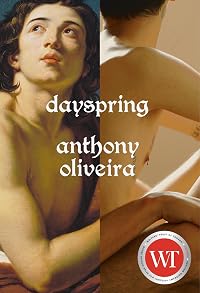
"A singular, stunning debut that transcends and transfigures genre--at once a bold retelling of biblical tales and an unforgettable contemporary coming-of-age story, connected in collapsing time across millennia. There are few love stories in the holy books. Love is what ruins. Love is what costs. Love is a flaming sword at our backs, a garden left to ruin and to wild. In Dayspring, Anthony Oliveira brings to vibrant, glorious life the gospel according to the disciple Christ loved--his show more companion in the days before the crucifixion, the only instrument that remembers with fidelity his sound. Sacred, profane, and rich with explicit desire and a poetic attention to form, Dayspring weaves electric and heart-wrenching stories of passion, grief, destruction, and survival into a narrative unmoored in space and time, one that re-examines and re-frames great and doomed figures from scripture and history, even as it casts its keen eye on the trials of modern life. Seamlessly blending fiction, memoir, and verse in the exhilarating tradition of Anne Carson and Madeline Miller, Dayspring is an immersive, mesmerizing work, one that wrenches beauty from cataclysm and finds bliss in apocalypse."-- show lessTags
Recommendations





























Member Reviews
Like the bible, Dayspring is poetic and very queer. It's viscerally incarnate, and about love. As someone else whose childhood was firmly Catholicised it was so familiar and so sad—I was brought right back to the rooms in which I argued with my catechism and CCD teachers, and personally, lost my faith. There are still some so beautiful things that I miss—the messages I always felt I was reading opposite of everyone else—and somehow this book contains all of them. It doesn't ignore all the things about religion that are anathema to faith and love, but here at least love is stronger. This one will stay with me a while.
Happy Easter! So, this is an ambitious book. And I don't think I'll be able to fully capture the great extent the author has explored same-sex desire and Christianity, but I will try. Bear with me.
Dayspring is not so much a novel as a loose collection of free verse, Biblical passages, and poetry by Christian authors of the past millennia put together as a meditation on the naturalness of same-sex desire and the religion. Much is noted for you, but most is not: it's up to the reader to disentangle what is a reworked passage of Kings, what is a phrase from a John Milton poem, and what is the author's own words. More than an author, Oliveira is a collage artist: much like musicians sampling a beat, the author retools the works of two show more millennia of Christian thought on the erotics of Christ into a contemporary understanding, adding his own lyrics to the greater sampling he has pulled from the pits.
The book follows the point of view of "John the Beloved," the beloved disciple of Christ, as he grapples with the intensity (dare I say, sometimes abusiveness) of his connection with Jesus while knowing how his loved one's story will always end. A bit like Achilles and Patroclus, with some interesting HIV/AIDS vibes, John narrates the story of Jesus, complete with twenty-something disciples, single-mother Mary, and vivacious Mary Magdalene.
The experience felt a bit like archeology. I was raised quite religiously in the "Evangelical" Pentecostal church and would attend Mass with my grandma in the summer. I learned a lot of the Bible, but not nearly enough to keep quite up with this. I spent the first half pretty intensely glossing it: beyond the usual canon, Oliveira makes use of Apocrypha, texts from the Koran, and later Medieval tradition to draw the greatest amount of material on the life of Christ as he can. For obvious reasons, much of the first half works in the story of David and Johnathan, with the Gospels coming in heavy as the story of Jesus' preaching begins.
One of the most coherent uses of Christian texts is the plethora of Beguine and "Free Spirit" thinkers. All of the big ones (Marguerite Porete, Meister Eckhart, Sister Catherine Treatise) make an appearance, and when paired with poetry from the "mainstream" work Juan de la Cruz, make a cogent argument for the ridiculousness of the former's prosecution. In these, Oliveira highlights the eroticism and emotional intensity of the potential relationship with Christ.
The story is also far from linear. Weaving in and out of Biblical towns set-dressed with contemporary objects, slang, and scenarios, the author has done what Christians have done since the beginning of time—place them in a time and place that allows us to relate to these figures as closely as humanly possible. It took a little for me to buy into it, but with 400 pages to play in, I quickly figured out how to wrestle with it. Just as desire is timeless, so is God—and just as he is omnipresent—so is time.
There's far, far too much to go into detail with everything that this book plays with. I recommend glossing as I did to some extent, but make sure to watch out for obvious reworks of the Gospels, the Old Testament histories, and Revelations. So much Revelations. The author absolutely soaks his prose in Biblical imagery, often taking phrases, sentences, and whole pages into it. It's tangled and beautiful, but a tiny bit the reason why I could not rate this 5 stars. With so much taken from other sources, much of the construction of this is simply other people's work. That's fine. I think Oliveira is a talented writer and obviously an extremely talented synthesizer, but I could not in good conscience pretend that he is the sole progenitor of the entirety of this work.
Being a person of even some faith in God while being queer is often more a headache than it's worth. Most people think you're secretly self-hating or delusional, and maybe we are, but my relationship with God and religion will always be a warm place in my heart I can call to when at my lowest. It's no surprise that many try to disavow as much of their past as they can, so this work was a wonderful, wonderful read over Holy Week, and I'm grateful for it. show less
Dayspring is not so much a novel as a loose collection of free verse, Biblical passages, and poetry by Christian authors of the past millennia put together as a meditation on the naturalness of same-sex desire and the religion. Much is noted for you, but most is not: it's up to the reader to disentangle what is a reworked passage of Kings, what is a phrase from a John Milton poem, and what is the author's own words. More than an author, Oliveira is a collage artist: much like musicians sampling a beat, the author retools the works of two show more millennia of Christian thought on the erotics of Christ into a contemporary understanding, adding his own lyrics to the greater sampling he has pulled from the pits.
The book follows the point of view of "John the Beloved," the beloved disciple of Christ, as he grapples with the intensity (dare I say, sometimes abusiveness) of his connection with Jesus while knowing how his loved one's story will always end. A bit like Achilles and Patroclus, with some interesting HIV/AIDS vibes, John narrates the story of Jesus, complete with twenty-something disciples, single-mother Mary, and vivacious Mary Magdalene.
The experience felt a bit like archeology. I was raised quite religiously in the "Evangelical" Pentecostal church and would attend Mass with my grandma in the summer. I learned a lot of the Bible, but not nearly enough to keep quite up with this. I spent the first half pretty intensely glossing it: beyond the usual canon, Oliveira makes use of Apocrypha, texts from the Koran, and later Medieval tradition to draw the greatest amount of material on the life of Christ as he can. For obvious reasons, much of the first half works in the story of David and Johnathan, with the Gospels coming in heavy as the story of Jesus' preaching begins.
One of the most coherent uses of Christian texts is the plethora of Beguine and "Free Spirit" thinkers. All of the big ones (Marguerite Porete, Meister Eckhart, Sister Catherine Treatise) make an appearance, and when paired with poetry from the "mainstream" work Juan de la Cruz, make a cogent argument for the ridiculousness of the former's prosecution. In these, Oliveira highlights the eroticism and emotional intensity of the potential relationship with Christ.
The story is also far from linear. Weaving in and out of Biblical towns set-dressed with contemporary objects, slang, and scenarios, the author has done what Christians have done since the beginning of time—place them in a time and place that allows us to relate to these figures as closely as humanly possible. It took a little for me to buy into it, but with 400 pages to play in, I quickly figured out how to wrestle with it. Just as desire is timeless, so is God—and just as he is omnipresent—so is time.
There's far, far too much to go into detail with everything that this book plays with. I recommend glossing as I did to some extent, but make sure to watch out for obvious reworks of the Gospels, the Old Testament histories, and Revelations. So much Revelations. The author absolutely soaks his prose in Biblical imagery, often taking phrases, sentences, and whole pages into it. It's tangled and beautiful, but a tiny bit the reason why I could not rate this 5 stars. With so much taken from other sources, much of the construction of this is simply other people's work. That's fine. I think Oliveira is a talented writer and obviously an extremely talented synthesizer, but I could not in good conscience pretend that he is the sole progenitor of the entirety of this work.
Being a person of even some faith in God while being queer is often more a headache than it's worth. Most people think you're secretly self-hating or delusional, and maybe we are, but my relationship with God and religion will always be a warm place in my heart I can call to when at my lowest. It's no surprise that many try to disavow as much of their past as they can, so this work was a wonderful, wonderful read over Holy Week, and I'm grateful for it. show less
"Went to the eleven o’clock mass. I always cringe when it gets to the part of 'Peace, peace be with you,' and you have to shake hands with the people next to you. I always leave before that. Or I pretend to be praying" — The Andy Warhol Diaries
Punk — Homosexual — Catholic . . . But Not Enough
Our Catholic martyrs are what some would call "an institute in a powerful [bureaucratic] process." — that long cosmic cycle in which the "punk" movement (contra-society) finds its way back to social acceptance in the Church. Joan of Arc, who begins her petition moments after her conflagration a cause de crossdressing, becomes a saint after five-hundred years in the queue. So it's not for us to say whether getting torn open is act of show more devotion. In the sense that it's not an actum sanctorum (act of the saints) this is only because no one has (yet) been canonized for it; it all depends on what strange priest has the sinecure two-thousand years hence. Meanwhile, in an analogous process, works of art are tracing slow eccentric orbits around this Catholic (read: "Universal") fulcrum. Works from Kathy Acker, Anne Carson, and Andy Warhol are orbiting upon the same Punk-Homosexual-Catholic plane Oliveira inhabits here. An investigation into these peculiar movements would perhaps afford a glimpse into the Heavenly-Bureaucratic process.
Acker's Blood and Guts in High School is quintessential 1980's punk in an escape orbit. Its portrayal of a consanguineous relationship that Freud could treat by-the-book manifests the same potential for anti-social movement we find in our martyrs. Oliveira is playing off similar limits of consanguinity in his lascivious depiction of a relationship with the son-of-god, which echoes those (dated) scenes in de Sade in which the entry of a crucifix into a forbidden orifice immediately fulminates the orgasm. Yet it would be a mistake to place the soul of "punk" in what's initially shocking. The secret of Capital (and Catholicism) is that anything can be reconciled. Acker's demand for a "permanent abortion" isn't as edgy in context: "I got to like that pale green room, the women who were more scared than I was so I could comfort them. I felt more secure there than in the outside world. I wanted a permanent abortion." (Acker, Blood and Guts) What's really "punk" in Acker is the secondary movement which refuses reconciliation — Joan of Arc comes back from the dead just to flip off the pope, throwing her petition for sainthood upon the conflagration. When Acker states simple "catchy" truth like, "abortions are the symbol, the outer image, of sexual relations in this world," this is hardly punk in comparison with her "disruptive" use of scholarship in the text (what Heti calls, "[putting] a lot of shit in the play") that ensures it'll never be a Bestseller (e.g. the awful "Persian Diary," the interview with Gene Genet, the "critique" of President Carter in which he has the same characteristics as the President from 120 Days of Sodom (totally nonsensical if you don't get the reference), &c . . . ) Acker uses erudition to refuse the return-journey back toward the Universal center, keeping readers at an all-caps DISTANCE, whereas Oliveira is solicitous in his quotations of the most popular work of John Donne ("Batter my Heart") and Milton ("They also serve who only stand and wait.”) It's perhaps worth saying what we have been getting at only obliquely: Oliveira might be heterodox but only because he wants to be orthodox so bad.
Anne Carson's lunar orbit in Autobiography of Red takes her around to the "dark side" of the moon in the depicted homosexual relation between Geryon and Heracles. We contrast the tragedy in Dayspring, which is the sense that "my partner will leave me forever (because he is perfect)," with the darker variant in Carson's work. In Red, Geryon is drawn to Heracles though all know the demigod is fated to slay him and his little pup (this was one of the twelve Labors), which is tragedy in the sense that "I'm in love with this slayer (indefinitely deferred)." People only become our slayers when we allow ourselves to love them; Carson, in this mode, touching on the necessary vulnerability of the love-relationship i.e. giving oneself totally over unto the Other. It's unclear how Oliveira's depiction of being in love with a perfect person can be tragic except in the moment in which the object of affection is lost to us. This kind of monopolar relationship reaches its climax at Calvary, but then narrative problems arise with the Resurrection, which comes off as bathos. In this moment one feels as if an improper form has been filed; a fire insurance claim submitted to the bureau, but one returns home to find the house Miraculously rebuilt. (What a headache!) (It's not worth having someone back after you've totally given up on him, except in Kierkegaard's sense of the Absurd in which you've held out hope despite having given up all hope.) There's a certain kind of radical love that's capable of turning everything on its head, but Oliveira's narrative is the comic-book version of that. Judas, whose actions are necessary for the Gospel narrative, is a rather good fit for a jilted lover of the Lord (who does it all for love, though no one suspects it), but this remains largely unexplored. Our narrator, who does not appear capable of this recuperative movement, hates Judas and Pilate with the same simplicity as any good Sunday-school boy.
Andy Warhol's oeuvre orbits itself like the Midgard Serpent biting its own tail — an avant-garde movement consuming and being consumed by the pop culture from which it's made. Oliveira, who is certainly Catholic enough, will never be as Catholic as Warhol, who never advertised it, and by all indication didn't take it very seriously. This is a Catholicism that doesn't "come unto the Church," but rather consists of a cringing movement away from it. Warhol, pretending to pray during Palm Sunday Mass so he won't have to shake hands with his neighbors, is still Catholic since even the movement that turns away from the neighbor is spreading Catholicism in that new place where the gaze rests (because all is Catholicism), being quietly Catholic. Oliveira, who encounters grievous narrative difficulties with the Resurrection, could have tapped Warhol, who, for decades after the death of his mother, was doing a little Resurrection with great ease (as if, for him, the petition to the heavenly bureau came pre-approved). Whenever someone would ask after the health of Mrs. Warhola, Warhol responds, "Oh, she's doing fine." show less
If I read this 10 times I don't think I would catch everything that has been put into it. It reads like poetry, like a common place book entry on love. It has so much Shakespeare in it, and so many words from so many authors gathered with prose and poetry that humanizes and queers a subject that has been so estranged from those things. This book has everything for an early modern queer theology nerd. Go and read it.
I don't normally give reviews for non ARC books, but I absolutely had to with this. I listened to the audio version and this wasn't an audiobook, it was a fully acted audio drama with multiple voice actors and different sound effects. I highly recommend if you're interested in this book, to pick up the audio version - it really enhances the entire experience.
This book is the story of Jesus, in both modern and biblical prose, who has a erotic relationship with his disciple, John. It follows the two up to, during and just after Jesus' crucifixion. I am non religious, and grew up non religious, but this was phenomenal - it contains short bible passages, sometimes just on their own, and sometimes with the voice of Jesus explaining with a show more young voice what he means by it.
It's a beautiful story, and one I'll be purchasing the physical copy for, if not just for the trophy for my shelf. I truly believe this is best experienced in audio. show less
This book is the story of Jesus, in both modern and biblical prose, who has a erotic relationship with his disciple, John. It follows the two up to, during and just after Jesus' crucifixion. I am non religious, and grew up non religious, but this was phenomenal - it contains short bible passages, sometimes just on their own, and sometimes with the voice of Jesus explaining with a show more young voice what he means by it.
It's a beautiful story, and one I'll be purchasing the physical copy for, if not just for the trophy for my shelf. I truly believe this is best experienced in audio. show less
Ratings
Members
- Recently Added By
Lists

Sexuality & Gender
160 works; 3 members
Author Information
12+ Works 141 Members
Awards and Honors
Distinctions
Common Knowledge
- Original publication date
- 2024
Classifications
- Genres
- Fiction and Literature, Poetry, General Fiction, LGBTQ+, Historical Fiction
- DDC/MDS
- 813.6 — Literature & rhetoric American literature in English American fiction in English 2000-
- LCC
- PR9199.4 .O4425 .D39 — Language and Literature English English Literature English literature: Provincial, local, etc.
- BISAC
Statistics
- Members
- 117
- Popularity
- 279,058
- Reviews
- 5
- Rating
- (3.79)
- Languages
- English
- Media
- Paper, Audiobook, Ebook
- ISBNs
- 4
- ASINs
- 1