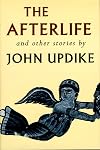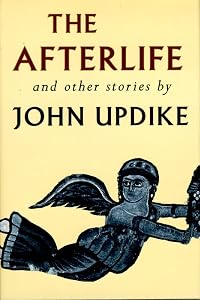
The Afterlife and Other Stories
by John Updike
On This Page
Description
Twenty-two stories on life in the sunset lane, illustrating the saying that every age has its charm, including old age. By the author of Brazil.Tags
Recommendations






















Member Reviews
Updike's stories are beautifully written, and the details of life presented here are touchingly real. That said, the characters in many of the stories are similar enough, and the themes similar enough, that it wasn't as compelling as his other work which I've read, and there wasn't enough variety as I'd like in a short story collection, even one from a single author. I did enjoy many of the stories, but I think each might have been more powerful if stumbled across in the midst of other authors or as narratives within a larger framework/novel. Real as they were, I was often left wishing for more.
Another great collection from Updike. There were two stories I just couldn't get into so I skipped them. Several stories dealing with an elderly or recently deceased mother were especially touching, I couldn't help but wonder if these were actually Updike and his own mother. Several phrases from the book that really stuck with me-
'He had come to see that the heart, likea rubber ball, loses bounce, and eventually goes dead.'
'Time takes all.'
'Nobody belongs to us, except in memory.'
'He had come to see that the heart, likea rubber ball, loses bounce, and eventually goes dead.'
'Time takes all.'
'Nobody belongs to us, except in memory.'
A collection of high quality stories, kind of autobiography told from a mature, experienced, yet still wondrous perspective.
Kreuzfahrt von John Updike ist ein weiteres dieser Mini Bücher. Es enthält 4 Erzählungen, von denen zwei von einem Ehepaar handeln, sie deutlich jünger als er, die Italien und Irland bereisen. Interessanterweise habe ich das Buch kurz vor meinem Besuch in Irland gelesen. Mir hat besonders gefallen, wie treffend die Beziehungen der Menschen dargestellt wurden - gute Beobachtungsgabe.
Jun 26, 2010German
Ratings
Members
- Recently Added By
Published Reviews
ThingScore 50
A WRITER as prolific and variously gifted as John Updike is bound, eventually, to frustrate readers. How does one absorb a body of work that includes 16 novels, 6 volumes of poetry, 5 fat compilations of essays and reviews, a memoir, a play, 4 books for children and now -- after a pause of 7 years -- his 11th collection of short stories? Were all this writing mediocre, one might still wonder show more at its mere volume. What is perhaps more striking is that so much of it is good, even dazzling. show less
added by private library
Not among the best of Updike's collections, but even the duller stories yield extraordinary pleasures of language and perception.
added by lexrex1215
Lists

Llibres que he llegit el 2009
35 works; 1 member
Author Information

342+ Works 53,741 Members
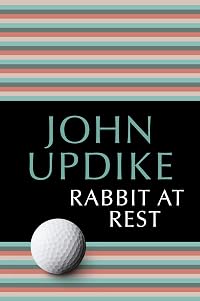
American novelist, poet, and critic John Updike was born in Reading, Pennsylvania on March 18, 1932. He received an A.B. degree from Harvard University, which he attended on a scholarship, in 1954. After graduation, he accepted a one-year fellowship to study painting at the Ruskin School of Drawing and Fine Art in Oxford, England. After returning show more from England in 1955, he worked for two years on the staff of The New Yorker. This marked the beginning of a long relationship with the magazine, during which he has contributed numerous short stories, poems, and book reviews. Although Updike's first published book was a collection of verse, The Carpentered Hen and Other Tame Creatures (1958), his renown as a writer is based on his fiction, beginning with The Poorhouse Fair (1959). During his lifetime, he wrote more than 50 books and primarily focused on middle-class America and their major concerns---marriage, divorce, religion, materialism, and sex. Among his best-known works are the Rabbit tetrology---Rabbit, Run (1960), Rabbit Redux (1971), Rabbit Is Rich (1981), and Rabbit at Rest (1988). Rabbit, Run introduces Harry "Rabbit" Angstrom as a 26-year-old salesman of dime-store gadgets trapped in an unhappy marriage in a dismal Pennsylvania town, looking back wistfully on his days as a high school basketball star. Rabbit Redux takes up the story 10 years later, and Rabbit's relationship with representative figures of the 1960s enables Updike to provide social commentary in a story marked by mellow wisdom and compassion in spite of some shocking jolts. In Rabbit Is Rich, Harry is comfortably middle-aged and complacent, and much of the book seems to satirize the country-club set and the swinging sexual/social life of Rabbit and his friends. Finally, in Rabbit at Rest, Harry arrives at the age where he must confront his mortality. Updike won the Pulitzer Prize for both Rabbit Is Rich and Rabbit at Rest. Updike's other novels range widely in subject and locale, from The Poorhouse Fair, about a home for the aged that seems to be a microcosm for society as a whole, through The Court (1978), about a revolution in Africa, to The Witches of Eastwick (1984), in which Updike tries to write from inside the sensibilities of three witches in contemporary New England. The Centaur (1963) is a subtle, complicated allegorical novel that won Updike the National Book Award in 1964. In addition to his novels, Updike also has written short stories, poems, critical essays, and reviews. Self-Consciousness (1989) is a memoir of his early life, his thoughts on issues such as the Vietnam War, and his attitude toward religion. He was elected to the American Academy of Arts and Letters in 1977. He died of lung cancer on January 27, 2009 at the age of 76. (Bowker Author Biography) John Updike was born in 1932, in Shillington, Pennsylvania. Since 1957 he has lived in Massachusetts. His novels have won the Pulitzer Prize, the National Book Award, the National Book Critics Circle Award, & the Howells Medal. (Publisher Provided) John Updike was born in 1932 and attended Harvard College and the Ruskin School of Drawing and Fine Art in Oxford, England. Form 1955 to 1957 he was a staff member of The New Yorker, which he contributed numerous writings. Updike's art criticism has appeared in publications including Arts and Antiques, The New Republic, The New York Times Book Review, and Realites, among many others. He is the author of such best-selling novels as Rabbit Run and Rabbit is Rich. His many works of fiction, poetry and criticism have been awarded the Pulitzer Prize, the National Book Award, the American Book Award, and the National Book Critics Circle Award. For the past 40 years he has lived in Massachusetts. (Publisher Provided) John Updike is the author of some 50 books, including collections of short stories, poems, & criticism. His novels have won the Pulitzer Prize, the National Book Award, the National Book Critics Circle Award, & the Howells Medal. Born in Shillington, Pennsylvania, in 1932, he has lived in Massachusetts since 1957. (Publisher Provided) show less
Work Relationships
Contains
Common Knowledge
- Canonical title
- The Afterlife and Other Stories
- Original title
- The Afterlife and Other Stories
- Original publication date
- 1994
- Dedication
- To Trevor Leonard Updike and Kai Daniels Freyleue, newcomers to this life.
- First words
- The Billingses, so settled in their ways, found in their fifties that their friends were doing sudden, surprising things. ("The Afterlife")
- Last words
- (Click to show. Warning: May contain spoilers.)Nobody belongs to us, except in memory. ("Grandparenting")
- Publisher's editor
- Jones, Judith
Classifications
Statistics
- Members
- 596
- Popularity
- 49,191
- Reviews
- 4
- Rating
- (3.61)
- Languages
- 7 — English, French, German, Hungarian, Italian, Portuguese, Spanish
- Media
- Paper, Audiobook, Ebook
- ISBNs
- 22
- ASINs
- 12