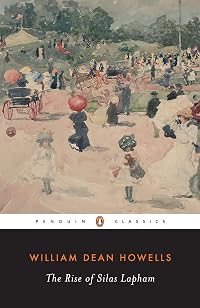
The Rise of Silas Lapham
by William Dean Howells
On This Page
Description
William Dean Howells' 1885 novel, The Rise of Silas Lapham tells the story of its protagonist's materialistic aspirations; his rise from rags to riches. Despite making a fortune in business, Silas feels he lacks social position; he banks on the marriage of his daughter to an aristocratic family to change this. But Silas faces a moral quandary when his business partner suggests dodgy business dealings..
Tags
Recommendations










































Member Recommendations


Member Reviews
The Wednesday morning Keele 'Continuing and Professional Education' class today featured The Rise of Silas Lapham (1885). Hard going to read this for me, but rewarding on looking back at and through it with the group. I decided Howells - or at least as evidenced in this book - was a bit of a leftie, if not even an armchair Marxist. This last paragraph from the book seems to convey the conditions/consciousness dialectic of Marxism, as Silas reflects on whether he has any regrets: "About what I done? Well, it don't always seem as if I done it...Seems sometimes as if it was a hole opened for me, and I crept out of it. I don't know... as I should always say it paid; but if I done it, and the thing was to do over again, right in the same show more way, I guess I should have to do it." An excellent study of social class, with observations through his characters' actions and thoughts that are as recognisable in today's society as they evidently were in the Boston of the 1880s.
Too long, many thought, but this may be a function of such works being first published in serialised form. show less
Too long, many thought, but this may be a function of such works being first published in serialised form. show less
The Rise of Silas Lapham, published in 1885, is the best known novel of William Dean Howells and was one of the first novels to focus on the American businessman. Howells is remembered for his long, close friendship with Mark Twain and for being one of the fist seven people chosen for membership in the American Academy of Arts and Letters, of which he was elected its first president. Despite the fact that Howells wrote over 100 books in various genres that included poems, novels, travel books, memoirs, plays and literary criticism he is largely out of print today.
The Rise of Silas Lapham is an American novel of manners that delves into what was then the relatively new societal clash between the old rich and the newly rich, each group show more well aware of their differences. It is set in a period by which time many old fortunes had become somewhat diminished and when the newly rich were often actually wealthier, if far less cultured, than the old rich whose manners and customs they tried so hard to emulate.
Silas Lapham is a self-made millionaire who made his fortune in the paint business. By the beginning of the novel, he has headquartered his business in Boston where he lives with his wife and two marriageable daughters. An act of kindness by Mrs. Lapham toward a stranger in need of medical attention happens to bring the Lapham family into contact with the Corey family, one of Boston’s many old money families. Complications set in when young Tom Corey falls in love with one of the Lapham girls and both families incorrectly assume that his love is for the pretty, younger daughter rather than for the older girl who wins Tom with her wit and personality. Both sisters are shocked when they realize the truth, and the Lapham family is severely strained by the stress placed on the relationship between the daughters.
If this were not enough, Silas Lapham begins to realize about the same time that his business and his personal fortune are suddenly at risk largely because of his own honesty and integrity. Rather than take advantage of less knowledgeable businessmen and possibly saving much of his fortune in the process, he decides on full disclosure of the details regarding his business outlook and watches as his business fails and he becomes bankrupt.
The Rise of Silas Lapham was considered to be a “realistic” novel at the time of its publication, and in comparison to much of American fiction that came before it, that was certainly the case. As Howells himself put it, “Let fiction cease to lie about life; let it portray men and women as they are, actuated by the motives and the passions in the measure we all know.” But according to the William Dean Howells Society, later authors such as Sinclair Lewis “denounced Howell’s fiction and his influence as being too genteel to represent the real America.”
I found that the novel reminds me of the best of Jane Austen’s work and I value it for the clear picture that it gives of American upper class society in the late nineteenth century. It is much more of a “page-turner” than one would imagine on first glance and I highly recommend it.
Rated at: 5.0 show less
The Rise of Silas Lapham is an American novel of manners that delves into what was then the relatively new societal clash between the old rich and the newly rich, each group show more well aware of their differences. It is set in a period by which time many old fortunes had become somewhat diminished and when the newly rich were often actually wealthier, if far less cultured, than the old rich whose manners and customs they tried so hard to emulate.
Silas Lapham is a self-made millionaire who made his fortune in the paint business. By the beginning of the novel, he has headquartered his business in Boston where he lives with his wife and two marriageable daughters. An act of kindness by Mrs. Lapham toward a stranger in need of medical attention happens to bring the Lapham family into contact with the Corey family, one of Boston’s many old money families. Complications set in when young Tom Corey falls in love with one of the Lapham girls and both families incorrectly assume that his love is for the pretty, younger daughter rather than for the older girl who wins Tom with her wit and personality. Both sisters are shocked when they realize the truth, and the Lapham family is severely strained by the stress placed on the relationship between the daughters.
If this were not enough, Silas Lapham begins to realize about the same time that his business and his personal fortune are suddenly at risk largely because of his own honesty and integrity. Rather than take advantage of less knowledgeable businessmen and possibly saving much of his fortune in the process, he decides on full disclosure of the details regarding his business outlook and watches as his business fails and he becomes bankrupt.
The Rise of Silas Lapham was considered to be a “realistic” novel at the time of its publication, and in comparison to much of American fiction that came before it, that was certainly the case. As Howells himself put it, “Let fiction cease to lie about life; let it portray men and women as they are, actuated by the motives and the passions in the measure we all know.” But according to the William Dean Howells Society, later authors such as Sinclair Lewis “denounced Howell’s fiction and his influence as being too genteel to represent the real America.”
I found that the novel reminds me of the best of Jane Austen’s work and I value it for the clear picture that it gives of American upper class society in the late nineteenth century. It is much more of a “page-turner” than one would imagine on first glance and I highly recommend it.
Rated at: 5.0 show less
William Dean Howells was born in 1837 and wrote prolifically until his death in 1920. The Rise of Silas Lapham is likely the best remembered, and most often read, of his works. It is a humorous novel with twin, intertwined plots. The first of business and social success, and then failure, in Gilded Age Boston. The other a love farce, and a commentary on ideas of romance in then current novels.
The book starts out slowly with a magazine writer interviewing Silas Lapham about his rise to success. Silas has had the good fortune of having a “paint mine” on his farm in Vermont, from which he’s been able to produce paint of such high quality that it has made him a fortune. The interview gambit serves to introduce the main characters and show more set up some of the tension that will play out through the book. After that slow start the plots start boiling.
The nouveau riche Laphams have relocated to Boston, and, owing to their country ways, they’ve stayed to themselves and haven’t tried to climb the social ladder to Boston’s high society. That all changes when a young man from a well established family seems to take an interest in one of their two daughters, and then flatters Silas by asking to come to work for him.
What follows is a series of misunderstandings, both in business and in love, between the honest country bred Laphams and the Boston Brahmins they find themselves mixing with.
The book stands the test of time. The language is perhaps formal, but not too formal. The style is perhaps dated, but not too dated. The humor comes through clearly. I often had a smile on my face as I raced through the pages. There are things going on in this book that make it “important” enough that it is still taught in some classrooms. But it is very accessible and easy to read as entertainment.
Reading this today, in 2022, with its young lovers and its social climbing, the whole thing struck me as being kind of an American version of Bridgerton (the TV show - I’ve not read the book). Or perhaps Bridgerton, being the later creation, is a British version of Silas Lapham. I guess the comparison is inevitable for a male reader like me, as Howells is often seen as a “women’s writer”.
As is true today, the primary audience for fiction in the 1880s was women. Howells knew that, and that is likely why he's given a prominent role to Silas's wife Persis Lapham. She is both a moral guide in business to her husband (and an equal partner in the early years), and the one the family looks to for guidance through the thicket of etiquette and expectation in Boston society. She is a fully fledged, complex character with both strengths and flaws.
Howells was also known as a “realist”. As to his place in American writing, he is sometimes said to fall between Mark Twain and Henry James. He was friends with both. James said of him that “[h]e adores the real, the natural, the colloquial, the moderate, the optimistic, the domestic, and the democratic...” That sensibility is, I think, the main reason this book has held up so well.
It doesn’t feel right to me to put Star ratings on classics like this. I recommend this book. I found that I liked it a lot more than I thought I would. “Silas Lapham” sounds like such an old-fashioned name that it does the book it's attached to a disservice. The book holds up much better than that old-fashioned name. show less
The book starts out slowly with a magazine writer interviewing Silas Lapham about his rise to success. Silas has had the good fortune of having a “paint mine” on his farm in Vermont, from which he’s been able to produce paint of such high quality that it has made him a fortune. The interview gambit serves to introduce the main characters and show more set up some of the tension that will play out through the book. After that slow start the plots start boiling.
The nouveau riche Laphams have relocated to Boston, and, owing to their country ways, they’ve stayed to themselves and haven’t tried to climb the social ladder to Boston’s high society. That all changes when a young man from a well established family seems to take an interest in one of their two daughters, and then flatters Silas by asking to come to work for him.
What follows is a series of misunderstandings, both in business and in love, between the honest country bred Laphams and the Boston Brahmins they find themselves mixing with.
The book stands the test of time. The language is perhaps formal, but not too formal. The style is perhaps dated, but not too dated. The humor comes through clearly. I often had a smile on my face as I raced through the pages. There are things going on in this book that make it “important” enough that it is still taught in some classrooms. But it is very accessible and easy to read as entertainment.
Reading this today, in 2022, with its young lovers and its social climbing, the whole thing struck me as being kind of an American version of Bridgerton (the TV show - I’ve not read the book). Or perhaps Bridgerton, being the later creation, is a British version of Silas Lapham. I guess the comparison is inevitable for a male reader like me, as Howells is often seen as a “women’s writer”.
As is true today, the primary audience for fiction in the 1880s was women. Howells knew that, and that is likely why he's given a prominent role to Silas's wife Persis Lapham. She is both a moral guide in business to her husband (and an equal partner in the early years), and the one the family looks to for guidance through the thicket of etiquette and expectation in Boston society. She is a fully fledged, complex character with both strengths and flaws.
Howells was also known as a “realist”. As to his place in American writing, he is sometimes said to fall between Mark Twain and Henry James. He was friends with both. James said of him that “[h]e adores the real, the natural, the colloquial, the moderate, the optimistic, the domestic, and the democratic...” That sensibility is, I think, the main reason this book has held up so well.
It doesn’t feel right to me to put Star ratings on classics like this. I recommend this book. I found that I liked it a lot more than I thought I would. “Silas Lapham” sounds like such an old-fashioned name that it does the book it's attached to a disservice. The book holds up much better than that old-fashioned name. show less
If the plot of this novel doesn't quite hold up to the passage of time, it is still fascinating as a social study. The two intertwined plots follow Silas Lapham's fortuitous rise to immense wealth and his fall due to a combination of naiveté and high principles. The secondary, less satisfactory plot, which more or less takes over the novel, follows a romance between Tom Corey, the son of an old Bostonian family and one of the Lapham daughters. Howells's reproduction of the speech modes that differentiated regions and especially classes is fascinating, but paradoxically lessened the interest of the book to me because so very much of it takes places in dialogue, and so much of the dialogue relies on innuendo and indirection that the show more movement of the plot is slowed enormously. Still, it is only because of the inhibiting strictures on social speech at the time that the romantic misunderstanding that anchors the love plot could happen. show less
The realism of Howell's novel centers on a "self-made man" who confronts the old-guard aristocratic society of Boston in the nineteenth century. The author uses a balanced structure in the classical manner, with a lucid prose and fine attention to detail that almost caress the reader. The deftly woven plot and sub-plots highlight the "rise" of Lapham in a moral sense even while his material fortunes deteriorate. Silas earns a fortune in the paint business, but he lacks traditional social standards, which he tries to attain through his daughter's marriage into the aristocratic Corey family.
Silas's morality does not fail him. He loses his money but makes the right moral decision when his partner proposes the unethical selling of the show more mills to English settlers. He is a sympathetic character even as he unwisely engages in an endeavor that is doomed by a society that would never accept him. The female characters, especially Lapham's daughter Penelope, are well written and rival portrayals of women by such novelists as Eliot and Wharton. Howells is known to be the father of American realism, and a denouncer of the sentimental novel. The love triangle of Irene Lapham, Tom Corey, and Penelope Lapham highlights Howells' views of sentimental novels as unrealistic and deceitful.
This is the first of major American novels of business, to be followed by those of Norris (The Octopus), Dreiser (The Financier) and Lewis (Babbit) among others. Howells sets his novel apart with his positive view of New England ideals and business itself. It is no wonder that this book has continuously been in print and is considered one the great works of American literature. Reading William Dean Howells' fine novel, The Rise of Silas Lapham, is an enjoyable experience. show less
Silas's morality does not fail him. He loses his money but makes the right moral decision when his partner proposes the unethical selling of the show more mills to English settlers. He is a sympathetic character even as he unwisely engages in an endeavor that is doomed by a society that would never accept him. The female characters, especially Lapham's daughter Penelope, are well written and rival portrayals of women by such novelists as Eliot and Wharton. Howells is known to be the father of American realism, and a denouncer of the sentimental novel. The love triangle of Irene Lapham, Tom Corey, and Penelope Lapham highlights Howells' views of sentimental novels as unrealistic and deceitful.
This is the first of major American novels of business, to be followed by those of Norris (The Octopus), Dreiser (The Financier) and Lewis (Babbit) among others. Howells sets his novel apart with his positive view of New England ideals and business itself. It is no wonder that this book has continuously been in print and is considered one the great works of American literature. Reading William Dean Howells' fine novel, The Rise of Silas Lapham, is an enjoyable experience. show less
This book is worth reading simply because of the structure -- it is perfectly symmetrical. there is an epiphany at the exact center and the opening and closing chapters are two different confessions -- one public, one private. It's an amazing work, though most people don't read it at this point.
Silas Lapham, a decorated former officer in the Civil War, makes a fortune in the Civil War, but, because of his countrified manners, has difficulties in introducing himself and his daughters (who must marry) into cultivated society in Boston. One daughter does make a match with a wealthy and cultivated son of the Corey family; however, when Lapham has the chance to make another fortune through the sale of his now failing paint company to some English speculators, he refuses to do so, and therefore shows his moral fiber. However, it is pertinent in this regard that the family has a farm in New Hampshire to which to repair, and which Mrs. Lapham prefers to Boston society.
Members
- Recently Added By
Lists

Find
10 works; 1 member

A Boston Reading List
120 works; 9 members

Lamont's Hundred Best Novels (1947)
100 works; 4 members

Harold Bloom - The Western Canon: C. The Democratic Age
336 works; 15 members
Trinity College Booklist (1951): Class Ten, English Literature
358 works; 5 members

Fiction (Mostly) in Selective Bibliography of American Literature 1775-1900
431 works; 3 members

AP Lit
363 works; 6 members

Recommended Reading : 600 Classics Reviewed, Editors of Salem Press, 2015
634 works; 6 members
Author Information

240+ Works 5,438 Members
William Dean Howells was born in Martin's Ferry, Ohio on March 1, 1837. He dropped out of school to work as a typesetter and a printer's apprentice. He taught himself through intensive reading and the study of Spanish, French, Latin, and German. He wrote a campaign biography of Abraham Lincoln in 1860. Lincoln appointed him U.S. consul in Venice, show more Italy in 1861 as a reward. After returning to the U.S. several years later, he became an assistant editor for The Atlantic Monthly, later becoming editor from 1871 to 1881. He also wrote columns for Harper's New Monthly Magazine and occasional pieces for The North American Review. As an editor and critic, he was a proponent of American realism. Although he wrote over a 100 books in various genres including novels, poems, literary criticism, plays, memoirs, and travel narratives, he is best known for his realistic fiction. His novels include A Modern Instance, The Rise of Silas Lapham, A Hazard of New Fortunes, The Undiscovered Country, A Chance Acquaintance, An Imperative Duty, Annie Kilburn, and The Coast of Bohemia. He received several honorary degrees from universities as well as a Gold Medal for fiction (later renamed after him as the Howells Medal) from the National Institute of Arts and Letters. He died from pneumonia on May 11, 1920. (Bowker Author Biography) show less
Some Editions
Awards and Honors
Series
Belongs to Publisher Series
Work Relationships
Is contained in
Common Knowledge
- Canonical title
- The Rise of Silas Lapham
- Original publication date
- 1885
- People/Characters
- Silas Lapham
- Important places
- Boston, Massachusetts, USA
- First words
- When Bartley Hubbard went to interview Silas Lapham for the "Solid Men of Boston" series, which he undertook to finish up in The Events, after he replaced their original projector on that newspaper, Lapham received him in his... (show all) private office by previous appointment.
- Last words
- (Click to show. Warning: May contain spoilers.)"I don't know as I should always say it paid; but if I done it, and the thing was to do over agin, right in the same way, I guess I should have to do it."
- Publisher's editor
- Meserve, Walter J; Nordloh, David J
Classifications
Statistics
- Members
- 1,571
- Popularity
- 14,524
- Reviews
- 12
- Rating
- (3.53)
- Languages
- Czech, English, Italian, Swedish
- Media
- Paper, Audiobook, Ebook
- ISBNs
- 113
- ASINs
- 63