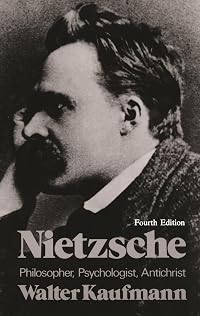
Nietzsche: Philosopher, Psychologist, Antichrist
by Walter Kaufmann
On This Page
Description
Walter A. Kaufmann (1921-1980) was professor of philosophy at Princeton University and a world-renowned scholar and translator of Nietzsche. This classic is the benchmark against which all modern books about Nietzsche are measured. When Walter Kaufmann wrote it in the immediate aftermath of World War II, most scholars outside Germany viewed Nietzsche as part madman, part proto-Nazi, and almost wholly unphilosophical. Kaufmann rehabilitated Nietzsche nearly single-handedly, presenting his show more works as one of the great achievements of Western philosophy. Responding to the powerful myths and countermyths that had sprung up around Nietzsche, Kaufmann offered a patient, evenhanded account of his life and works, and of the uses and abuses to which subsequent generations had put his ideas. Without ignoring or downplaying the ugliness of many of Nietzsche's proclamations, he set them in the context of his work as a whole and of the counterexamples yielded by a responsible reading of his books. More positively, he presented Nietzsche's ideas about power as one of the great accomplishments of modern philosophy, arguing that his conception of the "will to power" was not a crude apology for ruthless self-assertion but must be linked to Nietzsche's equally profound ideas about sublimation. He also presented Nietzsche as a pioneer of modern psychology and argued that a key to understanding his overall philosophy is to see it as a reaction against Christianity. Many scholars in the past half century have taken issue with some of Kaufmann's interpretations, but the book ranks as one of the most influential accounts ever written of any major Western thinker. Featuring a new foreword by Alexander Nehamas, this Princeton Classics edition of Nietzsche introduces a new generation of readers to one the most influential accounts ever written of any major Western thinker. "Illuminating." "Mr. Kaufmann has produced what may be called the definitive study of Nietzsche's life and thought-an informed, scholarly, and lustrous work.". show lessTags
Recommendations








Member Recommendations

galacticus Kaufmann revived Nietzsche studies in the English speaking world.
Member Reviews
This classic is the benchmark against which all modern books about Nietzsche are measured. When Walter Kaufmann wrote it in the immediate aftermath of World War II, most scholars outside Germany viewed Nietzsche as part madman, part proto-Nazi, and almost wholly unphilosophical. Kaufmann rehabilitated Nietzsche nearly single-handedly, presenting his works as one of the great achievements of Western philosophy.
Responding to the powerful myths and countermyths that had sprung up around Nietzsche, Kaufmann offered a patient, evenhanded account of his life and works, and of the uses and abuses to which subsequent generations had put his ideas. Without ignoring or downplaying the ugliness of many of Nietzsche's proclamations, he set them in show more the context of his work as a whole and of the counterexamples yielded by a responsible reading of his books. More positively, he presented Nietzsche's ideas about power as one of the great accomplishments of modern philosophy, arguing that his conception of the "will to power" was not a crude apology for ruthless self-assertion but must be linked to Nietzsche's equally profound ideas about sublimation. He also presented Nietzsche as a pioneer of modern psychology and argued that a key to understanding his overall philosophy is to see it as a reaction against Christianity.
Many scholars in the past half century have taken issue with some of Kaufmann's interpretations, but the book ranks as one of the most influential accounts ever written of any major Western thinker. show less
Responding to the powerful myths and countermyths that had sprung up around Nietzsche, Kaufmann offered a patient, evenhanded account of his life and works, and of the uses and abuses to which subsequent generations had put his ideas. Without ignoring or downplaying the ugliness of many of Nietzsche's proclamations, he set them in show more the context of his work as a whole and of the counterexamples yielded by a responsible reading of his books. More positively, he presented Nietzsche's ideas about power as one of the great accomplishments of modern philosophy, arguing that his conception of the "will to power" was not a crude apology for ruthless self-assertion but must be linked to Nietzsche's equally profound ideas about sublimation. He also presented Nietzsche as a pioneer of modern psychology and argued that a key to understanding his overall philosophy is to see it as a reaction against Christianity.
Many scholars in the past half century have taken issue with some of Kaufmann's interpretations, but the book ranks as one of the most influential accounts ever written of any major Western thinker. show less
Walter Kaufmann’s Nietzsche conquered a massive hurdle; take the misunderstood philosopher Friedrich Nietzsche and renew his image into that of a genius before his time. Kaufmann had a great deal against him; Nietzsche’s sister had controlled his image, and she was a horrible racist twit who didn’t understand his works. Compounding the issue was the fact that most people that who wrote about him didn’t understand his works either. When the Nazis took advantage of his writings and letters, they heavily edited what was printed or took his writings out of context. Is it any surprise then that he was accused of being a racist proto-nazi? It didn’t help that he spent the last years of his life insane.
Kaufmann’s book took show more Nietzsche and reexamined him under a different perspective, taking into account his early upbringing and all of the other events that produced him. The book goes through his philosophy point by point with a thorough and scholarly air while being divided into four parts. The first covers Nietzsche’s background, the second covers the development of his philosophy, the third covers his philosophy of power and the last section contains a synopsis of all of this. Kaufmann’s commentary on the meaning of God is Dead was especially enlightening and interesting.
As I said in a previous review, Nietzsche is someone that I had first heard of in school. I don’t remember exactly when or how that occurred. I was not aware that this book was the catalyst for Nietzsche being an acceptable figure to study again or that the first edition of this book is already almost seventy years old as of this review. I also thought that the book would be more of a biography than what it turned out to be. It certainly covers a bit of his life, but most of the book focuses on his Philosophy.
All in all, this book is fantastic. If you have read Nietzsche and came away confused, this book is an excellent remedy for that. show less
Kaufmann’s book took show more Nietzsche and reexamined him under a different perspective, taking into account his early upbringing and all of the other events that produced him. The book goes through his philosophy point by point with a thorough and scholarly air while being divided into four parts. The first covers Nietzsche’s background, the second covers the development of his philosophy, the third covers his philosophy of power and the last section contains a synopsis of all of this. Kaufmann’s commentary on the meaning of God is Dead was especially enlightening and interesting.
As I said in a previous review, Nietzsche is someone that I had first heard of in school. I don’t remember exactly when or how that occurred. I was not aware that this book was the catalyst for Nietzsche being an acceptable figure to study again or that the first edition of this book is already almost seventy years old as of this review. I also thought that the book would be more of a biography than what it turned out to be. It certainly covers a bit of his life, but most of the book focuses on his Philosophy.
All in all, this book is fantastic. If you have read Nietzsche and came away confused, this book is an excellent remedy for that. show less
Ratings
Members
- Recently Added By
Lists

In Our Time books
4,934 works; 2 members
Author Information

50+ Works 7,268 Members
Common Knowledge
- Original publication date
- 1950
- People/Characters
- Achilles; Alfred Adler; Aeschylus; Alcibiades; Alexander the Great; Anaxagoras (show all 222); Charles Andler (Charles Philippe Théodore | 1866-1933); Lou Andreas-Salomé (birth name varies, 1861-1937); Thomas Aquinas (Saint, 1225-1274); Ariadne; Aristophanes; Aristotle (384-322 BC/BCE); Francis Bacon (1561-1626); John Baillie; Jacques Barzun (Jacques Martin, 1907-2012); Charles Baudelaire (Charles Pierre, 1821-1867); Bruno Bauer (1809-1882); Alfred Baeumler or Bäumler (1887-1968); Ludwig van Beethoven; Eric Bentley; Arthur Berthold; Ernst Bertram; Rudolf Borchardt; Cesare Borgia; Ludwig Börne (Karl Ludwig, born Loeb Baruch, 1786-1837); Paul Bourget (Paul Charles Joseph, 1852-1935); Georg Brandes (Georg Morris Cohen, 1842-1927); Crane Brinton (Clarence Crane, 1898-1968); Brutus; Martin Buber; Buddha; Jacob Burckhardt (Carl Jacob Christoph, 1818-1897); Lord Byron; Julius Caesar; John Calvin (1509-1564); Paul Carus; Cassandra; Miguel de Cervantes; Houston Chamberlain; Paul Cohn; Samuel Taylor Coleridge; Ananda Coomaraswamy; Nicolaus Copernicus; Dante Alighieri (1265-1321); Gisela Deesz; Democritus; Demosthenes; Descartes; Paul Deussen; John Dewey; Dionysus; Don Quixote de la Mancha; Fyodor Dostoevsky; Thomas Edison; T. S. Eliot; Ralph Waldo Emerson; Empedocles; Epictetus; Epimenides; Euripides; Oscar Ewald; Barker Fairley; Bernhard Forster; Elisabeth Forster-Nietzsche; Francis of Assisi; Frederick II, Holy Roman Emperor; Sigmund Freud; Carl Fuchs; Friedrich Wilhelm IV, King of Prussia; Peter Gast; Genghis Khan; Stefan George; Karl von Gersdorff; Arthur de Gobineau; Johann Wolfgang von Goethe; Madison Grant; Jacob Grimm; Wilhelm Grimm; Ernst Gundolf; Friedrich Gundolf; Hans F. K. Gunther; Heinrich Hartle; George Frideric Handel; Warren G. Harding; Otto Harnack; Jane Harrison; Eduard von Hartmann; Nicolai Hartmann; Martin Havenstein; Joseph Haydn; Heraclitus; Hermann Hesse; Kurt Hildebrandt; Rudolf Hidebrandt; Emanuel Hirsch; Adolf Hitler; Josef Hofmiller; W. E. Hocking; Homer; Horace; Werner Jaeger; William James; Karl Jaspers; Karl Joel; James Joyce; Carl Jung; Julius Juthner; Immanuel Kant (1724-1804); Walter Kaufmann; Gottfried Keller; Søren Kierkegaard; Ludwig Klages; Heinrich von Kleist; G. Wilson Knight; John Knox; Hans Kohn; Heinrich Koselitz; Johanna Kruger; Jean Baptiste Lamarck; Julius Langbehn; Norbert Langer; Lao-Tze; George Vacher de Lapouge; Gottfried Wilhelm von Leibniz; Leonardo da Vinci; Gotthold Ephraim Lessing; Franz Liszt; Cesare Lombroso; Arthur O. Lovejoy; Karl Lowith; Walter Lowrie; Lucian Freud; Ludwig I, King of Bavaria; Ernst Mach; Maimonides; Thomas Malthus; Thomas Mann; Alfred von Martin; Cotton Mather; Friedrich Meinecke; Mephistopheles; Heinrich Meyer; Michelangelo; John Stuart Mill; Michel de Montaigne; George A. Morgan; Ernst Morwitz; Moses Malone; Wolfgang Amadeus Mozart; Heinrich Muller; Napoleon Bonaparte; Ernest Newman; Nicholas de Cusa; Friedrich Nietzsche; Richard Oehler; Regina Olsen; Franz Overbeck; Parmenides; Blaise Pascal; Paul McCartney; Ralph B. Perry; Phidias; Pablo Picasso; Plato (c.428-347 BC/BCE); Plotinus; Plutarch; Erich F. Podach; Ezra Pound; Pythagoras; Raphael; Paul Ree; Jean Paul Richter; Rainer Maria Rilke; Friedrich Ritschl; Auguste Rodin; Erwin Rohde; Alfred Rosenberg; Josiah Royce; Peter Paul Rubens (1577-1640); Arnold Ruge; Bertrand Russell; Edgar Salin; Lou Salome; George Santayana; Max Scheler; Leo Schestow; Friedrich Schiller; Friedrich Schlegel; A. W. Schlegel; Ernst Schmeitzner; Arthur Schopenhauer; Alfred Schuler; Albert Schweitzer; Servetius; William Shakespeare; George Bernard Shaw; Percy Bysshe Shelley; Georg Simmel; Socrates; Sophocles; Herbert Spencer; Walter T. Stace; Felix Stahelin; Count von Stauffenberg; Charlotte von Stein; Heinrich von Stein; Stendhal (Marie-Henri Beyle); Adalbert Stifter; Max Stirner; Lothrop Stoddard; David Strauss (David Friedrich, 1808-1874); Tertullian (Quintus Septimius Florens, c.155-c.220); August Strindberg; Theseus; Leo Tolstoy; Hans Vaihinger; Karl Vietor; Voltaire; Wilhelm Weigand; Alfred North Whitehead; Oscar Wilde; Émile Zola
- Important places
- Basel, Basel-Stadt, Switzerland; Berkeley, California, USA; Bonn, North Rhine-Westphalia, Germany
- Dedication
- To my wife and children, Hazel, Dinah and David
- First words
- Nietzsche became a myth even before he died in 1900, and today his ideas are overgrown and obscured by rank fiction.
- Last words
- (Click to show. Warning: May contain spoilers.)And like Socrates he did not wish to convert them to any metaphysics of his own, but said in essence: "Become who you are!"
- Blurbers
- Maritain, Jacques; Mann, Thomas
Classifications
Statistics
- Members
- 1,255
- Popularity
- 19,585
- Reviews
- 2
- Rating
- (4.12)
- Languages
- English, German
- Media
- Paper, Ebook
- ISBNs
- 10
- ASINs
- 20