On This Page
Description
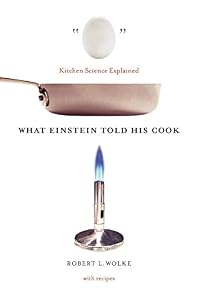
Why is red meat red? How do they decaffeinate coffee? Do you wish you understood the science of food but don't want to plow through dry, technical books? In What Einstein Told His Cook, University of Pittsburgh chemistry professor emeritus and award-winning Washington Post food columnist Robert L. Wolke provides reliable and witty explanations for your most burning food questions, while debunking misconceptions and helping you interpret confusing advertising and labeling. A finalist for both show more the James Beard Foundation and IACP Awards for best food reference, What Einstein Told His Cook engages cooks and chemists alike. show lessTags
Recommendations





Member Recommendations
Member Reviews
Q: What book do you remember from your childhood as irritating?
When I was somewhere around seven years old, I was given [b:Charlie Brown's Super Book of Questions and Answers about All Kinds of Animals ... from Snails to People!: Based on the Charles M. Schulz Characters|625877|Charlie Brown's Super Book of Questions and Answers about All Kinds of Animals ... from Snails to People! Based on the Charles M. Schulz Characters|Charles M. Schulz|https://d.gr-assets.com/books/1217209308s/625877.jpg|612230].
Although I’ve never been a question-and-answer type of reader (the questions asked never seemed to be the ones I wanted to know more about), I eventually came to enjoy the book for its information bites and colorful pictures of favorite show more comic friends. What Einstein Told His Cook follows the question and answer format, and once again, many of the questions aren’t ones I ask, in or out of the kitchen.
Q: What kinds of questions does the author answer?
Frequently, very basic ones (“What does the ‘prime’ really mean in ‘prime rib’?). Or very obscure ones (“Why does caviar have to be served with a special, fancy spoon?”). Sometimes even stupid ones (“I like my steaks and roast beef rare. But often there’ll be someone at the table who makes a nasty crack about my eating ‘bloody’ meat. What can I say in my defense?“) Buried in the last few chapters of the book are actually, rather interesting ones that no one else has ever explained to me (“why does my tea made from water boiled in the microwave leave more sediment?”)
Q: You mean the whole book is like ‘Dear Abby’ for people unfamiliar with cooking?
Yes. It really is all questions, with generally page-long answers. He throws in recipes that vaguely relate to the the questions for added interest. Chapters are divided into ‘Sweet Talk,’ ‘The Salt of the Earth,’ ‘The Fat of the Land,’ ‘Chemicals in the Kitchen,’ ‘Turf and Surf,’ ‘Fire and Ice,’ ‘Liquid Refreshment,’ ‘Those Mysterious Microwaves,’ and ‘Tools and Technology.’ You can tell by the titles that Wolke places more emphasis on attempting to be funny with his language over providing clear information. Unfortunately, the same thing happens with his answers.
Q: So why the ‘it was okay’ rating?
One problem I had is that Wolke pretends he is simplifying information by putting his ‘techspeak’ in parenthesis. However, he usually doesn’t elaborate or contextualize it, so it is actually more confusing. As a lifelong baker and someone with two years of college chemistry (including a year of organic, thank you very much), I don’t think I should have to furrow my brow at his ‘techspeak.’ An example of the lack of clarity: “The most common use for cream of tartar in the kitchen is for stabilizing beaten egg whites. It accomplishes this trick because it is somewhat acidic, even though it is a salt. (Techspeak: It lowers the pH of the mixture.)”
You’ll note that in his original explanation, he didn’t state why an acid would stabilize the egg whites. All his ‘techspeak’ did was explain what an ‘acid’ was (after first confusing the reader about what a ‘salt’ is). And, as a petty aside, I’ll note it isn’t really ‘techspeak.’ It’s science-speak. Save the ‘techspeak’ for the section on microwaves.
Q: C’mon, it wasn’t that bad, was it?
At times it was funny. For instance, in answering the question “After I roast a chicken, there are all these ooky drippings in the pan. Can I use them for anything?” he begins his answer with: “No. If you have to ask, you don’t deserve them. Pour off the fat, scrape the rest of the ‘ook’ into a jar, and ship it to me by overnight express.“
I’ll note he does do a good job with the physics part of cooking questions, particularly microwaves.
I did learn some things:
1. The connection between sulfites and oxidation (sulfites are used in preserving foods–particularly ‘raw’ type foods like dried apples, bear, wine, baked goods, processed seafood, vinegar and so forth) and a reminder they can trigger asthma symptoms as well as headaches and allergic reactions. Thus sulfites require a FDA label.
2. Pasteurization and ultra pasteurization (pasteurization is old-school heat and hold at 150 degrees, but fails to kill off Lactobacillus and Streptococcus, so you still need to refrigerate the milk. Ultra does a process of flash heating and then rapid chilling, and if aseptically packaged, could last up to a year—take note, doomsday preppers).
3. Why some recipes will call for both baking soda and baking powder (baking soda is a single chemical that reacts with liquid acids to neutralize them, in the process releasing bubbles of carbon dioxide gas–I should have remembered this, given Suzanne’ and my experiences in basic chemistry–while baking powder is baking soda plus a salt that acts as a dry acid. Thus it uses a two step process to react and produce carbon dioxide)
4. Why some recipes call for unsalted butter (different brands use different amounts of salt in their ‘salted butter;’ when chefs are making a recipe with a lot of butter, for taste reasons, it pays to be precise)
5. And, for about five minutes, I understood all the differences between copper, iron, stainless steel, aluminum pans and all the variations thereof. Can’t remember it, except that copper is where its at for cooks, due to heating properties.
Q: Do you recommend it?
I’m upgrading my recommendation to a ‘sort of.’ He really is best when he sticks to the physics in the kitchen and avoids the politics of food. You definitely have to like the format, know just a bit about cooking and want something you can pick up and put down without losing any momentum. Like Charlie Brown’s Super Book of Questions and Answers, this isn’t a format that engages me. Q&A lacks the details and context that elevates information from trivia to learning. And, much like Charlie Brown, Wolke prefers to avoid the politics of food, or even, on the occasions they intrude into questions, dismiss them. For instance, a question on why refined sugar is ‘bad, ‘ he gives an explanation of how sugar is refined, and then says, “when the molasses components are removed, will someone please explain to me how the remaining pure sucrose suddenly becomes evil and unhealthful?” Its the kind of answer that dismisses the question as it pretends to answer. Any dietitian can give you a dissertation on why refined sugar is bad (as opposed to fruit and dairy ‘sugars’). I really am all about context, which is why these Q&A formats don’t work for me. But if you enjoy it, he has a sequel out and waiting for you.
Q: Ultimate rating then?
Two and a half stars. I rounded up, because, you know. Besides, I like sciencey people. show less
When I was somewhere around seven years old, I was given [b:Charlie Brown's Super Book of Questions and Answers about All Kinds of Animals ... from Snails to People!: Based on the Charles M. Schulz Characters|625877|Charlie Brown's Super Book of Questions and Answers about All Kinds of Animals ... from Snails to People! Based on the Charles M. Schulz Characters|Charles M. Schulz|https://d.gr-assets.com/books/1217209308s/625877.jpg|612230].
Although I’ve never been a question-and-answer type of reader (the questions asked never seemed to be the ones I wanted to know more about), I eventually came to enjoy the book for its information bites and colorful pictures of favorite show more comic friends. What Einstein Told His Cook follows the question and answer format, and once again, many of the questions aren’t ones I ask, in or out of the kitchen.
Q: What kinds of questions does the author answer?
Frequently, very basic ones (“What does the ‘prime’ really mean in ‘prime rib’?). Or very obscure ones (“Why does caviar have to be served with a special, fancy spoon?”). Sometimes even stupid ones (“I like my steaks and roast beef rare. But often there’ll be someone at the table who makes a nasty crack about my eating ‘bloody’ meat. What can I say in my defense?“) Buried in the last few chapters of the book are actually, rather interesting ones that no one else has ever explained to me (“why does my tea made from water boiled in the microwave leave more sediment?”)
Q: You mean the whole book is like ‘Dear Abby’ for people unfamiliar with cooking?
Yes. It really is all questions, with generally page-long answers. He throws in recipes that vaguely relate to the the questions for added interest. Chapters are divided into ‘Sweet Talk,’ ‘The Salt of the Earth,’ ‘The Fat of the Land,’ ‘Chemicals in the Kitchen,’ ‘Turf and Surf,’ ‘Fire and Ice,’ ‘Liquid Refreshment,’ ‘Those Mysterious Microwaves,’ and ‘Tools and Technology.’ You can tell by the titles that Wolke places more emphasis on attempting to be funny with his language over providing clear information. Unfortunately, the same thing happens with his answers.
Q: So why the ‘it was okay’ rating?
One problem I had is that Wolke pretends he is simplifying information by putting his ‘techspeak’ in parenthesis. However, he usually doesn’t elaborate or contextualize it, so it is actually more confusing. As a lifelong baker and someone with two years of college chemistry (including a year of organic, thank you very much), I don’t think I should have to furrow my brow at his ‘techspeak.’ An example of the lack of clarity: “The most common use for cream of tartar in the kitchen is for stabilizing beaten egg whites. It accomplishes this trick because it is somewhat acidic, even though it is a salt. (Techspeak: It lowers the pH of the mixture.)”
You’ll note that in his original explanation, he didn’t state why an acid would stabilize the egg whites. All his ‘techspeak’ did was explain what an ‘acid’ was (after first confusing the reader about what a ‘salt’ is). And, as a petty aside, I’ll note it isn’t really ‘techspeak.’ It’s science-speak. Save the ‘techspeak’ for the section on microwaves.
Q: C’mon, it wasn’t that bad, was it?
At times it was funny. For instance, in answering the question “After I roast a chicken, there are all these ooky drippings in the pan. Can I use them for anything?” he begins his answer with: “No. If you have to ask, you don’t deserve them. Pour off the fat, scrape the rest of the ‘ook’ into a jar, and ship it to me by overnight express.“
I’ll note he does do a good job with the physics part of cooking questions, particularly microwaves.
I did learn some things:
1. The connection between sulfites and oxidation (sulfites are used in preserving foods–particularly ‘raw’ type foods like dried apples, bear, wine, baked goods, processed seafood, vinegar and so forth) and a reminder they can trigger asthma symptoms as well as headaches and allergic reactions. Thus sulfites require a FDA label.
2. Pasteurization and ultra pasteurization (pasteurization is old-school heat and hold at 150 degrees, but fails to kill off Lactobacillus and Streptococcus, so you still need to refrigerate the milk. Ultra does a process of flash heating and then rapid chilling, and if aseptically packaged, could last up to a year—take note, doomsday preppers).
3. Why some recipes will call for both baking soda and baking powder (baking soda is a single chemical that reacts with liquid acids to neutralize them, in the process releasing bubbles of carbon dioxide gas–I should have remembered this, given Suzanne’ and my experiences in basic chemistry–while baking powder is baking soda plus a salt that acts as a dry acid. Thus it uses a two step process to react and produce carbon dioxide)
4. Why some recipes call for unsalted butter (different brands use different amounts of salt in their ‘salted butter;’ when chefs are making a recipe with a lot of butter, for taste reasons, it pays to be precise)
5. And, for about five minutes, I understood all the differences between copper, iron, stainless steel, aluminum pans and all the variations thereof. Can’t remember it, except that copper is where its at for cooks, due to heating properties.
Q: Do you recommend it?
I’m upgrading my recommendation to a ‘sort of.’ He really is best when he sticks to the physics in the kitchen and avoids the politics of food. You definitely have to like the format, know just a bit about cooking and want something you can pick up and put down without losing any momentum. Like Charlie Brown’s Super Book of Questions and Answers, this isn’t a format that engages me. Q&A lacks the details and context that elevates information from trivia to learning. And, much like Charlie Brown, Wolke prefers to avoid the politics of food, or even, on the occasions they intrude into questions, dismiss them. For instance, a question on why refined sugar is ‘bad, ‘ he gives an explanation of how sugar is refined, and then says, “when the molasses components are removed, will someone please explain to me how the remaining pure sucrose suddenly becomes evil and unhealthful?” Its the kind of answer that dismisses the question as it pretends to answer. Any dietitian can give you a dissertation on why refined sugar is bad (as opposed to fruit and dairy ‘sugars’). I really am all about context, which is why these Q&A formats don’t work for me. But if you enjoy it, he has a sequel out and waiting for you.
Q: Ultimate rating then?
Two and a half stars. I rounded up, because, you know. Besides, I like sciencey people. show less
More superficial and less relevant *to me* than I'd hoped. ?áA lot like a lot of similar 'debunking pseudo-science' books I frequently read, including, just this week, the latest from Dr. Joe Schwarz. ?áSometimes the light tone is just right, sometimes Wolke strains for humor and doesn't reach it. ?áIt's always clear and easy to read though.
I did use a lot of book darts to mark bits of note, so let's see what they point to:
A recipe for 'White Chocolate' Bars. ?áOf course, white chocolate has no chocolate, and upon second look these bars look much too rich for me, more like fudge than blondies. ?áSkip.
Clarified butter [akin to ghee] will keep much longer than whole butter will, because bacteria can work away at protein, but show more not at pure oil."
To make clarified butter, melt slowly, then refrigerate. ?áThree layers appear, the top casein froth which is tasty and will flavor veggies nicely, the middle ghee, and the bottom watery sedimented layer, for which there is no suggested use.
Test your baking powder by adding it to ordinary water - it should fizz vigorously.
A recipe for Fish in a Package, which informs me that parchment paper and aluminum foil are interchangeable in these little oven-steamed packets.
Since metal conducts energy, thaw packages more quickly simply by placing them in a metal bowl or skillet, w/ as much surface in or near contact as possible. ?á(I tested this informally - it does seem to work terrifically!)
If using the microwave to heat water for tea, heat it extra long in a larger container, so that you can bring it to a full boil temperature, so you get fully dissolved tea and less sludgy precipitate. ?áOr use a teakettle on the stove. ?áI tried extra-long in the microwave and it seems like it did help quite a bit to make the tea more fully flavored and the empty cup less messy.
Chipped or crazed ceramic is not safe in the microwave, because the chip breaks the glaze and exposes the porous clay. ?áWater can get trapped in there, then it may boil in the hot microwave, and crack the cup or bowl.
A recipe for Lemon Curd. ?áOmg it looks nummy. ?áBut realistically I am not likely to make it, neither should I. ?áOh well.
It's important to use a measuring device close to the size of the amt you're measuring. ?áMy oldest son likes to get out the 2 cup glass measure and use it for everything, even the 1/4 cup oil. ?áBut because of settling, and the wide mouth relative to the portion, that's not going to yield a successful recipe. ?áWolke recommends the funnel-shaped Perfect Beaker made by EMSA Design of Frieling USA. ?áAccurate from one ounce to one pint. ?áI'm off to shop for it right after I finish this review.
"Spoilage bacteria make food repulsive and inedible, but they generally won't make us sick. ?áPathogenic bacteria, otoh, may be completely undetectable by taste or appearance, but are still dangerous. ?áLow temperatures inhibit them both."" show less
I did use a lot of book darts to mark bits of note, so let's see what they point to:
A recipe for 'White Chocolate' Bars. ?áOf course, white chocolate has no chocolate, and upon second look these bars look much too rich for me, more like fudge than blondies. ?áSkip.
Clarified butter [akin to ghee] will keep much longer than whole butter will, because bacteria can work away at protein, but show more not at pure oil."
To make clarified butter, melt slowly, then refrigerate. ?áThree layers appear, the top casein froth which is tasty and will flavor veggies nicely, the middle ghee, and the bottom watery sedimented layer, for which there is no suggested use.
Test your baking powder by adding it to ordinary water - it should fizz vigorously.
A recipe for Fish in a Package, which informs me that parchment paper and aluminum foil are interchangeable in these little oven-steamed packets.
Since metal conducts energy, thaw packages more quickly simply by placing them in a metal bowl or skillet, w/ as much surface in or near contact as possible. ?á(I tested this informally - it does seem to work terrifically!)
If using the microwave to heat water for tea, heat it extra long in a larger container, so that you can bring it to a full boil temperature, so you get fully dissolved tea and less sludgy precipitate. ?áOr use a teakettle on the stove. ?áI tried extra-long in the microwave and it seems like it did help quite a bit to make the tea more fully flavored and the empty cup less messy.
Chipped or crazed ceramic is not safe in the microwave, because the chip breaks the glaze and exposes the porous clay. ?áWater can get trapped in there, then it may boil in the hot microwave, and crack the cup or bowl.
A recipe for Lemon Curd. ?áOmg it looks nummy. ?áBut realistically I am not likely to make it, neither should I. ?áOh well.
It's important to use a measuring device close to the size of the amt you're measuring. ?áMy oldest son likes to get out the 2 cup glass measure and use it for everything, even the 1/4 cup oil. ?áBut because of settling, and the wide mouth relative to the portion, that's not going to yield a successful recipe. ?áWolke recommends the funnel-shaped Perfect Beaker made by EMSA Design of Frieling USA. ?áAccurate from one ounce to one pint. ?áI'm off to shop for it right after I finish this review.
"Spoilage bacteria make food repulsive and inedible, but they generally won't make us sick. ?áPathogenic bacteria, otoh, may be completely undetectable by taste or appearance, but are still dangerous. ?áLow temperatures inhibit them both."" show less
This one was an interesting combination of reference and cookbook. Setup somewhat like a Q&A or FAQ, the author addresses popular questions about food, cooking, kitchen tools and busts a few urban myths. His answers are from a chemist's POV and as a professor emeritus of nuclear chemistry for U of Pittsburgh, I guess he knows what he's talking about.
The narrative is laid back and engaging: he might be a chemistry professor but Mr. Wolke was (is?) also a columnist for The Washington Post and most of the writing is chatty and humorous.
More than a couple of the recipes sound like they're worth trying, too.
Overall, I enjoyed the book quite a bit - enough that I'm going to look for this other works for future reads.
The narrative is laid back and engaging: he might be a chemistry professor but Mr. Wolke was (is?) also a columnist for The Washington Post and most of the writing is chatty and humorous.
More than a couple of the recipes sound like they're worth trying, too.
Overall, I enjoyed the book quite a bit - enough that I'm going to look for this other works for future reads.
Wolke covers all kinds of kitchen science in this fun, easy-to-read book. His explanations are the answers to common questions like: If Teflon doesn't stick to anything, how does it stick to the pan?
Really fascinating reading, I frequently laughed out loud and read witty sentences aloud to whoever happened to be nearby (they chuckled halfheartedly - like they were humoring the crazy person).
If you like Good Eats, you will like this.
Really fascinating reading, I frequently laughed out loud and read witty sentences aloud to whoever happened to be nearby (they chuckled halfheartedly - like they were humoring the crazy person).
If you like Good Eats, you will like this.
I was somewhat disappointed with this book. I was hoping for more...
I'm not sure what I was hoping for. I do know that the book as a whole felt hodge-podge. Answers to some of the questions were quite thorough and others were so glancing as to leave me wondering why he bothered even including them.
The science of cooking is very fascinating to me (I've always been a wanna-be scientist) and I suppose it's a good thing that you can read this whole book in basically one sitting.
I guess I expected this book to more scientifically rigorous and less populist in style. I'm not sure why I expected that - it's clearly advertised as being a populist work - so I have only myself to blame for this disappointment.
I'm not sure what I was hoping for. I do know that the book as a whole felt hodge-podge. Answers to some of the questions were quite thorough and others were so glancing as to leave me wondering why he bothered even including them.
The science of cooking is very fascinating to me (I've always been a wanna-be scientist) and I suppose it's a good thing that you can read this whole book in basically one sitting.
I guess I expected this book to more scientifically rigorous and less populist in style. I'm not sure why I expected that - it's clearly advertised as being a populist work - so I have only myself to blame for this disappointment.
An interesting and oddly entertaining collection of practical food science lessons for the non-scientist. The author brings the world of chemistry alive fielding everyday questions about everything from nonstick surfaces to browning and emulsifying and the irradiation of fruits and vegetables. The recipes are enticing as well.
It was a bit difficult to get through some parts due to the science aspect. What I liked is that it's easy to pick up on; you can read any section without reading previous sections. When I read fiction, I have to frequently flip a few pages back and refresh myself on the plot. I also liked his witty commentary. Another reviewer mentioned that his humor doesn't make it through, but I chuckled quite often. Again, like another reviewer mentioned, I tabbed a lot of pages. I bought this book as a Christmas gift, and I find myself rushing to transcribe many recipes and techniques to my digital "cookbook."
It contains useful tips on both cooking ingredients and equipment, as well as information on common questions and misconceptions, and some show more recipes. I'd definitely recommend it! show less
It contains useful tips on both cooking ingredients and equipment, as well as information on common questions and misconceptions, and some show more recipes. I'd definitely recommend it! show less
Members
- Recently Added By
Lists

Best Science Books for Non-Scientists
113 works; 56 members

Best "Foodie" Books
114 works; 40 members

Chemistry
53 works; 3 members

The "A" List
67 works; 8 members
Author Information

13+ Works 2,682 Members
Robert L. Wolke is professor emeritus of chemistry at the University of Pittsburgh.
Awards and Honors
Distinctions
Series

Common Knowledge
- Original title
- What Einstein told his cook
Classifications
Statistics
- Members
- 1,286
- Popularity
- 18,793
- Reviews
- 25
- Rating
- (3.68)
- Languages
- 9 — English, French, German, Greek, Hungarian, Italian, Portuguese, Romanian, Spanish
- Media
- Paper, Audiobook, Ebook
- ISBNs
- 22
- ASINs
- 8