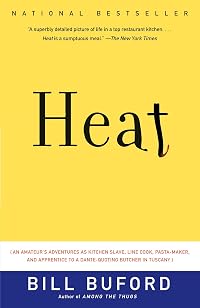
Heat: An Amateur's Adventures as Kitchen Slave, Line Cook, Pasta-Maker, and Apprentice to a Dante-Quoting Butcher in Tuscany
by Bill Buford
On This Page
Description
Writer Buford's memoir of his headlong plunge into the life of a professional cook. Expanding on his award-winning New Yorker article, Buford gives us a chronicle of his experience as "slave" to Mario Batali in the kitchen of Batali's three-star New York restaurant, Babbo. He describes three frenetic years of trials and errors, disappointments and triumphs, as he worked his way up the Babbo ladder from "kitchen bitch" to line cook, his relationship with the larger-than-life Batali, whose show more story he learns as their friendship grows through (and sometimes despite) kitchen encounters and after-work all-nighters, and his immersion in the arts of butchery in Northern Italy, of preparing game in London, and making handmade pasta at an Italian hillside trattoria.--From publisher description. show lessTags
Recommendations
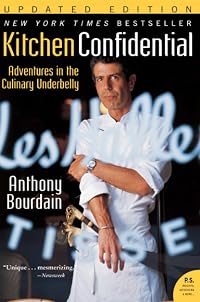
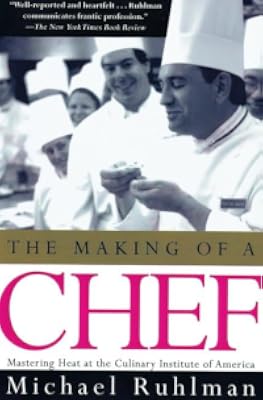
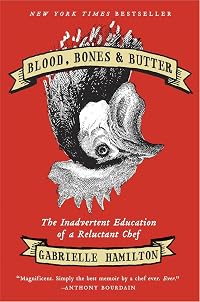
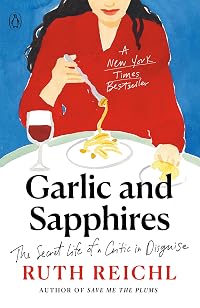
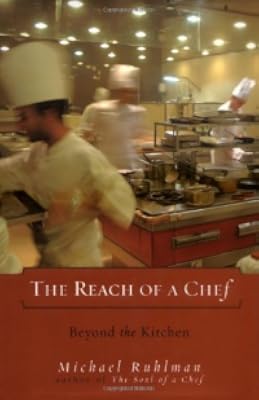
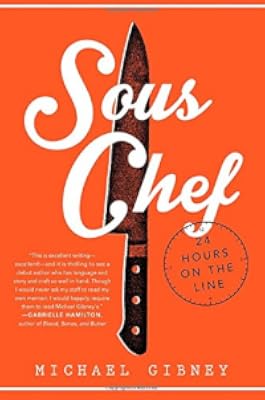
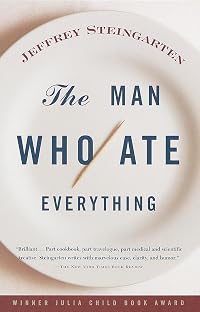
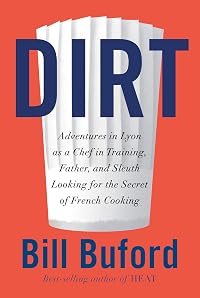
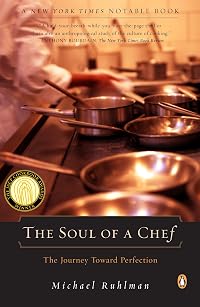

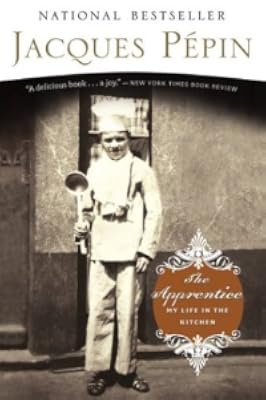
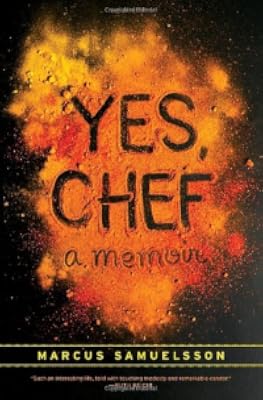

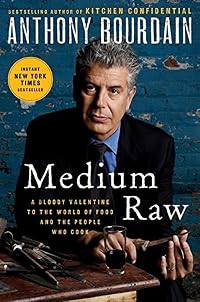
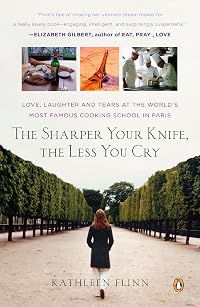
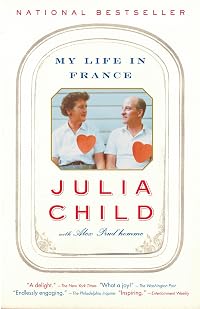
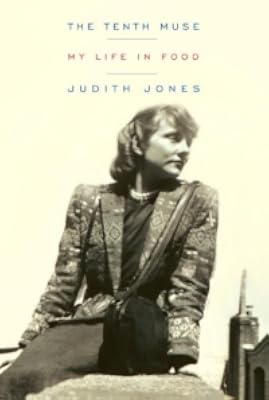
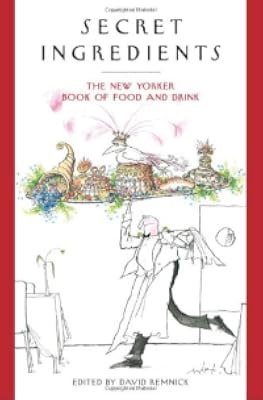
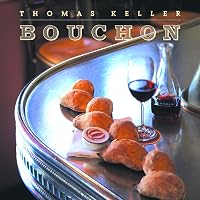
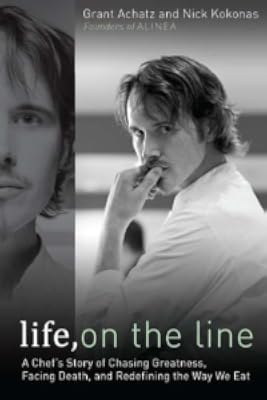
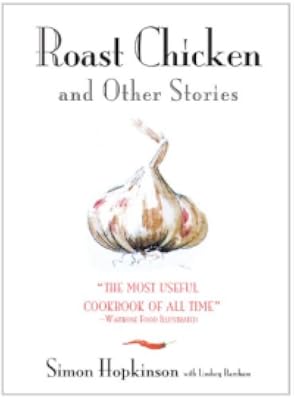




Member Recommendations


Member Reviews
I appreciate Bill Buford's cojones far more than, say, Anthony Bourdain's; at least the former allows a thread of humility to run through his account of learning an entirely unfamiliar trade. Heat also features, also, perhaps inadvertently, more flattering tableaux of kitchen work than the macho posturing of books by born-to-this chefs and cooks seem to have created thus far. Very little of this book's respectfulness is grudging.
Summary: Bill Buford managed to turn a journalistic assignment on superstar chef Mario Batali into a chance to work in the kitchen of Mario's NYC restaurant Babbo. He'd always been an enthusiastic cook, but he soon discovered that working in a restaurant kitchen is not at all the same thing. But as soon as he gets his bearing as a prep cook, and eventually as a line cook, he starts getting hungry for more: more food, more techniques, more authenticity, more history. He then travels to Italy, following more-or-less in Mario's footsteps, to learn how real pasta is made, and to learn from the last in a long line of small town butchers about Italian meat.
Review: Kitchen Confidential introduced me to an entire sub-genre that I didn't know show more I'd been missing: the restaurant/chef memoir. And, fairly or unfairly, it is the standard to which I compare all other entrants in the genre. Fortunately, Heat stands up to the comparison fairly well.
There are some things that I think Heat didn't do as well as Kitchen Confidential. As a portrait of a celebrity chef, it's certainly interesting, but less immediately compelling, presumably because it's written about Mario rather than by him. (Also possibly because I like Bourdain - as a personality - more than I do Batali.)
There are some things that Heat does about as well as Kitchen Confidential. As a behind-the-scenes look at the restaurant world, it's certainly not as thorough as KC, but it does have the benefit of being seen through the eyes of someone who is not a restaurant professional, thus making it easier for the reader to imagine themselves in the middle of that world. And the individual anecdotes are just as good, but I could seriously sit and listen to tales of chef-ly hijinks and bad behavior and food preparation all damn day.
There are also some things that Heat does better than Kitchen Confidential, mostly when it varies from formula and away from the restaurant. Buford's got a passion for food, clearly, but also for food history, and I found that his digressions on the subject - his obsession about when pasta dough first started being made with eggs, for example - were totally fascinating. I dare anyone to read the later sections of this book and not immediately want to jet off to Italy and beg someone to take you in and teach you about real food.
Buford's writing is drily witty at the same time as being cheerfully enthusiastic, and while the book is structured roughly linearly around Buford's various apprenticeships, there are frequent diversions and tangents - not only the pasta history one mentioned earlier, but also pieces of Mario's backstory, visits to England, a polemic about the proper cooking of polenta, etc. The bad news is that this meant that if I got distracted, I could often wind up a little lost, and that I had a hard time keeping all of the other kitchen staff straight, since they would disappear from the narrative for chapters at a time. The good news is that when I did get lost, it didn't really matter, since there wasn't really a plot to keep track of, and a new topic would be coming along soon anyways. Michael Kramer did a fine job with the narration, although hearing first-person memoirs read by anyone other than the author always takes a little getting used to.
Overall, while I didn't enjoy it quite as much as Kitchen Confidential, that's a high bar to clear, and it was definitely a solidly enjoyable listen. 4 out of 5 stars.
Recommendation: Recommended for foodies, those who like behind-the-scenes-style memoirs, and those who are both and looking for something else to read after finishing Kitchen Confidential. show less
Review: Kitchen Confidential introduced me to an entire sub-genre that I didn't know show more I'd been missing: the restaurant/chef memoir. And, fairly or unfairly, it is the standard to which I compare all other entrants in the genre. Fortunately, Heat stands up to the comparison fairly well.
There are some things that I think Heat didn't do as well as Kitchen Confidential. As a portrait of a celebrity chef, it's certainly interesting, but less immediately compelling, presumably because it's written about Mario rather than by him. (Also possibly because I like Bourdain - as a personality - more than I do Batali.)
There are some things that Heat does about as well as Kitchen Confidential. As a behind-the-scenes look at the restaurant world, it's certainly not as thorough as KC, but it does have the benefit of being seen through the eyes of someone who is not a restaurant professional, thus making it easier for the reader to imagine themselves in the middle of that world. And the individual anecdotes are just as good, but I could seriously sit and listen to tales of chef-ly hijinks and bad behavior and food preparation all damn day.
There are also some things that Heat does better than Kitchen Confidential, mostly when it varies from formula and away from the restaurant. Buford's got a passion for food, clearly, but also for food history, and I found that his digressions on the subject - his obsession about when pasta dough first started being made with eggs, for example - were totally fascinating. I dare anyone to read the later sections of this book and not immediately want to jet off to Italy and beg someone to take you in and teach you about real food.
Buford's writing is drily witty at the same time as being cheerfully enthusiastic, and while the book is structured roughly linearly around Buford's various apprenticeships, there are frequent diversions and tangents - not only the pasta history one mentioned earlier, but also pieces of Mario's backstory, visits to England, a polemic about the proper cooking of polenta, etc. The bad news is that this meant that if I got distracted, I could often wind up a little lost, and that I had a hard time keeping all of the other kitchen staff straight, since they would disappear from the narrative for chapters at a time. The good news is that when I did get lost, it didn't really matter, since there wasn't really a plot to keep track of, and a new topic would be coming along soon anyways. Michael Kramer did a fine job with the narration, although hearing first-person memoirs read by anyone other than the author always takes a little getting used to.
Overall, while I didn't enjoy it quite as much as Kitchen Confidential, that's a high bar to clear, and it was definitely a solidly enjoyable listen. 4 out of 5 stars.
Recommendation: Recommended for foodies, those who like behind-the-scenes-style memoirs, and those who are both and looking for something else to read after finishing Kitchen Confidential. show less
This book took me a long time to get through, but not because I wasn’t enjoying it immensely. It was more like the process of butchering and eating an entire pig, as he describes in the book: careful, slow, delicious work. I would think about it when I wasn’t reading it and look forward to getting back to it. I think my favorite aspect that sets this apart from other great restaurant books is that he’s an outsider coming in to the worlds he enters: upscale eateries, folk Italian food preparation. That made it relatable in a way, even though I’ve never worked in a kitchen in New York or cut out a bistecca in Tuscany. The part of course that left me dissatisfied was the bookend role that Mario Batali plays in it. Of course this show more was before the allegations came to the surface, but there are also allegations themselves that are related by the author. That left a bad taste in my mouth, even worse than the idea of 20 dirty pans falling into the $105-pasta-water at the height of service and not changing it out. show less
I read Buford's second book first (Dirt), and I think I liked it better. However, there was still some interesting stuff in here. Certainly Mario Batali's gross behavior is on full display, and I think maybe I am just a little disappointed that Buford seemed to be just fine with it. In fact, at one point he even said he "loved" the rowdy and abusive nature of the kitchen. I suppose, given the time and the general atmosphere of commercial kitchens at the time (and still, really), it didn't occur to anyone to object or maybe they worried their jobs may be on the line if they did. It was still a little uncomfortable though.
I also didn't enjoy how Buford seemed to have such a hard time understanding or accepting the poetry of the work and show more passions of the people in Italy. He boils the chianina down to economic ideas and dismisses the awe and beauty that the owner tells him about, for example. That's really disheartening coming from someone who is A) so obsessed with the origins and techniques of food that he works in kitchens for no pay to learn and write about it, and B) an editor of fiction, claiming to be a very literary kind of guy. There is value in the economic and historical considerations, yes, and I am glad they were included, but there is also value in the art and sentimental aspects as well and the way he blew them off made me a little sad.
So why still four stars? Well, because I still love learning vicariously through his crazy ideas to go get dirty an gain such an intimate knowledge of one thing. I also enjoy the crazy characters he meets in these places. Besides, I think he finally understood the poetry of it all when he went to France in Dirt, so I can appreciate Heat for all its good qualities having read Dirt first. show less
I also didn't enjoy how Buford seemed to have such a hard time understanding or accepting the poetry of the work and show more passions of the people in Italy. He boils the chianina down to economic ideas and dismisses the awe and beauty that the owner tells him about, for example. That's really disheartening coming from someone who is A) so obsessed with the origins and techniques of food that he works in kitchens for no pay to learn and write about it, and B) an editor of fiction, claiming to be a very literary kind of guy. There is value in the economic and historical considerations, yes, and I am glad they were included, but there is also value in the art and sentimental aspects as well and the way he blew them off made me a little sad.
So why still four stars? Well, because I still love learning vicariously through his crazy ideas to go get dirty an gain such an intimate knowledge of one thing. I also enjoy the crazy characters he meets in these places. Besides, I think he finally understood the poetry of it all when he went to France in Dirt, so I can appreciate Heat for all its good qualities having read Dirt first. show less
3.5/5
After reading Buford's amazing Among the Thugs I knew I needed to see what else he could do. A long time ago I heard Alton Brown talk about how popular cooking media became in the US after 9/11, as audiences were reaching for the comfort and familiarity of food through their TV's. This trend must've acted like nitrous to the already booming industry of celebrity chefs and high end dining. Heat was written at the height of this obsession with kitchens, restaurants, cooking and food. It's a memoir of sorts that starts with Buford taking time away from his editing work to explore his growing appreciation for food, and to grow his skill set by starting as a kitchen bitch in Mario Batali's New York restaurant Babbo. The book is much show more more than that though, as Buford takes many trips to Italy and eventually ends up apprenticing under a Butcher in a small town in Tuscany. In many ways it's a love letter to food in general, equal parts culinary history, Italian travelogue, and cooking tutorial.
Buford's writing (and subsequently the book itself) is at it's best when he describes his time at Babbo. There's something about his sarcastic style that is really suited to intense, stressful, and personal moments, no doubt one of the reasons why Among the Thugs is so strong. I really thought that the majority of the book was going to be focused around this time working all of the undesirable positions in a high end kitchen, and though I'm glad that it wasn't, I do wish there was more of it. I think the high-speed and sometimes toxic culture of the culinary world, as well as the passion and love that a lot of people start their careers with is really well expressed here.
It's unfortunate in hindsight that Buford's sage for this adventure ended up being Mario Batali. All of the descriptions of his growth in the scene and as a cook are eroded by what we now know to be true. Sadly though, there are even scenes here that make you do a double take, and wonder how Buford doesn't rebuke him, or at least openly question his behavior in a way that doesn't amount to a shrug and a "That's Mario for ya, what a crazy guy huh?". Mario doesn't completely escape the book without being chastised to some extent, especially by those who mentored him in Italy, but these rebukes are more about how he exploited what he learned in these small communities to make himself famous. If nothing else, Heat made me see Mario as not only the lecherous, slimy person that I knew him to be beforehand, but also to some degree a professional fraud, though I'm really not sure how much of that was intended by Buford. All of this goes a huge way to tainting and dating the book.
Buford also has a habit of poorly structured narratives, and unfortunately this is carried over here. It's quite simply a mess at times, and his writing is not nearly as strong when it comes to culinary history. Especially towards the middle it feels unfocused and lost. I do love his insight into the power of ungodly amounts of repetition, how doing is the best teacher given enough attempts. I wish more time had been given to discuss the vital role that immigrants play in kitchens, felt like that thread was pretty neatly ignored in favor of less important or interesting items.
Buford finishes with some comments about how the global economy and economics have supported a system in which the consumer is able to demand whatever food they want, whenever and wherever they want it. To provide it, we have lost the fine grain detail of producers that intimately know their products, who have passion for them, who can provide the best possible quality. Buford is pretty brazen about saying that he doesn't have any arguments against 'global market economics', except with respect to food. I think this view is more than a little shortsighted. I'm confident that if Buford were to do a similar multiyear deep dive into other consumer goods, he'd find that unchecked capitalism has 'ruined' them much like it has with food.
Heat didn't come together in the same way that Among the Thugs did for me. Though I enjoyed most of it I can't see myself recommending it, if only because of how big a role Mario plays. show less
After reading Buford's amazing Among the Thugs I knew I needed to see what else he could do. A long time ago I heard Alton Brown talk about how popular cooking media became in the US after 9/11, as audiences were reaching for the comfort and familiarity of food through their TV's. This trend must've acted like nitrous to the already booming industry of celebrity chefs and high end dining. Heat was written at the height of this obsession with kitchens, restaurants, cooking and food. It's a memoir of sorts that starts with Buford taking time away from his editing work to explore his growing appreciation for food, and to grow his skill set by starting as a kitchen bitch in Mario Batali's New York restaurant Babbo. The book is much show more more than that though, as Buford takes many trips to Italy and eventually ends up apprenticing under a Butcher in a small town in Tuscany. In many ways it's a love letter to food in general, equal parts culinary history, Italian travelogue, and cooking tutorial.
Buford's writing (and subsequently the book itself) is at it's best when he describes his time at Babbo. There's something about his sarcastic style that is really suited to intense, stressful, and personal moments, no doubt one of the reasons why Among the Thugs is so strong. I really thought that the majority of the book was going to be focused around this time working all of the undesirable positions in a high end kitchen, and though I'm glad that it wasn't, I do wish there was more of it. I think the high-speed and sometimes toxic culture of the culinary world, as well as the passion and love that a lot of people start their careers with is really well expressed here.
It's unfortunate in hindsight that Buford's sage for this adventure ended up being Mario Batali. All of the descriptions of his growth in the scene and as a cook are eroded by what we now know to be true. Sadly though, there are even scenes here that make you do a double take, and wonder how Buford doesn't rebuke him, or at least openly question his behavior in a way that doesn't amount to a shrug and a "That's Mario for ya, what a crazy guy huh?". Mario doesn't completely escape the book without being chastised to some extent, especially by those who mentored him in Italy, but these rebukes are more about how he exploited what he learned in these small communities to make himself famous. If nothing else, Heat made me see Mario as not only the lecherous, slimy person that I knew him to be beforehand, but also to some degree a professional fraud, though I'm really not sure how much of that was intended by Buford. All of this goes a huge way to tainting and dating the book.
Buford also has a habit of poorly structured narratives, and unfortunately this is carried over here. It's quite simply a mess at times, and his writing is not nearly as strong when it comes to culinary history. Especially towards the middle it feels unfocused and lost. I do love his insight into the power of ungodly amounts of repetition, how doing is the best teacher given enough attempts. I wish more time had been given to discuss the vital role that immigrants play in kitchens, felt like that thread was pretty neatly ignored in favor of less important or interesting items.
Buford finishes with some comments about how the global economy and economics have supported a system in which the consumer is able to demand whatever food they want, whenever and wherever they want it. To provide it, we have lost the fine grain detail of producers that intimately know their products, who have passion for them, who can provide the best possible quality. Buford is pretty brazen about saying that he doesn't have any arguments against 'global market economics', except with respect to food. I think this view is more than a little shortsighted. I'm confident that if Buford were to do a similar multiyear deep dive into other consumer goods, he'd find that unchecked capitalism has 'ruined' them much like it has with food.
Heat didn't come together in the same way that Among the Thugs did for me. Though I enjoyed most of it I can't see myself recommending it, if only because of how big a role Mario plays. show less
"You see statues everywhere to politicians, poets, bishops but none to cooks or bacon-curers or market gardeners.”
George Orwell said it correctly…………
“A human being is primarily a bag for putting food into; the other functions and faculties may be more godlike, but in point of time they come afterwards. A man dies and is buried, and all his words and actions forgotten, but the food he has eaten lives after him in the sound or rotten bones of his children. I think it could be plausibly argued that changes of diet are more important than changes in dynasty or even of religion. The Great War, for instance, could never have happened if tinned food had not been invented. And the history of the past four hundred years in England show more would have been immensely different if it had not been for the introduction of root crops and various other vegetables at the end of the Middle Ages, and a little later the introduction of non-alcoholic drinks (tea, coffee, cocoa) and also of distilled liquors to which the beer drinking English were not accustomed. Yet it is curious how seldom the all-importance of food is recognized. You see statues everywhere to politicians, poets, bishops but none to cooks or bacon-curers or market gardeners.”
George Orwell, The Road to Wigan Pier
One of the many quotes in the book Heat by Bill Buford which start us out; some mental food before you turn the page and read about Bill Buford’s culinary education. At the hands of Mario Batali...think about it... (Talk about the school of hard knocks..whew!)
Mario Batali scares me a little. He is a larger than life figure (seriously, no pun on his size) that can out eat, out party and out drink anyone. So….a book that paints you a rare portrait of what it’s like in Molto Mario’s kitchen? Yeah, I was interested in reading this one. It’s a culinary adventure book – like Kitchen Confidential – giving you a front row seat to the heated tempers behind the scenes of a five-star restaurant.
The details about the kitchen such as the staff interaction with one another, Buford’s treatment as a “kitchen slave,” the disgust and thinly veiled scorn over him not bringing his own knives. Buford takes you on a journey few will take. It was an education of butchering and the artistry involved, the ever widening array of ingredients presented, the skill of how to handle a knife as experienced by a novice, as Buford’s confidence and training increased…… humiliation, injury…..this book has all the makings of a very good Food Channel mini-movie!
“Cooking is the most massive rush. It’s like having the most amazing hard on, with Viagra sprinkled on top of it, and it’s still there twelve hours later.” Gordon Ramsey show less
George Orwell said it correctly…………
“A human being is primarily a bag for putting food into; the other functions and faculties may be more godlike, but in point of time they come afterwards. A man dies and is buried, and all his words and actions forgotten, but the food he has eaten lives after him in the sound or rotten bones of his children. I think it could be plausibly argued that changes of diet are more important than changes in dynasty or even of religion. The Great War, for instance, could never have happened if tinned food had not been invented. And the history of the past four hundred years in England show more would have been immensely different if it had not been for the introduction of root crops and various other vegetables at the end of the Middle Ages, and a little later the introduction of non-alcoholic drinks (tea, coffee, cocoa) and also of distilled liquors to which the beer drinking English were not accustomed. Yet it is curious how seldom the all-importance of food is recognized. You see statues everywhere to politicians, poets, bishops but none to cooks or bacon-curers or market gardeners.”
George Orwell, The Road to Wigan Pier
One of the many quotes in the book Heat by Bill Buford which start us out; some mental food before you turn the page and read about Bill Buford’s culinary education. At the hands of Mario Batali...think about it... (Talk about the school of hard knocks..whew!)
Mario Batali scares me a little. He is a larger than life figure (seriously, no pun on his size) that can out eat, out party and out drink anyone. So….a book that paints you a rare portrait of what it’s like in Molto Mario’s kitchen? Yeah, I was interested in reading this one. It’s a culinary adventure book – like Kitchen Confidential – giving you a front row seat to the heated tempers behind the scenes of a five-star restaurant.
The details about the kitchen such as the staff interaction with one another, Buford’s treatment as a “kitchen slave,” the disgust and thinly veiled scorn over him not bringing his own knives. Buford takes you on a journey few will take. It was an education of butchering and the artistry involved, the ever widening array of ingredients presented, the skill of how to handle a knife as experienced by a novice, as Buford’s confidence and training increased…… humiliation, injury…..this book has all the makings of a very good Food Channel mini-movie!
“Cooking is the most massive rush. It’s like having the most amazing hard on, with Viagra sprinkled on top of it, and it’s still there twelve hours later.” Gordon Ramsey show less
Essentially, the story of a journalist of no mean reputation (former editor of Granta and fiction editor of The New Yorker), who in frustration at his ineptness at cooking for dinner parties, decides to apprentice himself to Mario Batali, learning the ropes in his renowned New York restaurant, Babbo.
The title says it all. His culinary education takes him from nasty accidents in the kitchen to learning first-hand the arts of pasta making and butchering in Italy. Much of it focuses on the career of Mario Batali, which is an interesting story in itself, but I much preferred the recounting of Buford’s real life adventures, which are awe-inspiring. Talk about throwing yourself in at the deep end, he literally immerses himself in the world show more of a professional kitchen (often at the cost of bodily injury) and carries the reader along with him, hoping he won’t kill himself before he feels he’s learnt enough.
There are some amazing insights into the crazy world of celebrity chefs which are fascinating in themselves. But the whole book is written in such an engaging way and with such brilliant depiction of characters, you feel really disappointed to reach the end and have to break acquaintance with all of them. show less
The title says it all. His culinary education takes him from nasty accidents in the kitchen to learning first-hand the arts of pasta making and butchering in Italy. Much of it focuses on the career of Mario Batali, which is an interesting story in itself, but I much preferred the recounting of Buford’s real life adventures, which are awe-inspiring. Talk about throwing yourself in at the deep end, he literally immerses himself in the world show more of a professional kitchen (often at the cost of bodily injury) and carries the reader along with him, hoping he won’t kill himself before he feels he’s learnt enough.
There are some amazing insights into the crazy world of celebrity chefs which are fascinating in themselves. But the whole book is written in such an engaging way and with such brilliant depiction of characters, you feel really disappointed to reach the end and have to break acquaintance with all of them. show less
Members
- Recently Added By
Lists

Best "Foodie" Books
114 works; 40 members

Best Autobiographies and Memoirs
370 works; 67 members

Food Memoirs
97 works; 9 members
My Year Spent Doing Something Stupid so I Could Write This Book
31 works; 5 members
Author Information

71+ Works 10,951 Members
All Editions
Some Editions
Awards and Honors
Awards
Distinctions
Notable Lists
Common Knowledge
- Canonical title
- Heat: An Amateur's Adventures as Kitchen Slave, Line Cook, Pasta-Maker, and Apprentice to a Dante-Quoting Butcher in Tuscany
- Original publication date
- 2006
- People/Characters
- Bill Buford; Mario Batali
- Important places
- New York, New York, USA; Tuscany, Italy
- Dedication
- For Jessica ... che move il sole e l'altre stelle.
- First words
- The first glimpse I had of what Mario Batali's friends had described to me as the "myth of Mario" was on a cold Saturday night in January 2002, when I invited him to a birthday dinner.
- Blurbers
- Reed, Julia; Epstein, Jason
Classifications
- Genres
- Food & Cooking, Biography & Memoir, General Nonfiction, Nonfiction
- DDC/MDS
- 641.59455 — Applied science & technology Home economics & family management Food, Cooking & Recipes / Meals, Picnics Cooking; cookbooks Ethnic Cookbooks Europe Italy Tuscany
- LCC
- TX723.2 .T86 .B83 — Technology Home economics Home economics Cooking
- BISAC
Statistics
- Members
- 2,900
- Popularity
- 6,194
- Reviews
- 92
- Rating
- (3.77)
- Languages
- 11 — Dutch, English, Finnish, French, German, Greek, Italian, Norwegian (Bokmål), Portuguese, Spanish, Swedish
- Media
- Paper, Audiobook, Ebook
- ISBNs
- 31
- ASINs
- 9