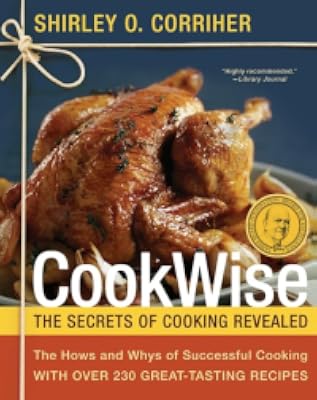
Cookwise: The Secrets of Cooking Revealed
by Shirley O. Corriher
On This Page
Description
In "CookWise", Shirley Corriher, the "Sherlock Holmes of cooking", reveals the astonishing drama set in motion every time a potato hits hot fat to become a French fry or the oven's heat bakes the outside of a chicken into a caramel crust. "Corriher is a true original--an experienced cook and teacher who also happens to be a trained chemist and a great storyteller".--Harold McGee.Tags
Recommendations



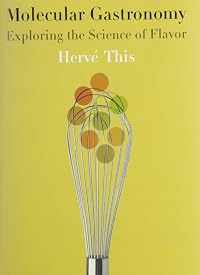
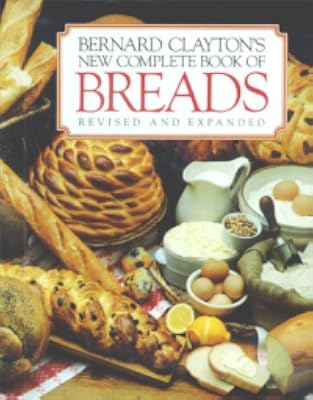
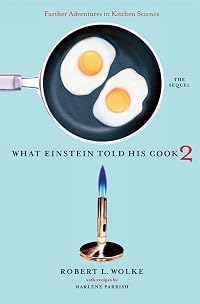
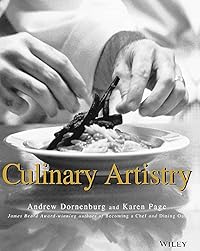



Member Recommendations
Member Reviews
Cookwise lifts the veil surrounding the culinary arts, allowing anyone to become the master of their own kitchen.
Before I got a copy of this book, I saw cooking as a confusing, random process requiring a combination of extraordinary good luck and expensive ingredients. How can you tell when something is cooked all the way through, without a timer and a prayer? Why do you need baking soda and what appears to be a frightening amount of butter? What type of oil should you use to grease that pan, if at all?
I realized, though, (while watching Ace of Cakes actually) that there is a definite science to cooking, something far more basic than the Top Chef world of foams, proteins and molecular gastronomy. You need these things for leavening, show more forming structures, blending tastes! But where could I get this information outside of a chemistry class?
The answer is Cookwise. This book explains the WHY behind every recipe - down to the way molecules bind at different temperatures - arming the reader with the foundation of culinary knowledge necessary for successfully selecting, revising and preparing any recipe.
Cookwise is a thick book, perfect for browsing and studying at a leisurely pace, to ensure you absorb all it has to offer. show less
Before I got a copy of this book, I saw cooking as a confusing, random process requiring a combination of extraordinary good luck and expensive ingredients. How can you tell when something is cooked all the way through, without a timer and a prayer? Why do you need baking soda and what appears to be a frightening amount of butter? What type of oil should you use to grease that pan, if at all?
I realized, though, (while watching Ace of Cakes actually) that there is a definite science to cooking, something far more basic than the Top Chef world of foams, proteins and molecular gastronomy. You need these things for leavening, show more forming structures, blending tastes! But where could I get this information outside of a chemistry class?
The answer is Cookwise. This book explains the WHY behind every recipe - down to the way molecules bind at different temperatures - arming the reader with the foundation of culinary knowledge necessary for successfully selecting, revising and preparing any recipe.
Cookwise is a thick book, perfect for browsing and studying at a leisurely pace, to ensure you absorb all it has to offer. show less
One of my favorite cookbooks of all time. Not just recipes, she teaches you how to "read" your food to determine both what went right/wrong and how to change things next time to get the result you want. This is a book I pick up used copies of whenever I find them in order to pass on to friends who want to level up their cooking.
Now that I've looked through this one, I vaguely remember reading it a few years ago, but I liked it better then, for some reason. This time around, I went from being totally impressed to completely overwhelmed in just a few pages. The book starts with bread. Well, I bake bread. So I know about that. But this went so far over my head, it was into the stratosphere. I was overwhelmed with a discussion of which kind of flour I needed, based on protein content. Then we got into the importance of adding a little crushed ice to the batter for some reason and a little malt barely syrup and something else, and on and on and on.
The one recipe I did try, shallot mashed potatoes with garlic, was a complete disaster. Too soupy and too hard. I show more followed the recipe instead of using my own instincts, so I should have cooked the potatoes until done, checking them myself, instead of going by the time in the recipe.
I did copy a couple of dessert recipes (what else?), one for this decadent chocolate thingy and one for pralines. We'll see how those turn out.
In my opinion, this cookbook is best used as a reference. If you have a recipe that isn't working for some reason, this is a good place to look for why. Maybe more experienced cooks or ones willing to follow all the complicated directions and look for all the special ingredients would turn out some fabulous food, but I do not have the time or patience for that. I did enjoy all the name dropping and hints from famous chefs. But I don't think I'll bother with this one again. show less
The one recipe I did try, shallot mashed potatoes with garlic, was a complete disaster. Too soupy and too hard. I show more followed the recipe instead of using my own instincts, so I should have cooked the potatoes until done, checking them myself, instead of going by the time in the recipe.
I did copy a couple of dessert recipes (what else?), one for this decadent chocolate thingy and one for pralines. We'll see how those turn out.
In my opinion, this cookbook is best used as a reference. If you have a recipe that isn't working for some reason, this is a good place to look for why. Maybe more experienced cooks or ones willing to follow all the complicated directions and look for all the special ingredients would turn out some fabulous food, but I do not have the time or patience for that. I did enjoy all the name dropping and hints from famous chefs. But I don't think I'll bother with this one again. show less
Not the kind of book you just sit down and read cover to cover - it is a cookbook, after all - and lacking the adorable, elementary school science teacher vibe she brings to her spots on Alton Brown's Good Eats, but still a pretty amazing book. As someone who would rather learn underlying principles and then be shooed out the door than master recipes by rote, this dense volume is right up my alley. You can see why Alton hero-worships her so fervently.
This is my favorite Science of Cooking book -- comprehensive, clear, more approachable than McGee's and less affected than A. Brown's.
Definitely cooking with the chemistry/science buff in mind. Somehow I appreciate the info and yet yearn for the mystery. When I get more upset about failed recipes, this the book to which I will turn. :-)
This cookbook is fabulous. You don't just learn how to cook things, you learn the science of WHY the recipes work. I love the multigrain bread recipe in this book.
Members
- Recently Added By
Lists

Best Science Books for Non-Scientists
113 works; 57 members

Favourite cook-books
75 works; 19 members

Top-Rated Books on LibraryThing
272 works; 117 members

Unread books
1,063 works; 85 members

Female Author
1,235 works; 65 members

The Five Books That Represent Us
391 works; 148 members
Author Information

4+ Works 1,573 Members
Shirley O. Corriher has a BA in chemistry from Vanderbilt University, where she was also a biochemist at the medical school. She is the author of the James Beard Award winners CookWise and BakeWise. Shirley has consulted for Julia Child, Procter Gamble, Pillsbury, the Joy of Cooking, and other brands. She is a noted international speaker and show more teacher and has won numerous awards, among them Bon Apptit's Cooking Teacher of the Year. She has appeared on many television shows, including Good Eats, and has written a regular column for the Los Angeles Times and for publications such as Cook's Illustrated and Fine Cooking. She lives in Atlanta. show less
Awards and Honors
Classifications
Statistics
- Members
- 1,110
- Popularity
- 22,832
- Reviews
- 10
- Rating
- (4.34)
- Languages
- English
- Media
- Paper
- ISBNs
- 3
- UPCs
- 1
- ASINs
- 5