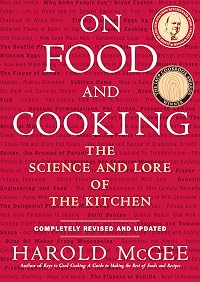
On Food and Cooking: The Science and Lore of the Kitchen
by Harold McGee
On This Page
Description
Harold McGee's On Food and Cooking is a kitchen classic. Hailed by Time magazine as "a minor masterpiece" when it first appeared in 1984, On Food and Cooking is the bible to which food lovers and professional chefs worldwide turn for an understanding of where our foods come from, what exactly they're made of, and how cooking transforms them into something new and delicious. Now, for its twentieth anniversary, Harold McGee has prepared a new, fully revised and updated edition of On Food and show more Cooking. He has rewritten the text almost completely, expanded it by two-thirds, and commissioned more than 100 new illustrations. As compulsively readable and engaging as ever, the new On Food and Cooking provides countless eye-opening insights into food, its preparation, and its enjoyment. On Food and Cooking pioneered the translation of technical food science into cook-friendly kitchen science and helped give birth to the inventive culinary movement known as "molecular gastronomy." Though other books have now been written about kitchen science, On Food and Cooking remains unmatched in the accuracy, clarity, and thoroughness of its explanations, and the intriguing way in which it blends science with the historical evolution of foods and cooking techniques. Among the major themes addressed throughout this new edition are: Traditional and modern methods of food production and their influences on food quality, the great diversity of methods by which people in different places and times have prepared the same ingredients, tips for selecting the best ingredients and preparing them successfully, the particular substances that give foods their flavors and that give us pleasure, and our evolving knowledge of the health benefits and risks of foods. On Food and Cooking is an invaluable and monumental compendium of basic information about ingredients, cooking methods, and the pleasures of eating. It will delight and fascinate anyone who has ever cooked, savored, or wondered about food. show lessTags
Recommendations



Member Recommendations
Member Reviews
Not a cookbook. Everything you ever might want to know about how food works. How ice cream is made, why bread rises, what kind of molds are in cheese, what are the parts of an egg. And yet, readable. Brill. May however, make you annoy your friends with "well you know, cheese on the Asian steppe in the late Iron Age..."
It is not a cookbook, but rather the context for all cookbooks: a stupendous compendium of how food -- every type of food -- works. It is heavy on chemistry (and its closing pages are a chemistry primer I wish I'd had in high school; read this first), but also patient explanations that a layperson / foodie will like: What is emulsification? Why do so many foods turn brown on exposure to air? How does the Maillard reaction work, and why is it the greatest thing to hit the culinary art since well before sliced bread? This is a reference book to be consulted often -- but I read it cover to cover, and enjoyed it lots.
I like to think that, while I don't know everything, I do know where to look it up. And this book is where I turn to most often: it tells me which fruit ripen faster in a paper bag (thank you, ethylene!), whether or not to refrigerate apples (wisdom which is trumped by my wife's preference), and what the bubbles in bread dough come from (in language, with pictures, that even my kids understand).
Advances in the state of the art may render some of the information out of date, but it will be a long time before it's all put together between two covers that make me want to throw out my McGee.
Advances in the state of the art may render some of the information out of date, but it will be a long time before it's all put together between two covers that make me want to throw out my McGee.
When I want to understand the muscle fiber structure of octopus, or learn about the history and definition of pumpernickel bread, or figure out how the qualities of corn syrup differ from that of honey, I turn to Harold McGee's On Food and Cooking. This is an impressively extensive reference book of ingredients, cooking techniques, food history, and food science. The information is grouped in chapters such as Milk and Dairy Products, Meat, and Edible Plants, with a nice chemistry primer covering atoms, molecules and energy at the end. A staggering amount of information is packed into each chapter ranging from interesting facts, history and detailed descriptions to excellent illustrations.
McGee dedicates 68 pages to eggs, covering such show more topics as how a hen makes an egg, why yolks sometimes turn green when cooked, the eight different proteins that make up an egg white along with their natural function and culinary properties (did you know ovalbumin is 54% of the total protein in albumen and it sets when heated to 180˚F?), plus, a silly cook's joke about cooking eggs on a spit from book printed in the 1400s, and fourteen pages on egg foams. Whew! If you have any tendencies toward research, you will be lost in the pages from the moment you open the cover. show less
McGee dedicates 68 pages to eggs, covering such show more topics as how a hen makes an egg, why yolks sometimes turn green when cooked, the eight different proteins that make up an egg white along with their natural function and culinary properties (did you know ovalbumin is 54% of the total protein in albumen and it sets when heated to 180˚F?), plus, a silly cook's joke about cooking eggs on a spit from book printed in the 1400s, and fourteen pages on egg foams. Whew! If you have any tendencies toward research, you will be lost in the pages from the moment you open the cover. show less
A really excellent look at the underlying physical phenomena that go on in the process of cooking; this is one of Alton Brown’s top references. McGee covers the physics and chemistry at a level that should be easy for anyone who made it through high school AP Chemistry and accessible to anyone who finds Scientific American readable. In addition to the science, he also includes interesting vignettes of history and etymology, including excerpts from historical cookbooks.
I don’t do a lot of cooking (yet), but in my limited areas of experience, there were some good a-ha moments. This would be a good book to keep on hand to reference any time you work with a particular ingredient or technique to deepen your understanding and suggest new show more possibilities. It would also be a good book for any high school chemistry teacher to keep on hand to interest a student who knows more about cooking, or to make cooking more interesting for a science type. show less
I don’t do a lot of cooking (yet), but in my limited areas of experience, there were some good a-ha moments. This would be a good book to keep on hand to reference any time you work with a particular ingredient or technique to deepen your understanding and suggest new show more possibilities. It would also be a good book for any high school chemistry teacher to keep on hand to interest a student who knows more about cooking, or to make cooking more interesting for a science type. show less
Title pretty much says it all. McGee gives you some very digestible tidbits of food science while also telling you the history & tradition of the foods and techniques he's covering. Far from exhaustive, but not meant to be. It is fairly comprehensive, though. McGee wisely breaks the text down into small sections and gives you the skinny on a huge range of food-related topics in deft, literate prose. There's also a solid. fifteen-page bibliography for those who do go in for exhaustive knowledge on any of the topics he treats. This is a food book for folks that love food but not necessarily food books. It gives you a quick and pleasant way to satiate and stimulate your curiosity about practically any food topic.
Ever wonder if copper bowls *really* make a difference when whipping egg whites? McGee includes both protein folding theory and spectrophotometer evidence. No shortage of electron microscope photographs either - but it's not *just* hardcore science geekery, he takes you through history and real science (repeatable experiments!)
Members
- Recently Added By
Lists

Best "Foodie" Books
114 works; 40 members

Simon & Schuster
136 works; 4 members
Author Information

5+ Works 5,274 Members
Harold McGee writes about the chemistry of food and cooking, and the science of everyday life. He has worked alongside some of world's most innovative chefs, including Thomas Keller and Heston Blumenthal. He lives with his family in California. (Publisher Provided)
Some Editions
Awards and Honors
Awards
Work Relationships
Has as a reference guide/companion
Common Knowledge
- Canonical title
- On Food and Cooking: The Science and Lore of the Kitchen
- Original title
- On Food and Cooking: The Science and Lore of the Kitchen
- Alternate titles
- McGee on Food and Cooking: An Encyclopedia of Kitchen Science, History, and Culture
- Original publication date
- 1984
- Dedication
- To my family
Classifications
Statistics
- Members
- 4,108
- Popularity
- 3,761
- Reviews
- 45
- Rating
- (4.60)
- Languages
- 7 — Chinese, Dutch, English, German, Italian, Portuguese, Spanish
- Media
- Paper, Ebook
- ISBNs
- 28
- UPCs
- 1
- ASINs
- 10