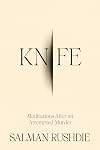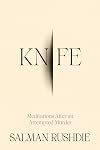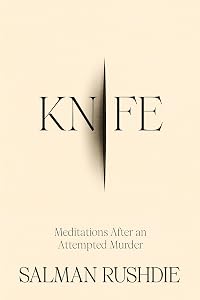
Knife: Meditations After an Attempted Murder
by Salman Rushdie
On This Page
Description
#1 NATIONAL BESTSELLER • From Booker Prize winner Salman Rushdie, a searing, deeply personal account of enduring—and surviving—an attempt on his life thirty years after the fatwa that was ordered against himOn the morning of August 12, 2022, Salman Rushdie was standing onstage at the Chautauqua Institution, preparing to give a lecture on the importance of keeping writers safe from harm, when a man in black—black clothes, black mask—rushed down the aisle toward him, wielding a show more knife. His first thought: So it’s you. Here you are.
What followed was a horrific act of violence that shook the literary world and beyond. Now, for the first time, and in unforgettable detail, Rushdie relives the traumatic events of that day and its aftermath, as well as his journey toward physical recovery and the healing that was made possible by the love and support of his wife, Eliza, his family, his army of doctors and physical therapists, and his community of readers worldwide.
Knife is Rushdie at the peak of his powers, writing with urgency, with gravity, with unflinching honesty. It is also a deeply moving reminder of literature’s capacity to make sense of the unthinkable, an intimate and life-affirming meditation on life, loss, love, art—and finding the strength to stand up again. show less
Tags
Recommendations


Member Recommendations
Member Reviews
"I don't believe it has, or should, or will, impact my writing style in any way at all… I don't see what an act of violence such as the one I experienced has to contribute to art." (pg. 199)
I've been struggling to think of a way to begin this review, so let me just say: This is not a good book. I went into it expecting something of a tour de force, some heartening or insightful "meditations on the attempted murder" of author Salman Rushdie, as the book's subtitle has it, but I was surprised at how banal it was. How could a book titled Knife be so lacking in penetration? Even after I scaled down my expectations (I laboured through this slight volume over more than a week, which is slow by my standards), I could only conclude that the show more book was a poor construction.
I did not want this to be the case; as with The Satanic Verses before it, I wanted to be able to wear it as a badge of honour in support of its author's plight. A writer, I thought – a person known, almost by definition, for their powers of sensory observation and ability to articulate them – who experiences an intense and unique horror and lives to tell the tale… how could the resultant piece of writing fail to be anything other than engrossing and important? But Knife, Rushdie's memoir of the 2022 attempt on his life and his subsequent recovery, proved to be unambitious, unreflective and...
The devil on my shoulder wants me to say 'disingenuous'. This was the charge laid against Rushdie's character by his attacker (unnamed in the book); the word and motive given for his attempted murder. It's not an especially strong word, though Rushdie appears piqued by it, and if not disingenuous in Knife he is at least lacking rigour in his reflections. On far too many occasions I noticed the author trying to have his cake and eat it; deliver a lazy cliché to the reader while simultaneously qualifying his disdain for lazy clichés:
"I sat up in bed, shaken by the dream's vividness and violence. It felt like a premonition (even though premonitions are things in which I don't believe)." (pg. 7)
"I don't usually think of my books as prophecies. I've had some trouble with prophets in my life, and I'm not applying for the job. But it's hard, thinking back to the genesis of that novel, not to see the image as – at the very least – a foreshadowing." (pg. 22)
"I don't believe in miracles, but my survival is miraculous." (pg. 63)
"These things did not give me 'closure', whatever that was… but they did mean that the assault weighed less heavily on me than before." (pg. 194)
"I don't like to think of writing as therapy – writing is writing, and therapy is therapy – but there was a good chance that telling the story as I saw it might make me feel better." (pg. 129)
This sort of equivocation is alarming in a writer of Rushdie's stature, and shows an author struggling against limitations of inspiration and skill that arrived far sooner than they ought to have done. At one point, Rushdie seems to want to tackle this flaw, declaring himself keen to think about "the irruption of the miraculous into the life of someone who didn't believe that the miraculous existed" (pg. 60), but this level of self-reflection is not expanded upon beyond that single line.
And it is this which makes me feel rather shabby in writing a critical review of Knife. One of Rushdie's main 'gotcha's against his attempted murderer is in quoting Socrates: "the unexamined life is not worth living". It is Rushdie's way of biting back at the man who knifed him, making him lesser. Fair enough – the man took his eye, after all – but on the major points of Knife, Rushdie leaves his own story unexamined. His recollections of the attack are flavourless and lack insight, aside from one decent passage on page 16 about how there was no out-of-body experience; "In fact, I have rarely felt so strongly connected to my body. My body was dying and it was taking me with it." Rushdie is dismissive when discussing the actual events of the day (such as why there was no security) and completely uninterested in the history or psychological makeup of his attacker. He admits he has made no attempt to research the man, which makes his invented 'confrontation' dialogue with the man in Chapter Six an ill-advised embarrassment. It is a clumsy sequence of stilted and unnatural dialogue, in which Rushdie has his own unopposed wit and intellect skewer the incel straw man he has created in place of the real Hadi Matar. It's some of the worst dialogue I've ever read.
The attack over, Rushdie devotes the rest of the book to his recovery efforts. Again, I feel shabby for saying so, for no doubt Rushdie showed great character in coming through his trials, but it is written without any enthusiasm or reflection. His doubts and mental hurdles are summarised, and the loving relationship between him and his wife is communicated through sickly clichés and rote exultations about her being 'beautiful' and a 'rock'. (Rushdie also quotes Star Wars – "As the Mandalorian of love would say: This is the way" (pg. 27) – a line so lame I had to read it again to make sure I hadn't imagined it.)
Elsewhere, Rushdie reproduces verbatim the good wishes which came in from around the world, from President Biden's limp, cut-and-paste 'thoughts and prayers' message to various random comments left on his Instagram page. His response to the attack is to seek refuge in yet more cliché: to profess that love triumphs over hate, that life triumphs over death. Those who helped him after the attack are 'heroes' (I think a venerated writer should not eat from the same word trough as a tabloid hack). He will write "the next chapter in the book of life" (pg. 195). And, of course, "love is a force, that in its most potent form it can move mountains. It can change the world" (pg. 56). The book quickly becomes cloying, dull and complacent.
It was remarkable that this was the case; as I wrote earlier, surely a book by a supposedly 'great' writer about a unique and raw event could not fail so completely? There are a few moments of spirit, including one genuine moment of wit when Rushdie remarks on the fact that his attacker brought a whole bag of knives to the event, rather than just one: "Did he think he might pass them out to the audience and invite them to join in?" (pp194-5). And I don't doubt that Rushdie's trials, and his thoughts and responses to them, are genuine. Only that the final work, Knife, does not suggest a writer on form, or even trying to be.
There's a distinct lack of ambition in Knife. Perhaps Rushdie is not yet fully recovered, but then again perhaps he is merely deflated that, after 30 years, he is yet again "defined by the knife", dragged back into discussing the Satanic Verses controversy (pg. 132). I wrote in my review of that fateful novel that it probably seems a curse to him to be forever known for his lesser work (I also wrote that I found The Satanic Verses crude rather than insightful, an impression of the author that has been reconfirmed by Knife). With this in mind, one can sense a reluctance on Rushdie's part to write or talk about this. Incredibly, early on in the book he twists the fact that his attacker had not even read his controversial novel to claim that "whatever the attack was about, it wasn't about The Satanic Verses" (pg. 5). It may initially appear an act of casuistry and perhaps – yes – disingenuous, but it's more like a writer trying to cobble something together to cope with a situation that he does not want, and escape a shadow which, he thinks, obscures appreciation of his writing.
For this undeserved curse, the author has my sympathy, but it doesn't change the final conclusion about the worth of Knife itself. For a book with a unique opportunity and potential, it is a great shame that it is banal, clichéd and lacking in real ambition or originality. Genuine insight, or even an original narration of events, is scarce, as is candour, use of language and wit. Rushdie is more concerned with just delivering whatever is on his mind, justifying it as "free association", whether that is listing other famous people who go by their middle names, other books that involve knives, or his unexamined political prejudices. Because of climate change, fish boil in the sea, apparently (pg. 193) and "white supremacy" lays claim to "Black bodies" and "women's bodies too" (pg. 180). A late attempt to fulfil his anointed role as free-speech spokesman sees him deliver a summary of the history of liberalism that could have been culled from SparkNotes (pg. 182). Remarkably for a book about a man targeted by Islamic extremism, Donald Trump and Boris Johnson are the figures who receive the most ire (and, as far as I can see, for nothing more than representing nascent political movements that Rushdie personally disagrees with). At one of the book's nadirs, Rushdie casually lumps Trump and Boris in with the Nazi war criminal Adolf Eichmann (pg. 94), a lack of care and proportion which shows him not to be the measured thinker he needs to be, particularly as those two men would also be at risk of violence when such ridiculous statements are taken to heart by the Hadi Matars of this world.
The battlelines drawn up around Salman Rushdie are fascinating, as is the defence of the principles at stake; the man's actual work less so. So underwhelming have been my reading experiences of Knife and The Satanic Verses that I would be quite content not to think of the author or read anything of his work again, leaving it only to those few who genuinely like that kind of writing. Now if only his opponents in the Islamic world would do the same, I don't think Rushdie would mind this conclusion.
"Truthfully, I would be happy never to speak about The Satanic Verses again." (pg. 99) show less
I've been struggling to think of a way to begin this review, so let me just say: This is not a good book. I went into it expecting something of a tour de force, some heartening or insightful "meditations on the attempted murder" of author Salman Rushdie, as the book's subtitle has it, but I was surprised at how banal it was. How could a book titled Knife be so lacking in penetration? Even after I scaled down my expectations (I laboured through this slight volume over more than a week, which is slow by my standards), I could only conclude that the show more book was a poor construction.
I did not want this to be the case; as with The Satanic Verses before it, I wanted to be able to wear it as a badge of honour in support of its author's plight. A writer, I thought – a person known, almost by definition, for their powers of sensory observation and ability to articulate them – who experiences an intense and unique horror and lives to tell the tale… how could the resultant piece of writing fail to be anything other than engrossing and important? But Knife, Rushdie's memoir of the 2022 attempt on his life and his subsequent recovery, proved to be unambitious, unreflective and...
The devil on my shoulder wants me to say 'disingenuous'. This was the charge laid against Rushdie's character by his attacker (unnamed in the book); the word and motive given for his attempted murder. It's not an especially strong word, though Rushdie appears piqued by it, and if not disingenuous in Knife he is at least lacking rigour in his reflections. On far too many occasions I noticed the author trying to have his cake and eat it; deliver a lazy cliché to the reader while simultaneously qualifying his disdain for lazy clichés:
"I sat up in bed, shaken by the dream's vividness and violence. It felt like a premonition (even though premonitions are things in which I don't believe)." (pg. 7)
"I don't usually think of my books as prophecies. I've had some trouble with prophets in my life, and I'm not applying for the job. But it's hard, thinking back to the genesis of that novel, not to see the image as – at the very least – a foreshadowing." (pg. 22)
"I don't believe in miracles, but my survival is miraculous." (pg. 63)
"These things did not give me 'closure', whatever that was… but they did mean that the assault weighed less heavily on me than before." (pg. 194)
"I don't like to think of writing as therapy – writing is writing, and therapy is therapy – but there was a good chance that telling the story as I saw it might make me feel better." (pg. 129)
This sort of equivocation is alarming in a writer of Rushdie's stature, and shows an author struggling against limitations of inspiration and skill that arrived far sooner than they ought to have done. At one point, Rushdie seems to want to tackle this flaw, declaring himself keen to think about "the irruption of the miraculous into the life of someone who didn't believe that the miraculous existed" (pg. 60), but this level of self-reflection is not expanded upon beyond that single line.
And it is this which makes me feel rather shabby in writing a critical review of Knife. One of Rushdie's main 'gotcha's against his attempted murderer is in quoting Socrates: "the unexamined life is not worth living". It is Rushdie's way of biting back at the man who knifed him, making him lesser. Fair enough – the man took his eye, after all – but on the major points of Knife, Rushdie leaves his own story unexamined. His recollections of the attack are flavourless and lack insight, aside from one decent passage on page 16 about how there was no out-of-body experience; "In fact, I have rarely felt so strongly connected to my body. My body was dying and it was taking me with it." Rushdie is dismissive when discussing the actual events of the day (such as why there was no security) and completely uninterested in the history or psychological makeup of his attacker. He admits he has made no attempt to research the man, which makes his invented 'confrontation' dialogue with the man in Chapter Six an ill-advised embarrassment. It is a clumsy sequence of stilted and unnatural dialogue, in which Rushdie has his own unopposed wit and intellect skewer the incel straw man he has created in place of the real Hadi Matar. It's some of the worst dialogue I've ever read.
The attack over, Rushdie devotes the rest of the book to his recovery efforts. Again, I feel shabby for saying so, for no doubt Rushdie showed great character in coming through his trials, but it is written without any enthusiasm or reflection. His doubts and mental hurdles are summarised, and the loving relationship between him and his wife is communicated through sickly clichés and rote exultations about her being 'beautiful' and a 'rock'. (Rushdie also quotes Star Wars – "As the Mandalorian of love would say: This is the way" (pg. 27) – a line so lame I had to read it again to make sure I hadn't imagined it.)
Elsewhere, Rushdie reproduces verbatim the good wishes which came in from around the world, from President Biden's limp, cut-and-paste 'thoughts and prayers' message to various random comments left on his Instagram page. His response to the attack is to seek refuge in yet more cliché: to profess that love triumphs over hate, that life triumphs over death. Those who helped him after the attack are 'heroes' (I think a venerated writer should not eat from the same word trough as a tabloid hack). He will write "the next chapter in the book of life" (pg. 195). And, of course, "love is a force, that in its most potent form it can move mountains. It can change the world" (pg. 56). The book quickly becomes cloying, dull and complacent.
It was remarkable that this was the case; as I wrote earlier, surely a book by a supposedly 'great' writer about a unique and raw event could not fail so completely? There are a few moments of spirit, including one genuine moment of wit when Rushdie remarks on the fact that his attacker brought a whole bag of knives to the event, rather than just one: "Did he think he might pass them out to the audience and invite them to join in?" (pp194-5). And I don't doubt that Rushdie's trials, and his thoughts and responses to them, are genuine. Only that the final work, Knife, does not suggest a writer on form, or even trying to be.
There's a distinct lack of ambition in Knife. Perhaps Rushdie is not yet fully recovered, but then again perhaps he is merely deflated that, after 30 years, he is yet again "defined by the knife", dragged back into discussing the Satanic Verses controversy (pg. 132). I wrote in my review of that fateful novel that it probably seems a curse to him to be forever known for his lesser work (I also wrote that I found The Satanic Verses crude rather than insightful, an impression of the author that has been reconfirmed by Knife). With this in mind, one can sense a reluctance on Rushdie's part to write or talk about this. Incredibly, early on in the book he twists the fact that his attacker had not even read his controversial novel to claim that "whatever the attack was about, it wasn't about The Satanic Verses" (pg. 5). It may initially appear an act of casuistry and perhaps – yes – disingenuous, but it's more like a writer trying to cobble something together to cope with a situation that he does not want, and escape a shadow which, he thinks, obscures appreciation of his writing.
For this undeserved curse, the author has my sympathy, but it doesn't change the final conclusion about the worth of Knife itself. For a book with a unique opportunity and potential, it is a great shame that it is banal, clichéd and lacking in real ambition or originality. Genuine insight, or even an original narration of events, is scarce, as is candour, use of language and wit. Rushdie is more concerned with just delivering whatever is on his mind, justifying it as "free association", whether that is listing other famous people who go by their middle names, other books that involve knives, or his unexamined political prejudices. Because of climate change, fish boil in the sea, apparently (pg. 193) and "white supremacy" lays claim to "Black bodies" and "women's bodies too" (pg. 180). A late attempt to fulfil his anointed role as free-speech spokesman sees him deliver a summary of the history of liberalism that could have been culled from SparkNotes (pg. 182). Remarkably for a book about a man targeted by Islamic extremism, Donald Trump and Boris Johnson are the figures who receive the most ire (and, as far as I can see, for nothing more than representing nascent political movements that Rushdie personally disagrees with). At one of the book's nadirs, Rushdie casually lumps Trump and Boris in with the Nazi war criminal Adolf Eichmann (pg. 94), a lack of care and proportion which shows him not to be the measured thinker he needs to be, particularly as those two men would also be at risk of violence when such ridiculous statements are taken to heart by the Hadi Matars of this world.
The battlelines drawn up around Salman Rushdie are fascinating, as is the defence of the principles at stake; the man's actual work less so. So underwhelming have been my reading experiences of Knife and The Satanic Verses that I would be quite content not to think of the author or read anything of his work again, leaving it only to those few who genuinely like that kind of writing. Now if only his opponents in the Islamic world would do the same, I don't think Rushdie would mind this conclusion.
"Truthfully, I would be happy never to speak about The Satanic Verses again." (pg. 99) show less
Novelist Salman Rushdie reflects on the knife attack in 2022 which he survived, but with the loss of sight from his right eye. The main text moves chronologically from the day before the attack, Rushdie's memories of the attack, and his recovery, up to about 13 months after. In between these events, Rushdie lets readers in to the workings of his mind, reflecting on knives as tools; on his relationship with his wife, poet Rachel Eliza Griffiths; why he is writing about the event; recovering not just physically, but mentally as he and his wife now deal with PTSD; and even an imagined conversation between himself and his attacker.
Wow. If this review can give a more coherent response than that, I'll be doing well. This book is just over 200 show more pages, but in it Rushdie manages to cover so much. He grapples with his response to the attack, as he first wants to face his attacker and how his thoughts on that morph over the year since. He shares his thoughts on love, politics (decidedly anti-Trump), religion (not religious and not a fan), and more. His reflective tone, references to literature and art, and beautiful language make this book a pleasure to read, even as it was difficult. He describes concepts in a way that this reader has a moment of recognition, an "of course, that makes sense," such as when he says about his PTSD: "It's hard to write about post-traumatic stress disorder at any time, because, well, there's trauma involved, and a lot of stress, and a consequential disorder in the self. It's harder when two of you, you and your beloved wife, are experiencing it at the same time but in different ways. And it's really hard to do it with one eye and one and a half hands, because the physicality of the writing, its awkwardness, reminds you at every stroke of the keyboard of the cause of your pain" (174). I've never read any of Rushdie's fiction, but I'll rectify that soon. show less
Wow. If this review can give a more coherent response than that, I'll be doing well. This book is just over 200 show more pages, but in it Rushdie manages to cover so much. He grapples with his response to the attack, as he first wants to face his attacker and how his thoughts on that morph over the year since. He shares his thoughts on love, politics (decidedly anti-Trump), religion (not religious and not a fan), and more. His reflective tone, references to literature and art, and beautiful language make this book a pleasure to read, even as it was difficult. He describes concepts in a way that this reader has a moment of recognition, an "of course, that makes sense," such as when he says about his PTSD: "It's hard to write about post-traumatic stress disorder at any time, because, well, there's trauma involved, and a lot of stress, and a consequential disorder in the self. It's harder when two of you, you and your beloved wife, are experiencing it at the same time but in different ways. And it's really hard to do it with one eye and one and a half hands, because the physicality of the writing, its awkwardness, reminds you at every stroke of the keyboard of the cause of your pain" (174). I've never read any of Rushdie's fiction, but I'll rectify that soon. show less
This slim volume serves as a kind of coda to Salman Rushdie's longer memoir, "Joseph Anton", in which he described his years of hiding following the fatwa. For several years he had remained under close security in case of an assassination attempt. In the opening pages of this memoir he describes the dread thought that came to him as a man wielding a knife ran onto the stage at his New York speaking event and assaulted him in August 2022: "So it's you. Here you are." The knife attack lasted no more than thirty seconds, so there isn't much to tell. The bulk of these pages are spent on describing the aftermath, a four month recovery which had me squirming with its various tales of body horror. But other than losing an eye and some of the show more mobility of his hand, Rushdie emerged from his ordeal remarkably fit. As one person told him, "You are fortunate your assailant didn't know how to kill a man with a knife."
Rushdie is exploring the idea of whether, having not been killed, this incident made him stronger. While he is not so sure, I agree with his friend Martin Amis that he is at least equal to it. My fear upon hearing the news at that time, aside from concern for whether he would live, was whether he would be changed in attitude and stance. Whether anger at this unfair act might diminish him. While he struggles here to understand the meaning of what happened, he has the same tone, the same dashes of humour and free association, the same moral stance that he has always held.
The chapter in which he imagines a conversation with his attacker is, I think, the crux of this work and the portion of the story he most needed to explore. He penetrates the mind of a fundamentalist extremist: how one becomes such, what it drives one to believe, how that belief drives one to act, and - I think it very likely - how fear and despair are that person's primary motivators and will never go away after they cross the line into violence. I would only have added the thought that every time such a person dismisses a question by saying "Every believer knows this", what they are truly saying is "I don't know." I was imagining the attacker in his jail cell years from now, perhaps long after Rushdie has passed (of old age, one hopes), daring at last to pick up this book and read this chapter. I expect Rushdie has imagined it, too. show less
Rushdie is exploring the idea of whether, having not been killed, this incident made him stronger. While he is not so sure, I agree with his friend Martin Amis that he is at least equal to it. My fear upon hearing the news at that time, aside from concern for whether he would live, was whether he would be changed in attitude and stance. Whether anger at this unfair act might diminish him. While he struggles here to understand the meaning of what happened, he has the same tone, the same dashes of humour and free association, the same moral stance that he has always held.
The chapter in which he imagines a conversation with his attacker is, I think, the crux of this work and the portion of the story he most needed to explore. He penetrates the mind of a fundamentalist extremist: how one becomes such, what it drives one to believe, how that belief drives one to act, and - I think it very likely - how fear and despair are that person's primary motivators and will never go away after they cross the line into violence. I would only have added the thought that every time such a person dismisses a question by saying "Every believer knows this", what they are truly saying is "I don't know." I was imagining the attacker in his jail cell years from now, perhaps long after Rushdie has passed (of old age, one hopes), daring at last to pick up this book and read this chapter. I expect Rushdie has imagined it, too. show less
Listening to Salman Rushdie being interviewed on The Current made me want to read this book. I've read three of his novels, but not The Satanic Verses.
The book tells of the near-fatal stabbing of Mr. Rushdie and the thirteen months following that attack, chronicling his physical and emotional recovery. It's as if he shared a journey with us. The book is conversational, blunt, personal, intimate and honest. It is also short, but covers a great deal, including the author's thoughts on religion, love, politics and more. HIs beautiful writing made this book a pleasure to read, despite the difficult contents.
The author writes that "Language was my knife", and with that knife he carves a meaning for what happened to him.
The author wonders if show more people will read him now because of the attack rather than his reputation as a writer. To me, it doesn't much matter how someone comes to a book or author. What matters is how they think, feel, or (sometimes) act after having done so. This book will affect people. show less
The book tells of the near-fatal stabbing of Mr. Rushdie and the thirteen months following that attack, chronicling his physical and emotional recovery. It's as if he shared a journey with us. The book is conversational, blunt, personal, intimate and honest. It is also short, but covers a great deal, including the author's thoughts on religion, love, politics and more. HIs beautiful writing made this book a pleasure to read, despite the difficult contents.
The author writes that "Language was my knife", and with that knife he carves a meaning for what happened to him.
The author wonders if show more people will read him now because of the attack rather than his reputation as a writer. To me, it doesn't much matter how someone comes to a book or author. What matters is how they think, feel, or (sometimes) act after having done so. This book will affect people. show less
Left me out of words. I like Rushdie's novels - those that I have read - a lot. I love this memoir even more. Blunt, honest and real, the horror of the murder attempt, the trauma, the recovery - I felt he not only shared something with us, the reader, he made us understand some existential truths about the nature of violence and what it does with people. I'm in awe of his courage and resilience.
Salman Rushdie recounts his experience of the knife attack that occurred on August 12, 2022, at Chautauqua Institution in upstate New York, where he was about to deliver a talk about the need to keep authors safe. The attack left him with one eye and an impaired hand, and nearly killed him. He candidly relates his injuries, surgeries, physical therapy, and psychological recovery. It also covers his responses to the underlying issues that led to the attempted murder.
He does not name his assailant, which I think was a good idea. Why give the criminal more attention? He addresses some of the negative publicity he has received, and his responses seem healthy to me. He also provides information about what it was like to live under the threat show more of death after the publication of The Satanic Verses. I knew about the fatwa, of course, but previously had little knowledge of what he went through and how he handled it.
It is written in a much more direct manner than his novels. My favorite parts are his social commentaries and reflections about religion, free speech, social media, literature, and other authors. He supports people in their personal decisions about religion as a private matter, but thinks it is dangerous to politicize it, as is evidenced in many parts of today’s world. I also loved his message that love is stronger than hate, and his expression of gratitude toward his family and close friends. He includes an imagined dialogue with his attacker, which provides the attacker’s perspective as he understands it. The book is his reclamation of the narrative of his life and part of his healing process. I wish him the best and look forward to reading his next work. show less
He does not name his assailant, which I think was a good idea. Why give the criminal more attention? He addresses some of the negative publicity he has received, and his responses seem healthy to me. He also provides information about what it was like to live under the threat show more of death after the publication of The Satanic Verses. I knew about the fatwa, of course, but previously had little knowledge of what he went through and how he handled it.
It is written in a much more direct manner than his novels. My favorite parts are his social commentaries and reflections about religion, free speech, social media, literature, and other authors. He supports people in their personal decisions about religion as a private matter, but thinks it is dangerous to politicize it, as is evidenced in many parts of today’s world. I also loved his message that love is stronger than hate, and his expression of gratitude toward his family and close friends. He includes an imagined dialogue with his attacker, which provides the attacker’s perspective as he understands it. The book is his reclamation of the narrative of his life and part of his healing process. I wish him the best and look forward to reading his next work. show less
Salman Rushdie’s Knife: Meditations After an Attempted Murder is a raw and introspective memoir that chronicles the author’s survival of a near-fatal stabbing in August 2022, as well as his reflections on life, art, and freedom in its aftermath. Written with one eye and limited use of one hand due to injuries sustained in the attack, the book is a personal reflection as well as a more general reflection on the forces that have influenced Rushdie's life, particularly the fatwa that was issued against him in 1989 after The Satanic Verses was published.
Rushdie opens with the brutal irony of the attack at the Chautauqua Institution, where he was getting ready to give a speech about defending writers from harm. He was stabbed 15 times in show more 27 seconds by a man in black who hurried onto the stage, leaving him partially paralyzed and blind in one eye. Gripping and unflinching, the first chapters describe the physical trauma and the immediate aftermath in a way that is both horrific and compassionate. Rushdie's ability to inject humor into this gloom—wailing over the destruction of his Ralph Lauren suit in the midst of the mayhem—gives a hint of his tenacity and unique voice.
The memoir unfolds in two broad movements: the attack and recovery, followed by a more reflective exploration of its meaning. Rushdie doesn’t dwell excessively on The Satanic Verses controversy, asserting that the assault by his attacker (referred to only as “the A”) wasn’t truly about that book—the assailant had barely read it. Instead, he frames the incident as a collision of personal and civilizational forces—a loner’s misguided rage intersecting with decades of ideological tension. This is where Knife shines as a literary work: Rushdie uses his novelist’s eye to probe the absurdity and tragedy of the event, imagining conversations with his attacker to grapple with motives that remain opaque.
Stylistically, the book is quintessential Rushdie—long, winding sentences peppered with literary allusions, from Shakespeare to Beckett, and a playful yet pointed use of language (e.g., calling his assailant “the Asinine man”). The prose is often lyrical and profound, especially when he reflects on love—particularly for his wife, Eliza Griffiths, whose support anchors his healing—or the power of art to defy violence.
In the end, Knife is Rushdie reclaiming his narrative—refusing to be defined solely as a victim. It’s not his deepest work philosophically, nor his most polished, but it’s among his most human. For readers new to Rushdie, it’s an accessible entry into his world; for longtime fans, it’s a testament to his enduring spirit. As he writes, “Language was my knife”—and with it, he carves meaning from chaos. show less
Rushdie opens with the brutal irony of the attack at the Chautauqua Institution, where he was getting ready to give a speech about defending writers from harm. He was stabbed 15 times in show more 27 seconds by a man in black who hurried onto the stage, leaving him partially paralyzed and blind in one eye. Gripping and unflinching, the first chapters describe the physical trauma and the immediate aftermath in a way that is both horrific and compassionate. Rushdie's ability to inject humor into this gloom—wailing over the destruction of his Ralph Lauren suit in the midst of the mayhem—gives a hint of his tenacity and unique voice.
The memoir unfolds in two broad movements: the attack and recovery, followed by a more reflective exploration of its meaning. Rushdie doesn’t dwell excessively on The Satanic Verses controversy, asserting that the assault by his attacker (referred to only as “the A”) wasn’t truly about that book—the assailant had barely read it. Instead, he frames the incident as a collision of personal and civilizational forces—a loner’s misguided rage intersecting with decades of ideological tension. This is where Knife shines as a literary work: Rushdie uses his novelist’s eye to probe the absurdity and tragedy of the event, imagining conversations with his attacker to grapple with motives that remain opaque.
Stylistically, the book is quintessential Rushdie—long, winding sentences peppered with literary allusions, from Shakespeare to Beckett, and a playful yet pointed use of language (e.g., calling his assailant “the Asinine man”). The prose is often lyrical and profound, especially when he reflects on love—particularly for his wife, Eliza Griffiths, whose support anchors his healing—or the power of art to defy violence.
In the end, Knife is Rushdie reclaiming his narrative—refusing to be defined solely as a victim. It’s not his deepest work philosophically, nor his most polished, but it’s among his most human. For readers new to Rushdie, it’s an accessible entry into his world; for longtime fans, it’s a testament to his enduring spirit. As he writes, “Language was my knife”—and with it, he carves meaning from chaos. show less
Members
- Recently Added By
Lists

Books Read in 2024
4,623 works; 126 members

READ in 2024
262 works; 1 member
FAB 2024
17 works; 1 member

Top Five Books of 2024
795 works; 264 members

Books Read in 2025
4,091 works; 97 members
Author Information

92+ Works 69,953 Members
Salman Rushdie was born in India on June 19, 1947. He was raised in Pakistan and educated in England. His novels include Grimus, Shame, The Satanic Verses, Haroun and the Sea of Stories, The Moor's Last Sigh, The Ground Beneath Her Feet, Fury, Shalimar the Clown, The Enchantress of Florence, Luka and the Fire of Life, and The Golden House. His show more non-fiction works include Joseph Anton, Imaginary Homelands, The Jaguar Smile, and Step across This Line. He also wrote a collection of short stories entitled East, West. He has received numerous awards including the Whitbread Prize for Best Novel twice, the James Tait Black Prize, the French Prix du Meilleur Livre Étranger, the Booker Prize in 1981 for Midnight's Children, and the 2014 PEN/Pinter Prize. (Bowker Author Biography) show less
Some Editions
Awards and Honors
Common Knowledge
- Canonical title*
- Kniv : tankar efter ett mordförsök
- Original publication date
- 2024-04-16
- People/Characters
- Rachel Eliza Griffiths; Salman Rushdie
- Important places
- Chautauqua Institution, Chautauqua, New York, USA
- Important events
- Assassination attempt on Salman Rushdie
- Epigraph
- "We are other, no longer what we were before the calamity of yesterday." - Samuel Beckett
- Dedication
- This book is dedicated to the men and women who saved my life.
- First words
- At a quarter to eleven on August 12, 2022, on a sunny Friday morning in upstate New York, I was attacked and almost killed by a young man with a knife just after I came out on stage at the amphitheater in Chautauqua to talk a... (show all)bout the importance of keeping writers safe from harm.
- Quotations
- Many people, liberal as well as conservative, find themselves in difficulty when asked to criticize religion. But if we could simply make the distinction between private religious faith and public, politicized ideology, it wo... (show all)uld be easier to see things as they are and to speak out without worrying about offended sensibilities.
One of the most important ways in which I have understood what happened to me, and the nature of the story I'm here to tell, is that it's a story in which hatred—the knife as a metaphor of hate—is answered, and finally ov... (show all)ercome, by love. - Last words
- (Click to show. Warning: May contain spoilers.)"We're done here," I said to Eliza, taking her hand. "Let's go home."
- Canonical DDC/MDS
- 823.914
- Canonical LCC
- PR6068.U757
*Some information comes from Common Knowledge in other languages. Click "Edit" for more information.
Classifications
Statistics
- Members
- 963
- Popularity
- 27,461
- Reviews
- 45
- Rating
- (3.98)
- Languages
- 14 — Danish, Dutch, English, Finnish, French, German, Hungarian, Icelandic, Italian, Polish, Portuguese, Russian, Spanish, Swedish
- Media
- Paper, Audiobook, Ebook
- ISBNs
- 40
- ASINs
- 13