On This Page
Description
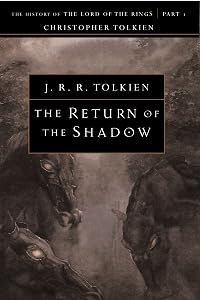
In this sixth volume of The History of Middle earth the story reaches The Lord of the Rings. In The Return of the Shadow (an abandoned title for the first volume) Christopher Tolkien describes, with full citation of the earliest notes, outline plans, and narrative drafts, the intricate evolution of The Fellowship of the Ring and the gradual emergence of the conceptions that transformed what J.R.R. Tolkien for long believed would be a far shorter book, 'a sequel to The Hobbit'. The show more enlargement of Bilbo's 'magic ring' into the supremely potent and dangerous Ruling Ring of the Dark Lord is traced and the precise moment is seen when, in an astonishing and unforeseen leap in the earliest narrative, a Black Rider first rode into the Shire, his significance still unknown. The character of the hobbit called Trotter (afterwards Strider or Aragorn) is developed while his indentity remains an absolute puzzle, and the suspicion only very slowly becomes certainty that he must after all be a Man. The hobbits, Frodo's companions, undergo intricate permutations of name and personality, and other major figures appear in strange modes: a sinister Treebeard, in league with the Enemy, a ferocious and malevolent Farmer Maggot. The story in this book ends at the point where J.R.R. Tolkien halted in the story for a long time, as the Company of the Ring, still lacking Legolas and Gimli, stood before the tomb of Balin in the Mines of Moria. The Return of the Shadow is illustrated with reproductions of the first maps and notable pages from the earliest manuscripts. show lessTags
Recommendations







Member Reviews
This is volume one of The History of the Lord of the Rings. I loved this, but I'll tell you right now that this is beyond nerdy, and if you aren't deeply interested in Tolkien and his creative process, it will be beyond boring to you. That said, it's an amazing trove of information on the development of The Lord of the Rings and of Middle-earth in general. Christopher Tolkien provides annotated exerpts from various drafts of The Lord of the Rings, starting with Tolkien's earliest conceptions. It provides one with loads of great trivia -- did you know that Strider was originally a hobbit with wooden shoes known as Trotter? And Frodo's name was originally Bingo, and Merry was Marmaduke? What was fascinating to me, as well, is how show more comparatively late in the writing process Tolkien seems to have hit upon the idea of the Rings of Power and the themes that became integral to the novel. Fascinating stuff. show less
http://nwhyte.livejournal.com/1824549.html
Here we have three-ish drafts of The Lord of the Rings up to the exploration of Moria. It is striking how quickly Tolkien shifted tone from the young-reader-ish style of The Hobbit, which surivives in the very first draft of the first chapter, but really no further, to adopt a more mature voice. But it's also interesting to see the evolution of the character who became Strider, at first a mysterious hobbit called Trotter who turns out to be a long-lost cousin of Bilbo's called Peregrine. The names and characters of Frodo and his friends changed very substantially between rewrites (though the dialogue between them was surprisingly constant). The original Fellowship includes the four hobbits from show more the Shire, Troter, Gandalf and Boromir but no dwarf or elf. At one point the editor quotes his father's marginal note "Christopher wants Odo kept" but admits that he is unable now to remember why (Odo ends up party Frodo and partly Pippin). The geography and distances between Bree and Rivendell are chopped about a bit, leaving some inconsistency in the published book. It's a fascinating insight into how revising a text can make it stronger, and how sometimes bits in the middle come right almost immediately while you are still tinkering with the beginning. show less
Here we have three-ish drafts of The Lord of the Rings up to the exploration of Moria. It is striking how quickly Tolkien shifted tone from the young-reader-ish style of The Hobbit, which surivives in the very first draft of the first chapter, but really no further, to adopt a more mature voice. But it's also interesting to see the evolution of the character who became Strider, at first a mysterious hobbit called Trotter who turns out to be a long-lost cousin of Bilbo's called Peregrine. The names and characters of Frodo and his friends changed very substantially between rewrites (though the dialogue between them was surprisingly constant). The original Fellowship includes the four hobbits from show more the Shire, Troter, Gandalf and Boromir but no dwarf or elf. At one point the editor quotes his father's marginal note "Christopher wants Odo kept" but admits that he is unable now to remember why (Odo ends up party Frodo and partly Pippin). The geography and distances between Bree and Rivendell are chopped about a bit, leaving some inconsistency in the published book. It's a fascinating insight into how revising a text can make it stronger, and how sometimes bits in the middle come right almost immediately while you are still tinkering with the beginning. show less
This one, I've read! All the way through. And would like to read it again. It's deep, and not that easy to read. I would recommend a chapter at a time, to fully inundate oneself in the process Tolkien went through while he moved from the joviality and child-like-ness of The Hobbit to the darker themes of the War of the Ring.
There is even the point in his writing where he seems to realize that he needs to write something darker. It's while he's describing four hobbits trekking through the Shire and a cloaked figure comes up to them. It's Gandalf and merriment ensues. Then four hobbits are trekking through the Shire and a cloaked figure comes up to them. It's Gandalf, but they are scared before he reveals himself. Then four hobbits are show more walking through the Shire and a cloaked figure comes up behind them. It starts to sniff at them and they are frightened by its presence.
The book includes the original writings, then Christopher Tolkien's commentary and history of the writings, and it is fascinating to see how the names and countries and themes evolved. A must-read for any Tolkien geek. show less
There is even the point in his writing where he seems to realize that he needs to write something darker. It's while he's describing four hobbits trekking through the Shire and a cloaked figure comes up to them. It's Gandalf and merriment ensues. Then four hobbits are trekking through the Shire and a cloaked figure comes up to them. It's Gandalf, but they are scared before he reveals himself. Then four hobbits are show more walking through the Shire and a cloaked figure comes up behind them. It starts to sniff at them and they are frightened by its presence.
The book includes the original writings, then Christopher Tolkien's commentary and history of the writings, and it is fascinating to see how the names and countries and themes evolved. A must-read for any Tolkien geek. show less
I really love this. It's not for everyone, but I find seeing the process by which The Lord of the Rings came into being absolutely fascinating, as a fan who knows the books in their finished form inside out. Really magnificent work by Christopher Tolkien here.
This is book 6 in The History of Middle Eath series, but is the beginning of the 4-book study on The Lord of the Rings. I found it pretty interesting, much more interesting than the previous 5 (except maybe for The Lays of Beleriand) though I did enjoy those as well. This gets back to hobbits, and its really neat to see how the story develops. For instance- Strider started out as a hobbit!!
Não lido
Ratings
Members
- Recently Added By
Lists

LOTR wishlist
9 works; 1 member
Author Information

610+ Works 519,546 Members
A writer of fantasies, Tolkien, a professor of language and literature at Oxford University, was always intrigued by early English and the imaginative use of language. In his greatest story, the trilogy The Lord of the Rings (1954--56), Tolkien invented a language with vocabulary, grammar, syntax, even poetry of its own. Though readers have show more created various possible allegorical interpretations, Tolkien has said: "It is not about anything but itself. (Certainly it has no allegorical intentions, general, particular or topical, moral, religious or political.)" In The Adventures of Tom Bombadil (1962), Tolkien tells the story of the "master of wood, water, and hill," a jolly teller of tales and singer of songs, one of the multitude of characters in his romance, saga, epic, or fairy tales about his country of the Hobbits. Tolkien was also a formidable medieval scholar, as evidenced by his work, Beowulf: The Monster and the Critics (1936) and his edition of Anciene Wisse: English Text of the Anciene Riwle. Among his works published posthumously, are The Legend of Sigurd and Gudrún and The Fall of Arthur, which was edited by his son, Christopher. In 2013, his title, TheHobbit (Movie Tie-In) made The New York Times Best Seller List. (Bowker Author Biography) show less
All Editions
Some Editions
Awards and Honors
Awards
Series

Work Relationships
Is contained in
Common Knowledge
- Canonical title
- The Return of the Shadow
- Original title
- The Return of the Shadow
- Original publication date
- 1988-08-25; 1988
- People/Characters
- Aragorn II; Frodo Baggins; Gimli; Legolas; Farmer Maggot; Treebeard (show all 10); Tom Bombadil; Trotter; Bingo; Adelard Took
- Important places
- Middle-earth; Moria; The Shire; Rivendell; Bree; Anduin (show all 8); Bag End, Hobbiton, The Shire; Beleriand
- Important events
- Battle of Five Armies; The Council of Elrond
- Dedication
- To Rayner Unwin
- First words
- As is well known, the manuscripts and typescripts of The Lord of the Rings were sold by J.R.R. Tolkien to Marquette University, Milwaukee, a few years after its publication, together with those of The Hobbit and Farmer Giles ... (show all)of Ham, and also Mr. Bliss.
- Last words
- (Click to show. Warning: May contain spoilers.)And on the right-hand bottom corner of the page, torn off from the rest, is the name Kazaddûm.
- Original language
- English
Classifications
Statistics
- Members
- 1,880
- Popularity
- 11,503
- Reviews
- 6
- Rating
- (3.86)
- Languages
- 7 — English, Finnish, German, Hungarian, Italian, Polish, Spanish
- Media
- Paper, Ebook
- ISBNs
- 18
- UPCs
- 2
- ASINs
- 9