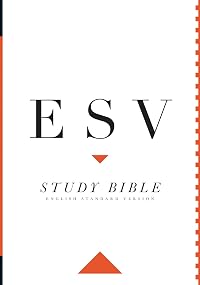
ESV Study Bible
by Crossway (Publisher)
On This Page
Description
The ESV Study Bible was created to help people understand the Bible in a deeper way. Combining the best and most recent evangelical Christian scholarship with the highly regarded ESV text, it is the most comprehensive study Bible ever published. The ESV Study Bible features more than 2,750 pages of extensive, accessible Bible resources, including completely new notes, full-color maps, illustrations, charts, timelines, and articles created by an outstanding team of 93 evangelical Christian show more scholars and teachers. In addition to the 757,000 words of the ESV Bible itself, the notes and resources of the ESV Study Bible comprise an additional 1.1 million words of insightful explanation and teaching-equivalent to a 20-volume Bible resource library all contained in one volume. (Please note this edition does not come with free access to the Online ESV Study Bible resources.) - 9-point Lexicon type (single-column Bible text); 7-point Frutiger type (double-column study notes) - Black letter text - Concordance - Extensive articles - 240 full-color maps and illustrations. show lessTags
Recommendations
















Member Recommendations

lhungsbe My go-to version of the Bible. No additions or deletions. Easy to read.
20

by anonymous user

by anonymous user

by anonymous user

by anonymous user

by anonymous user

by anonymous user

by anonymous user

by anonymous user


by anonymous user

by anonymous user

by anonymous user

by anonymous user
by anonymous user
Member Reviews
The ESV Study Bible represents, among the numerous translations I have owned over the years, a particularly effective balance between formal equivalence (word-for-word) and readability, achieving clarity without compromising textual precision. In contrast to earlier experiences with the Ryrie Study Bible—which leans toward a distinctly dogmatic and interpretively narrow stance—the ESV offers a noticeably less biased presentation of biblical texts.
The supplementary materials in the back of this student edition demonstrate high academic quality while remaining rooted in evangelical tradition. Notably, the section "God’s Plan for Salvation" is structured in an apologetic framework consistent with broadly evangelical convictions (such show more as those held within Baptist circles), while commendably refraining from entering into intra-evangelical conflicts regarding matters like perseverance or assurance of salvation.
Whereas certain translations prioritize theological or academic rigor often at the expense of doctrinal clarity, the ESV Study Bible proposes an integrated approach. Its study notes and resources encompass both rational (theological) and relational (doctrinal and applicative) aspects, distinguishing it from alternative editions such as the Life Application Bible, which, while accessible and practically oriented, can risk neglecting deeper rational engagement. For new or younger believers, the Life Application Study is fantastic.
In sum, the ESV Study Bible succeeds in providing a robust connection between theological knowledge and personal belief, establishing a foundation that supports both intellectual inquiry and formative spiritual practice. It's the version I carry every Sunday and read from daily. show less
The supplementary materials in the back of this student edition demonstrate high academic quality while remaining rooted in evangelical tradition. Notably, the section "God’s Plan for Salvation" is structured in an apologetic framework consistent with broadly evangelical convictions (such show more as those held within Baptist circles), while commendably refraining from entering into intra-evangelical conflicts regarding matters like perseverance or assurance of salvation.
Whereas certain translations prioritize theological or academic rigor often at the expense of doctrinal clarity, the ESV Study Bible proposes an integrated approach. Its study notes and resources encompass both rational (theological) and relational (doctrinal and applicative) aspects, distinguishing it from alternative editions such as the Life Application Bible, which, while accessible and practically oriented, can risk neglecting deeper rational engagement. For new or younger believers, the Life Application Study is fantastic.
In sum, the ESV Study Bible succeeds in providing a robust connection between theological knowledge and personal belief, establishing a foundation that supports both intellectual inquiry and formative spiritual practice. It's the version I carry every Sunday and read from daily. show less
The English Standard Version with helpful articles and running commentary on the text.
The ESV is an excellent formal equivalence English translation of the Bible. It faithfully renders the words and concepts of the original texts but does so in clear and easily understood English. As such, the ESV is an excellent primary Bible for reading and preaching, and well-suited for everyday use.
The study Bible has many additional resources. The quality of the maps and diagrams are superb: if you really want to get a good rendering of the installations described in Exodus, 1 Kings/2 Chronicles, and Ezekiel, the diagrams in the ESV Study Bible prove extremely helpful There are introductions to each testament, each section of books within each show more testament, and for each individual book; there are also articles at the beginning, between the testaments, and at the end regarding the history of the Biblical text, the theology of the OT and NT, the history of the intertestamental period, matters regarding various religions, denominations, the history of Christianity, Biblical ethics and morality, and such like. Within each book there is a running commentary at the bottom, explaining the meaning of the text in sections and verses. The ESV Study Bible also highlights literary aspects and themes present within the texts, which is most helpful.
There are many great strengths to this study Bible; many of the comments are extremely good and useful for general understanding. There is an unevenness about the commentary since each book is commented upon by someone different. Occasionally a commentator will focus a bit much on a particular line of argument in a way that distracts from the text, but most of the comments are relevant and useful.
On the whole, I felt the OT commentary was much stronger than the NT commentary. The OT is more even-handed; in matters regarding eschatology, multiple interpretations are suggested, and primacy is not inherently given to any particular eschatological plan. It is in the New Testament where it becomes plainly evident that the commentators are conservative Evangelicals with a Calvinist bent. For better or worse, far too many of the NT comments attempt to explain what the text is "not" saying, which can sometimes be useful but can also be problematic. Baptism is relegated to symbolic status; faith only and especially substitutionary atonement are magnified; the commentators' adherence to "once saved, always saved" is so obvious that they resort to minimizing the texts which show the challenge with such a view (Hebrews 3:12-14, 6:4-6, 10:26-31, 2 Peter 2:20-22, etc.), attempting to say that they don't say what they clearly say because of other passages that in no way deny what is being said. The commentators do recognize that multiple elders over a single congregation was the original organization of NT churches. Some commentators have more sympathy for dispensational premillennialism but it is not as prevalent as might be expected.
So, as with any commentary, caveat emptor: test all things. Nevertheless, when it comes to cultural background, making general sense of the text in context (especially in the OT), maps, diagrams, and other such things, the ESV Study Bible remains a great resource and worth consideration. show less
The ESV is an excellent formal equivalence English translation of the Bible. It faithfully renders the words and concepts of the original texts but does so in clear and easily understood English. As such, the ESV is an excellent primary Bible for reading and preaching, and well-suited for everyday use.
The study Bible has many additional resources. The quality of the maps and diagrams are superb: if you really want to get a good rendering of the installations described in Exodus, 1 Kings/2 Chronicles, and Ezekiel, the diagrams in the ESV Study Bible prove extremely helpful There are introductions to each testament, each section of books within each show more testament, and for each individual book; there are also articles at the beginning, between the testaments, and at the end regarding the history of the Biblical text, the theology of the OT and NT, the history of the intertestamental period, matters regarding various religions, denominations, the history of Christianity, Biblical ethics and morality, and such like. Within each book there is a running commentary at the bottom, explaining the meaning of the text in sections and verses. The ESV Study Bible also highlights literary aspects and themes present within the texts, which is most helpful.
There are many great strengths to this study Bible; many of the comments are extremely good and useful for general understanding. There is an unevenness about the commentary since each book is commented upon by someone different. Occasionally a commentator will focus a bit much on a particular line of argument in a way that distracts from the text, but most of the comments are relevant and useful.
On the whole, I felt the OT commentary was much stronger than the NT commentary. The OT is more even-handed; in matters regarding eschatology, multiple interpretations are suggested, and primacy is not inherently given to any particular eschatological plan. It is in the New Testament where it becomes plainly evident that the commentators are conservative Evangelicals with a Calvinist bent. For better or worse, far too many of the NT comments attempt to explain what the text is "not" saying, which can sometimes be useful but can also be problematic. Baptism is relegated to symbolic status; faith only and especially substitutionary atonement are magnified; the commentators' adherence to "once saved, always saved" is so obvious that they resort to minimizing the texts which show the challenge with such a view (Hebrews 3:12-14, 6:4-6, 10:26-31, 2 Peter 2:20-22, etc.), attempting to say that they don't say what they clearly say because of other passages that in no way deny what is being said. The commentators do recognize that multiple elders over a single congregation was the original organization of NT churches. Some commentators have more sympathy for dispensational premillennialism but it is not as prevalent as might be expected.
So, as with any commentary, caveat emptor: test all things. Nevertheless, when it comes to cultural background, making general sense of the text in context (especially in the OT), maps, diagrams, and other such things, the ESV Study Bible remains a great resource and worth consideration. show less
I love the ESV translation and based on what I've seen and heard, it's the most accurate "non-wooden" translation available in English today. Sadly, however, I don't care as much for the commentary in the ESV Study Bible. I find it to be lacking in depth, sometimes so obvious as to be redundant, and sometimes wildly interpretive. I hope some different study versions emerge to go along with the excellent translation.
I read a different translation of the bible every year in a 1 year study. This translation has very comprehensive study notes, loads of maps, weights & measures, doctrine overview, canon of the scripture, history of salvation, etc. It's the best study Bible I've read so far. It digs in deep without being opinionated & follows each passage.
The Positives of the ESV Study Bible
The Maps! If you like maps, this is your Bible. Most Study Bibles have maps, especially in the back of the Book. But, this study Bible is map-paradise. There are maps in the back, but also in the front of each book placing the book in location. Not only that but there are maps in the study notes at the bottom of the page, and they are in color. So, if you are talking about a battle, in the notes there will be a map of the area and arrows showing the movement of each side. If there is a journey, a map will chart the course.
The Charts! I'm a "chart-girl." At least my girlfriend used to call me that. There are charts, charts, charts: genealogies, charts of kings, charts of all the mentions of a word or show more phrase in a book (such as how many time The Spirit of the Lord is mentioned), charts of percentages, etc.
The Historical/Archaeological Corroboration: Events are put into their historical setting. For example, the book of Nahum is a prophecy against the Assyrians, and the author names the rulers of Assyria with their dates of reign, the affliction they brought against Israel, and the significance historically. The study notes often list archaeological corroboration. For example, in I Kings 14:25-26 the note tells that "a monumental relief of the Bubastite Portal of the main temple of Amon...catalogs, town by town, Shishak's military incursion into Israel and Judah. The Karnak relief provides striking verification of the biblical account."
The literary significance: At the beginning of each book there is a section titled "Literary Features." This section clearly talks about the genre of the book and some literary features employed by the author, holding each book up as some of the world's great literature.
Possible Negatives:
Each book of the Bible has a different author/s for the notes; some authors seem more conservative than others. (This is also one of this Study Bible's great strengths because dozens of theologians are writing in their area of specialization.) For example, there is a note in Genesis arguing that the flood did not have to be worldwide.
Prophecy: Your view of future prophecy may differ. For example, the notes in the book of I Thessalonians do not use the term "Rapture" but instead the "Second Coming of Christ." However, the notes in Revelation do delineate the various viewpoints on end-time prophecy. There are diagrams/timelines showing future events from the various schools of interpretation including Dispensational Premillennialism, Historical Premillennialism, Preterists Schools, Idealist School, etc. Then there are more charts discussing various ideas on the Millennium.
Overall I think this Study Bible is worth it for the maps and charts alone. The colored graphics for the Tabernacle, Solomon's Temple, and Herod's Temple (not to mention of the city of Jerusalem) are outstanding. Even if you disagree on the some of the comments on prophecy, this would be a great reference book to have on your shelf. I thought the notes were very helpful in linking events to their historical setting. show less
The Maps! If you like maps, this is your Bible. Most Study Bibles have maps, especially in the back of the Book. But, this study Bible is map-paradise. There are maps in the back, but also in the front of each book placing the book in location. Not only that but there are maps in the study notes at the bottom of the page, and they are in color. So, if you are talking about a battle, in the notes there will be a map of the area and arrows showing the movement of each side. If there is a journey, a map will chart the course.
The Charts! I'm a "chart-girl." At least my girlfriend used to call me that. There are charts, charts, charts: genealogies, charts of kings, charts of all the mentions of a word or show more phrase in a book (such as how many time The Spirit of the Lord is mentioned), charts of percentages, etc.
The Historical/Archaeological Corroboration: Events are put into their historical setting. For example, the book of Nahum is a prophecy against the Assyrians, and the author names the rulers of Assyria with their dates of reign, the affliction they brought against Israel, and the significance historically. The study notes often list archaeological corroboration. For example, in I Kings 14:25-26 the note tells that "a monumental relief of the Bubastite Portal of the main temple of Amon...catalogs, town by town, Shishak's military incursion into Israel and Judah. The Karnak relief provides striking verification of the biblical account."
The literary significance: At the beginning of each book there is a section titled "Literary Features." This section clearly talks about the genre of the book and some literary features employed by the author, holding each book up as some of the world's great literature.
Possible Negatives:
Each book of the Bible has a different author/s for the notes; some authors seem more conservative than others. (This is also one of this Study Bible's great strengths because dozens of theologians are writing in their area of specialization.) For example, there is a note in Genesis arguing that the flood did not have to be worldwide.
Prophecy: Your view of future prophecy may differ. For example, the notes in the book of I Thessalonians do not use the term "Rapture" but instead the "Second Coming of Christ." However, the notes in Revelation do delineate the various viewpoints on end-time prophecy. There are diagrams/timelines showing future events from the various schools of interpretation including Dispensational Premillennialism, Historical Premillennialism, Preterists Schools, Idealist School, etc. Then there are more charts discussing various ideas on the Millennium.
Overall I think this Study Bible is worth it for the maps and charts alone. The colored graphics for the Tabernacle, Solomon's Temple, and Herod's Temple (not to mention of the city of Jerusalem) are outstanding. Even if you disagree on the some of the comments on prophecy, this would be a great reference book to have on your shelf. I thought the notes were very helpful in linking events to their historical setting. show less
For most of my Christian life I have always been NIV-positive. Someone introduced the ESV Study Bible to me about a year ago and I haven't reverted back to my NIV Bible ever since. I have understood that the ESV is a revised version of the RSV and perhaps the most accurate English translation of the Bible to date. Similar to the Tyndale English Bible, it captures both the thought-for-thought and word-for-word translation better than any other English version. This study version has excellent commentary from notable Bible scholars, theologians, and seminary professors throughout the English speaking world. I highly recommend this study Bible to any Christian ready to dig deeper into God's Word.
Well, hard to rate the Bible under 5 stars, lol! :D This gets a 5 both for content and the actual physical book itself. Very pleased with the bonded-leather quality, maps, text notes/resources, etc. And the content ... suffice to say, life-changing.
Members
- Recently Added By
Lists

Books We'd Want on a Desert Island
203 works; 131 members
Author Information

Awards and Honors
Awards
Common Knowledge
- Canonical title
- ESV Study Bible
- Original publication date
- 2008-10-15
- Publisher's editor
- Dennis, Lane T.; Grudem, Wayne
- Disambiguation notice
- This work contains all editions of The ESV Study Bible. Please do not combine it with any other study Bible or Bible translation.
Study bibles are distinguished by their particular set of notes and study aids, not just... (show all) by translation. Do not combine this with other ESV study bibles with different notes. The Archaeology, Church History, Reformation, Student and The ESV Study Bible are all different works
Classifications
Statistics
- Members
- 3,155
- Popularity
- 5,512
- Reviews
- 16
- Rating
- (4.81)
- Languages
- English, French
- Media
- Paper, Ebook
- ISBNs
- 91
- ASINs
- 7