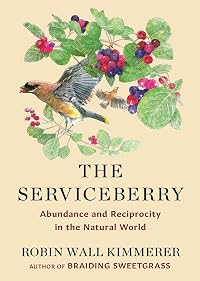
The Serviceberry: Abundance and Reciprocity in the Natural World
by Robin Wall Kimmerer
On This Page
Description
Robin Wall Kimmerer harvests serviceberries alongside the birds, she considers the ethic of reciprocity that lies at the heart of the gift economy. How, she asks, can we learn from Indigenous wisdom and the plant world to reimagine what we value most? Our economy is rooted in scarcity, competition, and the hoarding of resources, and we have surrendered our values to a system that actively harms what we love. Meanwhile, the serviceberry's relationship with the natural world is an embodiment show more of reciprocity, interconnectedness, and gratitude. The tree distributes its wealth, its abundance of sweet, juicy berries, to meet the needs of its natural community. And this distribution insures its own survival. show lessTags
Recommendations


































Member Reviews
Robin Wall Kimmerer first received my notice in 2020 when her 2013 book, Braiding Sweetgrass was on the NY Times paperback best seller list. My book group read it in 2022 and I enjoyed her thoughtful writing style and how she "gently challenge[s] us to reevaluate our relationship with the natural world." In The Serviceberry, she takes one aspect that she touched on in Braiding Sweetgrass, that of reciprocity and the gift economy and expands on it. What if, she asks, our communities could be based more on mutual giving than monetary transactions? What if we were more like the serviceberries, giving of abundance instead of hoarding?
The long essay that follows in a meditation on and attempted answer to that question. It's sometimes show more meandering and repetitive in the way sitting down with a friend and hashing out possibilities can be. But I enjoyed the contemplation, and thought about ways I have been part of a gift economy - my neighbor just yesterday morning was out in my yard cutting rhubarb, and I am very glad that she can use it because goodness knows I have more than enough for just myself. And when I do use it, I love to make things, have some and gift the rest away. Or take Little Free Libraries - an example Kimmerer herself uses in the book. I like to think that Kimmerer would be delighted to know that I found this book in a Little Free Library and plan on putting it out in my own to send on to the next person. For all that she talks about the good of this kind of economy, Kimmerer is clear eyed in knowing that some people will take advantage, and does not think that capitalism will go away any time soon. But she does challenge you to think about a better, more communal way of interacting, both in relationship with each other and the natural world. show less
The long essay that follows in a meditation on and attempted answer to that question. It's sometimes show more meandering and repetitive in the way sitting down with a friend and hashing out possibilities can be. But I enjoyed the contemplation, and thought about ways I have been part of a gift economy - my neighbor just yesterday morning was out in my yard cutting rhubarb, and I am very glad that she can use it because goodness knows I have more than enough for just myself. And when I do use it, I love to make things, have some and gift the rest away. Or take Little Free Libraries - an example Kimmerer herself uses in the book. I like to think that Kimmerer would be delighted to know that I found this book in a Little Free Library and plan on putting it out in my own to send on to the next person. For all that she talks about the good of this kind of economy, Kimmerer is clear eyed in knowing that some people will take advantage, and does not think that capitalism will go away any time soon. But she does challenge you to think about a better, more communal way of interacting, both in relationship with each other and the natural world. show less
My working assumption when I picked up this extended essay was that I was going to be getting natural history informed by musings on personal values. In reality, it's more the other way around, as Kimmerer considers the contrasts between a socioeconomic system informed by values of reciprocity and appreciation, as opposed to the current state of affairs where the drives for "full-market values" and empire building seemed to have led society into an untenable cul-de-sac.
While the more cynical might scoff, it's also quite clear that the current state of affairs is not tenable, and seems to be failing before our eyes; not helped by "beggar-thy-neighbor" attitudes that will only lead to a conflict of all-against-all. Genuine food for show more thought. I would also note that even back in the 1970s when I was studying undergrad economics, my professors dryly noted that "Homo Economicus" is just a theoretical place holder, not a real thing! show less
While the more cynical might scoff, it's also quite clear that the current state of affairs is not tenable, and seems to be failing before our eyes; not helped by "beggar-thy-neighbor" attitudes that will only lead to a conflict of all-against-all. Genuine food for show more thought. I would also note that even back in the 1970s when I was studying undergrad economics, my professors dryly noted that "Homo Economicus" is just a theoretical place holder, not a real thing! show less
Summary: A day of picking serviceberries leads to an extended reflection on natural abundance, reciprocity, and gratitude.
An invitation to pick serviceberries results in an extended meditation by Robin Wall Kimmerer on “abundance and reciprocity in the natural world,” in the words of her subtitle. She marvels at the abundant clusters of berries, rapidly filling her pail. This is sheer gift, both to her and the birds filling their bellies” with berries. All one can do is give thanks for this gift, and share the abundance. As she does so, she considers the web of reciprocity the berries represent. Bushes nourished by fallen leaves, birds nourished by berries. Birds spreading their seeds, spreading the bushes to new locations. show more Kimmerer recalls how the berries are part of the traditional Potawatomi food economy.
It’s an economy unlike the market economy that dominates most of our economic transactions. Instead, Kimmerer reflects on the gift economy her serviceberry experience represents. Specifically, it reminds her of the source of the gift and how that implies care both for the source and for the gift itself. And she considers how commoditization of gifts promotes accumulation rather than sharing, scarcity rather than abundance.
I was struck by how contrary to our individualism are the gift economies she describes. Instead of accumulating paper currency or its equivalent, the currency of gift economies is gratitude and connection. The prosperity of each is shared in the anticipation of enjoying the generosity of others. One charts, not the flow of money, but relationships. Kimmerer points to the potlatches of Pacific Northwest people as a well-known example of gift economy.
She reflects on ways gift economies function in our mixed economies. These range from free garden produce stands to Little Free Libraries (and their larger tax-supported counterparts). They include public parks and lands that we all enjoy. The latter part of the book then considers the ethic of honorable harvest in gift economies, versus the unchecked extractive nature of our commodity economies. Through a question posed by a fellow tribal member, she queries, “If the economy requires people to consume more resources than the earth can replenish, just to keep the whole thing from collapsing, isn’t it time for a new economy?”
Kimmerer is not an economist but an ecologist. But what she observes from her ecology and the wisdom of indigenous peoples, makes a case for economists to begin thinking about that new economy. What is most notable for me however is that Kimmerer’s ecology and her gift economy are full of gratitude, generosity, joy, connectedness, and wholeness. It is not an ethic of fear, guilt, or burden, or survival of the economically fittest. There is a goodness about what she describes that is perhaps the most powerful argument for devoting ourselves to learn the gift economy. G’chi megwech, Robin Wall Kimmerer! show less
An invitation to pick serviceberries results in an extended meditation by Robin Wall Kimmerer on “abundance and reciprocity in the natural world,” in the words of her subtitle. She marvels at the abundant clusters of berries, rapidly filling her pail. This is sheer gift, both to her and the birds filling their bellies” with berries. All one can do is give thanks for this gift, and share the abundance. As she does so, she considers the web of reciprocity the berries represent. Bushes nourished by fallen leaves, birds nourished by berries. Birds spreading their seeds, spreading the bushes to new locations. show more Kimmerer recalls how the berries are part of the traditional Potawatomi food economy.
It’s an economy unlike the market economy that dominates most of our economic transactions. Instead, Kimmerer reflects on the gift economy her serviceberry experience represents. Specifically, it reminds her of the source of the gift and how that implies care both for the source and for the gift itself. And she considers how commoditization of gifts promotes accumulation rather than sharing, scarcity rather than abundance.
I was struck by how contrary to our individualism are the gift economies she describes. Instead of accumulating paper currency or its equivalent, the currency of gift economies is gratitude and connection. The prosperity of each is shared in the anticipation of enjoying the generosity of others. One charts, not the flow of money, but relationships. Kimmerer points to the potlatches of Pacific Northwest people as a well-known example of gift economy.
She reflects on ways gift economies function in our mixed economies. These range from free garden produce stands to Little Free Libraries (and their larger tax-supported counterparts). They include public parks and lands that we all enjoy. The latter part of the book then considers the ethic of honorable harvest in gift economies, versus the unchecked extractive nature of our commodity economies. Through a question posed by a fellow tribal member, she queries, “If the economy requires people to consume more resources than the earth can replenish, just to keep the whole thing from collapsing, isn’t it time for a new economy?”
Kimmerer is not an economist but an ecologist. But what she observes from her ecology and the wisdom of indigenous peoples, makes a case for economists to begin thinking about that new economy. What is most notable for me however is that Kimmerer’s ecology and her gift economy are full of gratitude, generosity, joy, connectedness, and wholeness. It is not an ethic of fear, guilt, or burden, or survival of the economically fittest. There is a goodness about what she describes that is perhaps the most powerful argument for devoting ourselves to learn the gift economy. G’chi megwech, Robin Wall Kimmerer! show less
Kimmerer uses the serviceberry as a metaphor for a gift economy, imagining how our world might be improved if we moved from an exclusively cash economy to a gift economy that recognizes that exchanging of goods is a reciprocal human relationship based on care and mutual prosperity. It's a very short book, but this act of imagining an alternative economic system is so important right now. We're stuck in a capitalist dystopia, and the first step for getting out of it is to imagine other ways that we might structure our world. Capitalism is so entrenched that it's hard to even think of any other way, but this book offers some ideas that feel very realistic, at least on a small scale.
This book complements a lot of the ideas in David show more Graeber's books. show less
This book complements a lot of the ideas in David show more Graeber's books. show less
I wasn't really expecting an essay on gift economies and contemplation on how they intersect with current economic trends, but I am delighted. I think Kimmerer is right, that this is how we move on from unsustainable trends, into a mature and abundant community. Gorgeous, accessible, and lovingly tied in to science. A joyful path forward, if we can find the way to take it.
Advanced Reader's Copy provided by Edelweiss.
Advanced Reader's Copy provided by Edelweiss.
THE SERVICEBERRY: ABUNDANCE AND RECIPROCITY IN THE NATURAL WORLD is an intriguing, concise (106 pages), non-fiction treatise on economic systems that, believe it or not, reads like a beautiful fable
Author Robin Wall Kimmerer, best known for the bestseller BRAIDING SWEETGRASS (which I have not read) asks us to contemplate a different way of living. Instead of a Capitalist society organized around the principle of scarcity where each person strives to own as much as possible, Kimmerer wants us to consider the philosophy of indigenous peoples.
Why not a gift economy instead? She argues that natural resources like land and water should never be owned, but instead, should be cared for by the entire community. There ARE already enough show more resources to provide for all the beings on the planet, if only we could learn to value collective community above the individual. Then, we could simply exchange (or pass on) assets generously - without an agreement for immediate or future reward? The stroller your young child no longer needs is given to a neighbor with a new baby; another neighbor with grown children passes on a bicycle to your child.
It may sound overly simplistic or naive but Kimmerer uses the workings of the natural world as a model. Trees use water and sunlight to produce flowers. Those flowers attract insects who, in exchange for nectar, help with pollination. Fruit that grows from this pollination is then eaten by birds who in turn spread seeds to start new trees. In a world facing climate disaster because of human excess and greed, doesn't it make more sense for humans to operate under a similar system of reciprocity?
As a noted scientist, educator, and ecologist, Kimmerer has something to teach us all. She offers an appealing vision of a world that is more sustainable. One with greater equity, more sharing, and less waste. The language she uses to describe her vision is lovely. And for a book you can read in less than two hours, it will certainly leave you pondering. For example, It made me wonder how different life might be if European settlers in North America had come NOT with arrogance and White Supremacy, but with an openness to learn from indigenous peoples. THE SERVICEBERRY is not only worth reading but worth giving as a gift. show less
Author Robin Wall Kimmerer, best known for the bestseller BRAIDING SWEETGRASS (which I have not read) asks us to contemplate a different way of living. Instead of a Capitalist society organized around the principle of scarcity where each person strives to own as much as possible, Kimmerer wants us to consider the philosophy of indigenous peoples.
Why not a gift economy instead? She argues that natural resources like land and water should never be owned, but instead, should be cared for by the entire community. There ARE already enough show more resources to provide for all the beings on the planet, if only we could learn to value collective community above the individual. Then, we could simply exchange (or pass on) assets generously - without an agreement for immediate or future reward? The stroller your young child no longer needs is given to a neighbor with a new baby; another neighbor with grown children passes on a bicycle to your child.
It may sound overly simplistic or naive but Kimmerer uses the workings of the natural world as a model. Trees use water and sunlight to produce flowers. Those flowers attract insects who, in exchange for nectar, help with pollination. Fruit that grows from this pollination is then eaten by birds who in turn spread seeds to start new trees. In a world facing climate disaster because of human excess and greed, doesn't it make more sense for humans to operate under a similar system of reciprocity?
As a noted scientist, educator, and ecologist, Kimmerer has something to teach us all. She offers an appealing vision of a world that is more sustainable. One with greater equity, more sharing, and less waste. The language she uses to describe her vision is lovely. And for a book you can read in less than two hours, it will certainly leave you pondering. For example, It made me wonder how different life might be if European settlers in North America had come NOT with arrogance and White Supremacy, but with an openness to learn from indigenous peoples. THE SERVICEBERRY is not only worth reading but worth giving as a gift. show less
We live in a time when every choice matters. The Serviceberry by Robin Wall Kimmerer
“When an economic system actively destroys what we love, isn’t it time for a different system?” Robin Wall Kimmerer asks us in The Serviceberry. She contrasts the Indigenous idea of a gift economy, where one views abundance as a gift to be shared, to the market economy that allows wealth to be privately held by a few.
Her illustration is the native serviceberry tree, whose berries were a staple that Native Americans used in pemmican. “Imagine a fruit that tastes like a Blueberry crossed with the satisfying heft of an Apple, a touch of rosewater, and a minuscule crunch of almond-flavored seeds.” Birds and animals rely on the berries.
She tells of show more a woman whose Serviceberry trees were so productive, she gave the berries away, an example of a gift economy where wone with an abundance shares with others. She references public libraries as another example of a gift economy, for the books belong to everyone.
Take only what you need, what is given. Never take over half or waste what you have been given. This teaching is contrary to a market economy focusing on buying more, waste actually a positive: buy cheap, toss, buy more, keep the factories going.
I participate on a social media site for our city where we give stuff away. People get what they need, and items are recycled and not trashed. A few years back, our apple trees were so productive we couldn’t keep up. We made applesauce and apple butter and froze them and baked. We have away boxes of apples. Our two mile square city has a half dozen Little Free Libraries. My weekly quilt group brings fabric and patterns and supplies to give away on the ‘free table” and we often share quilts we entirely made with fabric found there.
People do want to share.
It will take a revolution, or worse, to change the market economy. But we can each personally choose to live with gratitude, sharing what we have.
Thanks to the publisher for a free book through NetGalley. show less
“When an economic system actively destroys what we love, isn’t it time for a different system?” Robin Wall Kimmerer asks us in The Serviceberry. She contrasts the Indigenous idea of a gift economy, where one views abundance as a gift to be shared, to the market economy that allows wealth to be privately held by a few.
Her illustration is the native serviceberry tree, whose berries were a staple that Native Americans used in pemmican. “Imagine a fruit that tastes like a Blueberry crossed with the satisfying heft of an Apple, a touch of rosewater, and a minuscule crunch of almond-flavored seeds.” Birds and animals rely on the berries.
She tells of show more a woman whose Serviceberry trees were so productive, she gave the berries away, an example of a gift economy where wone with an abundance shares with others. She references public libraries as another example of a gift economy, for the books belong to everyone.
Take only what you need, what is given. Never take over half or waste what you have been given. This teaching is contrary to a market economy focusing on buying more, waste actually a positive: buy cheap, toss, buy more, keep the factories going.
I participate on a social media site for our city where we give stuff away. People get what they need, and items are recycled and not trashed. A few years back, our apple trees were so productive we couldn’t keep up. We made applesauce and apple butter and froze them and baked. We have away boxes of apples. Our two mile square city has a half dozen Little Free Libraries. My weekly quilt group brings fabric and patterns and supplies to give away on the ‘free table” and we often share quilts we entirely made with fabric found there.
People do want to share.
It will take a revolution, or worse, to change the market economy. But we can each personally choose to live with gratitude, sharing what we have.
Thanks to the publisher for a free book through NetGalley. show less
Members
- Recently Added By
Lists

LoanStars | Adult List: November 2024
10 works; 1 member

Indie Next Picks
196 works; 4 members

Habitat Hero books
37 works; 1 member

2025
42 works; 1 member

Books Read in 2025
4,091 works; 97 members

Lending Library
4 works; 1 member

Science: Earth
109 works; 1 member

naturallogg's 2025 in Books
50 works; 1 member
Author Information

22+ Works 10,385 Members
Robin Wall Kimmerer is a mother, scientist, decorated professor, and enrolled member of the Citizen Potawatomi Nation. Her first book, Garhering Moss, was awarded the John Burroughs Medal for outstanding nature writing. Her writings haw appeared in Orion, O Magazine, and numerous scientific journals. She lives in Fablus, New York, where she is show more SUNY Distinguished Teaching Professor of Environmental Biology, and the founder and director of the Center for Native Peoples and the Environment. show less
Some Editions
Awards and Honors
Awards
Distinctions
Common Knowledge
- Original publication date
- 2024-11-19
- Dedication
- To my good neighbors, Paulie and Ed Drexler.
- First words
- The cool breath of evening slips off the wooded hills, displacing the heat of the day, and with it come the birds, as eager for the cool as I am.
- Quotations
- What if scarcity is just a cultural construct, a fiction that fences us off from a. better way of life? (78)
- Last words
- (Click to show. Warning: May contain spoilers.)How will we answer?
- Original language
- English
Classifications
- Genres
- Science & Nature, Economics, Nonfiction, General Nonfiction
- DDC/MDS
- 581.63097 — Natural sciences & mathematics Plants (Botany) Specific topics in natural history of plants Miscellaneous nontaxonomic kinds of plants Beneficial plants
- LCC
- E98 .B7 .K56 — History of the United States America Indians of North America
- BISAC
Statistics
- Members
- 1,478
- Popularity
- 15,748
- Reviews
- 42
- Rating
- (4.15)
- Languages
- English, Spanish
- Media
- Paper, Audiobook, Ebook
- ISBNs
- 12
- ASINs
- 5