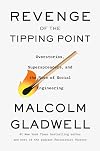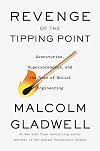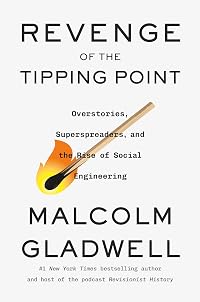
Revenge of the Tipping Point: Overstories, Superspreaders, and the Rise of Social Engineering
by Malcolm Gladwell
On This Page
Description
A lot has changed in 25 years. A quarter-century after the publication of his groundbreaking first book, Malcolm Gladwell returns with a brand-new volume that reframes the lessons of The Tipping Point in a startling and revealing light — this time in an immersive audio format that transports you, the listener, directly inside of each riveting story.Why is Miami... Miami? What does the heartbreaking fate of the cheetah tell us about the way we raise our children? Why do Ivy League schools show more care so much about sports? What is the Magic Third, and what does it mean for racial harmony? In this provocative new work, Malcolm Gladwell returns to the subject of social epidemics and tipping points, this time with the aim of explaining the dark side of contagious phenomena.
Through a series of gripping stories, Gladwell traces the rise of a new and troubling form of social engineering. As with his podcast Revisionist History and bestsellers Talking to Strangers and The Bomber Mafia, pressing play on this audiobook will bring each scene and story to life with vivid first-person accounts, captivating oral histories, illuminating moments from history past and present, and a cinematic original music score.
Take to the streets of Los Angeles with Malcolm to meet the world's most successful bank robbers, rediscover a forgotten television show from the 1970s that changed the world, visit the site of a historic experiment on a tiny cul-de-sac in northern California, and explore an alternate history of two of the biggest epidemics of our day: COVID and the opioid crisis.
Revenge of the Tipping Point is Gladwell's most personal book yet. With his characteristic mix of storytelling and social science, he offers a guide to making sense of the contagions of the modern world. It's time we took tipping points seriously.
. show less
Tags
Recommendations













Member Reviews
A Five-Star Review for "Revenge of the Tipping Point"
Malcolm Gladwell's "Revenge of the Tipping Point" is a brilliant and thought-provoking exploration of the dark side of social epidemics. Building on the foundation laid by his earlier work, "The Tipping Point," Gladwell masterfully examines how the very forces that can drive positive change can also be manipulated and exploited, leading to unintended and often devastating consequences.
One of the book's greatest strengths is its ability to weave together seemingly disparate stories and ideas into a compelling and cohesive narrative. Gladwell takes us on a journey from the streets of Los Angeles, where a teenage bank robbery epidemic raged, to the halls of Harvard University, where the show more admissions process favors athletes over academics, to the world of prescription painkillers, where the aggressive marketing of OxyContin fueled a national crisis.
Through these captivating examples, Gladwell introduces us to several key concepts that are essential for understanding the dynamics of social epidemics:
Overstories: These are the overarching narratives that shape our beliefs and behaviors. Gladwell shows how overstories can emerge from a variety of sources, including historical events, cultural trends, and even bureaucratic policies. The impact of overstories is illustrated by the example of "triplicate laws," which required doctors in certain states to make multiple copies of opioid prescriptions. These laws, initially intended as a simple bureaucratic measure, created a lasting narrative around the dangers of opioids, ultimately influencing prescribing practices and addiction rates for decades.
Superspreaders: These are the individuals or groups who disproportionately influence the course of an epidemic. In the context of disease outbreaks, superspreaders possess biological characteristics that make them exceptionally contagious. However, Gladwell extends this concept to other domains, arguing that certain individuals can act as superspreaders of ideas, behaviors, and even social problems. In the case of the opioid crisis, a small group of doctors, dubbed the "Super Core," were responsible for prescribing a vast majority of OxyContin, effectively fueling the epidemic.
Group Proportions: This concept highlights how group dynamics change significantly when a minority group reaches a certain critical mass. Gladwell explores this idea in the context of racial integration, corporate leadership, and even social movements, demonstrating how shifts in group proportions can trigger dramatic and often unexpected changes in behavior and outcomes.
Gladwell's writing is engaging, accessible, and often humorous, making complex ideas easy to grasp. He masterfully interweaves scientific research, historical anecdotes, and personal stories to create a narrative that is both informative and entertaining.
"Revenge of the Tipping Point" is not simply a rehash of Gladwell's previous work; it's a significant evolution of his thinking. The book challenges us to think critically about the forces that shape our world and to recognize the potential for both positive and negative tipping points. Gladwell urges us to be more aware of the overstories that influence our beliefs and to consider the unintended consequences of our actions.
This book is a must-read for anyone interested in understanding the hidden forces that drive social change. It's a timely and important work that will leave you questioning your assumptions and pondering the future of our increasingly interconnected world.
The full Deep Dive review of this book can be watched from our YouTube channel...
https://youtu.be/IHFf2WZ8toc show less
Malcolm Gladwell's "Revenge of the Tipping Point" is a brilliant and thought-provoking exploration of the dark side of social epidemics. Building on the foundation laid by his earlier work, "The Tipping Point," Gladwell masterfully examines how the very forces that can drive positive change can also be manipulated and exploited, leading to unintended and often devastating consequences.
One of the book's greatest strengths is its ability to weave together seemingly disparate stories and ideas into a compelling and cohesive narrative. Gladwell takes us on a journey from the streets of Los Angeles, where a teenage bank robbery epidemic raged, to the halls of Harvard University, where the show more admissions process favors athletes over academics, to the world of prescription painkillers, where the aggressive marketing of OxyContin fueled a national crisis.
Through these captivating examples, Gladwell introduces us to several key concepts that are essential for understanding the dynamics of social epidemics:
Overstories: These are the overarching narratives that shape our beliefs and behaviors. Gladwell shows how overstories can emerge from a variety of sources, including historical events, cultural trends, and even bureaucratic policies. The impact of overstories is illustrated by the example of "triplicate laws," which required doctors in certain states to make multiple copies of opioid prescriptions. These laws, initially intended as a simple bureaucratic measure, created a lasting narrative around the dangers of opioids, ultimately influencing prescribing practices and addiction rates for decades.
Superspreaders: These are the individuals or groups who disproportionately influence the course of an epidemic. In the context of disease outbreaks, superspreaders possess biological characteristics that make them exceptionally contagious. However, Gladwell extends this concept to other domains, arguing that certain individuals can act as superspreaders of ideas, behaviors, and even social problems. In the case of the opioid crisis, a small group of doctors, dubbed the "Super Core," were responsible for prescribing a vast majority of OxyContin, effectively fueling the epidemic.
Group Proportions: This concept highlights how group dynamics change significantly when a minority group reaches a certain critical mass. Gladwell explores this idea in the context of racial integration, corporate leadership, and even social movements, demonstrating how shifts in group proportions can trigger dramatic and often unexpected changes in behavior and outcomes.
Gladwell's writing is engaging, accessible, and often humorous, making complex ideas easy to grasp. He masterfully interweaves scientific research, historical anecdotes, and personal stories to create a narrative that is both informative and entertaining.
"Revenge of the Tipping Point" is not simply a rehash of Gladwell's previous work; it's a significant evolution of his thinking. The book challenges us to think critically about the forces that shape our world and to recognize the potential for both positive and negative tipping points. Gladwell urges us to be more aware of the overstories that influence our beliefs and to consider the unintended consequences of our actions.
This book is a must-read for anyone interested in understanding the hidden forces that drive social change. It's a timely and important work that will leave you questioning your assumptions and pondering the future of our increasingly interconnected world.
The full Deep Dive review of this book can be watched from our YouTube channel...
https://youtu.be/IHFf2WZ8toc show less
TL/DR: If you are a fan of Gladwell’s this book is worth a read, otherwise it’s a pass. The stories here just don’t gel together into a satisfying whole — unlike his prior books this one left me with a shrug rather than the feeling of being satisfyingly enlightened.
************
Is it me, or is it Malcolm? I’ve read almost every book Malcolm Gladwell has put out. I’ve enjoyed being led down the interesting path he always takes through stories that flesh out the hypothesis that is the reason for each of his books. His conversational writing style and ability to weave disparate narratives into a satisfying whole are hallmarks of his work. That second trait is not as much on display in this book, so perhaps that’s why this one show more left me with a shrug rather than a feeling of having been satisfyingly enlightened, as his prior books have. I’m leaning toward the notion that it’s not me, it’s Malcolm.
It might also be a sign of the times we are living in. These are serious times for both the US and the world. The world’s leading democracy is in crisis, daily ceding it’s leadership role in the world while, with oligarchy already at hand, seemingly descending further each day into autocracy. Gladwell’s conversational style and light touch “aha” moments seem out of sync with the times.
It’s hard to believe that it’s been twenty-five years since Gladwell’s first book, The Tipping Point, was published. The book was inspired by Gladwell’s fascination with the sudden drop in crime in New York City that occurred in the 1990s. It was a book-long discourse on what he calls social epidemics. The book included a chapter on crime and an exposition on the “broken windows” theory of policing (crack down hard on the little crimes and the bigger crimes will be reined in). “Broken windows”, accompanied by stop and frisk policing, were being put forward at the time to explain why New York’s crime rate, spiraling out of control for years, had suddenly dropped.
The Tipping Point looked at all kinds of phenomena from suicide rates to crime rates to how best sellers become best sellers, all through the lens of epidemiology. Was crime an epidemic? Did New York City’s approach — “stop and frisk” policing — act as an inoculant to the city’s epidemic of crime? Gladwell said yes.
The book was an instant best-seller and propelled Gladwell to years of celebrity and celebrity’s evil twin - disdain. Some see him as a big-picture thinker capable of putting insights into relatable contexts and understandable language, opening these ideas up for the rest of us. Some see him as Captain Obvious. I’ve been more of the latter than the former.
In between that book and this latest one, Gladwell has gone on to pen a number of very successful nonfiction books. And the world at large has changed a lot. For one thing we’ve all lived through the COVID epidemic, and so we’ve become a little more knowledgeable about epidemiology than we might like.
For another thing, stop and frisk and the broken windows theory of policing have fallen out of favor, as studies have shown little correlation between those techniques and crime rates. It’s that point in particular that has caused people in the intervening years to question Gladwell’s whole approach in writing The Tipping Point.
So, it’s not surprising that, when the 25th anniversary of the publication of The Tipping Point came around that Gladwell decided rather than issue a revised version, he would revisit the whole notion of social epidemics with a completely new book. Thus was born Revenge of the Tipping Point.
The big picture idea of this book is that, yes social epidemics do exist, and people who understand that are in a position to manipulate them. Frustratingly, he’s not talking about two of today’s hottest topics that would seem to fit into the overall idea of the book. He’s not talking about propaganda - the manipulation of the press to influence the spread of ideas. And social media — seemingly designed to spread social epidemics (they’re called “memes”) —doesn’t come up at all in this book.
He is talking about less obvious manipulations of human behavior. The book bounces from stories about TV show Will and Grace and its purported influence on the acceptance of gay marriage, to COVID — an actual epidemic — and how the spread of the COVID virus didn’t fit into easily understandable trajectories, to why Harvard has a women’s rugby team.
The stories are all interesting in and off themselves, and I do think I tore through this book at the same fast pace I’ve read his prior books. But do those stories add up to a cohesive whole that offers some fresh insight applicable to our times, as have his previous books? I have to say, at least for me, they did not. show less
************
Is it me, or is it Malcolm? I’ve read almost every book Malcolm Gladwell has put out. I’ve enjoyed being led down the interesting path he always takes through stories that flesh out the hypothesis that is the reason for each of his books. His conversational writing style and ability to weave disparate narratives into a satisfying whole are hallmarks of his work. That second trait is not as much on display in this book, so perhaps that’s why this one show more left me with a shrug rather than a feeling of having been satisfyingly enlightened, as his prior books have. I’m leaning toward the notion that it’s not me, it’s Malcolm.
It might also be a sign of the times we are living in. These are serious times for both the US and the world. The world’s leading democracy is in crisis, daily ceding it’s leadership role in the world while, with oligarchy already at hand, seemingly descending further each day into autocracy. Gladwell’s conversational style and light touch “aha” moments seem out of sync with the times.
It’s hard to believe that it’s been twenty-five years since Gladwell’s first book, The Tipping Point, was published. The book was inspired by Gladwell’s fascination with the sudden drop in crime in New York City that occurred in the 1990s. It was a book-long discourse on what he calls social epidemics. The book included a chapter on crime and an exposition on the “broken windows” theory of policing (crack down hard on the little crimes and the bigger crimes will be reined in). “Broken windows”, accompanied by stop and frisk policing, were being put forward at the time to explain why New York’s crime rate, spiraling out of control for years, had suddenly dropped.
The Tipping Point looked at all kinds of phenomena from suicide rates to crime rates to how best sellers become best sellers, all through the lens of epidemiology. Was crime an epidemic? Did New York City’s approach — “stop and frisk” policing — act as an inoculant to the city’s epidemic of crime? Gladwell said yes.
The book was an instant best-seller and propelled Gladwell to years of celebrity and celebrity’s evil twin - disdain. Some see him as a big-picture thinker capable of putting insights into relatable contexts and understandable language, opening these ideas up for the rest of us. Some see him as Captain Obvious. I’ve been more of the latter than the former.
In between that book and this latest one, Gladwell has gone on to pen a number of very successful nonfiction books. And the world at large has changed a lot. For one thing we’ve all lived through the COVID epidemic, and so we’ve become a little more knowledgeable about epidemiology than we might like.
For another thing, stop and frisk and the broken windows theory of policing have fallen out of favor, as studies have shown little correlation between those techniques and crime rates. It’s that point in particular that has caused people in the intervening years to question Gladwell’s whole approach in writing The Tipping Point.
So, it’s not surprising that, when the 25th anniversary of the publication of The Tipping Point came around that Gladwell decided rather than issue a revised version, he would revisit the whole notion of social epidemics with a completely new book. Thus was born Revenge of the Tipping Point.
The big picture idea of this book is that, yes social epidemics do exist, and people who understand that are in a position to manipulate them. Frustratingly, he’s not talking about two of today’s hottest topics that would seem to fit into the overall idea of the book. He’s not talking about propaganda - the manipulation of the press to influence the spread of ideas. And social media — seemingly designed to spread social epidemics (they’re called “memes”) —doesn’t come up at all in this book.
He is talking about less obvious manipulations of human behavior. The book bounces from stories about TV show Will and Grace and its purported influence on the acceptance of gay marriage, to COVID — an actual epidemic — and how the spread of the COVID virus didn’t fit into easily understandable trajectories, to why Harvard has a women’s rugby team.
The stories are all interesting in and off themselves, and I do think I tore through this book at the same fast pace I’ve read his prior books. But do those stories add up to a cohesive whole that offers some fresh insight applicable to our times, as have his previous books? I have to say, at least for me, they did not. show less
Malcolm Gladwell wrote The Tipping Point twenty-five years ago. He went into this book expecting simply to update it; however, he ended up taking a different direction. While the first book looked at “tipping points” from an optimistic point of view, the second examines the darker side, noting examples of where tipping points are manipulated or harmful. Gladwell looks at recent examples of epidemics, citing how they tend to follow patterns. He has chosen interesting topics, such as bank robberies, “white flight,” the opioid epidemic, and COVID-19.
The book employs specific terminology. Overstories are prevailing narratives and cultural beliefs that shape community behavior in a similar manner to the functioning of a forest show more canopy. Identifying the Overstory is a key to understanding why certain social movements flourish. Superspreaders are people or mechanisms that widely disseminate information or other factors that contribute to social trend or epidemic. I found some of the examples quite illuminating, such as the role of television in shifting public awareness (at least during the time when many people watched similar programming.) Gladwell posits that cultural messages can be more influential than formal laws in shaping beliefs and behaviors.
The biggest strength of this book is Gladwell’s ability to tell a great story, and I found it exceptionally entertaining. I am pretty sure there are other scientific factors at play in these scenarios, but I found many nuggets of wisdom. Gladwell simplifies complex concepts in a manner that is easy to understand. It is focused on a specific point in time, so I’m not sure how long it will remain relevant. Still, I think it is worth reading if you are interested in behavioral psychology, sociology, or how seemingly small changes can lead to larger social transformations. show less
The book employs specific terminology. Overstories are prevailing narratives and cultural beliefs that shape community behavior in a similar manner to the functioning of a forest show more canopy. Identifying the Overstory is a key to understanding why certain social movements flourish. Superspreaders are people or mechanisms that widely disseminate information or other factors that contribute to social trend or epidemic. I found some of the examples quite illuminating, such as the role of television in shifting public awareness (at least during the time when many people watched similar programming.) Gladwell posits that cultural messages can be more influential than formal laws in shaping beliefs and behaviors.
The biggest strength of this book is Gladwell’s ability to tell a great story, and I found it exceptionally entertaining. I am pretty sure there are other scientific factors at play in these scenarios, but I found many nuggets of wisdom. Gladwell simplifies complex concepts in a manner that is easy to understand. It is focused on a specific point in time, so I’m not sure how long it will remain relevant. Still, I think it is worth reading if you are interested in behavioral psychology, sociology, or how seemingly small changes can lead to larger social transformations. show less
***.5
It's an entertaining book and the audio production is very well done, with Gladwell doing an excellent job as narrator. But the logical leaps necessary to reach the stated conclusions from the anecdotal evidence provided are sometimes a bit much.
He also makes a rather glaring error while describing an observant Jewish man attending to some business on Saturday night after midnight when Shabbat ends. But midnight has no significance whatsoever in the Jewish calendar, the start and end times of holidays (including the weekly Shabbat) are determined based on sunset. If he flubbed such a basic concept and it made it through the editing process, I worry about what other errors are lurking within.
It's an entertaining book and the audio production is very well done, with Gladwell doing an excellent job as narrator. But the logical leaps necessary to reach the stated conclusions from the anecdotal evidence provided are sometimes a bit much.
He also makes a rather glaring error while describing an observant Jewish man attending to some business on Saturday night after midnight when Shabbat ends. But midnight has no significance whatsoever in the Jewish calendar, the start and end times of holidays (including the weekly Shabbat) are determined based on sunset. If he flubbed such a basic concept and it made it through the editing process, I worry about what other errors are lurking within.
This was a fascinating book; I enjoyed Mr. Gladwell’s story-telling and weaving of different narratives to make a coherent point. I actually thought that it was somewhat complementary to Yuval Noah Harari’s Nexus, which also talks about the power of stories we tell ourselves.
One of the reasons Revenge of the Tipping Point by Malcolm Gladwell is so enjoyable is because it speaks to a large audience, getting people who know nothing about a subject to find it fascinating. As a result, however, the stories that are brought forth are rebranded, or retold, of known ideas.
The book deserves a much closer look and a dose of critical thinking. Often time there’s a literary sleight of hand to hedge the narrative, which sounds authoritative show more otherwise. That doesn’t take away from the point though, even though I found some of the cases more convincing than others.
I am a firm believer in what the book is attempting to show, how little things can make a huge difference, purposefully or not. I do think though that Mr. Gladwell’s examples are somewhat outdated as the world has moved at a tremendous pace.
While the book offers no solutions, it is thought-provoking but is too vanilla. It’s as if the author tried to avoid complexity and the hard, and often ugly, truths despite his independent status. show less
One of the reasons Revenge of the Tipping Point by Malcolm Gladwell is so enjoyable is because it speaks to a large audience, getting people who know nothing about a subject to find it fascinating. As a result, however, the stories that are brought forth are rebranded, or retold, of known ideas.
The book deserves a much closer look and a dose of critical thinking. Often time there’s a literary sleight of hand to hedge the narrative, which sounds authoritative show more otherwise. That doesn’t take away from the point though, even though I found some of the cases more convincing than others.
I am a firm believer in what the book is attempting to show, how little things can make a huge difference, purposefully or not. I do think though that Mr. Gladwell’s examples are somewhat outdated as the world has moved at a tremendous pace.
While the book offers no solutions, it is thought-provoking but is too vanilla. It’s as if the author tried to avoid complexity and the hard, and often ugly, truths despite his independent status. show less
This follow up to The Tipping Point shows how tipping points can be manipulated, with real world examples used to explain concepts such as overstories and superspreaders. In the examples in the book, tipping points are manipulated to benefit those already enjoying the most privilege in our society.
I always learn from Mr. Gladwell's books. He has a way of viewing society and behaviour that is always insightful and helpful in understanding the world. I like his conversational style of writing and his use of stories to introduce concepts.
I would have liked a little more focus on the impact of social media on tipping points, but overall, this is another winner from Malcolm Gladwell.
I always learn from Mr. Gladwell's books. He has a way of viewing society and behaviour that is always insightful and helpful in understanding the world. I like his conversational style of writing and his use of stories to introduce concepts.
I would have liked a little more focus on the impact of social media on tipping points, but overall, this is another winner from Malcolm Gladwell.
Malcolm Gladwell’s “Revenge of the Tipping Point” is an odd follow-up to his first book, “The Tipping Point,” a bestseller that became a sensation twenty-five years ago. This time, instead of presenting a coherent update on the origin and nature of epidemics, the author peppers us with anecdotes, but fails to convincingly connect the dots between the stories he tells.
Some of the questions that Gladwell raises are why opioid addiction became a crisis that has taken an enormous number of American lives; how an executive retreat led to a Covid crisis in Boston; what occurred in an elite school that led to a rash of teen suicides; and why administrators at Harvard decided to form a female rugby team.
In "Revenge of the Tipping show more Point," we encounter such terms as overstories, the magic third, small area variation, and group proportions, but Gladwell does not persuasively explain how these and other concepts bring us from Point A to Point B. Therefore, we are left with a work of non-fiction that initially piques our curiosity, but does not fulfill its initial promise—to clarify how we can use social engineering to make our world healthier, happier, and more equitable. show less
Some of the questions that Gladwell raises are why opioid addiction became a crisis that has taken an enormous number of American lives; how an executive retreat led to a Covid crisis in Boston; what occurred in an elite school that led to a rash of teen suicides; and why administrators at Harvard decided to form a female rugby team.
In "Revenge of the Tipping show more Point," we encounter such terms as overstories, the magic third, small area variation, and group proportions, but Gladwell does not persuasively explain how these and other concepts bring us from Point A to Point B. Therefore, we are left with a work of non-fiction that initially piques our curiosity, but does not fulfill its initial promise—to clarify how we can use social engineering to make our world healthier, happier, and more equitable. show less
Members
- Recently Added By
Lists

LoanStars | Adult List: October 2024
10 works; 1 member

Globe and Mail | Canadian Non-Fiction: January 11, 2025
10 works; 1 member

Globe and Mail | Canadian Non-Fiction: March 22, 2025
10 works; 1 member

Globe and Mail | Canadian Non-Fiction: March 15, 2025
10 works; 1 member
Globe and Mail | Canadian Non-Fiction: March 8, 2025
10 works; 1 member

Globe and Mail | Canadian Non-Fiction: March 1, 2025
10 works; 1 member

Globe and Mail | Canadian Non-Fiction: February 22, 2025
10 works; 1 member

Globe and Mail | Canadian Non-Fiction: February 15, 2025
10 works; 1 member
Globe and Mail | Canadian Non-Fiction: February 8, 2025
10 works; 1 member
Globe and Mail | Canadian Non-Fiction: February 1, 2025
10 works; 1 member

Globe and Mail | Canadian Non-Fiction: January 25, 2025
10 works; 1 member

Globe and Mail | Canadian Non-Fiction: January 18, 2025
10 works; 1 member
Globe and Mail | Canadian Non-Fiction: Year End, 2024
10 works; 1 member
Globe and Mail | Canadian Non-Fiction: October 12, 2024
10 works; 1 member

Globe and Mail | Canadian Non-Fiction: December 21, 2024
10 works; 1 member
Globe and Mail | Canadian Non-Fiction: December 14, 2024
10 works; 1 member
Globe and Mail | Canadian Non-Fiction: December 7, 2024
10 works; 1 member

Globe and Mail | Canadian Non-Fiction: November 30, 2024
10 works; 1 member
Globe and Mail | Canadian Non-Fiction: November 23, 2024
10 works; 1 member
Globe and Mail | Canadian Non-Fiction: November 16, 2024
10 works; 1 member
Globe and Mail | Canadian Non-Fiction: November 9, 2024
10 works; 1 member
Globe and Mail | Canadian Non-Fiction: November 2, 2024
10 works; 1 member
Globe and Mail | Canadian Non-Fiction: October 26, 2024
10 works; 1 member
Globe and Mail | Canadian Non-Fiction: October 19, 2024
10 works; 1 member
Globe and Mail | Canadian Non-Fiction: March 29, 2025
10 works; 1 member
Author Information

56+ Works 83,590 Members
In 2005, Time named Malcolm Gladwell one of its 100 most influential people. He is the author of three books, each of which reached number one on the New York Times Best Seller list. They are: The Tipping Point, Blink, and Outliers. His fourth book, What the Dog Saw and Other Adventures was published in 2009. He is a is a British-born Canadian show more journalist and author. Gladwell was a reporter for the Washington Post from 1987 to 1996, working first as a science writer and then as New York City bureau chief. Since 1996, he has been a staff writer for The New Yorker. He graduated with a degree in history from the University of Toronto's Trinity College in 1984. (Publisher Provided) show less
Awards and Honors
Common Knowledge
- People/Characters
- Rosabeth Moss Kanter
- Dedication
- For Edie, Daisy, and Kate
- First words
- Twenty-five years ago, I published my first book. It was entitled The Tipping Point: How Little Things Make a Big Difference. -Author's Note
Chairwoman: I'd like to ask you one final question, and I'd like to begin with you, Dr. ________. Will you apologize to the American people...?
A group of politicians has called a hearing to discuss an epidemic. Thr... (show all)ee witnesses have been subpoenaed. It's the height of the pandemic. The meeting is virtual. Everyone is at home, in front of bookcases and kitchen cabinets. We're an hour into the proceedings. I'm leaving out all identifying details for the moment because I want to focus exclusively on what was said: the words that were used, and the intentions behind them. -Introduction, The Passive Voice, "Has Also Been Associated..."
In the early afternoon of November 29, 1983, the Los Angeles field office of the Federal Bureau of Investigation received a call from a Bank of America branch in the Melrose District. The call was taken by an FBI agent named ... (show all)Linda Webster. She was the person in the office who fielded what were known as 2-11s: reports of bank robberies. There had just been a holdup, she was told. The suspect was a young white male, wearing a New York Yankees baseball cap. Slender. Polite. Southern accent. Well dressed. He said please and thank you. -Chapter One, Casper and C-Dog, "It was just like wildfire. Everyone was jumping into the game." - Last words
- (Click to show. Warning: May contain spoilers.)Or, we can pick them up ourselves, and use them to build a better world.
- Canonical DDC/MDS
- 302.13
- Canonical LCC
- HM1033.G533
Classifications
Statistics
- Members
- 922
- Popularity
- 29,022
- Reviews
- 22
- Rating
- (3.81)
- Languages
- English, Spanish
- Media
- Paper, Audiobook, Ebook
- ISBNs
- 12
- ASINs
- 6