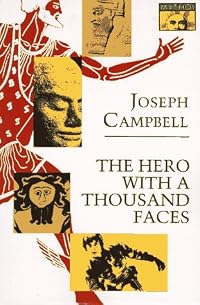
The Hero with a Thousand Faces
by Joseph Campbell
On This Page
Description
Since its release in 1949, The Hero With a Thousand Faces has influenced millions of readers by combining the insights of modern psychology with Joseph Campbell's revolutionary understanding of comparative mythology. In these pages, Campbell outlines the Hero's Journey, a universal motif of adventure and transformation that runs through virtually all of the world's mythic traditions. He also explores the Cosmogonic Cycle, the mythic pattern of world creation and destruction.Tags
Recommendations













Member Recommendations
ed.pendragon Interesting to contrast Campbell's 'hero monomyth' hypothesis with Booker's Freudian interpretation of how all literature, plays and films can be judged by how they match with his identification of universal plotlines.
22
tootstorm Before Lucas, Barth was one of the first writers to intentionally take the formula for what it was: A psychological pattern we're doomed to follow and that just...well, makes sense. Why? Who cares! More overly-intellectual dick-and-fart jokes, please!
13
Member Reviews
I know this is a classic, and perhaps without this book later mythological studies would not have been so world-encompassing, and I know Campbell was a product of his time. But having to read such a deep book with so much now-disputed scholastic inquiry is a slog. Yes, it is what it is, and I think as more cultures begin to reclaim their own voices, the impact of this book will remain in the far-off footnotes of mythological research rather than at the vanguard of world mythologies.
Resolvi passar pela íntegra de um livro que, hoje em dia, é mais conhecido como fornecedor de regras de roteiro do que uma análise freudiana universalista da importância da mitologia para o estabelecimento de um senso saudável de pertencimento coletivo humano. Um pouco como o manual de roteiro "Poética", do Aristótolo, mas tal como na leitura real do último, há mais do que simplesmente a lista das etapas do herói e uma lista de histórias agrupadas pela sua similaridade. Primeiro, porque fica patente a grande quantidade de soluções e desvios a partir do esquema, que por vezes parece excessivamente geral ou amplo. Depois, a insistência de Campbell no papel arquetípico significa um olhar para os estágios pós-mitológicos show more (religiosos e de secularização) que busca alertar para o fato de que, se os mitos refletem os povos, eles apontam para o comum do humano e não para a elaboração de facções ou o desencantamento meramente individualista. show less
http://nwhyte.livejournal.com/1811366.html
I have to say that I was rather disappointed by this classic work on mythology. On the plus side, it is indeed fascinating to put myths from very different points in time and space beside each other to note the similarities; Campbell is consistent and clinical in subjecting the Bible to the same scrutiny as any other culture; and for myself, I learned a thing or two about Cuchulain, not just a local hero and contributor to Ulster geography but in fact an exemplar of several different widely found characters in folklore.
But I found the structure rather confusing, both at macro and at micro level. I couldn't quite be sure what Campbell's basic thesis is, whether he thinks that there is a single show more archetypal hero myth in which all hero stories (maybe even all stories) are rooted (which is what he seems to say in the introduction) or whether he thinks it's impossible to be so concrete (which is what he seems to say in the epilogue). While each individual chapter and section is supposed to illustrate a certain element of the "monomyth", in fact the examples given often have little bearing on the point that is being made; Campbell tells us what he is going to say, then actually says something a bit different, and then fails to tell us what he has said. (The chapter on Transformations of the Hero, where Cuchulain comes up, seemed rather better structured than the rest.) Of course, it is the nature of folklore to be rambling and discursive, but one can analyse a thing without taking on too many of that thing's characteristics.
Anyway, I can see why this was an influential book of its time, but I felt that the approach was old-fashioned even for 1948, and hope that there are better introductions to world folklore out there. show less
I have to say that I was rather disappointed by this classic work on mythology. On the plus side, it is indeed fascinating to put myths from very different points in time and space beside each other to note the similarities; Campbell is consistent and clinical in subjecting the Bible to the same scrutiny as any other culture; and for myself, I learned a thing or two about Cuchulain, not just a local hero and contributor to Ulster geography but in fact an exemplar of several different widely found characters in folklore.
But I found the structure rather confusing, both at macro and at micro level. I couldn't quite be sure what Campbell's basic thesis is, whether he thinks that there is a single show more archetypal hero myth in which all hero stories (maybe even all stories) are rooted (which is what he seems to say in the introduction) or whether he thinks it's impossible to be so concrete (which is what he seems to say in the epilogue). While each individual chapter and section is supposed to illustrate a certain element of the "monomyth", in fact the examples given often have little bearing on the point that is being made; Campbell tells us what he is going to say, then actually says something a bit different, and then fails to tell us what he has said. (The chapter on Transformations of the Hero, where Cuchulain comes up, seemed rather better structured than the rest.) Of course, it is the nature of folklore to be rambling and discursive, but one can analyse a thing without taking on too many of that thing's characteristics.
Anyway, I can see why this was an influential book of its time, but I felt that the approach was old-fashioned even for 1948, and hope that there are better introductions to world folklore out there. show less
Along with Kafka, Joyce, Asimov, and Gibson, Campbell has earned himself a spot as one of the authors that have had the greatest impact on my psyche and the way I see the world. Easily one of my favourite books ever. Campbell's prose is poetic, yet succinct. He puts his points across in a beautiful way through myths and legends from all over the globe. I found that every chapter lead me down a road of epiphany and wonder, and I know for certain I'll be coming back to this book throughout my life.
Had to look up words like henotheistic and cathectic. Didn’t learn anything useful until page 384: “No tribal rite has yet been recorded which attempts to keep winter from descending; on the contrary: the rites all prepare the community to endure, together with the rest of nature, the season of the terrible cold.” Etc. And on the next page: “…anyone in exile from the community is a nothing. From the other point of view, however, this exile is the first step of the quest.” Which made me think of my trans friends.
Robert Graves was easier to read, if less plausible.
Robert Graves was easier to read, if less plausible.
Campbell’s thesis is that cultures around the world share a particular myth. You know the one: hero sets out on adventure, overcomes some obstacles, and returns. These myths (the monomyth) share certain features, not all of which are always apparent on a first reading. He illustrates each feature with a couple of myths from widely separated cultures. I find his arguments convincing.
Campbell further argues that these similarities are as a result of deep-wired human psychology. He uses Freud and Jung to back up this argument. I’ve read neither of those writers so can’t really comment on the specifics of what certain story elements symbolise to the subconscious, but overall I find this argument convincing too. Consider the show more alternatives, of which I see two in particular.
All stories of this type can be traced by descent to a single progenitor, recently by text and before that, orally. As the story is shared by all cultures, some of which had the story before they were contacted by other cultures, we would have to trace the line of descent back to Africa, to the first humans. There is of course no evidence this did not happen. In some cases there is clear evidence of literary dependency. Take Moses and Jesus, both of whom conform to the myth. It’s quite clear that the story of Jesus has been told in such a way as to call Moses to the mind of the reader. Jesus is a new Moses. But I would argue that of all the elements from the story of Moses that the writers could have drawn on they chose so many of those elements that conform to the monomyth. It seems likely that something about the monomyth makes stories feel right to us because of the way our brains are wired.
The second objection would be that what Campbell is describing is something we like to call “plot”. Quite right. It is plot. But why is it plot? Why is it that stories of this type that have the elements Campbell defines perfect? Plot doesn’t happen in real life, but when we’re a hero, or have an adventure, or do something bad, why do we plot the events, create a narrative? And why is the story we create so often analogous to the monomyth? I would argue that it is because the monomyth is hard-wired into our brains.
While reading the book I found it useful to keep before me one particular myth. Campbell can be rather an abstract thinker and it can be useful to ask “What would be a practical example of this?”. I used Star Wars. I should imagine that most people who read this book these days do so because they’ve heard George Lucas based Star Wars on it. If you are a Star Wars fan you’ve probably seen that circular diagram of the Hero’s Journey knocking about on You Tube or something. That diagram is in the book. Seeing the diagram on You Tube is not a substitute for reading the book. Reading it is a rich and rewarding experience, far deeper and wide ranging than the narrow focus of my comments here.
I could give umpteen examples of why every basement-dwelling, neck-bearded man-boy should read this book, but will restrict myself to one. You know the sequence where Luke Skywalker leaves the family farm to find R2D2 and gets beaten up by the Sand People? I had always taken this purely as plot. There is of course world-building and character development, but this is all window-dressing, fake rocks and all. For story purposes Luke must meet Obi-Wan Kenobi. Having read Campbell’s book it’s now apparent to me that this episode conforms to what he calls “crossing the threshold”. The Sand People are Threshold Guardians “at the entrance to the zone of magnified power”. That realisation led me to another thought I’d not managed before: that that episode actually fore-shadows the climax of the whole film where (spoilers) R2D2 and C3P0 are out of action, and with Luke facing defeat it is the appearance of Obi-Wan that saves the day.
The Hero with a Thousand Faces has achieved the impossible and made me appreciate the artistry of Star Wars all the more. show less
Campbell further argues that these similarities are as a result of deep-wired human psychology. He uses Freud and Jung to back up this argument. I’ve read neither of those writers so can’t really comment on the specifics of what certain story elements symbolise to the subconscious, but overall I find this argument convincing too. Consider the show more alternatives, of which I see two in particular.
All stories of this type can be traced by descent to a single progenitor, recently by text and before that, orally. As the story is shared by all cultures, some of which had the story before they were contacted by other cultures, we would have to trace the line of descent back to Africa, to the first humans. There is of course no evidence this did not happen. In some cases there is clear evidence of literary dependency. Take Moses and Jesus, both of whom conform to the myth. It’s quite clear that the story of Jesus has been told in such a way as to call Moses to the mind of the reader. Jesus is a new Moses. But I would argue that of all the elements from the story of Moses that the writers could have drawn on they chose so many of those elements that conform to the monomyth. It seems likely that something about the monomyth makes stories feel right to us because of the way our brains are wired.
The second objection would be that what Campbell is describing is something we like to call “plot”. Quite right. It is plot. But why is it plot? Why is it that stories of this type that have the elements Campbell defines perfect? Plot doesn’t happen in real life, but when we’re a hero, or have an adventure, or do something bad, why do we plot the events, create a narrative? And why is the story we create so often analogous to the monomyth? I would argue that it is because the monomyth is hard-wired into our brains.
While reading the book I found it useful to keep before me one particular myth. Campbell can be rather an abstract thinker and it can be useful to ask “What would be a practical example of this?”. I used Star Wars. I should imagine that most people who read this book these days do so because they’ve heard George Lucas based Star Wars on it. If you are a Star Wars fan you’ve probably seen that circular diagram of the Hero’s Journey knocking about on You Tube or something. That diagram is in the book. Seeing the diagram on You Tube is not a substitute for reading the book. Reading it is a rich and rewarding experience, far deeper and wide ranging than the narrow focus of my comments here.
I could give umpteen examples of why every basement-dwelling, neck-bearded man-boy should read this book, but will restrict myself to one. You know the sequence where Luke Skywalker leaves the family farm to find R2D2 and gets beaten up by the Sand People? I had always taken this purely as plot. There is of course world-building and character development, but this is all window-dressing, fake rocks and all. For story purposes Luke must meet Obi-Wan Kenobi. Having read Campbell’s book it’s now apparent to me that this episode conforms to what he calls “crossing the threshold”. The Sand People are Threshold Guardians “at the entrance to the zone of magnified power”. That realisation led me to another thought I’d not managed before: that that episode actually fore-shadows the climax of the whole film where (spoilers) R2D2 and C3P0 are out of action, and with Luke facing defeat it is the appearance of Obi-Wan that saves the day.
The Hero with a Thousand Faces has achieved the impossible and made me appreciate the artistry of Star Wars all the more. show less
This is a book that has its place. It takes a big look over mythology and religion beliefs and applies current (circa 1949) psycho-analysis to this study. I like the premise, but it over reaches. Too much generalizations, and too much Freudian logic. I really don't think that there is an overarching sub-conscious desire in humans to overpower the father and copulate with the mother. I also think Campbell over generalizes, making broad assumptions without understanding the nuances.
There is also the question of language. Campbell uses language that is standard for anthropologists of the age. Words such as "primitive", "Simple", and other words that denotes uncultured are used. But the author makes it clear at the end of the book that show more people are people, regardless of where they live. show less
There is also the question of language. Campbell uses language that is standard for anthropologists of the age. Words such as "primitive", "Simple", and other words that denotes uncultured are used. But the author makes it clear at the end of the book that show more people are people, regardless of where they live. show less
Members
- Recently Added By
Lists

Non-Fiction Worth Reading
1,015 works; 255 members

Maestros
15 works; 1 member

Antigua Grecia
43 works; 2 members

Northern Exposure's Chris in the Morning Reading List
31 works; 1 member

Bibliography for How to be a Heroine
148 works; 12 members

The Great Courses: How to View and Appreciate Great Movies
30 works; 1 member

Mind Expanding Books by hackerkid
581 works; 8 members

Shaykh Hamza's Book Recommendations
439 works; 3 members

Story/Myth Reading List
25 works; 1 member

Reading Glasses Podcast
410 works; 3 members

Vlogbrothers Book Recommendations
307 works; 4 members

Mythology
9 works; 2 members

Books in the Bibliography of The History of Hell by Alice K. Turner
155 works; 1 member

Unread books
1,063 works; 87 members
Author Information

Joseph Campbell was born in White Plains, New York on March 26, 1904. He received a B.A. in English literature in 1925 and an M.A. in Medieval literature in 1927 from Columbia University. He was awarded a Proudfit Traveling Fellowship to continue his studies at the University of Paris. After he had received and rejected an offer to teach at his show more high school alma mater, his Fellowship was renewed, and he traveled to Germany to resume his studies at the University of Munich. During the year he was housemaster of Canterbury School, he sold his first short story, Strictly Platonic, to Liberty magazine. In 1934, he accepted a position in the literature department at Sarah Lawrence College, a post he would retain until retiring in 1972. During his lifetime, he wrote more than 40 books including The Hero with a Thousand Faces, The Mythic Image, the four-volume The Masks of God, and The Power of Myth with Bill Moyers. During the 1940s and 1950s, he collaborated with Swami Nikhilananda on translations of the Upanishads and The Gospel of Sri Ramakrishna. He received several awards including National Institute of Arts and Letters Award for Contributions to Creative Literature and the 1985 National Arts Club Gold Medal of Honor in Literature. He died after a brief struggle with cancer on October 30, 1987. (Bowker Author Biography) show less
Some Editions
Awards and Honors
Series
Belongs to Publisher Series
Work Relationships
Contains
Is replied to in
Inspired
Has as a commentary on the text
Common Knowledge
- Canonical title
- The Hero with a Thousand Faces
- Original title
- The Hero with a Thousand Faces
- Original publication date
- 1949-04-07
- People/Characters
- Aeneas; Mohammed; Lao-tsu; Frog King; Wotan; Buddha (show all 8); Apollo; Luke Skywalker
- Dedication
- To my father and mother
- First words
- PREFACE
"The truths contained in religious doctrines are after all so distorted and systematically disguised," writes Sigmund Freud, "that the mass of humanity cannot recognize them as truth. The case is similar to what ... (show all)happens when we tell a child that new-born babies are brought by the stork. Here, too, we are telling the truth in symbolic clothing, for we know what the large bird signifies. But the child does not know it. ... It is the purpose of the present book to uncover some of the truths disguised for us under the figures of religion and mythology by bringing together a multitude of not-too-difficult examples and letting the ancient meaning become apparent of itself. ... Joseph Campbell, 1948
Whether we listen with aloof amusement to the dreamlike mumbo jumbo of some red-eyed witch doctor of the Congo, or read with cultivated rapture thin translations from the sonnets of the mystic Lao-tse; now and again crack the... (show all) hard nutshell of an argument of Aquinas, or catch suddenly the shining meaning of a bizarre Eskimo fairy tale: it will be always the one, shape-shifting yet marvelously constant story that we find, together with a challengingly persistent suggestion of more remaining to be experienced than will ever be known or told. - Last words
- (Click to show. Warning: May contain spoilers.)And so every one of us shares the supreme ordeal—carries the cross of the redeemer—not in the bright moments of his tribe's great victories, but in the silences of his personal despair.
- Original language
- English
- Canonical DDC/MDS
- 201.3
Classifications
- Genres
- Anthropology, Literature Studies and Criticism, General Nonfiction, Religion & Spirituality, Nonfiction, Philosophy, History
- DDC/MDS
- 201.3 — Religion The Bible & Christianity Religious mythology, general classes of religion, interreligious relations and attitudes, social theology Mythology and mythological foundations
- LCC
- BL313 .C28 — Philosophy, Psychology and Religion Religions. Mythology. Rationalism Religions. Mythology. Rationalism The myth. Comparative mythology
- BISAC
Statistics
- Members
- 10,772
- Popularity
- 868
- Reviews
- 84
- Rating
- (4.07)
- Languages
- 17 — Czech, Dutch, English, Finnish, French, German, Hungarian, Italian, Norwegian (Bokmål), Polish, Portuguese, Romanian, Croatian, Spanish, Swedish, Turkish, Chinese, traditional
- Media
- Paper, Audiobook, Ebook
- ISBNs
- 71
- UPCs
- 2
- ASINs
- 50