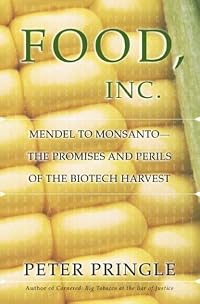
Food, Inc.: Mendel to Monsanto--The Promises and Perils of the Biotech Harvest
by Peter Pringle
On This Page
Description
For most people, the global war over genetically modified foods is a distant and confusing one. The battles are conducted in the mystifying language of genetics. A handful of corporate "life science" giants, such as Monsanto, are pitted against a worldwide network of anticorporate ecowarriors like Greenpeace. And yet the possible benefits of biotech agriculture to our food supply are too vital to be left to either partisan. The companies claim to be leading a new agricultural revolution that show more will save the world with crops modified to survive frost, drought, pests, and plague. The greens warn that "playing God" with plant genes is dangerous. It could create new allergies, upset ecosystems, destroy biodiversity, and produce uncontrollable mutations. Worst of all, the antibiotech forces say, a single food conglomerate could end up telling us what to eat. In Food, Inc., acclaimed journalist Peter Pringle shows how both sides in this overheated conflict have made false promises, engaged in propaganda science, and indulged in fear-mongering. In this urgent dispatch, he suggests that a fertile partnership between consumers, corporations, scientists, and farmers could still allow the biotech harvest to reach its full potential in helping to overcome the problem of world hunger, providing nutritious food and keeping the environment healthy. show lessTags
Recommendations



Member Reviews
This book is less about the science of genetically modified food, and more about the politics, presenting incidents that entered mainstream news reports, and delving into behind-the-scenes actions and motivations of the various players: scientists, corporations, activists. Not wholly satisfying if one is seeking a definitive conclusion, but useful to get a sense of what’s fact and what’s spin.
In Food, Inc. Peter Pringle explains the scientific, political, and legal history of genetically modified foods. The book was written in 2003, so it is incredibly dated as far as the subject matter goes, but I was looking for a book that was somewhat unbiased, and they are few and far between with this incredibly controversial issue.
I don’t think I will ever completely understand how genetics works or how scientists have been able to do all that they have with genomes, but this book did enhance my understanding of the scientific process of genetic modification. It also refreshed my memory on some of the legal battles surrounding GM foods and scientific studies that have been done on these foods.
Overall, I found the book to be show more readable and well-researched.
A few opinions (mostly on the issues rather than the book….)
Since GM foods are considered “substantially equivalent” to their non-GM counterparts, there is no compulsory testing by U.S. regulatory agencies. Companies that manufacture genetically modified seeds are responsible for testing for safety themselves before releasing them to the public. I’m not saying GM foods are inherently unsafe, but should we really trust corporations to do their own testing?
The whole patenting of genetic materials/seeds/living things bothers me. I am not completely up to date on current legal issues regarding patents on genetic material and since this book has been published several of more ridiculous patents have been revoked, but there still seem to be some problems.
Human ingenuity blows my mind. People can be really, really smart. They can also be really, really greedy, and therein lies the problem. If only scientists could just be scientists and learn, innovate, and discover without interference from big money.
But alas, that is not the world we live in.
It is hard to know the long term consequences of our actions as a society. It is impossible to tell in what direction science will take us. The genes we modify today may come back to haunt us twenty years. Or they may save us from mass starvation. Time will tell. I realize this science could hold a lot of promise. I just wish we’d proceed with a little more caution and a lot less greed. show less
I don’t think I will ever completely understand how genetics works or how scientists have been able to do all that they have with genomes, but this book did enhance my understanding of the scientific process of genetic modification. It also refreshed my memory on some of the legal battles surrounding GM foods and scientific studies that have been done on these foods.
Overall, I found the book to be show more readable and well-researched.
A few opinions (mostly on the issues rather than the book….)
Since GM foods are considered “substantially equivalent” to their non-GM counterparts, there is no compulsory testing by U.S. regulatory agencies. Companies that manufacture genetically modified seeds are responsible for testing for safety themselves before releasing them to the public. I’m not saying GM foods are inherently unsafe, but should we really trust corporations to do their own testing?
The whole patenting of genetic materials/seeds/living things bothers me. I am not completely up to date on current legal issues regarding patents on genetic material and since this book has been published several of more ridiculous patents have been revoked, but there still seem to be some problems.
Human ingenuity blows my mind. People can be really, really smart. They can also be really, really greedy, and therein lies the problem. If only scientists could just be scientists and learn, innovate, and discover without interference from big money.
But alas, that is not the world we live in.
It is hard to know the long term consequences of our actions as a society. It is impossible to tell in what direction science will take us. The genes we modify today may come back to haunt us twenty years. Or they may save us from mass starvation. Time will tell. I realize this science could hold a lot of promise. I just wish we’d proceed with a little more caution and a lot less greed. show less
Pringle moves fast across the emerging technology of Genetically Modified (GM) foods, also known by the term 'transgenic'. This brief book is an excellent introduction to the history and current (as of 2003) landscape. It hits on the goals and effects of the post WWII Green Revolution, which boosted worldwide grain production while at the same time encouraging megafarms (smaller farmers were less able to afford the costly packages of new hybrid seed and speciallized pesticides and hardware).
The author is very careful not to present the situation with an overt bias, offering all sides of the argument, though Pringle is clearly someone who believes the benefits of GM food production are worth serious and long-term efforts. Overall an show more excellent and quick-reading on GM, biotech in general, and the many challenges facing the world food supply. Four Stars. show less
The author is very careful not to present the situation with an overt bias, offering all sides of the argument, though Pringle is clearly someone who believes the benefits of GM food production are worth serious and long-term efforts. Overall an show more excellent and quick-reading on GM, biotech in general, and the many challenges facing the world food supply. Four Stars. show less
Ratings
Members
- Recently Added By
Author Information

12+ Works 600 Members
Peter Pringle is the author of several nonfiction books, including The Murder of Nikolai Vavilov and Food, Inc., and co-author of the bestselling Those Are Real Bullets. A veteran British foreign correspondent for the Sunday Times, the Observer, and the Independent, he has also written for the New York Times and the Washington Post. He lives in show more New York City. show less
Awards and Honors
Distinctions
Common Knowledge
- People/Characters
- Gregor Mendel; Monsanto
- Important events
- Green Revolution
- First words
- This book is for those who still have an open mind about genetically modified foods -- despite the constant flow of alarms from consumer watchdogs and constant assurances from the agricultural establishment that everything do... (show all)wn on the farm is lovely.
- Last words
- (Click to show. Warning: May contain spoilers.)These experimental foods deserve respect from those who discover them, call for more caution from those who regulate them and grow them, and finally, at the end of this real food chain, demand close study by those of us who eat them.
Classifications
- Genres
- Nonfiction, Science & Nature, Sociology, General Nonfiction, Food & Cooking
- DDC/MDS
- 363.192 — Society, government, & culture Social problems and social services Public Safety - Police, Crime Investigation Public safety from hazards Food
- LCC
- S494.5 .B563 .P74 — Agriculture Agriculture (General)
- BISAC
Statistics
- Members
- 167
- Popularity
- 195,388
- Reviews
- 3
- Rating
- (4.15)
- Languages
- English, French
- Media
- Paper, Ebook
- ISBNs
- 6
- ASINs
- 1